Magnesium — Benefits Deep Dive
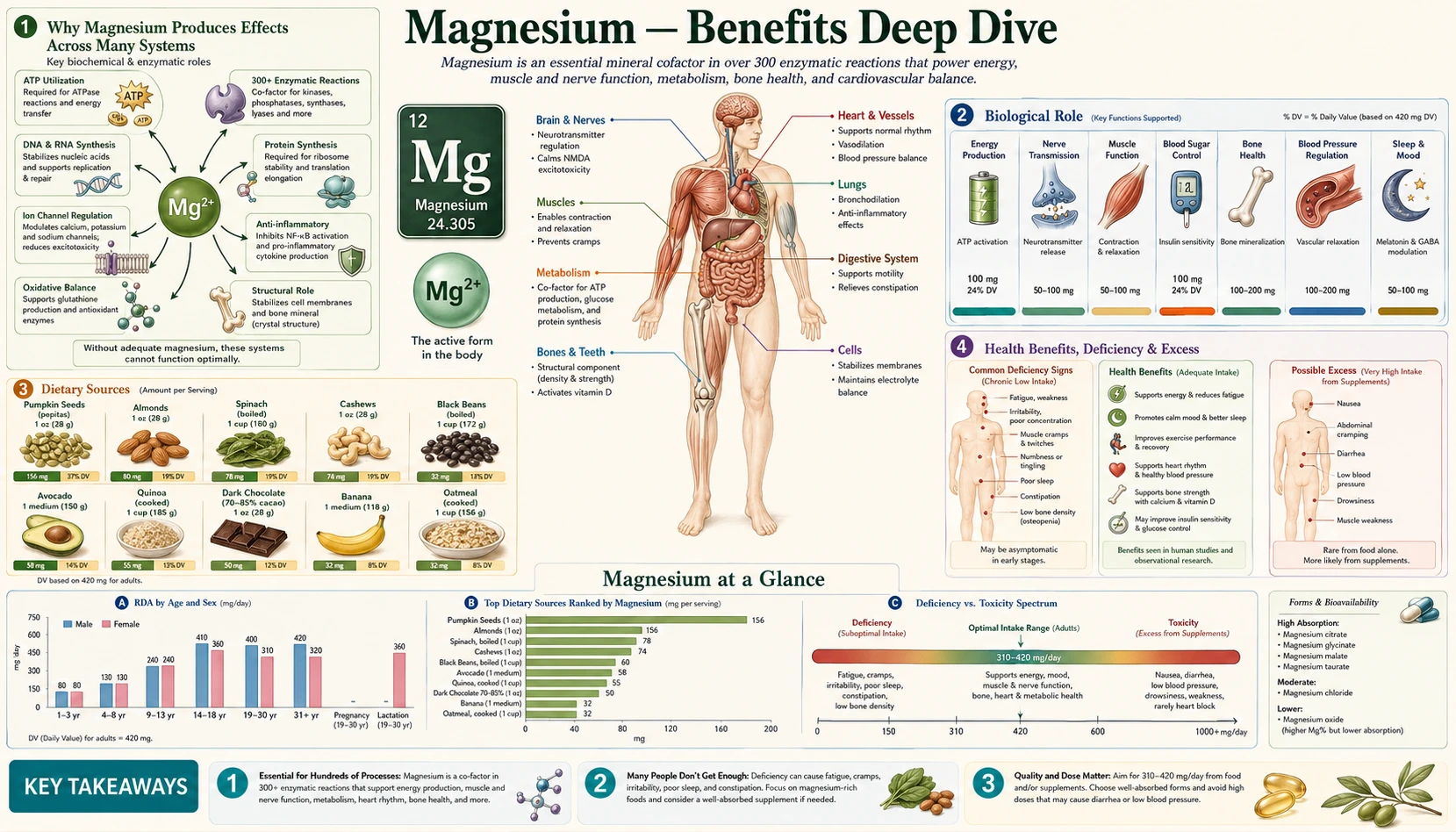
Magnesium is the fourth most abundant mineral in the human body and the second most abundant intracellular cation (after potassium). It is the obligate cofactor for more than 600 enzyme reactions and a modulator for another 200 — spanning energy production (every kinase that touches ATP requires Mg-ATP), DNA replication, neurotransmission, muscle contraction-relaxation, cardiovascular tone, bone mineralization, and immune function. Despite this centrality, an estimated 50% of adults in developed countries fail to meet the estimated average requirement, and subclinical deficiency is now recognized as a driver of hypertension, atrial fibrillation, insomnia, migraine, leg cramps, restless legs, anxiety, type 2 diabetes, and osteoporosis. Four benefit pages below explore the conditions where magnesium produces the largest clinical effect — cardiovascular disease, sleep disturbance, neuromuscular dysfunction, and migraine prophylaxis.
Deep-Dive Articles
Heart Health
Blood pressure reduction (2.0/1.78 mmHg meta-analysis of 34 RCTs), atrial fibrillation prevention (30-40% postoperative AF reduction after cardiac surgery), torsades de pointes as first-line IV magnesium emergency therapy, 77% lower sudden cardiac death risk in the Nurses' Health Study highest plasma magnesium quartile, the natural calcium-channel-blocker mechanism, vascular calcification inhibition, and the 8% stroke risk reduction per 100 mg/day dietary increment.
Sleep
GABA-A receptor potentiation, voltage-dependent NMDA receptor blockade, support of the tryptophan→serotonin→melatonin pathway, HPA-axis cortisol dampening, parasympathetic activation. The Abbasi 2012 elderly insomnia trial (500 mg/day for 8 weeks): shorter sleep onset, longer total sleep, higher sleep efficiency, lower cortisol, higher melatonin. Glycinate vs threonate for sleep; combining with B6, glycine, L-theanine.
Muscle Function
Magnesium as the body's endogenous calcium antagonist at the neuromuscular junction. The SERCA-pump-failure model of cramps. Nocturnal leg cramps in pregnancy and aging, restless legs (Hornyak 1998), eyelid twitches (orbicularis myokymia), generalized fasciculations, exercise-induced muscle cramps in athletes (Schwellnus, Miller pickle-juice trial), bronchospasm, smooth muscle. Glycinate vs malate vs threonate vs taurate — the muscle-specific form-selection guide.
Migraines
Mauskop's body of work on serum and intracellular magnesium deficiency in migraine. The American Academy of Neurology / American Headache Society Level B (probably effective) rating for 600 mg/day oral magnesium. IV magnesium sulfate for acute migraine in the ED, with the Bigal aura-subgroup specificity. Pediatric migraine (Wang 2003), menstrual migraine and the luteal magnesium drop (Facchinetti), the cortical spreading depression mechanism, CGRP modulation.
Interactive Visualization Magnesium — the mineral that makes ATP work Bare ATP is useless and enzymes reject it. Watch magnesium clamp the phosphates and switch it on, plug the NMDA channel, and let a cramping muscle finally let go. Launch →
Table of Contents
- Deep-Dive Articles
- Why Magnesium Produces Effects Across Many Systems
- Research Papers: Heart Health
- Research Papers: Sleep
- Research Papers: Muscle Function
- Research Papers: Migraine
- Research Papers: Cross-Cutting (Mechanism, Status, Safety)
- External Authoritative Resources
- Connections
- Featured Videos
Why Magnesium Produces Effects Across Many Systems
Most minerals act through one or two principal mechanisms — iron carries oxygen on hemoglobin and serves as a redox cofactor in a handful of enzymes; iodine is incorporated into thyroid hormone; selenium is the catalytic atom in glutathione peroxidase. Magnesium is unusual because it operates through four fundamentally different mechanisms, each of which maps to a distinct category of clinical effect. The breadth of magnesium's clinical reach is not because magnesium is "good for everything" in some vague nutritional sense — it's because magnesium sits at four distinct nodes in cellular biochemistry, any one of which can become rate-limiting under common modern conditions.
- Mg-ATP is the active form of cellular energy currency — Every kinase reaction in the cell (and there are hundreds) uses Mg-ATP, not free ATP, as substrate. The magnesium ion neutralizes the negative charge on the ATP triphosphate group, positions the gamma-phosphate for transfer, and stabilizes the transition state of the catalysis. Without magnesium, ATP is biologically inert. This puts magnesium at the catalytic core of glycolysis, the Krebs cycle, oxidative phosphorylation, fatty acid synthesis, protein synthesis, nucleotide synthesis, and signal transduction. The clinical translation is the diffuse fatigue and energy-failure pattern seen in moderate magnesium deficiency, and the specific energy-failure pattern documented by phosphorus MR spectroscopy in migraine cortex.
- Magnesium is the body's endogenous voltage-dependent NMDA receptor blocker — At resting membrane potential, magnesium ions physically occupy the NMDA glutamate receptor channel, preventing calcium influx. Only when a neuron is already strongly depolarized does the magnesium ion leave the pore, allowing NMDA activation. This makes magnesium the central nervous system's gatekeeper of excitatory glutamatergic tone. The same mechanism underlies the sleep-onset effect, the cortical-spreading-depression suppression in migraine, the anxiety-reducing effect, and a substantial fraction of the neuroprotective effect documented in stroke and traumatic brain injury research.
- Magnesium is the body's endogenous calcium antagonist — Calcium triggers contraction in cardiac, vascular smooth, and skeletal muscle; magnesium opposes that trigger and supports the relaxation phase. At the cardiomyocyte, this controls heart rhythm and is why magnesium is first-line IV therapy for torsades de pointes (see Heart Health). At vascular smooth muscle, it controls blood pressure (the 2 mmHg systolic reduction from 368 mg/day in 34 RCTs). At skeletal muscle, it controls cramps, twitches, restless legs, and exercise cramping (see Muscle Function). At smooth muscle in the airways, gut, and uterus, it controls bronchospasm, constipation, and uterine tone — the basis of IV magnesium use in severe asthma and preeclampsia.
- Magnesium is a hormone-signaling cofactor — Activation of vitamin D to its bioactive 1,25-dihydroxy form requires magnesium-dependent enzymes; insulin receptor tyrosine kinase activity requires magnesium-ATP; PTH secretion is modulated by magnesium; and the 2022 Cell paper from Lötscher and colleagues showed that extracellular magnesium is required for the active conformation of LFA-1 on cytotoxic T cells, directly linking magnesium status to antiviral and antitumor immunity. The hormone and immune-signaling mechanism gives magnesium a major role in calcium metabolism, glucose homeostasis (the type 2 diabetes risk reduction), bone health (osteoporosis), and adaptive immunity that cannot be predicted from the energy, NMDA, or calcium-antagonism mechanisms alone.
Because magnesium is rate-limiting at all four nodes simultaneously, deficiency does not produce one neat clinical syndrome — it produces a constellation. The constellation can include fatigue (mechanism 1), insomnia and migraine (mechanism 2), cramps and arrhythmia (mechanism 3), insulin resistance and bone loss (mechanism 4). Patients often present with three or four of these simultaneously and don't realize they share a single underlying nutritional deficit. The diagnostic clue is the constellation, not any single symptom — and the therapeutic test is a 4-8 week trial of 300-400 mg elemental magnesium, which is cheap, low-risk, and frequently produces improvement across multiple complaints simultaneously.
Research Papers: Heart Health
- Zhang X et al. (2016). Effects of magnesium supplementation on blood pressure: a meta-analysis of randomized double-blind placebo-controlled trials. Hypertension. PubMed: Zhang 2016 BP meta-analysis
- Del Gobbo LC et al. (2013). Circulating and dietary magnesium and risk of cardiovascular disease: a systematic review and meta-analysis of prospective studies. Am J Clin Nutr. PubMed: Del Gobbo 2013
- Chiuve SE et al. (2011). Plasma and dietary magnesium and risk of sudden cardiac death in women. Am J Clin Nutr. (Nurses' Health Study, 77% SCD reduction in highest quartile) PubMed: Chiuve SCD
- Woods KL, Fletcher S (1994). Long-term outcome after intravenous magnesium sulphate in suspected acute myocardial infarction: LIMIT-2 trial. Lancet. PubMed: LIMIT-2
- Liao F, Folsom AR, Brancati FL (1998). ARIC Study: low magnesium and coronary heart disease risk. Am Heart J. PubMed: ARIC magnesium
- Larsson SC, Orsini N, Wolk A (2012). Dietary magnesium intake and risk of stroke: a meta-analysis of prospective studies. Am J Clin Nutr. PubMed: Larsson stroke
- DiNicolantonio JJ, O'Keefe JH, Wilson W (2018). Subclinical magnesium deficiency: a principal driver of cardiovascular disease and a public health crisis. Open Heart. PubMed: DiNicolantonio 2018
- Cook NR et al. (2007). Magnesium-rich water and cardiovascular mortality. Am J Hypertens. (water-hardness epidemiology) PubMed: Hard water and CV mortality
- Fang X et al. (2016). Dietary magnesium intake and the risk of cardiovascular disease, type 2 diabetes, and all-cause mortality: dose-response meta-analysis. BMC Med. PubMed: Fang dose-response
- Bain LK et al. (2015). Magnesium and atrial fibrillation in postoperative cardiac surgery patients meta-analysis. PubMed: Magnesium and postop AF
Research Papers: Sleep
- Abbasi B et al. (2012). The effect of magnesium supplementation on primary insomnia in elderly: a double-blind placebo-controlled clinical trial. J Res Med Sci. — PubMed: Abbasi 2012
- Rondanelli M et al. (2011). Effect of melatonin, magnesium, and zinc on primary insomnia in long-term care residents: double-blind placebo-controlled trial. J Am Geriatr Soc. PubMed: Rondanelli 2011
- Hornyak M et al. (1998). Magnesium therapy for periodic leg movements-related insomnia and restless legs syndrome: open pilot study. Sleep. PubMed: Hornyak 1998
- Boyle NB, Lawton C, Dye L (2017). The effects of magnesium supplementation on subjective anxiety and stress — a systematic review. Nutrients. PubMed: Boyle anxiety review
- Mah J, Pitre T (2021). Oral magnesium supplementation for insomnia in older adults: a systematic review and meta-analysis. BMC Complement Med Ther. PubMed: Mah Pitre 2021 review
- Slutsky I et al. (2010). Enhancement of learning and memory by elevating brain magnesium (magnesium L-threonate). Neuron. PubMed: Slutsky threonate
- Bannai M, Kawai N (2012). New therapeutic strategy for amino acid medicine: glycine improves the quality of sleep. J Pharmacol Sci. PubMed: Bannai glycine sleep
- Tarleton EK et al. (2017). Role of magnesium supplementation in the treatment of depression: a randomized clinical trial. PLOS ONE. PubMed: Tarleton depression
- Held K et al. (2002). Oral magnesium supplementation reverses age-related neuroendocrine and sleep EEG changes. Pharmacopsychiatry. PubMed: Held EEG study
- Nielsen FH, Johnson LK, Zeng H (2010). Magnesium supplementation improves indicators of low magnesium status and inflammatory stress. Magnes Res. PubMed: Nielsen 2010
Research Papers: Muscle Function
- Sebo P, Cerutti B, Haller DM (2014). Effect of magnesium therapy on nocturnal leg cramps: systematic review and meta-analysis. Family Practice. PubMed: Sebo 2014
- Garrison SR et al. (2012). Magnesium for skeletal muscle cramps. Cochrane Database Syst Rev. PubMed: Garrison Cochrane
- Dahle LO et al. (1995). The effect of oral magnesium substitution on pregnancy-induced leg cramps. Am J Obstet Gynecol. PubMed: Dahle pregnancy
- Miller KC et al. (2010). Reflex inhibition of electrically induced muscle cramps in hypohydrated humans (pickle juice). Med Sci Sports Exerc. PubMed: Miller pickle juice
- Schwellnus MP (2009). Cause of exercise associated muscle cramps (EAMC) — altered neuromuscular control. Br J Sports Med. PubMed: Schwellnus EAMC
- Russell IJ et al. (1995). Treatment of fibromyalgia syndrome with Super Malic (magnesium malate). J Rheumatol. PubMed: Russell Super Malic
- Lukaski HC (2004). Vitamin and mineral status: effects on physical performance. Nutrition. PubMed: Lukaski performance
- Hornyak M et al. (1998). Magnesium and PLMS — the seminal RLS trial. Sleep. PubMed: Hornyak RLS
- Allen RP et al. (2014). Restless legs syndrome/Willis-Ekbom disease diagnostic criteria. Sleep Med. PubMed: IRLSSG criteria
- Goodman L (2002). IV magnesium sulfate for severe acute asthma in the ED. Cochrane review. PubMed: IV magnesium asthma
Research Papers: Migraine
- Mauskop A, Varughese J (2012). Why all migraine patients should be treated with magnesium. J Neural Transm. PubMed: Mauskop 2012
- Peikert A, Wilimzig C, Köhne-Volland R (1996). Prophylaxis of migraine with oral magnesium: prospective multicenter double-blind RCT. Cephalalgia. PubMed: Peikert 1996
- Bigal ME et al. (2002). Intravenous magnesium sulphate in acute treatment of migraine without aura and migraine with aura. Cephalalgia. PubMed: Bigal IV magnesium
- Chiu HY et al. (2016). Effects of intravenous and oral magnesium on reducing migraine: meta-analysis of RCTs. Pain Physician. Search PubMed
- Wang F et al. (2003). Oral magnesium oxide prophylaxis of frequent migrainous headache in children. Headache. PubMed: Wang pediatric
- Facchinetti F et al. (1991). Magnesium prophylaxis of menstrual migraine: effects on intracellular magnesium. Headache. PubMed: Facchinetti menstrual
- Holland S et al. (2012). AAN/AHS evidence-based guideline update: NSAIDs and other complementary treatments for episodic migraine prevention. Neurology. (Level B for magnesium) PubMed: AAN/AHS 2012
- Köseoglu E et al. (2008). The effects of magnesium prophylaxis in migraine without aura. Magnes Res. PubMed: Köseoglu
- Lodi R et al. (2001). Deficient energy metabolism is associated with low free magnesium in the brains of patients with migraine and cluster headache. Brain Res Bull. PubMed: Lodi MR spectroscopy
- Welch KMA, Ramadan NM (1995). Mitochondria, magnesium and migraine. J Neurol Sci. PubMed: Welch Ramadan
Research Papers: Cross-Cutting (Mechanism, Status, Safety)
- de Baaij JH, Hoenderop JG, Bindels RJ (2015). Magnesium in man: implications for health and disease. Physiological Reviews. PubMed: de Baaij review
- Rosanoff A, Weaver CM, Rude RK (2012). Suboptimal magnesium status in the United States. Nutrition Reviews. PubMed: Rosanoff status
- Gröber U, Schmidt J, Kisters K (2015). Magnesium in prevention and therapy. Nutrients. PubMed: Gröber review
- Fang X et al. (2016). Dose-response: dietary magnesium and type 2 diabetes risk. Nutrients. PubMed: Fang T2DM
- Veronese N et al. (2016). Effect of magnesium supplementation on glucose metabolism: meta-analysis. Eur J Clin Nutr. PubMed: Veronese glucose
- Lötscher J et al. (2022). Magnesium sensing via LFA-1 regulates CD8+ T cell effector function. Cell. PubMed: Lötscher Cell 2022
- Altman D et al. (2002). Magpie Trial: Magnesium sulphate for women with pre-eclampsia. Lancet. PubMed: Magpie Trial
- Doyle LW et al. (2009). Magnesium sulphate for women at risk of preterm birth for neuroprotection of the fetus. Cochrane Database Syst Rev. PubMed: Doyle Cochrane
- Orchard TS et al. (2014). Magnesium intake, bone mineral density, and fractures: Women's Health Initiative. Am J Clin Nutr. PubMed: Orchard WHI
- Workinger JL, Doyle RP, Bortz J (2018). Challenges in the diagnosis of magnesium status. Nutrients. PubMed: Workinger diagnosis
External Authoritative Resources
- Linus Pauling Institute — Magnesium Micronutrient Information Center — the single most authoritative scientific summary of magnesium biology, regularly updated
- NIH Office of Dietary Supplements — Magnesium Fact Sheet (Health Professionals)
- Harvard T.H. Chan School of Public Health — The Nutrition Source: Magnesium
- Sleep Foundation — Magnesium and Sleep
- MedlinePlus — Magnesium
- PubMed — All research on magnesium (~200,000+ papers)
Connections
- All Minerals
- Magnesium: The Mineral That Makes ATP Work — interactive animation
- Magnesium (Main Page)
- Magnesium for Heart Health
- Magnesium for Sleep
- Magnesium for Muscle Function
- Magnesium for Migraines
- Magnesium Glycinate
- Calcium
- Potassium
- Zinc
- Vitamin D3
- Vitamin K2
- Vitamin B6
- Glycine
- Taurine
- Hypertension
- Atrial Fibrillation
- Migraine
- Insomnia
- Anxiety
- Restless Legs Syndrome
- Insulin Resistance
- Osteoporosis
- Magnesium Replenishment
- Sleep Hygiene
- Stress Management
- Cramp Prevention
- Magnesium Test