Magnesium: Food Sources & Daily Intake
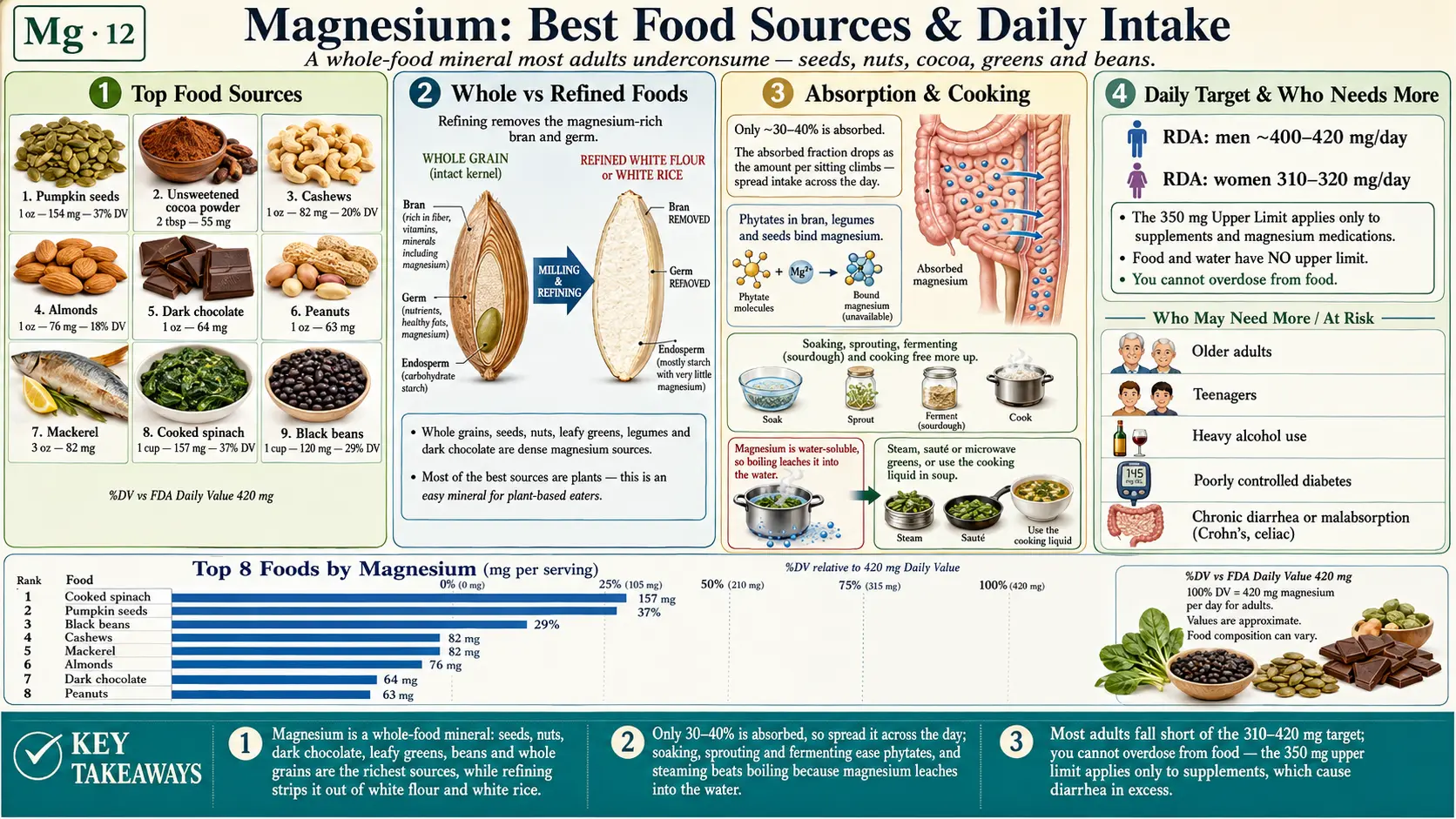
Magnesium is a mineral your body uses in hundreds of everyday reactions — making energy, building bone, steadying nerves and muscles, and keeping your heartbeat regular. It is overwhelmingly a whole-food nutrient: the richest sources are seeds, nuts, dark chocolate, leafy greens, beans and whole grains. Refined and heavily processed foods lose most of their magnesium, which is one reason a typical modern diet often falls short.
| Magnesium: Food Sources & Daily Intake | ||||||
|---|---|---|---|---|---|---|
| Rank | Food (serving) | Per 100 g | %DV / 100g | Glucose | Fructose | Notes |
| 1 | Pumpkin Seeds 1 oz / 28 g | 550 mg | 🟢 131% | 0.1 | 0.1 | One of the densest whole-food sources of magnesium. |
| 2 | Cocoa Powder, Unsweetened 2 tbsp / 11 g | 499 mg | 🟢 119% | — | — | |
| 3 | Cashews 1 oz / 28 g | 292 mg | 🟢 70% | 0.1 | 0.1 | |
| 4 | Almonds 1 oz / 28 g | 270 mg | 🟢 64% | 0.2 | 0.1 | |
| 5 | Dark Chocolate 1 oz / 28 g | 228 mg | 🟢 54% | 0 | 0 | The higher the cocoa percentage, the more magnesium. |
| 6 | Peanuts 1 oz / 28 g | 225 mg | 🟢 54% | — | — | |
| 7 | Mackerel 3 oz / 85 g | 97 mg | 🟡 23% | — | — | |
| 8 | Spinach 1 cup / 180 g | 87 mg | 🟡 21% | — | — | Cooking shrinks the leaves, so a cup delivers far more than raw. |
| 9 | Swiss Chard 1 cup / 175 g | 86 mg | 🟡 20% | — | — | |
| 10 | Black Beans 1 cup / 172 g | 70 mg | 🟡 17% | — | — | |
| 11 | Navy Beans 1 cup / 182 g | 53 mg | 🟡 13% | 0 | 0 | |
| 12 | Buckwheat 1 cup / 168 g | 51 mg | 🟡 12% | 0.2 | 0.1 | A naturally magnesium-rich whole grain (and gluten-free). |
| 13 | Chia Seeds 1 oz / 28 g | 50 mg | 🟡 12% | — | — | |
| 14 | Brown Rice 1 cup / 195 g | 39 mg | ⚪ 9% | 0 | 0 | Common staple. |
| 15 | Lentils 1 cup / 198 g | 36 mg | ⚪ 9% | — | — | |
| 16 | Halibut 3 oz / 85 g | 33 mg | ⚪ 8% | — | — | |
| 17 | Beef Organ Meats 3 oz / 85 g | 12 mg | ⚪ 3% | 0 | 0 | Nutrient-dense organ meat. |
| 18 | Pork Organ Meats 3 oz / 85 g | 18 mg | ⚪ 4% | — | — | Nutrient-dense organ meat. |
| 19 | Chicken Organ Meats 3 oz / 85 g | 20 mg | ⚪ 5% | — | — | Nutrient-dense organ meat (giblets). |
Interactive Visualization Magnesium — the mineral that makes ATP work Bare ATP is useless and enzymes reject it. Watch magnesium clamp the phosphates and switch it on, plug the NMDA channel, and let a cramping muscle finally let go. Launch →
Table of Contents
- How to Read These Tables
- Recommended Intakes & Upper Limits
- Bioavailability & Absorption
- Cooking & Storage
- Vegetarian & Vegan Sources
- Who Needs to Pay Attention
- Data Sources & References
- Connections
- Featured Videos
How to Read These Tables
- Spread it across the day. The body absorbs only about 30–40% of the magnesium in a meal, and the fraction absorbed drops as the amount in one sitting climbs. Several modest sources through the day beat one big serving.
- %DV vs your personal target. The %DV column compares a serving against the FDA Daily Value of 420 mg. Your own target (the RDA) is roughly 400–420 mg for men and 310–320 mg for women — see the second table for your life stage.
- Per 100 g vs per serving. Per-100 g lets you compare foods fairly, but seeds and cocoa look enormous because you eat them in small amounts. The serving size shown beside each food is the realistic number — a handful of pumpkin seeds or a cup of cooked spinach is what counts.
Recommended Intakes & Upper Limits
Your personal target depends on age, sex and pregnancy. The Daily Value used for the %DV column above is a single label figure; the table below is the age-specific guidance.
| Life stage | RDA / AI (mg/day) | Upper limit (mg/day) |
|---|---|---|
| Infants 0–6 mo | 30 (AI) | None established |
| Infants 7–12 mo | 75 (AI) | None established |
| Children 1–3 y | 80 | 65 |
| Children 4–8 y | 130 | 110 |
| Children 9–13 y | 240 | 350 |
| Males 14–18 y | 410 | 350 |
| Males 19–30 y | 400 | 350 |
| Males 31+ y | 420 | 350 |
| Females 14–18 y | 360 | 350 |
| Females 19–30 y | 310 | 350 |
| Females 31+ y | 320 | 350 |
| Pregnancy | 350–400 | 350 |
| Lactation | 310–360 | 350 |
Bioavailability & Absorption
Where your magnesium comes from matters. Refining and processing strip it out: milling grain to make white flour or white rice removes the magnesium-rich germ and bran, so refined staples carry only a fraction of the mineral found in their whole-grain forms. Within a food, absorption is shaped by other compounds present. Phytates — natural plant compounds concentrated in the bran of grains, in legumes and in some seeds — bind magnesium and lower how much you absorb. This is rarely a problem on a varied diet, and simple kitchen steps help: soaking, sprouting, fermenting (as in sourdough) and ordinary cooking all reduce phytate and free up more of the mineral.
Cooking & Storage
Magnesium is water-soluble, so the main loss in the kitchen comes from boiling — the mineral leaches out into the cooking water and is poured down the drain. With greens like spinach and Swiss chard, you keep more by steaming, sautéing or microwaving instead of boiling in lots of water, or by using the cooking liquid in a soup or sauce. Magnesium itself is stable to heat, so it is the water, not the temperature, that does the damage. Seeds, nuts and dark chocolate are eaten without boiling, which is part of why they stay such reliable sources.
Vegetarian & Vegan Sources
This is an easy mineral for plant-based eaters — in fact most of the very best sources are plants. Seeds, nuts, leafy greens, legumes, whole grains and dark chocolate all deliver generous magnesium, so a varied vegan or vegetarian diet typically meets the target without any special planning. The practical tips are the same as for everyone: lean on whole grains rather than refined ones, and soak or sprout beans and grains to ease the effect of phytates on absorption.
Who Needs to Pay Attention
Falling short is common: national surveys find many people, especially older adults and teenagers, take in less magnesium than recommended, largely because diets lean heavily on refined, processed foods. Healthy kidneys clear any excess from food, so deficiency from diet alone develops slowly and is more likely with heavy alcohol use, poorly controlled diabetes, chronic diarrhea or malabsorption (such as Crohn’s or celiac disease), or certain long-term medications. Early signs include fatigue, muscle cramps and twitches; severe depletion can disturb heart rhythm. You cannot overdose on magnesium from food. The UL of 350 mg/day applies only to supplements and magnesium-containing medications, where too much causes diarrhea, nausea and cramping — the body’s built-in signal to ease off.
Data Sources & References
- NIH Office of Dietary Supplements — Magnesium Fact Sheet (DV, RDA, UL)
- Linus Pauling Institute — Magnesium Micronutrient Information Center
- PubMed — magnesium absorption, bioavailability and dietary requirements
- PubMed — magnesium intake, deficiency and human health
Connections
- All Minerals
- Magnesium: The Mineral That Makes ATP Work — interactive animation
- Magnesium (Main Page)
- Magnesium Benefits
- Magnesium History
- Calcium (works in balance with magnesium)
- Potassium
- Vitamin D3 (needs magnesium to activate)
- Chia Seeds