Berberine — Benefits Deep Dive
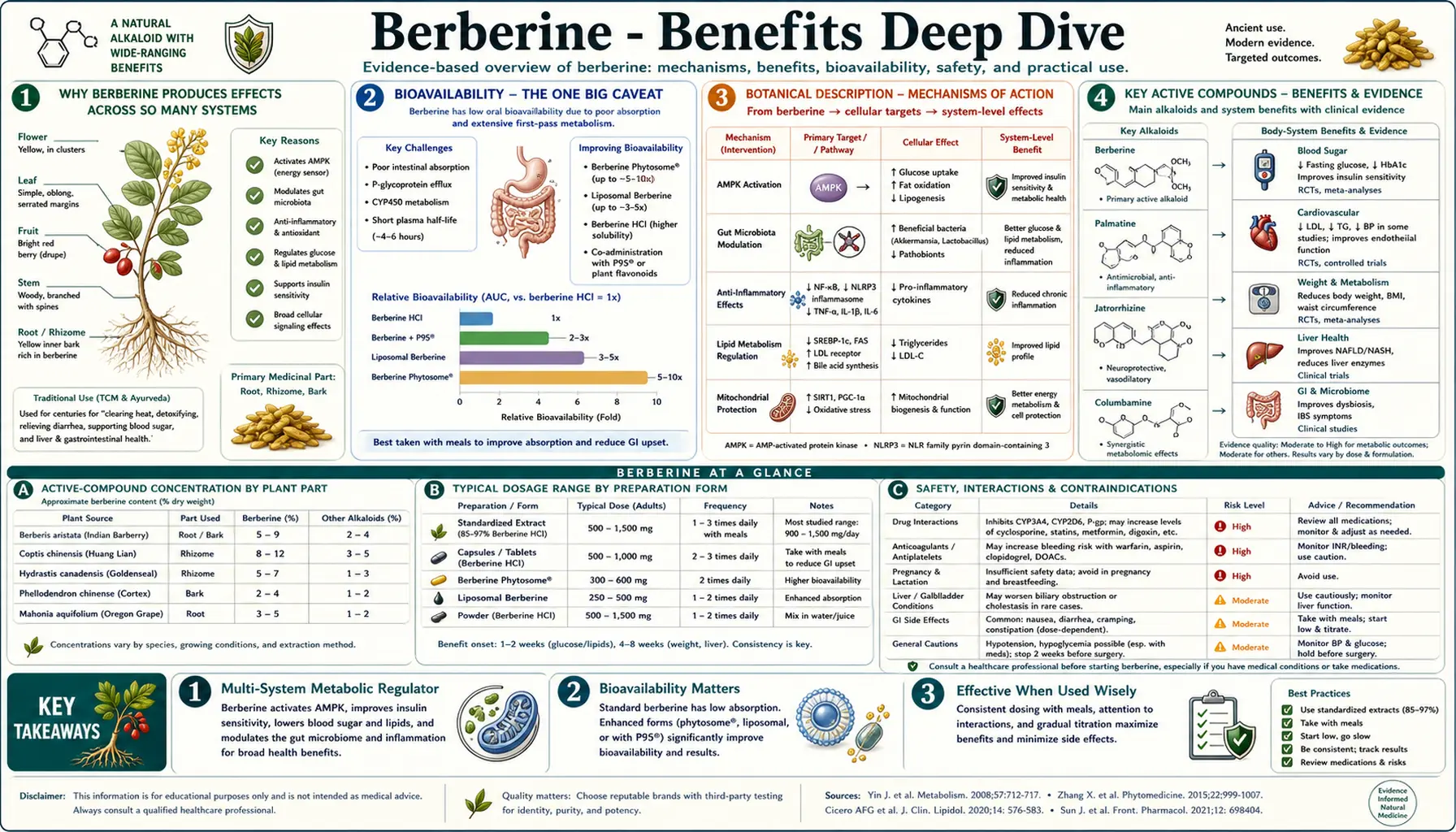
Berberine is a yellow isoquinoline alkaloid extracted from the roots, rhizomes, and bark of several botanically unrelated plants — Coptis chinensis (Chinese goldthread), Phellodendron amurense (Amur cork tree), Berberis species (barberry, Oregon grape), and the rhizomes of Hydrastis canadensis (goldenseal). It has been used for two millennia in Traditional Chinese Medicine and Ayurveda, but only in the last two decades has Western evidence-based medicine confirmed why it works. The mechanistic story converges on a single molecular target: AMP-activated protein kinase (AMPK), the cellular "metabolic master switch" that also happens to be the principal target of the diabetes drug metformin. The 2008 Yin trial demonstrated that berberine 500 mg three times daily produces a 0.9% HbA1c reduction that is statistically indistinguishable from metformin — earning berberine the popular name "nature's metformin." Four benefit pages below explore the clinical domains where berberine produces its largest, best-documented effects: glycemic control, lipid metabolism, gastrointestinal infection and dysbiosis, and the broader metabolic syndrome cluster that ties them all together through AMPK activation.
Deep-Dive Articles
Blood Sugar & Glycemic Control
The Yin 2008 head-to-head trial vs metformin showing equivalent 0.9% HbA1c reduction, the Lan 2015 and Dong 2012 meta-analyses pooling over 25 trials, AMPK activation as the shared mechanism with metformin, the "nature's metformin" framing, dosing (500 mg three times daily with meals), GI side effects (transient diarrhea, cramping) and how to mitigate them, and the practical use case for patients who cannot tolerate metformin or who want an adjunct.
Cholesterol & Lipid Metabolism
The Kong 2004 Nature Medicine paper that established LDL-receptor upregulation as the lipid mechanism (LDL reduction of approximately 29%), the dual AMPK + LDLR pathway that differs from the HMG-CoA-reductase inhibition of statins, the favorable effect on triglycerides and HDL, comparative efficacy data vs statins, the role for statin-intolerant patients, and the rationale for combining low-dose statin with berberine in resistant cases.
Gut Health, SIBO & Dysbiosis
The Chedid 2014 trial showing herbal antimicrobials (including berberine) non-inferior to rifaximin for SIBO eradication, the broad-spectrum antimicrobial activity against bacteria, yeast, and protozoa, the C. difficile pilot data, dysbiosis-rotation protocols, the historical use for bacterial diarrhea and dysentery, and the practical microbial-modulation framework that distinguishes berberine from antibiotic monotherapy.
AMPK & Metabolic Syndrome
AMPK as the cellular "master switch" sensing low energy (high AMP:ATP ratio) and orchestrating glucose uptake, fatty acid oxidation, mitochondrial biogenesis, and autophagy. The Wei 2012 PCOS trial showing improved insulin sensitivity and reproductive outcomes, application to non-alcoholic fatty liver disease (NAFLD), waist circumference and visceral adiposity, the unifying mechanism behind berberine's simultaneous effect on glucose, lipids, weight, and inflammation.
Table of Contents
- Deep-Dive Articles
- Why Berberine Produces Effects Across So Many Systems
- Bioavailability — The One Big Caveat
- Research Papers: Glycemic Control
- Research Papers: Lipids & Cardiovascular
- Research Papers: Gut, SIBO & Antimicrobial
- Research Papers: AMPK & Metabolic Syndrome
- Research Papers: Cross-Cutting (Mechanism, Safety, Forms)
- External Authoritative Resources
- Connections
- Featured Videos
Why Berberine Produces Effects Across So Many Systems
Berberine is unusual among natural products because its diverse clinical effects — on blood sugar, lipids, gut microbes, body weight, blood pressure, hepatic steatosis, and PCOS — all trace back to a small number of molecular targets that happen to sit at metabolic chokepoints. Five mechanisms account for essentially the entire pharmacology:
- AMPK activation — berberine activates AMP-activated protein kinase, the cellular fuel sensor that turns on when energy is low. AMPK in turn increases glucose uptake, switches mitochondria from fatty-acid synthesis to fatty-acid oxidation, stimulates mitochondrial biogenesis, and triggers autophagy. This is the same target as the diabetes drug metformin, which is why berberine and metformin produce nearly indistinguishable HbA1c reductions. AMPK activation explains the glycemic effect and most of the broader metabolic-syndrome cluster.
- LDL-receptor upregulation — the 2004 Kong paper in Nature Medicine showed that berberine stabilizes hepatic LDL-receptor mRNA, dramatically increasing the number of LDL receptors on the surface of hepatocytes and pulling LDL particles out of circulation. This mechanism is different from statins (which inhibit HMG-CoA reductase to reduce hepatic cholesterol synthesis) and explains the additive lipid-lowering when the two are combined — see the cholesterol deep-dive.
- Broad-spectrum antimicrobial activity — berberine has direct activity against many bacteria (Gram-positive and Gram-negative), yeasts (particularly Candida), and protozoa (Giardia, Entamoeba). The mechanism appears to involve DNA intercalation, FtsZ ring inhibition (preventing bacterial cell division), and efflux-pump inhibition. This explains the historical use for bacterial diarrhea and dysentery and the modern role in SIBO and dysbiosis management.
- GLUT4 translocation — independent of AMPK, berberine appears to directly increase translocation of the insulin-responsive glucose transporter GLUT4 from intracellular vesicles to the plasma membrane of muscle and adipose cells. This is the same translocation event that insulin triggers, and it explains why berberine improves insulin sensitivity in the absence of significant changes in fasting insulin levels.
- DPP-4 inhibition — berberine has measurable inhibitory activity against dipeptidyl peptidase-4 (DPP-4), the enzyme that degrades the incretin hormones GLP-1 and GIP. This is the same target as the gliptin class of diabetes drugs (sitagliptin, linagliptin, saxagliptin). The DPP-4 inhibition is modest compared to prescription gliptins but contributes additively to the post-prandial glucose-lowering effect.
The convergence of five mechanisms on overlapping pathways — glucose uptake, lipid metabolism, microbial ecology, energy sensing — explains why berberine is one of the most-studied herbal compounds of the past two decades. PubMed indexes over 5,000 papers on berberine, of which approximately 1,500 were published since 2020. No other single plant alkaloid has accumulated this much modern mechanistic evidence in such a short time.
Bioavailability — The One Big Caveat
The single most important practical limitation of berberine is its extraordinarily poor oral bioavailability — the conventional figure is approximately 1% in humans. The molecule is poorly absorbed across the intestinal epithelium, and what does get absorbed is rapidly subject to P-glycoprotein efflux back into the gut lumen, then hepatic first-pass metabolism through cytochrome P450 enzymes (especially CYP2D6 and CYP3A4) into a variety of demethylated metabolites.
The paradox is that despite this 1% bioavailability, oral berberine produces clinically meaningful systemic effects on blood glucose, lipids, and inflammation. Three explanations have emerged:
- Active metabolites — the demethylated metabolites (berberrubine, demethyleneberberine, jatrorrhizine, thalifendine) retain significant pharmacologic activity and circulate at higher concentrations than the parent compound.
- Gut-luminal effect — the 99% that is not absorbed remains in the gut at locally pharmacologic concentrations, where it exerts antimicrobial effects on the gut microbiome and directly stimulates the gut epithelium (including L-cells that secrete GLP-1). The gut-microbiome modulation alone is now thought to account for a meaningful fraction of berberine's metabolic effects, even before any systemic absorption.
- Enterohepatic recirculation — the small fraction that is absorbed is excreted in bile back into the gut and partially re-absorbed, extending the effective duration of action.
Two formulation approaches address bioavailability directly:
- Dihydroberberine — a reduced form of berberine that is approximately 5× more bioavailable than the parent compound. Manufacturers (e.g., NNB's GlucoVantage) market dihydroberberine as allowing lower per-dose amounts (typically 100-200 mg) to achieve effects equivalent to standard berberine 500 mg.
- Sodium caprate / piperine combinations — absorption enhancers that inhibit P-glycoprotein efflux and increase tight-junction permeability. Several commercial products combine berberine with sodium caprate (e.g., Thorne's formulation) or with piperine (the black-pepper alkaloid used in turmeric formulations for the same purpose).
The clinical guidance is straightforward: if standard berberine 500 mg three times daily with meals achieves the target effect (which it usually does, based on the trial evidence), there is no need for the more expensive enhanced forms. If the response is inadequate or GI tolerance is poor at the standard dose, dihydroberberine at a lower per-dose amount is a reasonable second-line trial. For more on practical dosing, see the main Berberine page.
Research Papers: Glycemic Control
- Yin J, Xing H, Ye J (2008). Efficacy of berberine in patients with type 2 diabetes mellitus. Metabolism. — PubMed: Yin 2008 vs metformin
- Lan J et al. (2015). Meta-analysis of the effect and safety of berberine in the treatment of type 2 diabetes mellitus. Journal of Ethnopharmacology. — PubMed: Lan 2015 meta-analysis
- Dong H et al. (2012). Berberine in the treatment of type 2 diabetes mellitus: a systematic review and meta-analysis. Evidence-Based Complementary and Alternative Medicine. — PubMed: Dong 2012 meta-analysis
- Zhang Y et al. (2008). Treatment of type 2 diabetes and dyslipidemia with the natural plant alkaloid berberine. JCEM. — PubMed: Zhang JCEM 2008
- Berberine AMPK activation mechanism — PubMed: Berberine AMPK
- Berberine GLUT4 translocation mechanism — PubMed: Berberine GLUT4
- Berberine vs metformin head-to-head comparisons — PubMed: Berberine vs metformin
- Berberine for prediabetes / impaired glucose tolerance — PubMed: Berberine prediabetes
- Berberine DPP-4 inhibition activity — PubMed: Berberine DPP-4
- Berberine and insulin sensitivity in skeletal muscle — PubMed: Berberine insulin sensitivity
Research Papers: Lipids & Cardiovascular
- Kong W et al. (2004). Berberine is a novel cholesterol-lowering drug working through a unique mechanism distinct from statins. Nature Medicine. — PubMed: Kong Nature Medicine 2004
- Berberine LDL-receptor upregulation hepatocyte mechanism — PubMed: Berberine LDLR mRNA
- Berberine plus statin combination therapy — PubMed: Berberine plus statin
- Berberine for statin-intolerant patients — PubMed: Berberine for statin-intolerant
- Berberine effect on triglycerides — PubMed: Berberine triglycerides
- Berberine effect on HDL cholesterol — PubMed: Berberine HDL
- Berberine and atherosclerosis progression — PubMed: Berberine atherosclerosis
- Berberine and PCSK9 / LDL clearance pathway — PubMed: Berberine PCSK9
- Berberine blood pressure modulation — PubMed: Berberine blood pressure
- Berberine meta-analysis lipid endpoints — PubMed: Berberine lipid meta-analysis
Research Papers: Gut, SIBO & Antimicrobial
- Chedid V et al. (2014). Herbal therapy is equivalent to rifaximin for the treatment of small intestinal bacterial overgrowth. Global Advances in Health and Medicine. — PubMed: Chedid 2014 SIBO herbal
- Berberine for Clostridium difficile infection — PubMed: Berberine C. difficile
- Berberine antimicrobial spectrum Gram-positive Gram-negative — PubMed: Berberine antimicrobial spectrum
- Berberine for bacterial diarrhea historical clinical trials — PubMed: Berberine bacterial diarrhea
- Berberine and the gut microbiome / dysbiosis modulation — PubMed: Berberine gut microbiome
- Berberine FtsZ inhibition bacterial cell division — PubMed: Berberine FtsZ
- Berberine efflux pump inhibition resistance reversal — PubMed: Berberine efflux pump
- Berberine for Helicobacter pylori — PubMed: Berberine H. pylori
- Berberine for Candida and antifungal activity — PubMed: Berberine antifungal
- Berberine for Giardia and protozoal diarrhea — PubMed: Berberine protozoal
Research Papers: AMPK & Metabolic Syndrome
- Wei W et al. (2012). A clinical study on the short-term effect of berberine in comparison to metformin on the metabolic characteristics of women with polycystic ovary syndrome. European Journal of Endocrinology. — PubMed: Wei 2012 PCOS
- Berberine AMPK master switch energy sensor mechanism — PubMed: Berberine AMPK master switch
- Berberine for non-alcoholic fatty liver disease (NAFLD) — PubMed: Berberine NAFLD
- Berberine for PCOS ovulation and reproductive outcomes — PubMed: Berberine PCOS reproductive
- Berberine and visceral adipose / waist circumference — PubMed: Berberine visceral fat
- Berberine and metabolic syndrome cluster outcomes — PubMed: Berberine metabolic syndrome
- AMPK mitochondrial biogenesis fatty acid oxidation — PubMed: AMPK mitochondrial biogenesis
- Berberine autophagy mTOR pathway — PubMed: Berberine autophagy mTOR
- Berberine and inflammation NF-kappaB pathway — PubMed: Berberine NF-kB
- Berberine weight loss / body composition trials — PubMed: Berberine weight loss
Research Papers: Cross-Cutting (Mechanism, Safety, Forms)
- Berberine bioavailability 1% oral absorption pharmacokinetics — PubMed: Berberine bioavailability
- Dihydroberberine enhanced bioavailability — PubMed: Dihydroberberine
- Berberine plus sodium caprate absorption enhancer — PubMed: Berberine + sodium caprate
- Berberine CYP3A4 CYP2D6 drug interactions — PubMed: Berberine CYP interactions
- Berberine safety profile and adverse effects review — PubMed: Berberine safety
- Berberine pregnancy contraindication kernicterus risk — PubMed: Berberine pregnancy caution
- Berberine source plants Coptis Phellodendron Berberis — PubMed: Berberine source plants
- Berberrubine and active metabolites pharmacology — PubMed: Berberine metabolites
- Berberine isoquinoline alkaloid chemistry — PubMed: Berberine chemistry
- Berberine network pharmacology multi-target review — PubMed: Berberine multi-target
External Authoritative Resources
- NCCIH (NIH National Center for Complementary & Integrative Health) — Berberine — the U.S. government's consumer-facing summary of evidence and safety
- MedlinePlus — Berberine — National Library of Medicine drug-and-supplement information
- Examine.com — Berberine — independent research-based supplement reference with graded evidence summaries
- Linus Pauling Institute — Micronutrient Information Center — for related metabolic-syndrome and antioxidant micronutrient context
- PubMed — All berberine research (5,000+ papers)
Connections
- All Herbs
- Berberine Benefits Deep Dive (Remedies) — a parallel benefits hub for the same compound in the Remedies tree, with its own four sub-articles on blood sugar and insulin sensitivity, cholesterol, the gut microbiome, and dosing, forms and cautions.
- Berberine (Main Page)
- Berberine for Blood Sugar
- Berberine for Cholesterol
- Berberine for Gut Health & SIBO
- Berberine, AMPK & Metabolic Syndrome
- Barberry (Berberine Source)
- Goldenseal (Berberine Source)
- Bitter Melon
- Gymnema
- Cinnamon
- Hemoglobin A1C
- Fasting Insulin
- Lipid Panel
- Diabetes
- Insulin Resistance
- Metabolic Syndrome
- PCOS
- SIBO
- Non-Alcoholic Fatty Liver Disease
- Atherosclerosis
- Blood Sugar
- Gut Healing
- Inositol