Berberine — Benefits Deep Dive
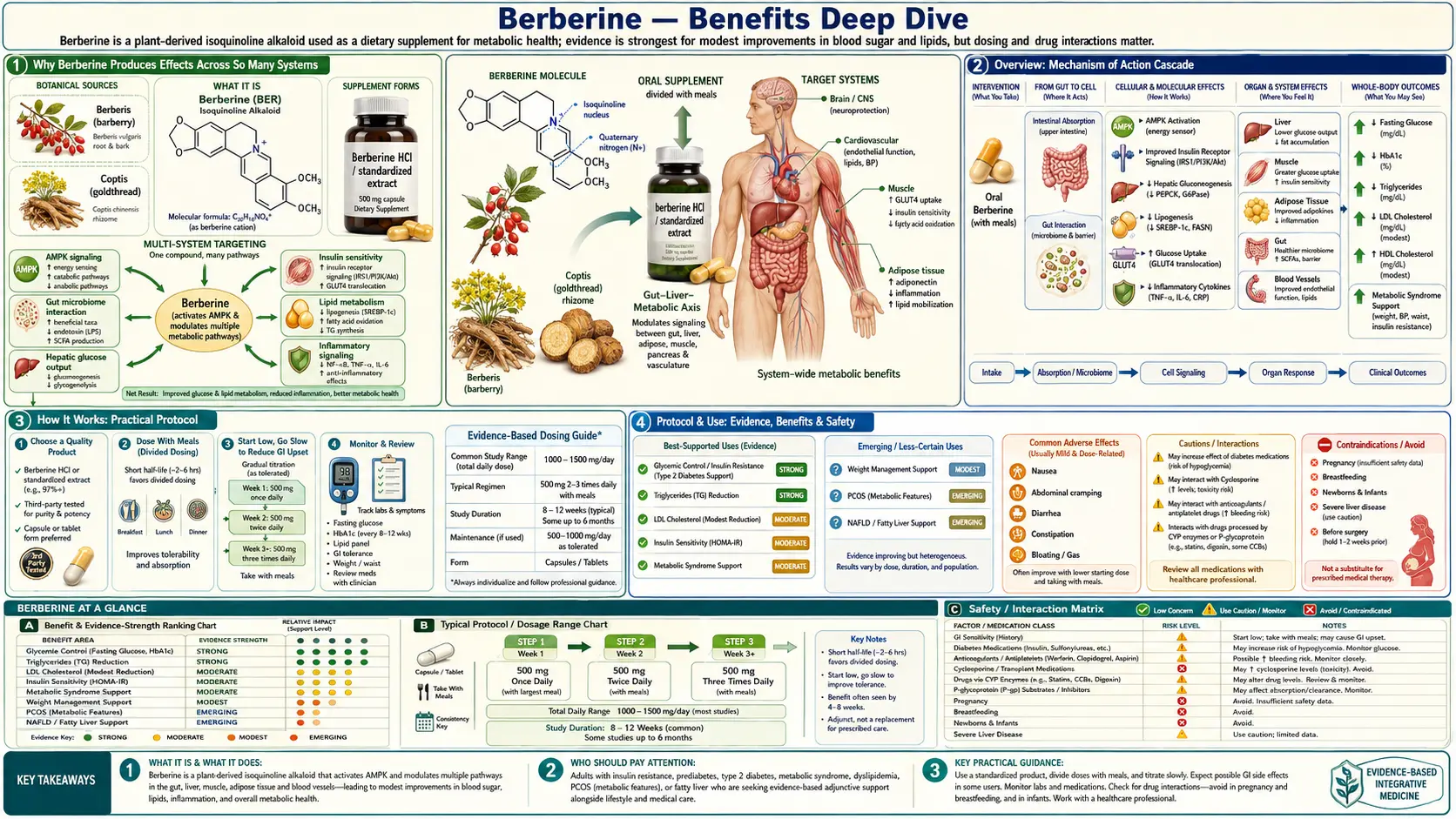
Berberine is one of the most extensively studied plant-derived isoquinoline alkaloids in modern pharmacology, with more than four decades of clinical trial data establishing it as a legitimate metabolic agent. It is the only naturally occurring molecule that produces a metformin-comparable reduction in fasting glucose and HbA1c in randomized head-to-head trials, while simultaneously lowering LDL cholesterol, triglycerides, and ApoB through an LDL-receptor-stabilizing mechanism distinct from statins. Its action through AMP-activated protein kinase (AMPK), the master cellular energy sensor, plus parallel effects on gut microbiome composition, intestinal DPP-4 activity, and PCSK9 expression, explains why berberine produces benefits across glucose, lipids, and the gut barrier from a single molecule. The four deep-dive pages below explore the principal clinical applications — type 2 diabetes and insulin resistance, dyslipidemia and cardiovascular risk, gut microbiome modulation, and the practical questions of dosing form, dihydroberberine versus standard berberine, and the contraindications that matter (pregnancy, jaundiced neonates, CYP2D6/CYP3A4 drug interactions).
Deep-Dive Articles
Blood Sugar & Insulin Sensitivity
The metformin-comparable trial data (Yin 2008 Metabolism), AMPK activation as the master mechanism, GLUT4 translocation independent of insulin, hepatic gluconeogenesis suppression, intestinal alpha-glucosidase inhibition, the 0.7-1.0% HbA1c reduction seen in pooled meta-analyses, and the rationale for combining berberine with metformin for additive effect in difficult-to-control type 2 diabetes.
Cholesterol & Cardiovascular
The Kong 2004 Nature Medicine paper establishing berberine as an LDL-receptor stabilizer (distinct from statin HMG-CoA reductase inhibition), the 20-25% LDL-C reduction in pooled trials, PCSK9 suppression, triglyceride lowering through SREBP-1c modulation, the Italian Armolipid Plus combination evidence, and the case for berberine as an alternative when patients cannot tolerate statins or as add-on for residual risk.
Gut Microbiome
Why berberine's 1-5% oral bioavailability is a feature rather than a bug — the bulk of an oral dose remains in the gut lumen where it remodels the microbiome, suppresses opportunistic Enterobacteriaceae and lipopolysaccharide-producing taxa, expands short-chain-fatty-acid producers (Akkermansia, Faecalibacterium), reduces metabolic endotoxemia, and the proposed gut-mediated mechanism behind glucose and lipid effects.
Dosing, Forms & Cautions
The standard 500 mg three-times-daily protocol (1,500 mg/day total), dihydroberberine's 5-fold higher oral bioavailability allowing 200 mg twice daily, berberine phytosome and silymarin-paired formulations, GI tolerance and titration strategy, the absolute pregnancy contraindication (kernicterus risk in neonates from bilirubin displacement), and the CYP2D6/CYP3A4 inhibition that drives clinically relevant interactions with metformin, cyclosporine, and many psychiatric medications.
Table of Contents
- Deep-Dive Articles
- Why Berberine Produces Effects Across So Many Systems
- Research Papers: Blood Sugar & Insulin Sensitivity
- Research Papers: Cholesterol & Cardiovascular
- Research Papers: Gut Microbiome
- Research Papers: Pharmacokinetics, Forms, and Cautions
- Research Papers: Cross-Cutting (AMPK, Mechanism, Safety)
- External Authoritative Resources
- Connections
- Featured Videos
Why Berberine Produces Effects Across So Many Systems
Most plant alkaloids act on a narrow pharmacological target — morphine on opioid receptors, caffeine on adenosine receptors, nicotine on cholinergic receptors. Berberine is unusual because it acts on a single master regulator (AMP-activated protein kinase, AMPK) plus the gut microbiome, and AMPK in turn coordinates hundreds of downstream metabolic processes. The breadth of berberine's clinical effect — glucose, lipids, gut barrier, weight, inflammation, NAFLD — is not the result of polypharmacology in the traditional sense. It is the result of pulling a single master lever that controls everything downstream.
- AMPK activation (the master metabolic switch) — berberine activates AMPK at concentrations achievable with oral dosing. AMPK is the cell's low-energy sensor: when ATP runs low and AMP accumulates, AMPK turns on, which shuts down anabolic processes (fatty acid synthesis, cholesterol synthesis, gluconeogenesis) and turns up catabolic processes (fatty acid oxidation, glucose uptake, mitochondrial biogenesis). Metformin works through the same final pathway. Berberine reaches AMPK by a slightly different route (inhibition of complex I of the mitochondrial electron transport chain at higher concentrations, and a more direct route at lower concentrations), but the downstream effects on glucose disposal, hepatic gluconeogenesis, and insulin sensitivity overlap substantially.
- LDL-receptor stabilization (a non-statin lipid mechanism) — the Kong 2004 Nature Medicine paper established that berberine stabilizes hepatic LDL-receptor mRNA against degradation by the extracellular signal-regulated kinase pathway. More LDL-receptors on hepatocytes means more LDL particles cleared from circulation, lowering serum LDL-C. This is mechanistically distinct from statin HMG-CoA reductase inhibition, which is why berberine and statins are additive when combined and why berberine works for many patients with statin intolerance.
- Gut microbiome remodeling (the unabsorbed-fraction mechanism) — only 1-5% of an oral berberine dose is absorbed systemically. The remaining 95-99% transits the lower GI tract and acts locally on the gut microbiome, suppressing lipopolysaccharide-producing taxa (Enterobacteriaceae, certain Bacteroides species) and expanding short-chain-fatty-acid producers (Akkermansia muciniphila, Faecalibacterium prausnitzii). This microbiome remodeling reduces metabolic endotoxemia (circulating LPS) and produces secondary improvements in systemic insulin sensitivity through the gut-liver-adipose axis — explaining why some of berberine's metabolic benefit appears even though tissue concentrations of the parent molecule are very low.
The clinical translation is that berberine produces dose-dependent, head-to-head metformin-comparable benefits on glucose (HbA1c reduction of 0.7-1.0%) and statin-comparable benefits on lipids (LDL-C reduction of 20-25%) from a single molecule taken at 1,500 mg/day in three divided doses. The fourth deep-dive page covers the practical questions: when standard berberine is sufficient versus when dihydroberberine's 5-fold higher bioavailability is worth the price, how to titrate to avoid the initial GI symptoms, the absolute pregnancy contraindication, and the CYP450 interactions that matter most.
Research Papers: Blood Sugar & Insulin Sensitivity
- Yin J et al. (2008). Efficacy of berberine in patients with type 2 diabetes mellitus — head-to-head versus metformin — PubMed: Yin 2008 metformin comparison
- Lan J et al. (2015). Meta-analysis of the effect and safety of berberine in the treatment of type 2 diabetes mellitus, hyperlipidaemia and hypertension — PubMed: Lan 2015 meta-analysis
- Dong H et al. (2012). Berberine in the treatment of type 2 diabetes mellitus: a systemic review and meta-analysis — PubMed: Dong 2012 meta-analysis
- Berberine and AMPK activation mechanism (Lee 2006 Diabetes) — PubMed: Lee AMPK 2006
- Berberine and GLUT4 translocation in muscle — PubMed: GLUT4 translocation
- Berberine suppresses hepatic gluconeogenesis — PubMed: Hepatic gluconeogenesis
- Berberine and intestinal alpha-glucosidase inhibition — PubMed: Alpha-glucosidase
- Berberine and DPP-4 inhibition (incretin effect) — PubMed: DPP-4 inhibition
- Berberine for polycystic ovary syndrome (PCOS) insulin resistance — PubMed: PCOS
- Berberine in metabolic syndrome (Zhang 2008) — PubMed: Zhang metabolic syndrome
Research Papers: Cholesterol & Cardiovascular
- Kong W et al. (2004). Berberine is a novel cholesterol-lowering drug working through a unique mechanism distinct from statins — PubMed: Kong Nature Medicine 2004
- Berberine LDL-receptor stabilization mechanism (ERK pathway) — PubMed: LDLR stabilization
- Berberine and PCSK9 suppression — PubMed: PCSK9 suppression
- Armolipid Plus combination (berberine + monacolin K + policosanol) for dyslipidemia — PubMed: Armolipid Plus
- Berberine and triglyceride reduction via SREBP-1c — PubMed: SREBP-1c
- Pisciotta L et al. (2012). Berberine in patients with statin intolerance — PubMed: Statin intolerance
- Berberine for nonalcoholic fatty liver disease (NAFLD) — PubMed: NAFLD
- Berberine in hypertension and endothelial function — PubMed: Hypertension
- Berberine and atherosclerosis in animal models — PubMed: Atherosclerosis
- Berberine and cardiac arrhythmia (historical use in China) — PubMed: Arrhythmia
Research Papers: Gut Microbiome
- Berberine and gut microbiome remodeling in metabolic syndrome — PubMed: Microbiome remodeling
- Berberine expands Akkermansia muciniphila — PubMed: Akkermansia
- Berberine and short-chain-fatty-acid production (butyrate, propionate) — PubMed: SCFA production
- Berberine suppresses Enterobacteriaceae and metabolic endotoxemia — PubMed: Metabolic endotoxemia
- Berberine bioavailability and gut conversion to dihydroberberine — PubMed: Gut conversion
- Berberine historical use as antidiarrheal — PubMed: Antidiarrheal
- Berberine and small intestinal bacterial overgrowth (SIBO) — PubMed: SIBO
- Berberine antimicrobial activity (mechanism: nucleic acid binding, FtsZ inhibition) — PubMed: Antimicrobial mechanism
- Berberine and intestinal tight junction / barrier integrity — PubMed: Tight junction integrity
- Berberine and bile acid metabolism via FXR — PubMed: FXR bile acid
Research Papers: Pharmacokinetics, Forms, and Cautions
- Berberine oral bioavailability (1-5%) and P-glycoprotein efflux — PubMed: Bioavailability
- Dihydroberberine pharmacokinetics (5-fold higher bioavailability) — PubMed: Dihydroberberine PK
- Berberine phytosome formulation (Berberine PhytoLipid Delivery) — PubMed: Phytosome
- Berberine and bilirubin displacement (neonatal kernicterus risk) — PubMed: Bilirubin kernicterus
- Berberine and CYP2D6 inhibition (drug interaction profile) — PubMed: CYP2D6
- Berberine and CYP3A4 inhibition — PubMed: CYP3A4
- Berberine and cyclosporine interaction (transplant patients) — PubMed: Cyclosporine interaction
- Berberine and metformin combination pharmacology — PubMed: Metformin combination
- Berberine GI tolerability and titration strategy — PubMed: GI tolerability
- Berberine safety in long-term human use — PubMed: Long-term safety
Research Papers: Cross-Cutting (AMPK, Mechanism, Safety)
- AMPK as the master cellular energy sensor (Hardie review) — PubMed: AMPK master sensor
- Berberine inhibits mitochondrial complex I (mechanism of AMPK activation) — PubMed: Complex I inhibition
- Berberine and weight loss meta-analysis — PubMed: Weight loss meta-analysis
- Berberine and inflammation (NF-kB suppression) — PubMed: NF-kB suppression
- Berberine anticancer activity (preclinical) — PubMed: Anticancer preclinical
- Berberine sources: Berberis vulgaris, Coptis chinensis, Hydrastis canadensis — PubMed: Botanical sources
- Berberine in traditional Chinese medicine (Huang Lian) — PubMed: TCM Huang Lian
- Berberine and Alzheimer's disease (preclinical AMPK and amyloid effects) — PubMed: Alzheimer preclinical
- Berberine and acne (oral, anti-inflammatory mechanism) — PubMed: Acne treatment
- Berberine antimicrobial resistance modulator activity — PubMed: Antimicrobial resistance
External Authoritative Resources
- StatPearls — Berberine — the standard clinical reference summary on berberine mechanism, dosing, and safety
- Mount Sinai — Berberine Supplement Monograph
- Examine.com — Berberine Evidence Review — comprehensive evidence grading by outcome
- MedlinePlus — Berberine
- PubMed — All research on berberine (~7,000+ papers)
Connections
- All Remedies
- Berberine Benefits Deep Dive (Herbs) — a parallel benefits hub for the same compound in the Herbs tree, with its own four sub-articles on blood sugar, cholesterol, gut health and SIBO, and AMPK and metabolic syndrome.
- Berberine (Main Page)
- Berberine for Blood Sugar & Insulin Sensitivity
- Berberine for Cholesterol & Cardiovascular
- Berberine for Gut Microbiome
- Berberine Dosing, Forms & Cautions
- Berberine and Iron Overload
- Type 2 Diabetes
- Insulin Resistance
- Metabolic Syndrome
- Dyslipidemia
- SIBO
- NAFLD
- PCOS
- Goldenseal (Hydrastis canadensis)