Berberine, AMPK & Metabolic Syndrome
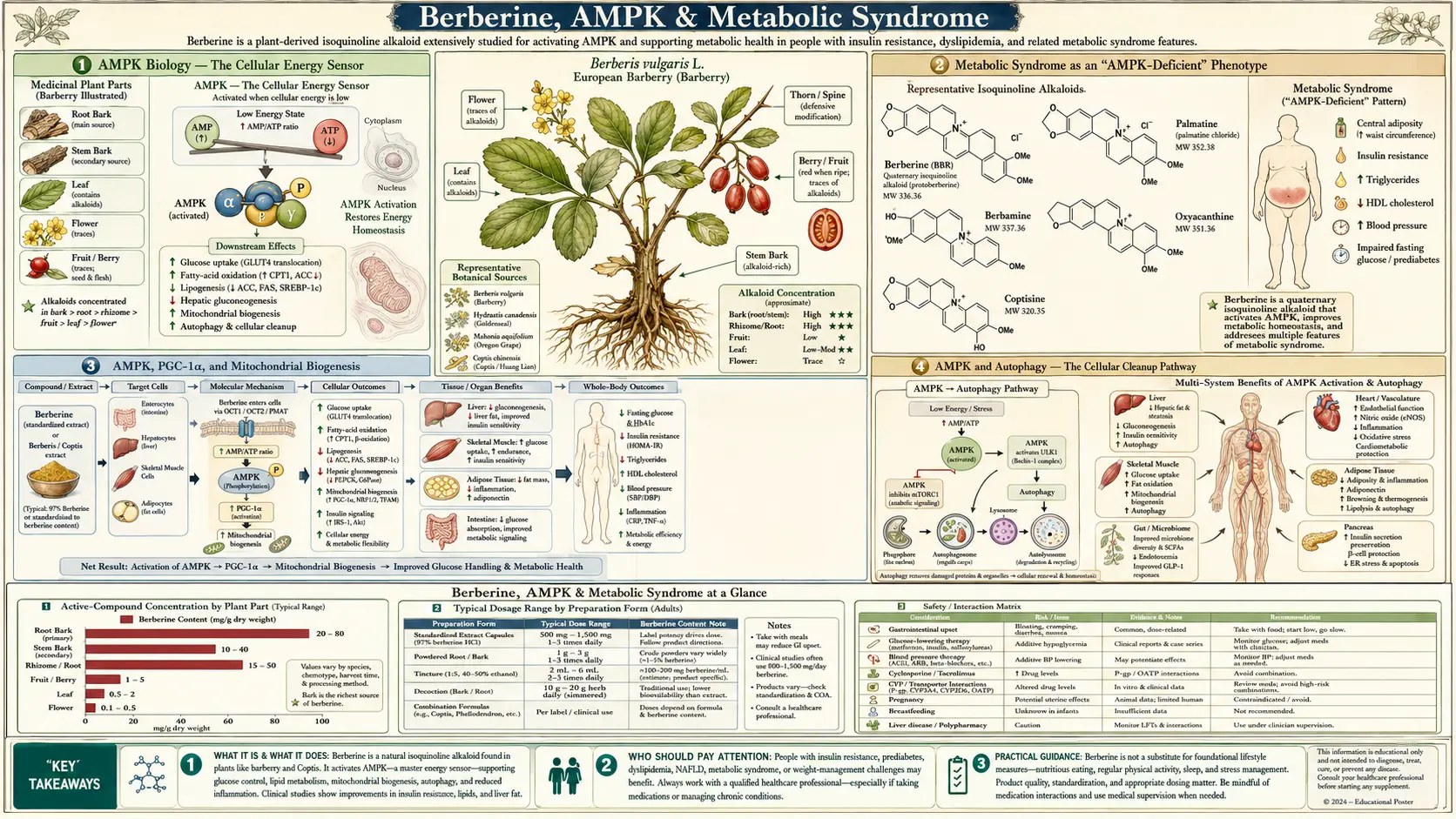
AMP-activated protein kinase (AMPK) is the cellular master switch that decides whether a cell builds or burns. When energy is abundant (high ATP, low AMP), AMPK is quiet and the cell builds — synthesizes fat, protein, glycogen, cholesterol. When energy is scarce (low ATP, high AMP), AMPK is activated and the cell burns — oxidizes fat, takes up glucose, makes new mitochondria, turns on autophagy. The reason berberine produces simultaneous improvements in glucose, lipids, weight, blood pressure, hepatic steatosis, and PCOS is that all of these conditions share a common upstream driver: a cellular metabolic state stuck in the "build" mode despite already being energy-replete. Berberine flips the master switch back toward "burn" via direct AMPK activation. This is the same target as metformin and the same effect as caloric restriction and exercise — which is why berberine is sometimes called a "caloric restriction mimetic" in addition to a "metformin mimetic." The Wei 2012 PCOS trial in European Journal of Endocrinology showed equivalence to metformin on insulin sensitivity, ovulation, and pregnancy outcomes in a population of younger metabolic-syndrome patients. This deep-dive walks through the AMPK biology, the metabolic syndrome cluster as a single AMPK-deficient phenotype, the PCOS evidence, the NAFLD application, the visceral adiposity data, and the practical case for berberine as a multi-target metabolic intervention.
Table of Contents
- AMPK Biology — The Cellular Energy Sensor
- Metabolic Syndrome as an "AMPK-Deficient" Phenotype
- AMPK, PGC-1α, and Mitochondrial Biogenesis
- AMPK and Autophagy — The Cellular Cleanup Pathway
- The Wei 2012 PCOS Trial
- Berberine for PCOS — Beyond the Wei Trial
- Berberine for Non-Alcoholic Fatty Liver Disease (NAFLD)
- Visceral Adipose and Waist Circumference
- Blood Pressure and Endothelial Function
- Inflammation — hs-CRP, NF-kappaB, and the Metabolic Inflammasome
- Berberine as a Caloric Restriction Mimetic
- Integrated Metabolic Syndrome Protocol
- Key Research Papers
- Connections
- Featured Videos
AMPK Biology — The Cellular Energy Sensor
AMP-activated protein kinase (AMPK) is a heterotrimeric enzyme complex composed of three subunits: an alpha (catalytic) subunit and beta and gamma (regulatory) subunits. The gamma subunit contains four cystathionine-beta-synthase (CBS) domains that bind adenine nucleotides — ATP, ADP, or AMP. The relative occupancy of these binding sites by ATP versus AMP is the cellular energy sensor.
When cellular energy is plentiful (ATP >> AMP), the gamma subunit binds ATP, AMPK is dephosphorylated and inactive. When cellular energy is scarce (AMP rising relative to ATP, typically because of muscle contraction, hypoxia, glucose deprivation, or mitochondrial inhibition), AMP displaces ATP at the gamma subunit. This conformational change exposes the activating phosphorylation site on the alpha subunit, allowing upstream kinases (LKB1, CaMKKβ) to phosphorylate Thr172. Phosphorylated AMPK is the active form, with approximately 1,000× greater catalytic activity than the unphosphorylated form.
Once active, AMPK phosphorylates dozens of downstream substrates to coordinate a global shift from anabolism (building) to catabolism (breaking down):
- Glucose — AMPK phosphorylates TBC1D1 and TBC1D4 to trigger GLUT4 translocation from intracellular vesicles to the plasma membrane in skeletal muscle, increasing glucose uptake without requiring insulin
- Fatty acids — AMPK phosphorylates and inhibits acetyl-CoA carboxylase (ACC), reducing malonyl-CoA production, which removes the brake on CPT1-mediated fatty acid transport into mitochondria for oxidation
- Cholesterol — AMPK phosphorylates and inhibits HMG-CoA reductase, the rate-limiting enzyme of cholesterol synthesis. This is a partial overlap with the statin mechanism (see the cholesterol deep-dive).
- Glycogen — AMPK inhibits glycogen synthase (reducing glycogen storage) and activates glycogen phosphorylase (releasing stored glucose)
- Protein synthesis — AMPK inhibits mTORC1, which is the central regulator of protein synthesis. This is the mechanism by which AMPK activation overlaps with the longevity-extending effects of caloric restriction and rapamycin.
- Hepatic gluconeogenesis — AMPK inhibits the transcriptional coactivators (CRTC2/TORC2, CREB) that drive expression of the gluconeogenic enzymes PEPCK and G6Pase. This is the principal mechanism by which AMPK reduces hepatic glucose output and is a major contributor to the glycemic effects of both metformin and berberine.
The net cellular phenotype of AMPK activation is exactly what is needed in metabolic syndrome: more glucose uptake, more fat burning, less fat storage, less cholesterol synthesis, less hepatic glucose output, less protein synthesis (less anabolic muscle growth in the short term, but more cellular cleanup and longevity signaling in the long term).
Metabolic Syndrome as an "AMPK-Deficient" Phenotype
Metabolic syndrome is the constellation of central obesity (waist circumference >40 inches in men, >35 inches in women), elevated triglycerides (>150 mg/dL), low HDL (<40 in men, <50 in women), elevated blood pressure (>130/85), and elevated fasting glucose (>100 mg/dL). Three of these five criteria diagnose the syndrome.
The mechanistic unification of these seemingly disparate features comes through insulin resistance and the metabolic state that drives it. The visceral adipocyte under conditions of chronic energy surplus accumulates large amounts of triglyceride, becomes dysfunctional, secretes inflammatory cytokines (TNF-alpha, IL-6, MCP-1), and exports free fatty acids and adipokines that drive insulin resistance in liver and muscle. The liver, receiving the portal-vein flood of free fatty acids and fructose, accumulates triglyceride (the NAFLD phenotype), becomes insulin resistant, and continues to produce glucose despite elevated insulin (the hyperglycemia of insulin resistance). The skeletal muscle, also insulin resistant, fails to take up post-prandial glucose. The pancreatic beta cells compensate by secreting more insulin (the hyperinsulinemia phase), then progressively fail (the diabetes phase).
What ties all of this together is that AMPK activity is suppressed in the metabolic syndrome state. Studies in adipose tissue, liver, and skeletal muscle from metabolic syndrome patients consistently show reduced AMPK phosphorylation and reduced AMPK activity compared to lean insulin-sensitive controls. The reason for this is partly direct (high cellular ATP from the chronic energy surplus, reduced AMP) and partly indirect (inflammatory cytokines suppress AMPK activity; ceramide accumulation from fatty acid spillover suppresses AMPK).
The implication is that any intervention that activates AMPK should reverse the underlying metabolic dysfunction simultaneously across all the manifestations:
- Caloric restriction does this — chronically reduces caloric intake, raises cellular AMP:ATP, activates AMPK
- Exercise does this — acutely raises AMP:ATP during contraction, chronically improves AMPK responsiveness
- Metformin does this — pharmacologically activates AMPK through mitochondrial complex I inhibition
- Berberine does this — pharmacologically activates AMPK through a similar (and possibly identical) mitochondrial mechanism plus direct LKB1 activation
This is why berberine produces simultaneous improvement in glucose, lipids, blood pressure, weight, and inflammation — the apparent multi-target effect is actually a single-target effect on AMPK propagating through the entire metabolic syndrome cluster.
AMPK, PGC-1α, and Mitochondrial Biogenesis
Beyond the immediate metabolic shifts, AMPK activation triggers mitochondrial biogenesis — the production of new mitochondria. The pathway is: AMPK phosphorylates and activates PGC-1α (peroxisome proliferator-activated receptor gamma coactivator-1 alpha), the master transcriptional coactivator for mitochondrial biogenesis. PGC-1α then coactivates a network of transcription factors (NRF1, NRF2, TFAM, ERR-alpha) that drive expression of both the nuclear-encoded mitochondrial proteins and the mitochondrial-DNA-encoded ones, leading to assembly of new mitochondria.
More mitochondria per cell means more oxidative capacity, more fatty acid oxidation potential, less dependence on glycolysis for ATP, and improved aerobic capacity. This is the molecular basis for the exercise-adaptation phenotype — trained skeletal muscle has 50-100% more mitochondria per cell than untrained muscle, with proportionally improved fat-burning capacity.
Berberine's AMPK activation drives the same mitochondrial biogenesis program. Studies in cultured cells and in rodent models have shown that chronic berberine treatment increases mitochondrial density and oxidative capacity in skeletal muscle, brown adipose tissue, and liver. The clinical translation in humans is less directly measured but is implied by the improvements in exercise tolerance, the reduction in resting fatigue, and the improvement in aerobic fitness measures reported in some clinical trials.
For metabolic syndrome patients, the mitochondrial biogenesis effect is therapeutically important because metabolic syndrome is associated with reduced mitochondrial density and function (the "mitochondrial dysfunction hypothesis" of insulin resistance). Restoring mitochondrial number and function via AMPK activation addresses one of the root drivers of the syndrome rather than just managing the downstream lab abnormalities.
AMPK and Autophagy — The Cellular Cleanup Pathway
Autophagy is the cellular process by which damaged organelles, misfolded proteins, and other cellular debris are sequestered in double-membrane autophagosomes and delivered to lysosomes for degradation. The breakdown products (amino acids, lipids, nucleotides) are recycled for new biosynthesis. Autophagy is most active during fasting, exercise, and other low-energy states — it is the cell's way of generating substrates from internal stores when external substrates are unavailable.
AMPK is one of the principal upstream activators of autophagy. AMPK phosphorylates and activates ULK1 (the mammalian homolog of yeast Atg1), the kinase that initiates autophagosome formation. AMPK also inhibits mTORC1, which is normally suppressive of autophagy — so AMPK activates autophagy by two converging mechanisms.
The implications for metabolic disease and longevity:
- Damaged mitochondria (a feature of metabolic syndrome) are cleared via mitophagy, a specialized form of autophagy. AMPK activation enhances mitophagy and removes the dysfunctional mitochondria that otherwise contribute to insulin resistance and oxidative stress.
- Misfolded protein aggregates (a feature of aging and neurodegeneration) are cleared via aggrephagy. AMPK activation by berberine, metformin, or caloric restriction has been investigated for potential cognitive benefits through this pathway.
- Excess lipid droplets in hepatocytes (the NAFLD phenotype) are cleared via lipophagy, a specialized autophagy that delivers lipid droplets to lysosomes for breakdown by lysosomal acid lipase. AMPK activation by berberine enhances hepatocyte lipophagy and is one mechanism for its effects on NAFLD.
- Senescent cells (a hallmark of aging) accumulate at higher rates when autophagy is impaired; AMPK activation may slow senescence accumulation.
The autophagy effects of berberine are mostly inferred from the AMPK pathway and from animal-model evidence rather than directly measured in humans, but they form part of the rationale for berberine in age-related metabolic decline and as a "caloric restriction mimetic."
The Wei 2012 PCOS Trial
The 2012 Wei, Zhao, Sheng, et al. trial published in European Journal of Endocrinology is the foundational clinical evidence for berberine in polycystic ovary syndrome (PCOS). The investigators randomized 89 anovulatory PCOS patients to:
- Berberine 500 mg three times daily for 3 months
- Metformin 500 mg three times daily for 3 months
- Placebo for 3 months
Outcomes were measured at 3 months and included menstrual regularity, ovulation rate, body composition, lipid profile, insulin sensitivity (HOMA-IR), and reproductive hormones. Key findings:
- Waist-to-hip ratio reduction: berberine produced larger reduction than metformin (statistically significant)
- Lipid profile: berberine produced larger improvements in total cholesterol, LDL, triglycerides, and HDL than metformin
- HOMA-IR (insulin resistance): both arms improved significantly vs placebo; the between-group difference was not statistically significant
- Fasting blood glucose: both arms reduced; equivalent magnitude
- SHBG (sex hormone binding globulin): berberine produced greater increase than metformin, contributing to reduced free androgens
- Free androgen index: reduced in both arms; equivalent
- Menstrual frequency and ovulation rate: improved in both arms; equivalent
- Adverse events: GI symptoms (diarrhea, cramping) more common in berberine arm early; equivalent by week 8
A subsequent follow-up trial by the same group examined cumulative pregnancy rates in PCOS patients undergoing IVF (with berberine or metformin co-administration alongside fertility treatment) and reported that the berberine arm had numerically higher cumulative pregnancy rates than the metformin arm, although the difference did not reach statistical significance.
The implication is that berberine is non-inferior to (and on some metrics superior to) metformin for the metabolic and reproductive features of PCOS. Given the equivalent efficacy and the additional lipid benefits, berberine is a defensible first-line choice in PCOS, particularly for patients who cannot tolerate metformin or who have concurrent dyslipidemia.
Berberine for PCOS — Beyond the Wei Trial
PCOS is the most common endocrine disorder in reproductive-age women, affecting approximately 5-10% of the population. The pathophysiology is dominated by insulin resistance — the same metabolic-syndrome cluster discussed above, but with the addition of androgen excess driven by insulin's direct stimulation of ovarian theca-cell androgen production. The result is a phenotype of:
- Menstrual irregularity or amenorrhea (anovulation)
- Hyperandrogenism (acne, hirsutism, male-pattern hair loss)
- Polycystic ovarian morphology on ultrasound
- Insulin resistance (often with frank acanthosis nigricans)
- Central obesity, dyslipidemia, increased cardiovascular risk
- Infertility from anovulation
- Increased risk of type 2 diabetes (40-50% lifetime risk), endometrial hyperplasia, and gestational diabetes
The conventional pharmacotherapy is metformin (for the insulin resistance), oral contraceptives (for the androgen excess and endometrial protection), spironolactone (for hirsutism), and letrozole or clomiphene (for ovulation induction in patients seeking pregnancy). The combination is effective but the pill burden is substantial and the long-term safety of multi-decade contraceptive use in this population is debated.
Berberine's appeal in PCOS:
- Addresses the insulin resistance directly (same mechanism as metformin)
- Reduces visceral adiposity (the Wei 2012 waist-to-hip ratio benefit)
- Improves lipid profile simultaneously
- Increases SHBG, which reduces free androgens
- Improves menstrual regularity and ovulation rates
- Single agent producing improvements across multiple PCOS dimensions
- Safety profile favorable for younger reproductive-age women, with the critical exception that berberine must be discontinued before attempted conception and is absolutely contraindicated in pregnancy (kernicterus risk in the fetus)
The practical protocol for PCOS:
- Berberine 500 mg three times daily with meals as the primary metabolic agent
- Plus inositol (myo-inositol 2 g + D-chiro-inositol 50 mg, twice daily) — the inositol literature in PCOS is independently strong; the combination is mechanistically complementary. See the Inositol page.
- Plus aggressive lifestyle (Mediterranean or low-glycemic diet, 150 minutes/week of activity, weight loss of 5-10% if BMI >25)
- Spironolactone if needed for hirsutism
- Oral contraceptive only if hormonal contraception is independently needed; not as primary PCOS therapy
- Discontinue berberine 1-2 menstrual cycles before attempted conception; resume after delivery and breastfeeding
For more on PCOS, see the PCOS main page.
Berberine for Non-Alcoholic Fatty Liver Disease (NAFLD)
Non-alcoholic fatty liver disease (NAFLD), now often called metabolic-associated steatotic liver disease (MASLD), is the most common chronic liver disease worldwide, affecting approximately 25% of the global adult population. The pathophysiology is hepatic insulin resistance driving de novo lipogenesis (the liver synthesizes triglycerides from carbohydrate substrates), combined with reduced fatty acid oxidation (impaired mitochondrial function). The accumulated triglyceride forms lipid droplets that crowd hepatocyte cytoplasm and impair function.
Berberine's mechanisms address NAFLD on multiple fronts:
- AMPK activation — inhibits ACC, reducing de novo lipogenesis; increases fatty acid oxidation via CPT1 release
- LDL-receptor upregulation — pulls cholesterol-containing lipoproteins out of circulation, reducing the substrate pool for further hepatic triglyceride synthesis
- Lipophagy — AMPK-mediated autophagy of intrahepatocyte lipid droplets
- Reduced metabolic endotoxemia — gut-microbiome modulation reduces circulating LPS, which would otherwise drive Kupffer-cell inflammation and progression toward NASH
- Mitochondrial biogenesis — new mitochondria restore oxidative capacity and reduce reliance on glycolysis
Clinical trials of berberine in NAFLD have shown:
- Hepatic steatosis reduction on MRI proton density fat fraction (MRI-PDFF, the most quantitative non-invasive measure)
- Transaminase (ALT, AST) reductions of approximately 20-40% from baseline
- Improvements in HOMA-IR and metabolic syndrome criteria
- Modest weight loss (approximately 2-4 kg over 3-6 months)
- Favorable safety profile in patients with mild-to-moderate steatosis
The clinical use case is patients with confirmed NAFLD (FibroScan with elevated CAP, or MRI-PDFF), no significant fibrosis (FibroScan <8 kPa), and the metabolic syndrome cluster as the underlying driver. Berberine 500 mg three times daily plus lifestyle intervention is a reasonable approach. For patients with significant fibrosis (FibroScan >8 kPa, F2 or higher), the disease is more advanced and prescription pharmacotherapy (resmetirom, vitamin E in non-diabetics) plus aggressive lifestyle is more appropriate — berberine can be an adjunct but should not be primary.
For more on NAFLD, see the Non-Alcoholic Fatty Liver Disease page.
Visceral Adipose and Waist Circumference
Visceral adipose tissue (VAT) — the fat stored within the abdominal cavity around internal organs, distinct from subcutaneous fat — is the metabolically dangerous fat depot. Visceral fat secretes pro-inflammatory cytokines (TNF-alpha, IL-6) into the portal venous drainage that goes directly to the liver, drives hepatic insulin resistance, and contributes to the metabolic syndrome cluster.
Berberine's effect on visceral adiposity is one of the more consistent findings across clinical trials:
- Waist circumference reductions of 2-5 cm over 3-6 months at standard dosing
- Waist-to-hip ratio improvements (the Wei 2012 PCOS trial showed this clearly)
- MRI- or CT-measured visceral fat area reductions reported in several trials
- Disproportionate effect on visceral vs subcutaneous fat — berberine appears to preferentially reduce VAT while sparing subcutaneous depots
The mechanism involves both the direct AMPK-mediated increase in fatty acid oxidation in adipocytes and the indirect effect through improved insulin sensitivity (insulin normally suppresses lipolysis; in insulin-resistant adipocytes, lipolysis is uninhibited and contributes to the free fatty acid spillover that drives hepatic and muscle insulin resistance). Restoring insulin sensitivity in adipocytes via AMPK activation re-establishes appropriate lipolytic control.
The clinical implication is that berberine should be expected to produce modest weight loss (2-4 kg over 3-6 months) with a favorable body composition shift (loss of visceral fat, relative preservation of muscle mass). This is similar in magnitude to the weight loss seen with metformin but smaller than with GLP-1 receptor agonists (semaglutide, tirzepatide), which produce 5-15% weight loss but at substantially higher cost and with their own side-effect profile.
Blood Pressure and Endothelial Function
Berberine produces modest reductions in blood pressure in hypertensive patients and improves endothelial function (measured by flow-mediated dilation of the brachial artery) in metabolic syndrome patients. The Lan 2015 meta-analysis included blood pressure as an endpoint and reported small but statistically significant reductions in systolic blood pressure (approximately 4-7 mmHg) and diastolic blood pressure (approximately 3-5 mmHg) with berberine therapy.
The mechanisms appear to be:
- Improved endothelial nitric oxide synthase (eNOS) activity, increasing NO production and vasodilation
- Reduced oxidative stress in the vascular wall
- Direct effect on vascular smooth muscle calcium handling
- Indirect effects through improved insulin sensitivity (hyperinsulinemia is a known driver of sympathetic nervous system activity and sodium retention)
- Anti-inflammatory effects in the vascular wall
Berberine is not a substitute for standard antihypertensive therapy in patients with stage 2 hypertension (systolic >140 or diastolic >90), but it can be a useful adjunct in patients with stage 1 hypertension (130-139 systolic) and the metabolic syndrome cluster who want a multi-target approach. The modest blood pressure effect adds to the other metabolic benefits.
Inflammation — hs-CRP, NF-kappaB, and the Metabolic Inflammasome
Metabolic syndrome is a low-grade chronic inflammatory state. The visceral adipose tissue secretes pro-inflammatory cytokines (TNF-alpha, IL-6, MCP-1) that elevate circulating C-reactive protein (CRP), drive insulin resistance, and contribute to atherosclerotic plaque formation and progression. The NF-kappaB transcription factor pathway is the central driver of this chronic inflammation, and the NLRP3 inflammasome is the principal sensor that detects metabolic stress (saturated fatty acids, cholesterol crystals, hyperglycemia) and activates the inflammatory cascade.
Berberine has well-documented anti-inflammatory effects through multiple pathways:
- Direct inhibition of NF-kappaB activation, reducing transcription of pro-inflammatory cytokine genes
- Inhibition of the NLRP3 inflammasome, reducing IL-1-beta processing and secretion
- Reduction in circulating IL-6, TNF-alpha, and hs-CRP in clinical trials
- AMPK-mediated suppression of inflammatory signaling (AMPK and NF-kappaB are reciprocally regulated)
- Reduced metabolic endotoxemia through gut-microbiome modulation (lower circulating LPS, lower TLR4 signaling)
The clinical translation: hs-CRP reductions of 20-30% are typical with berberine therapy, which is in the same range as moderate-dose statins. For patients with metabolic syndrome and elevated hs-CRP (a marker of residual cardiovascular risk), berberine adds anti-inflammatory benefit on top of its lipid and glycemic effects.
Berberine as a Caloric Restriction Mimetic
Caloric restriction (typically 20-40% reduction in caloric intake without malnutrition) is one of the most reliable interventions for extending lifespan in animal models. The mechanisms include AMPK activation, mTOR inhibition, sirtuin (SIRT1, SIRT3) activation, autophagy induction, mitochondrial biogenesis, and reduced oxidative damage. These pathways converge to produce a phenotype of metabolic flexibility, mitochondrial efficiency, and resistance to age-related decline.
"Caloric restriction mimetics" are interventions that activate the same downstream pathways without requiring actual caloric restriction. The best-studied are:
- Metformin — AMPK activation, mTOR inhibition; the TAME (Targeting Aging with Metformin) trial is testing longevity effects in humans
- Rapamycin — direct mTOR inhibition; extends lifespan in multiple animal models
- Resveratrol — SIRT1 activation; effects in humans modest and inconsistent
- NAD+ precursors (NR, NMN) — restore declining NAD+ levels that limit sirtuin activity
- Berberine — AMPK activation, mTOR inhibition, autophagy induction, mitochondrial biogenesis
Berberine arguably has the strongest combined profile of any of these — it activates AMPK robustly, inhibits mTOR indirectly through AMPK, induces autophagy, drives mitochondrial biogenesis, and has documented effects on the metabolic syndrome cluster that is the proximate clinical manifestation of aging-related metabolic decline. The longevity claim for berberine is not yet supported by direct human evidence (no equivalent of the TAME trial exists for berberine), but the mechanistic case is strong.
For patients interested in the "metabolic healthspan" framing, berberine is a reasonable component of an anti-aging strategy that includes:
- Time-restricted eating or periodic fasting (the actual caloric restriction)
- Regular exercise (the AMPK and mitochondrial biogenesis inducer)
- Mediterranean or low-carb dietary pattern
- Berberine 500 mg three times daily as caloric restriction mimetic
- Optional adjuncts: low-dose metformin, NAD+ precursor, omega-3 fatty acids, vitamin D, magnesium
This is a reasonable framework but should be understood as preventive metabolic care rather than as evidence-based longevity therapy — the human longevity trials are not yet done.
Integrated Metabolic Syndrome Protocol
A practical berberine-based protocol for the metabolic syndrome patient:
- Diagnostic confirmation — waist circumference, HbA1c, fasting glucose, fasting insulin, full lipid panel, hs-CRP, ALT/AST, blood pressure. Confirm 3-of-5 metabolic syndrome criteria. Consider FibroScan or MRI-PDFF if NAFLD suspected.
- Lifestyle foundation — Mediterranean or low-glycemic diet, 150-300 minutes/week of moderate-intensity activity (mix of aerobic and resistance), 7-9 hours of sleep per night, alcohol limit, smoking cessation. This is the non-negotiable foundation; pharmacotherapy and supplements are adjuncts.
- Berberine 500 mg three times daily with meals — the primary supplement intervention. Titrate up over 2-3 weeks to minimize GI side effects.
- Adjunctive supplements based on individual lab abnormalities:
- Omega-3 EPA/DHA 2-4 g/day if triglycerides elevated
- Magnesium glycinate 400 mg/day — broadly supportive of insulin sensitivity
- Vitamin D3 2,000-5,000 IU/day if serum 25-OH-D <40 ng/mL
- Inositol (myo + D-chiro combination) if PCOS or insulin resistance prominent
- Coenzyme Q10 100-200 mg/day if on a statin
- NAC 600 mg twice daily if NAFLD prominent
- Prescription medications based on which metabolic syndrome features dominate:
- Metformin if HbA1c >6.0% and patient willing to combine with berberine
- Low-to-moderate dose statin if LDL >160 or cardiovascular risk elevated
- SGLT2 inhibitor (empagliflozin, dapagliflozin) if HbA1c remains elevated despite metformin + berberine
- GLP-1 receptor agonist (semaglutide, tirzepatide) if significant weight loss is the priority
- ACE inhibitor or ARB if blood pressure >130/80 and concurrent kidney or cardiac concern
- Monitoring schedule — recheck full metabolic syndrome labs at 3 months, 6 months, then annually if stable. Adjust regimen based on response.
- Reassess at each visit whether prescription medications can be reduced as metabolic improvement occurs. Berberine + lifestyle can sometimes allow discontinuation of one or more prescription drugs over 12-24 months.
For more on metabolic syndrome and related conditions, see the Metabolic Syndrome page, the Insulin Resistance page, and the Blood Sugar Remedies page.
Key Research Papers
- Wei W, Zhao H, Wang A, et al. (2012). A clinical study on the short-term effect of berberine in comparison to metformin on the metabolic characteristics of women with polycystic ovary syndrome. European Journal of Endocrinology 166(1):99-105. — PubMed
- Lee YS, Kim WS, Kim KH, et al. (2006). Berberine, a natural plant product, activates AMP-activated protein kinase with beneficial metabolic effects in diabetic and insulin-resistant states. Diabetes 55(8):2256-2264. — PubMed
- Turner N, Li JY, Gosby A, et al. (2008). Berberine and its more biologically available derivative, dihydroberberine, inhibit mitochondrial respiratory complex I: a mechanism for the action of berberine to activate AMP-activated protein kinase and improve insulin action. Diabetes. — PubMed
- Hardie DG (2014). AMPK — sensing energy while talking to other signaling pathways. Cell Metabolism. — PubMed
- Yin J, Gao Z, Liu D, Liu Z, Ye J (2008). Berberine improves glucose metabolism through induction of glycolysis. American Journal of Physiology — Endocrinology and Metabolism. — PubMed
- Zhou JY, Zhou SW (2010). Berberine regulates glucose and lipid metabolism, ameliorates inflammation through PKC and PPAR-alpha pathways. Journal of Pharmacological Sciences. — PubMed
- Yan HM, Xia MF, Wang Y, et al. (2015). Efficacy of berberine in patients with non-alcoholic fatty liver disease. PLoS One. — PubMed
- Hu Y, Davies GE (2010). Berberine inhibits adipogenesis in high-fat diet-induced obesity mice. Fitoterapia. — PubMed
- An Y, Sun Z, Zhang Y, Liu B, Guan Y, Lu M (2014). The use of berberine for women with polycystic ovary syndrome undergoing IVF treatment. Clinical Endocrinology. — PubMed
- Cao C, Su M (2019). Effects of berberine on glucose-lipid metabolism, inflammatory factors and insulin resistance in patients with metabolic syndrome. Experimental and Therapeutic Medicine. — PubMed
- Mirhadi E, Roufogalis BD, Banach M, Barati M, Sahebkar A (2018). Resveratrol: mechanistic and therapeutic perspectives in pulmonary arterial hypertension. Pharmacological Research. — PubMed
- Brusq JM, Ancellin N, Grondin P, et al. (2006). Inhibition of lipid synthesis through activation of AMP kinase: an additional mechanism for the hypolipidemic effects of berberine. Journal of Lipid Research. — PubMed
PubMed Topic Searches
- PubMed: Berberine AMPK metabolic
- PubMed: Berberine and PCOS
- PubMed: Berberine and NAFLD
- PubMed: Berberine visceral fat
- PubMed: Berberine mitochondrial biogenesis
- PubMed: Berberine autophagy / CR mimetic
Connections
- All Herbs
- Berberine Overview
- Berberine Benefits Hub
- Berberine for Blood Sugar
- Berberine for Cholesterol
- Berberine for Gut Health & SIBO
- Metabolic Syndrome
- Insulin Resistance
- PCOS
- Diabetes
- Non-Alcoholic Fatty Liver Disease
- Atherosclerosis
- Inositol
- Hemoglobin A1C
- Fasting Insulin
- Lipid Panel
- Blood Sugar
- Fasting / Time-Restricted Eating
- Omega-3 Fatty Acids
- Metformin — the prescription AMPK activator berberine was tested head-to-head against in the Wei 2012 PCOS trial.
- Covered in depth on its own page: Insulin Resistance · Caloric Restriction