Berberine: History and Traditional Use
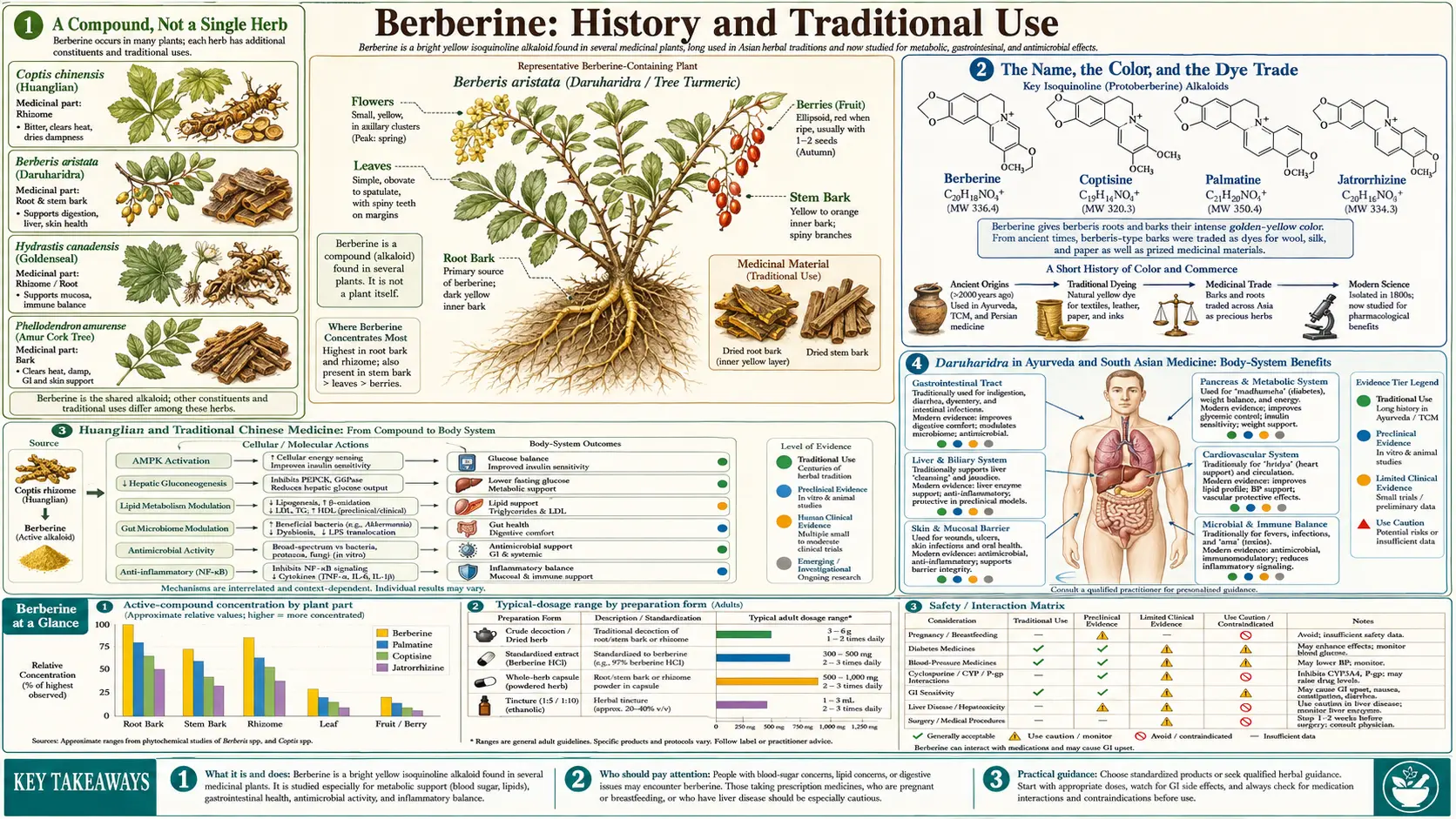
Berberine is unusual among popular supplements: it is not an herb but a single bright-yellow compound that several unrelated plants happen to make. There is no founder and no single place of origin — instead, healers in China, India, the Middle East, and Europe each independently noticed that certain intensely bitter, yellow-rooted plants calmed the gut, settled fevers, and dyed cloth a brilliant gold. Centuries later, chemists discovered that the same molecule lay behind all of these scattered traditions. This page traces that story honestly: what the old texts actually record, what is folklore, and the documented scientific milestones — from the naming of the compound in the 1830s to the modern clinical trials that brought berberine back to attention.
Table of Contents
- A Compound, Not a Single Herb
- The Name, the Color, and the Dye Trade
- Huanglian and Traditional Chinese Medicine
- Daruharidra in Ayurveda and South Asian Medicine
- Barberry in the Mediterranean and European Traditions
- Isolating and Naming the Compound (1820s–1830s)
- The Modern Rediscovery: From Antimicrobial to Metabolic Star
- From Tradition to Modern Research
- Research Papers and References
- Connections
- Featured Videos
A Compound, Not a Single Herb
Most entries in this herb section describe a single plant with a single history. Berberine is different, and the difference shapes everything about its story. Berberine is a compound — a yellow isoquinoline alkaloid — that is produced by a number of botanically unrelated plants growing on different continents. The plants people actually gathered and brewed include Coptis chinensis (Chinese goldthread, or huanglian), Phellodendron amurense (Amur cork tree, huangbai), several Berberis species (the barberries and Oregon grape), and the North American woodland plant Hydrastis canadensis (goldenseal). What links them is not their family tree but their chemistry: each concentrates berberine, mostly in the root, rhizome, or inner bark, which is why each has a vivid yellow interior and a sharply bitter taste.
This matters for honest history. No one invented berberine, and there is no single founder, discoverer, or place of origin. Instead, separate cultures — in East Asia, South Asia, the Middle East, and Europe — independently learned to use whichever bitter yellow-rooted plant grew near them, long before anyone knew that a shared molecule explained their similar effects. The story of berberine is therefore really several parallel plant histories that converged only in the nineteenth century, when chemistry revealed that the Chinese goldthread, the Indian barberry, the European barberry, and American goldenseal were all delivering the same active substance. For that reason the sections below follow the plants and their traditions first, and the molecule only afterward.
A reader will also notice that several of those source plants have their own pages on this site. Barberry (Berberis vulgaris) and Goldenseal (Hydrastis canadensis) are the two berberine-rich herbs most familiar in the West; their individual histories overlap closely with the account given here, because in practice their traditional uses are the traditional uses of berberine.
The Name, the Color, and the Dye Trade
The modern word berberine is young compared with the plants it comes from. According to Merriam-Webster, the English word was first recorded in 1832, and it derives from the German Berberin, which in turn was built on the scientific-Latin plant name Berberis. The compound, in other words, was named after the barberry genus from which it was first obtained — not the other way around. The genus name Berberis itself is much older: lexicographers commonly trace it through Medieval Latin barbaris/barberis back to an Arabic source (often given as barbārīs), a derivation usually presented as the accepted etymological tradition rather than as a precisely dated event.
Long before any of this, the most obvious feature of these plants was simply their color. Berberine is a strong natural dye, and the yellow roots and bark of Berberis, Coptis, and goldenseal were widely used to color wool, leather, and wood a deep, lasting yellow. This dual identity — a brilliant dyestuff that was also a bitter medicine — runs through the plant lore of several cultures and is part of why the roots were gathered, traded, and valued in the first place. The Sanskrit name for Indian barberry captures the same observation directly, as the next sections describe: it literally means "yellow wood."
It is worth being clear that the dye use is the most securely documented "everyday" use of these plants: a yellow root that visibly stains the hands needs no special interpretation. The medicinal claims attached to the same roots are older and richer, but they come to us through traditional medical texts and folk practice, and are best read as the inherited experience of those traditions rather than as proven modern therapeutics.
Huanglian and Traditional Chinese Medicine
The deepest written record of a berberine-rich plant belongs to China. The rhizome of Coptis species — known in Chinese as huanglian (黃連), usually translated "golden thread" or "yellow link" for its segmented, gold-colored root — is one of the most venerable herbs in the Chinese pharmacopoeia. According to a comprehensive 2019 review of Coptidis Rhizoma in Pharmaceutical Biology, its medicinal use was first listed in the Shennong Bencao Jing (the Divine Farmer's Classic of Materia Medica), a foundational herbal compiled in China during the Han dynasty (conventionally dated to roughly the first to second century CE, drawing on older oral tradition). That places documented use of this plant at well over fifteen hundred years, and the popular description of berberine-containing herbs as having been used for "around 2,500 years" reflects this long East Asian and South Asian lineage taken together.
Within traditional Chinese medical theory, huanglian is classified as a profoundly bitter and cold herb whose role is to "clear heat, dry dampness, and detoxify." In plain terms, it was reached for in conditions a modern reader would broadly recognize as infectious or inflammatory: the same 2019 review summarizes its historical use for diarrhea, vomiting, abdominal fullness, jaundice, high fever with delirium, toothache, and skin conditions such as eczema, among others. Huanglian became one of the most heavily used herbs in the entire tradition; the review notes that it appears in tens of thousands of recorded Chinese medical formulas, frequently paired with other herbs rather than used alone.
It is important to read these indications as traditional categories, not modern diagnoses. The herb was understood through a framework of heat, damp, and toxicity, and the conditions it addressed — especially acute diarrhea and dysentery-like illness — are exactly where a bitter, antimicrobial yellow root would have offered real, repeatable comfort. Modern chemistry later confirmed that berberine is the principal active alkaloid of huanglian, which is why this plant sits at the historical center of the berberine story.
Daruharidra in Ayurveda and South Asian Medicine
South Asia has its own long-standing berberine plant: Berberis aristata, the Indian barberry or "tree turmeric," known in Sanskrit and Ayurveda as Daruharidra. The name is itself a small piece of history, as it joins daru ("wood") and haridra ("turmeric" / "yellow") — literally "yellow wood" or "tree turmeric," again naming the plant for its brilliant yellow root. A 2012 review in Fitoterapia documents that Berberis aristata has a long traditional reputation in Ayurveda, Siddha, and Unani medicine, used as an anti-pyretic (fever-reducing), antibacterial, and hepatoprotective remedy and applied to complaints including diarrhea, jaundice, skin diseases, wound healing, and eye and ear infections.
One traditional preparation deserves a specific mention because it is so well attested: rasaut (also spelled rasaunt or rasont), a thick extract made by boiling the root and lower-stem bark of Berberis aristata in water and concentrating it down. Folk and classical practice held rasaut to be especially useful applied to the eyes for inflammation and "sore eyes," and taken internally for indigestion and other complaints. The herb is widely said to appear in the classical Ayurvedic compendia (the Charaka and Sushruta Samhitas) and in formulations such as the multi-root preparation Dashamoola; those textual attributions are part of the received Ayurvedic tradition, and a reader should treat the very early dates sometimes attached to them as traditional rather than precisely fixed.
As in China, the through-line is unmistakable: a bitter, intensely yellow root, valued for fevers, digestive and liver complaints, infected eyes and skin, and wounds. Chemically, the Fitoterapia review identifies berberine as the primary active alkaloid of the plant, concentrated in the root — once again placing this distinct, independent tradition squarely on the berberine map.
Barberry in the Mediterranean and European Traditions
In the Mediterranean world and across Europe, the relevant plant was the common barberry, Berberis vulgaris — a thorny shrub with bright-yellow inner wood and tart red berries. Its history is closely tied to the dedicated Barberry page on this site, and the two accounts overlap, because European barberry use is in practice the European chapter of berberine's story. Traditionally, the root bark and stem bark were the medicinal parts, valued — as everywhere these yellow roots were used — chiefly as a bitter remedy for the liver, the digestion, and the gut. The tart berries had a separate, mostly culinary and household life, used for preserves, sauces, and cooling drinks, a role they still hold in Persian and other regional cuisines.
Because the secure, plainly documented use of European barberry is as a dye and a bitter, this page treats its more specific historical medical claims with appropriate caution and points readers to the dedicated Barberry article for detail. What can be said with confidence is that Berberis vulgaris was a familiar European medicinal and household plant; that its yellow root was used to dye wool, leather, and wood; and that — as the next section describes — it was precisely this common barberry that gave nineteenth-century chemists the material from which they first isolated and named berberine. In that sense the humble European hedgerow shrub occupies a pivotal place in the compound's recorded history, even though its richest medicinal traditions lie in Asia.
Isolating and Naming the Compound (1820s–1830s)
The nineteenth century was the great age of alkaloid chemistry — the period in which chemists first learned to pull single active compounds out of medicinal plants — and berberine belongs to that wave of discovery. The compound is commonly credited as having been isolated and named by the German pharmacists Johann Andreas Buchner and Herberger, who in 1830 obtained a pure yellow substance from the common barberry, Berberis vulgaris, and gave it the name berberine after the plant. This is the event that the English word's 1832 first-recorded date (above) reflects.
As often happened in early alkaloid work, the same molecule had quietly turned up before, under other names, isolated from other plants by chemists who did not yet realize they were looking at the same thing. Secondary histories of the compound record that a yellow principle named jamaicine was obtained from the "Jamaica cabbage tree" by Hüttenschmid in 1824, and that a substance called xanthopicrite was isolated by Chevallier and Pelletan (from a Xanthoxylum/prickly-ash species) in 1826; both were subsequently shown to be identical to the berberine that Buchner and Herberger characterized. These specific names and dates come to us through later review literature rather than from a single contemporaneous record, so they are best presented as the commonly cited account of berberine's isolation rather than as an undisputed first.
The deeper significance of this nineteenth-century work is conceptual. Once berberine could be isolated and identified, chemists could test plant after plant for it — and they found it in barberry, in goldthread, in goldenseal, in the Amur cork tree, and beyond. That is the moment the scattered, independent traditions of Asia, the Middle East, and Europe were revealed to share a single chemical thread. The folk knowledge had come first, accumulated over many centuries; the unifying explanation arrived only with the laboratory.
The Modern Rediscovery: From Antimicrobial to Metabolic Star
For much of the twentieth century, berberine was studied and used chiefly for what its traditional record had always emphasized: the gut. It was investigated and applied as an antimicrobial and anti-diarrheal agent, fitting neatly with huanglian's ancient reputation for "clearing heat" in dysentery-like illness and with barberry's and goldthread's long use for digestive infection. In this role berberine was a respectable but unglamorous compound, familiar mainly within herbal and traditional-medicine practice and in regions where berberine-containing plants were part of everyday care.
Its modern fame came from an entirely different direction. A landmark clinical milestone — and one of the most-cited single studies in berberine's history — was published in 2008 by Jun Yin, Huili Xing, and Jianping Ye in the journal Metabolism. In a pilot trial of adults with type 2 diabetes, the authors reported that berberine produced reductions in blood sugar (including hemoglobin A1c and fasting glucose) broadly comparable to those of the standard first-line drug metformin, along with improvements in blood lipids. That head-to-head comparison with a mainstream pharmaceutical is what propelled berberine out of its narrow antimicrobial niche and into wide attention as a metabolic supplement, and it is the source of the popular nickname "nature's metformin."
A note of honesty belongs here, because real people read these pages to make health decisions. That 2008 study was explicitly a pilot trial in a small group of patients, and the body of evidence since then — though substantial and genuinely promising — is still maturing. Berberine's metabolic story is a recent, evolving area of research, not a settled folk tradition; the rich historical record described above concerns the gut, the liver, fevers, and dye, not blood sugar. The clinical detail, dosing, and current evidence for berberine's metabolic uses are covered on the companion Berberine Benefits pages, and nothing here should be taken as a recommendation to replace prescribed medication.
From Tradition to Modern Research
Seen whole, berberine's history is a striking case of independent traditions converging on a single substance. Chinese physicians reaching for huanglian, Ayurvedic practitioners preparing rasaut from Daruharidra, and European herbalists using barberry root were — without any contact or shared theory — all administering the same bitter yellow alkaloid, and all reaching broadly similar conclusions about where it helped: the gut, digestive and liver complaints, fevers, and infected eyes, skin, and wounds. That repeated, cross-cultural convergence on a bitter, antimicrobial yellow root is exactly the kind of pattern that, in retrospect, pointed toward a real shared activity, even though the chemistry to explain it would not arrive for many centuries.
The arc from folk use to laboratory runs cleanly through this page. Long traditional use came first — from the Han-dynasty Shennong Bencao Jing through the Ayurvedic and European herbals. The unifying chemistry came in the nineteenth century, when berberine was isolated and named and then found across many plants. And a genuinely modern research interest came last, sparked by the 2008 metabolic trial and the wave of study that followed it. Tradition raised the questions about this bitter yellow compound; modern research is still working through the answers.
For the chemistry, mechanisms, dosing, bioavailability, and current clinical evidence, see the main Berberine page and the Berberine Benefits deep-dive articles. For the individual histories of the two berberine-rich plants best known in the West, see Barberry and Goldenseal.
Research Papers and References
The list below combines key peer-reviewed reviews and a landmark clinical trial with curated PubMed topic-search links into the historical, ethnobotanical, and clinical literature on berberine and its source plants. Historical primary texts (the Shennong Bencao Jing and the classical Ayurvedic Samhitas) are named in the article as historical sources rather than as modern citations, and the early-nineteenth-century isolation account is drawn from later review literature. Author names, titles, and journals are given as plain text; only stable identifiers (DOI / PMID / PubMed) are linked, and each opens in a new tab.
- Wang J, Wang L, Lou GH, Zeng HR, Hu J, Huang QW, Peng W, Yang XB. Coptidis Rhizoma: a comprehensive review of its traditional uses, botany, phytochemistry, pharmacology and toxicology. Pharmaceutical Biology. 2019;57(1):193-225. — doi:10.1080/13880209.2019.1577466
- Potdar D, Hirwani RR, Dhulap S. Phyto-chemical and pharmacological applications of Berberis aristata. Fitoterapia. 2012;83(5):817-830. — doi:10.1016/j.fitote.2012.04.012
- Yin J, Xing H, Ye J. Efficacy of berberine in patients with type 2 diabetes mellitus. Metabolism. 2008;57(5):712-717. — PMID: 18442638
- Nadalin P, Kim YG, Park SU. Recent studies on berberine and its biological and pharmacological activities. EXCLI Journal. 2023;22:315-328. — doi:10.17179/excli2023-5898
- Berberine — traditional use and ethnopharmacology of source plants — PubMed: berberine traditional use ethnopharmacology
- Coptis chinensis / huanglian historical and traditional Chinese medicine use — PubMed: Coptis chinensis huanglian traditional medicine
- Berberis aristata (Daruharidra) Ayurvedic traditional use — PubMed: Berberis aristata Daruharidra Ayurveda
- Berberine versus metformin for type 2 diabetes — PubMed: berberine metformin type 2 diabetes
External Authoritative Resources
Connections
- All Herbs
- Berberine: Nature’s Metabolic Optimizer — the modern clinical monograph this history leads into — AMPK activation, the blood-sugar and lipid trials, PCOS and NAFLD, dosing, bioavailability, and drug interactions.
- Berberine Hub
- Berberine Benefits Deep Dive
- Barberry
- Goldenseal
- Bitter Melon
- Gymnema
- Cinnamon