Pistachios - Beneficial Foods
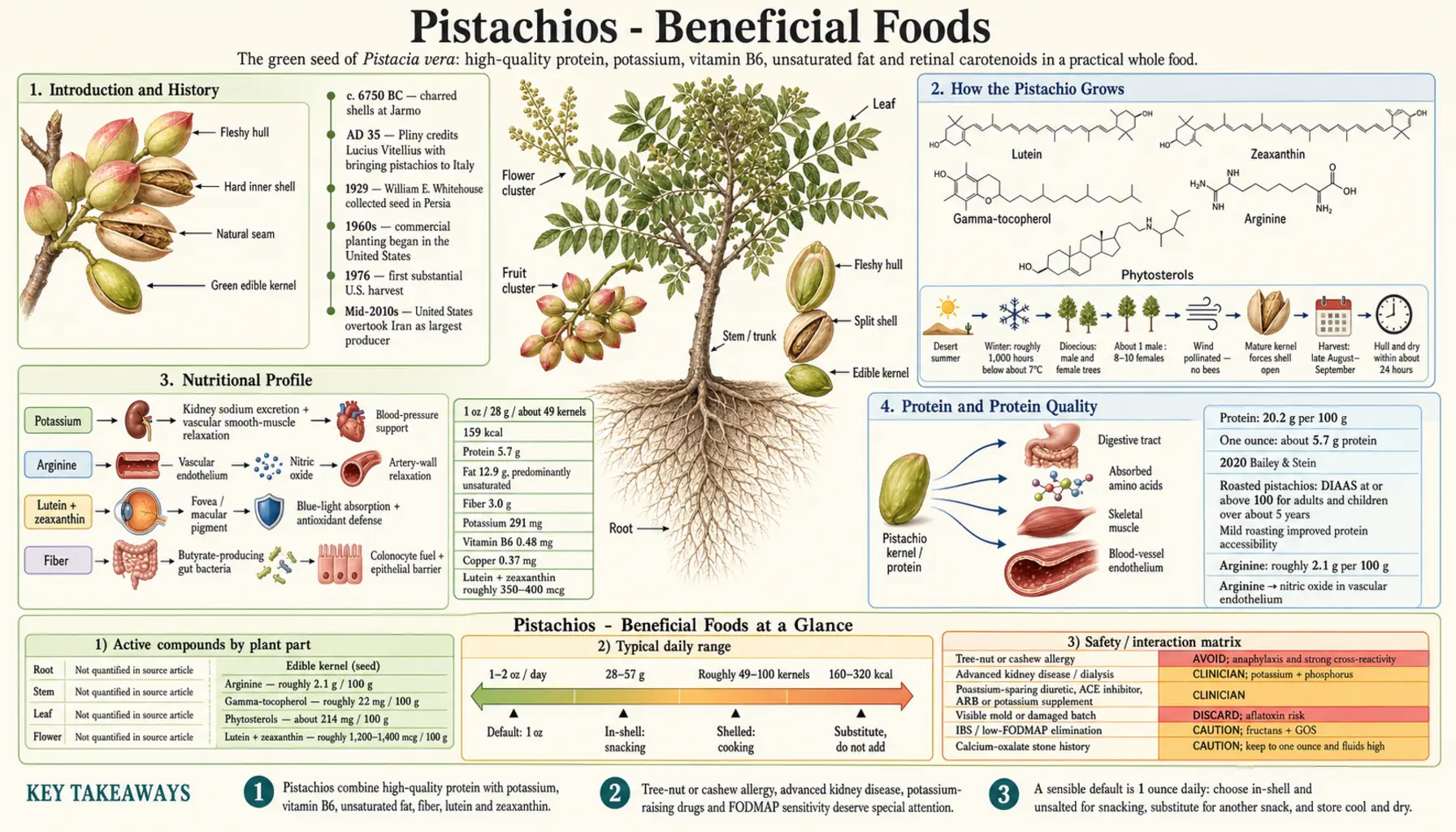
The pistachio is the green, faintly sweet seed of Pistacia vera, a small desert tree that has fed people across Central and Western Asia for close to nine thousand years. It is the only nut in common use that tells you when it is ripe: the shell splits open by itself on the tree. That split is not just a curiosity — it is why pistachios are eaten more slowly than any other nut, and slow eating matters more for appetite than almost anything printed on a label.
Nutritionally the pistachio is unusual in three ways: it sits at the top of the tree-nut protein table and its protein is of unusually high quality, it carries more potassium than any comparable nut, and it is the only nut with a meaningful amount of lutein and zeaxanthin — the two carotenoids the retina pulls from the bloodstream and concentrates at the center of vision. Those three things are its own. The fiber, the unsaturated fat, the vitamin B6 and the copper it shares with the rest of the nut family.
Table of Contents
- Introduction and History
- How the Pistachio Grows
- Nutritional Profile
- Protein and Protein Quality
- Potassium, Magnesium, B6 and Copper
- Lutein, Zeaxanthin and the Eyes
- Shelling Your Own and the Satiety Effect
- Blood Pressure and Blood Vessels
- Cholesterol and Blood Lipids
- Blood Sugar and Metabolic Markers
- Fiber and the Gut Microbiome
- How to Buy, Store and Prepare
- How Much to Eat
- Who Should Be Careful
- Connections
- References & Research
- Featured Videos
Introduction and History
Pistachios are among the oldest nuts in the human diet, and the archaeology is unusually clear about it. Charred pistachio shells were recovered from the early farming settlement at Jarmo, in the hills of northeastern Iraq, in deposits dated to roughly 6750 BC — older than pottery there. Wild Pistacia trees grew across the dry uplands running from eastern Turkey through Syria and Iran into Turkmenistan and Afghanistan, and people gathered from them long before anyone planted them in rows. The domesticated tree almost certainly comes from what is now northeastern Iran and Central Asia; pistachios appear in the Hebrew Bible among the gifts Jacob sends into Egypt in Genesis 43:11, one of only two nuts named in that text.
The tree reached the Mediterranean through Rome; Pliny the Elder credits Lucius Vitellius, a Roman governor of Syria, with bringing pistachios to Italy around AD 35. Sicily still grows one of the most prized pistachios in the world on the volcanic slopes around Bronte, on Mount Etna — small, intensely green, resinous, harvested only in alternate years. Turkey built its own tradition around Gaziantep, where the smaller, darker Antep pistachio defines baklava, and Iran built the world's largest industry around Rafsanjan and Kerman.
The American story is recent and traceable to one man. In 1929 the USDA botanist William E. Whitehouse spent months collecting pistachio seed in Persia; from that collection came the 'Kerman' cultivar, which suited California's Central Valley almost perfectly. Commercial planting began in the 1960s, the first substantial harvest came in 1976, and California, Arizona and New Mexico now supply essentially the whole United States crop. Around the middle of the 2010s the United States overtook Iran as the world's largest producer.
How the Pistachio Grows
- It is a desert tree with a winter requirement. Pistachios need long, blazing, dry summers to fill the kernel and a cold winter — roughly a thousand hours below about 7 °C — to break dormancy. That combination exists in few places, which is why production concentrates in Iran, the United States, Turkey and a handful of Mediterranean and Central Asian countries.
- The trees are male or female, and only the females bear. Pistacia vera is dioecious and wind-pollinated. Growers plant roughly one male for every eight to ten females and rely entirely on wind — no bees are involved. A still, humid spring means empty shells that season.
- The shell splits when the kernel is mature. As the kernel fills it outgrows the hard inner shell and forces it open along a natural seam — in Iran the split nut is called khandan, "laughing." A closed shell usually means an immature or hollow kernel, so those are sorted out and sold at a discount.
- Speed after harvest determines quality. Nuts grow in clusters inside a fleshy hull; trees are shaken onto catch frames in late August and September, and the hull must come off and the nut dry within about twenty-four hours. Delay stains the shell and, far more importantly, leaves moisture against the kernel where molds of the Aspergillus group can grow and produce aflatoxin. Nearly everything the industry does on harvest day is aimed at that single risk.
Nutritional Profile
Figures are for raw shelled kernels; dry-roasted unsalted pistachios differ too little to change any practical decision.
Per 100 grams — macronutrients:
- Calories: about 560 kcal
- Protein: 20.2 g
- Total fat: 45.3 g — saturated 5.9 g, monounsaturated 23.3 g, polyunsaturated 13.7 g
- Carbohydrate: 27.2 g, of which fiber 10.6 g and sugars 7.7 g (mostly sucrose, which is why pistachios taste sweeter than other nuts)
- Water: 4.4 g
Per 100 grams — minerals:
- Potassium 1,025 mg; phosphorus 490 mg; magnesium 121 mg; calcium 105 mg
- Iron 3.9 mg; zinc 2.2 mg; copper 1.3 mg; manganese 1.2 mg; selenium about 7 mcg
- Sodium 1 mg — every milligram on a salted pistachio's label was added afterward
Per 100 grams — vitamins, carotenoids and other compounds:
- Vitamin B6 1.7 mg — the highest of any nut, roughly a full day's reference intake
- Thiamin 0.87 mg; riboflavin 0.16 mg; niacin 1.3 mg; folate about 51 mcg
- Vitamin E: about 2.9 mg as alpha-tocopherol plus roughly 22 mg as gamma-tocopherol, one of the richest ordinary sources of the gamma form
- Vitamin K about 13 mcg; vitamin C about 5.6 mg
- Lutein and zeaxanthin roughly 1,200–1,400 mcg depending on cultivar and roasting — far more than any other tree nut; beta-carotene about 205 mcg
- Phytosterols about 214 mg, the highest of the common nuts; arginine about 2.1 g
Per one ounce (28 grams, about 49 kernels):
- 159 calories; 5.7 g protein; 12.9 g fat, predominantly unsaturated
- 7.7 g carbohydrate, of which 3.0 g fiber (about 11 percent of the Daily Value)
- 291 mg potassium — comparable to a small banana, in a fifth of the weight
- 0.48 mg vitamin B6 (about 28 percent DV); 0.37 mg copper (about 41 percent DV); 0.25 mg thiamin (about 21 percent DV)
- 139 mg phosphorus; 34 mg magnesium; 0.34 mg manganese
- Roughly 350–400 mcg lutein plus zeaxanthin
Protein and Protein Quality
Pistachios sit at the very top of the tree-nut protein table. At 20.2 grams per 100 grams they are effectively tied with almonds (about 21.2 g) and clearly ahead of cashews (18 g), walnuts and hazelnuts (15 g), pecans (9 g) and macadamias (8 g). You will often read that the pistachio is the highest-protein nut; be a little careful with that. The gap between pistachios and almonds is smaller than the variation between cultivars and seasons, and peanuts — a legume rather than a tree nut — are higher again at about 26 grams per 100 grams. What is fair to say is that pistachios and almonds share the top of the list, and that an ounce delivers about 5.7 grams of protein, which is real food protein rather than a rounding error.
The more interesting story is quality. Plant proteins are usually limited by one or two indispensable amino acids — grains run short of lysine, legumes short of methionine — and quality scoring penalizes them accordingly. The current method, the Digestible Indispensable Amino Acid Score (DIAAS), measures how much of each essential amino acid actually survives digestion and gets absorbed. A score of 100 or above means the food can meet requirements on its own, which is normally the preserve of eggs, dairy and meat.
In 2020 a protein-quality analysis by Bailey and Stein put raw and roasted pistachios through DIAAS testing and reported that roasted pistachios scored at or above 100 for adults and for children over about five years of age — making the pistachio a complete protein source by the strictest current standard, and one of very few plant foods that qualify. Roasting improved the score: mild heat denatures the protein and makes it more accessible to digestive enzymes while the amino acid pattern stays intact.
Pistachio protein is also rich in arginine, at roughly 2.1 grams per 100 grams. Arginine is the substrate the vascular endothelium uses to make nitric oxide, the signal that relaxes artery walls — one of the plausible mechanisms behind the blood-pressure findings below, and part of why pistachios keep appearing in cardiovascular trials rather than only in weight studies.
Potassium, Magnesium, B6 and Copper
Potassium is the pistachio's quiet distinction. At 1,025 mg per 100 grams, or 291 mg in a one-ounce handful, pistachios carry more potassium than any other commonly eaten nut — a handful delivers roughly what a small banana does, in a fifth of the weight. That matters because dietary potassium has a real effect on blood pressure and most adults take in well under half the recommended 4,700 mg a day. Potassium relaxes vascular smooth muscle, promotes sodium excretion at the kidney, and blunts the pressor effect of a salty diet. When a pistachio trial reports lower blood pressure, potassium is part of the explanation alongside the arginine and the unsaturated fat.
Vitamin B6 is where pistachios lead outright. At 1.7 mg per 100 grams they are the richest nut source by a wide margin, and one ounce supplies about 28 percent of the Daily Value. B6, as pyridoxal-5-phosphate, is the working cofactor for well over a hundred enzymes: it builds serotonin, dopamine, GABA and melatonin from their amino acid precursors, it is required for heme synthesis, and it drives the transsulfuration pathway that clears homocysteine. Deficiency is not rare in older adults, heavy drinkers, or people taking isoniazid, hydralazine, penicillamine or long-term oral contraceptives.
Copper is unusually concentrated — about 41 percent of the Daily Value per ounce. Copper sits at the center of ceruloplasmin, cytochrome c oxidase, lysyl oxidase and superoxide dismutase — the machinery of iron transport, mitochondrial energy, collagen cross-linking and antioxidant defense.
The rest of the panel is solid rather than remarkable. Magnesium at 121 mg per 100 grams contributes to a diet that is chronically short of it, phosphorus at 490 mg is high, and manganese at 1.2 mg covers roughly half a day's requirement. Iron is present at 3.9 mg per 100 grams, but as non-heme iron in a phytate-containing food it is modestly absorbed — pair it with a vitamin C source.
Lutein, Zeaxanthin and the Eyes
The green tint in a pistachio kernel is not decoration. It comes from chlorophyll and from carotenoids, and among the carotenoids are lutein and zeaxanthin — two xanthophylls the human retina actively transports out of the bloodstream and stacks at the fovea, the pinhead of tissue responsible for reading, faces and fine detail. That deposit is the macular pigment, and it does two jobs: it absorbs blue light before it reaches the photoreceptors, and it quenches the reactive oxygen species that a lifetime of light exposure generates in the retina.
Pistachios contain roughly 1,200 to 1,400 mcg of lutein plus zeaxanthin per 100 grams — about 350 to 400 mcg in a handful. No other tree nut comes close; almonds, walnuts, cashews and pecans carry trace amounts at best. Dark leafy greens remain the heavyweight sources, with kale and spinach running to several thousand micrograms per 100 grams. But the pistachio has one advantage over a leaf: carotenoids are fat-soluble, and the nut arrives with 13 grams of fat per ounce already attached. Lutein absorbed from a meal containing almost no fat is poor; from a nut it is not.
The evidence has moved past composition tables. A randomized controlled trial from the Tufts nutrition group, published in the Journal of Nutrition, fed healthy adults a daily portion of pistachios for several months and measured macular pigment optical density directly — the pigment itself, in the living eye, not a blood level. It increased significantly in the pistachio group. That outcome matters, because macular pigment optical density is the intermediate marker linking dietary lutein to lower rates of age-related macular degeneration in the large observational cohorts, and it is the marker that responded in the AREDS2 supplement trial.
What this does not mean is that pistachios treat eye disease. Nobody has shown they prevent macular degeneration or slow it once it has started; the trials are short, the outcome is a pigment measurement, and the participants had healthy eyes. It does mean a handful is a genuine, well-absorbed source of the two carotenoids the retina demands.
Shelling Your Own and the Satiety Effect
Researchers at Eastern Illinois University ran a pair of simple studies, published in Appetite in 2011, that have been quoted ever since. In the first, people snacking from a bowl of in-shell pistachios ate about 41 percent fewer calories than people snacking from a bowl of already-shelled kernels — roughly 125 calories against 211 — and reported the same fullness. In the companion study, people given in-shell pistachios with no mention of calories consumed around 86 fewer calories than the shelled group. In a further variation, leaving the discarded shells in the bowl instead of clearing them away cut intake by another 18 percent.
Three mechanisms are at work, and none is exotic:
- Time. Cracking a shell takes a couple of seconds; across 49 kernels, eating an ounce becomes a several-minute activity rather than two handfuls. The gut's satiety signals — cholecystokinin, GLP-1, peptide YY — take fifteen to twenty minutes to register. Slowing the eating rate lets them arrive before the bowl is empty.
- Visible evidence. The pile of empty shells is an honest running total. Almost every other snack erases the record of what you have eaten; the pistachio leaves it in front of you, and it works whether or not you are consciously counting.
There is a second, purely physiological reason a pistachio calorie is worth slightly less than the label says. Baer, Gebauer and Novotny measured the actual metabolizable energy of pistachios in people rather than assuming the standard Atwater factors, and found it about 5 percent lower than the calculated value. The reason is the cell wall: some fat stays locked inside intact plant cells that chewing does not fully rupture and passes through undigested. Five percent is not a diet plan, but it points the same way as everything else here — the whole pistachio behaves better than its nutrient list suggests.
The practical advice that follows is simple: buy them in the shell. In-shell unsalted pistachios in a bowl, with a second bowl for the shells, is one of the few genuinely self-limiting foods a pantry can hold. Shelled kernels are for cooking.
Blood Pressure and Blood Vessels
Pistachios have been studied for blood pressure more carefully than most foods, partly because they combine three plausible mechanisms in one package: a high potassium load, a high arginine content feeding nitric-oxide production, and a fat profile that is roughly 80 percent unsaturated.
The most informative single trial came from Penn State. Sauder, McCrea, Ulbrecht, Kris-Etherton and West fed adults with well-controlled type 2 diabetes a diet containing pistachios and measured not just clinic blood pressure but twenty-four-hour ambulatory blood pressure, heart rate variability and systemic hemodynamics. The pistachio diet lowered ambulatory blood pressure, increased heart rate variability (a marker of healthier autonomic balance and less sympathetic drive), and reduced peripheral vascular resistance. Earlier work from the same group found that a pistachio diet blunted the blood-pressure rise provoked by acute mental stress. Smaller trials using flow-mediated dilation and arterial stiffness endpoints have reported improved endothelial function after several weeks of daily pistachios — and a vessel lining that makes nitric oxide freely is one that dilates and resists the adhesion molecules that begin plaque.
Pooled analyses of tree-nut trials find modest but real blood-pressure reductions, with pistachios among the clearest. The honest summary: effect sizes run to a few millimetres of mercury, which is unimpressive for one person and substantial across a population, since a few millimetres sustained over decades measurably changes stroke and heart-attack rates. Pistachios are not a treatment for hypertension, and nobody should stop a prescribed antihypertensive because of a bowl of nuts.
Cholesterol and Blood Lipids
The cleanest lipid data comes from a dose-response feeding study by Gebauer, West, Kay, Alaupovic, Bagshaw and Kris-Etherton, published in the American Journal of Clinical Nutrition in 2008. Participants with moderately raised cholesterol ate a controlled background diet with either no pistachios, roughly one serving a day, or roughly two servings a day. LDL cholesterol fell in a dose-dependent way — on the order of 9 percent at one serving and 12 percent at two — with total cholesterol falling alongside it and HDL essentially preserved. Dose-response is what makes the study persuasive: an effect that scales with intake is much harder to explain away than a single-dose difference.
Several ingredients contribute:
- Fat composition. Of 45 grams of fat per 100 grams, 23 are monounsaturated and 14 polyunsaturated against under 6 saturated. Replacing dietary saturated fat with unsaturated fat lowers LDL — one of the most reproducible findings in all of nutrition.
- Phytosterols. At roughly 214 mg per 100 grams, pistachios have the highest plant-sterol content of the common nuts. Plant sterols compete with cholesterol for incorporation into intestinal micelles, so less cholesterol is absorbed.
Beyond the standard panel, Kay, Gebauer, West and Kris-Etherton reported something more specific in the Journal of Nutrition in 2010: a pistachio diet raised serum antioxidants — lutein, gamma-tocopherol, beta-carotene — and lowered oxidized LDL. That distinction matters. LDL particles do their damage mainly after oxidative modification; oxidized LDL is what scavenger receptors on macrophages recognize, and that recognition turns a macrophage into a foam cell and starts a plaque. A food that lowers LDL concentration and reduces the oxidized fraction is acting at two points in the same process, which is the practical case for pistachios in cholesterol management — provided they replace something else in the diet rather than being added on top of it.
Blood Sugar and Metabolic Markers
Pistachios have a very low glycemic impact on their own — the carbohydrate is wrapped in fiber, fat and protein — and they also flatten the response to carbohydrate eaten with them. Work from the Toronto group led by Kendall and Jenkins fed pistachios alone and alongside high-carbohydrate foods such as bread and rice, and found that adding pistachios reduced the post-meal glucose rise substantially and in proportion to the amount added. Fat and protein slow gastric emptying, fiber slows absorption at the brush border, and the peak comes lower and later.
The strongest evidence in people who actually need it comes from a Spanish randomized crossover trial by Hernández-Alonso, Salas-Salvadó, Baldrich-Mora, Juanola-Falgarona and Bulló, published in Diabetes Care in 2014. Adults with prediabetes ate about 57 grams of pistachios a day for four months in one arm and a matched control diet in the other. In the pistachio arm, fasting glucose, fasting insulin and HOMA-IR — the standard index of insulin resistance — all fell, as did fibrinogen, oxidized LDL and several inflammatory markers. This is the population where the finding matters most: prediabetes is the window in which type 2 diabetes is still avoidable. In people who already have type 2 diabetes, effects on lipids and inflammatory markers have been reproduced but glycemic effects are more modest — the usual pattern in nut research, where dietary change does more when the metabolic damage is early.
Fiber and the Gut Microbiome
Ten and a half grams of fiber per 100 grams makes pistachios one of the higher-fiber nuts; a one-ounce handful carries about 3 grams. Some is soluble, and some is the insoluble cell-wall material that keeps a fraction of the nut's fat out of circulation.
Ukhanova and colleagues, working with USDA researchers, ran a randomized crossover feeding study comparing almonds and pistachios and sequenced participants' gut bacteria. Both nuts shifted the microbial community and pistachios produced the larger change — notably an increase in butyrate-producing bacteria. Butyrate is the short-chain fatty acid colonocytes prefer as fuel; it strengthens the epithelial barrier, suppresses inflammatory signalling in gut-associated immune tissue, and regulates gene expression in the colonic lining through histone deacetylase inhibition. A food that raises butyrate producers is feeding the gut lining, not merely passing through it. This is the same phenomenon as the missing 5 percent of metabolizable energy: those calories are not lost, they are redirected to the microbiome.
Ramp up gradually — going from no nuts to two ounces a day overnight commonly produces a week or two of gas and bloating while the community adapts. Pistachios pair well with fermented foods such as whole-milk yogurt and kefir.
How to Buy, Store and Prepare
In-shell for snacking, shelled for cooking. The shell is the portion control, and it also protects the kernel from light and oxygen. Buy shelled kernels only in quantities you will use within a few weeks. Look for a high proportion of naturally split shells: that means mature, well-filled kernels, while a bag heavy with closed shells is lower grade and often hollow.
Unsalted, or lightly salted. The raw nut contains 1 mg of sodium per 100 grams. A salted roasted pistachio can carry 300 to 500 mg per 100 grams, and heavily salted ones far more — which quietly cancels the potassium advantage that makes the pistachio interesting for blood pressure in the first place. If you like salt, buy unsalted and add a pinch yourself. Skip the flavored coatings entirely; chili-lime, honey-roasted and barbecue versions are delivery systems for sugar, maltodextrin and flavorings.
Judge the kernel, not the shell. Good kernels are pale green to yellow-green with a purplish skin, firm, and smell sweet and faintly resinous. Reject anything that smells like old crayons or paint — that is rancidity, and with 14 grams of polyunsaturated fat per 100 grams it happens faster than in a peanut. Discard kernels that are shrivelled, discolored, dusty-looking or visibly moldy — pistachios are one of the tree nuts most often flagged for aflatoxin, and visible mold is the one signal a home kitchen can act on.
Storage is about oxygen, light and heat. In an airtight container in a dark pantry, shelled kernels keep about two to three months and in-shell nuts longer. The refrigerator extends that to about a year and the freezer to two years or more — pistachios freeze well, need no thawing and lose nothing in texture. Never store nuts in a warm cabinet above a stove, which is where most home rancidity comes from.
Preparation. Raw pistachios need nothing. To roast, spread shelled kernels in a single layer in a moderate oven — around 160 to 175 °C (325 to 350 °F) — for 5 to 8 minutes, shaking once, and pull them while they still look underdone; residual heat finishes them, and they go from perfect to bitter in about a minute. Mild heat improves protein digestibility without destroying the carotenoids; high or prolonged heat degrades both the carotenoids and the green color. For vivid green in baking, blanch kernels in boiling water for one minute and rub off the purple skins.
Kitchen uses. Chopped over whole-milk yogurt with honey. Crushed as a crust for salmon or chicken. Blitzed with garlic, basil, olive oil and hard cheese into the Sicilian pistachio pesto. Ground into a paste for cakes and ice cream. Scattered over roasted carrots, beets or Brussels sprouts, where the sweetness of the nut works against the char. Stirred through rice, lentils or a grain salad.
How Much to Eat
The everyday amount is one to two ounces a day — 28 to 57 grams, roughly 49 to 100 kernels, 160 to 320 calories. That range is not arbitrary; it is what the trials used. The lipid dose-response study compared roughly one and two servings a day, the prediabetes trial used 57 grams, and most nut research settles around 30 grams a day. One ounce is the sensible default, two if pistachios are doing real work as a protein source. In the shell, an ounce is roughly a heaped half-cup of whole nuts.
Substitute, do not add. Pistachios are calorie-dense at 560 calories per 100 grams. Every study that showed benefit either held total calories constant or relied on the spontaneous appetite reduction nuts produce. Two ounces a day added on top of an unchanged diet is 640 calories a week you did not have before. Put them where a processed snack used to be — mid-afternoon for most people, or before a carbohydrate-heavy meal if blood sugar is the concern.
Variety beats loyalty. No single nut has everything: pistachios lead on potassium, B6, lutein and protein quality, walnuts on alpha-linolenic acid, almonds on vitamin E and calcium, pumpkin seeds on zinc and magnesium, and cashews and peanuts each their own. Rotate.
Who Should Be Careful
Tree-nut allergy. Pistachio is a recognized tree-nut allergen and reactions can be severe, including anaphylaxis. The point that matters most is botanical family: pistachio belongs to the Anacardiaceae, along with cashew, mango and — less appetizingly — poison ivy and poison oak. Cross-reactivity between pistachio and cashew is strong and well documented, because their major storage proteins are closely related; a large share of people allergic to one react to the other, so a diagnosed cashew allergy makes pistachios suspect until an allergist says otherwise, and vice versa. Pistachio allergy does not predict allergy to almonds or walnuts, which belong to entirely different families, but cross-contamination in bulk bins and processing plants is a real and separate hazard.
Aflatoxin. Pistachios, along with Brazil nuts, figs and maize, are among the foods most often found carrying aflatoxins — potent liver carcinogens made by Aspergillus flavus and A. parasiticus. The risk is created in the first day after harvest, when a damaged or slowly hulled nut holds moisture, and it grows again during humid storage. Regulators cap total aflatoxins in pistachios sold for direct consumption in the low single digits of micrograms per kilogram, and pistachios are one of the most intensively sampled commodities at import. For a shopper this reduces to three rules: buy from suppliers with real turnover rather than a dusty bulk bin, discard any shrivelled, discolored or moldy kernel without tasting it, and store nuts cool and dry. Never eat around a moldy batch — the toxin is not confined to the visibly affected nuts.
Advanced kidney disease and potassium-raising drugs. This is the one group for whom the pistachio's strengths become liabilities. At 1,025 mg of potassium and 490 mg of phosphorus per 100 grams, pistachios are a concentrated source of both minerals that advanced chronic kidney disease and dialysis diets restrict. Anyone on a potassium-restricted or phosphorus-restricted diet, or taking a potassium-sparing diuretic, an ACE inhibitor, an angiotensin receptor blocker or a potassium supplement, should treat nuts as a food to discuss with a clinician rather than a free snack.
Phytate and mineral absorption. Like all nuts and seeds, pistachios contain phytic acid, which binds iron, zinc and calcium in the gut and reduces their absorption. In a varied diet this is a minor accounting adjustment — the nut brings more minerals than the phytate withholds — but it matters more for people whose diets rely heavily on nuts, seeds, whole grains and legumes and who are already short of iron or zinc. Soaking or roasting reduces phytate somewhat. Pistachios are low to moderate in oxalate; anyone with a history of calcium-oxalate kidney stones may want to keep the portion to one ounce and fluid intake high.
Fructans and FODMAP sensitivity. Pistachios are high in fructans and galacto-oligosaccharides and are among the nuts restricted during the elimination phase of a low-FODMAP diet for irritable bowel syndrome. People who react badly to onions, garlic and legumes often react to a large portion the same way, while a small portion is frequently tolerated.
Claims that outrun the evidence. Pistachios are sometimes marketed as a sleep food because laboratory analyses report a relatively high melatonin content for a plant food; no trial has shown that eating them improves sleep, and the amounts are far below what sleep research uses. A small Turkish study reporting improved erectile function on a pistachio diet is likewise cited far beyond what one short, unblinded trial can support. Pistachios are a good food with a genuinely interesting evidence base for lipids, blood pressure, glucose and macular pigment. They are not a remedy and not a supplement — they are a whole food that earns its place in a bowl.
Connections
- All Food
- Almonds — the other top-protein nut.
- Walnuts — the nut to eat for plant omega-3 fat.
- Cashews — the pistachio's close relative, and its main cross-allergy.
- Peanuts — a legume, not a nut.
- Pumpkin Seeds — for zinc and magnesium.
- Potassium — the mineral behind the blood-pressure effect.
- Vitamin B6 — pistachios are the richest nut source.
- Copper — an ounce covers roughly 40 percent of the Daily Value.
- Lutein and Zeaxanthin — what the retina concentrates.
- Hypertension — where potassium, arginine and unsaturated fat converge.
- Macular Degeneration — behind the macular-pigment research.
References & Research
- Dreher ML. Pistachio nuts: composition and potential health effects. Nutrition Reviews, 2012. — Search PubMed
- Bailey HM, Stein HH. Raw and roasted pistachio nuts are complete protein sources for adults. 2020. — Search PubMed
- Gebauer SK, West SG, Kay CD, Alaupovic P, Bagshaw D, Kris-Etherton PM. Effects of pistachios on cardiovascular disease risk factors and potential mechanisms of action: a dose-response study. American Journal of Clinical Nutrition, 2008. — Search PubMed
- Kay CD, Gebauer SK, West SG, Kris-Etherton PM. Pistachios increase serum antioxidants and lower serum oxidized-LDL in hypercholesterolemic adults. Journal of Nutrition, 2010. — Search PubMed
- Sauder KA, McCrea CE, Ulbrecht JS, Kris-Etherton PM, West SG. Pistachio nut consumption modifies systemic hemodynamics, increases heart rate variability, and reduces ambulatory blood pressure in well-controlled type 2 diabetes: a randomized trial. Journal of the American Heart Association, 2014. — Search PubMed
- Hernández-Alonso P, Salas-Salvadó J, Baldrich-Mora M, Juanola-Falgarona M, Bulló M. Beneficial effect of pistachio consumption on glucose metabolism, insulin resistance, inflammation, and related metabolic risk markers: a randomized clinical trial. Diabetes Care, 2014. — Search PubMed
- Kennedy-Hagan K, Painter JE, Honselman C, Halvorson A, Rhodes K, Skwir K. The effect of pistachio shells as a visual cue in reducing caloric consumption. Appetite, 2011. — Search PubMed
- Baer DJ, Gebauer SK, Novotny JA. Measured energy value of pistachios in the human diet. British Journal of Nutrition, 2012. — Search PubMed
- Ukhanova M, Wang X, Baer DJ, Novotny JA, Fredborg M, Mai V. Effects of almond and pistachio consumption on gut microbiota composition in a randomised cross-over human feeding study. British Journal of Nutrition, 2014. — Search PubMed
- Scott TM, Rasmussen HM, Chen O, Johnson EJ. Pistachio consumption increases macular pigment optical density in healthy adults: a randomized controlled trial. Journal of Nutrition, 2022. — Search PubMed