Zeaxanthin: The Central-Macula Carotenoid Antioxidant
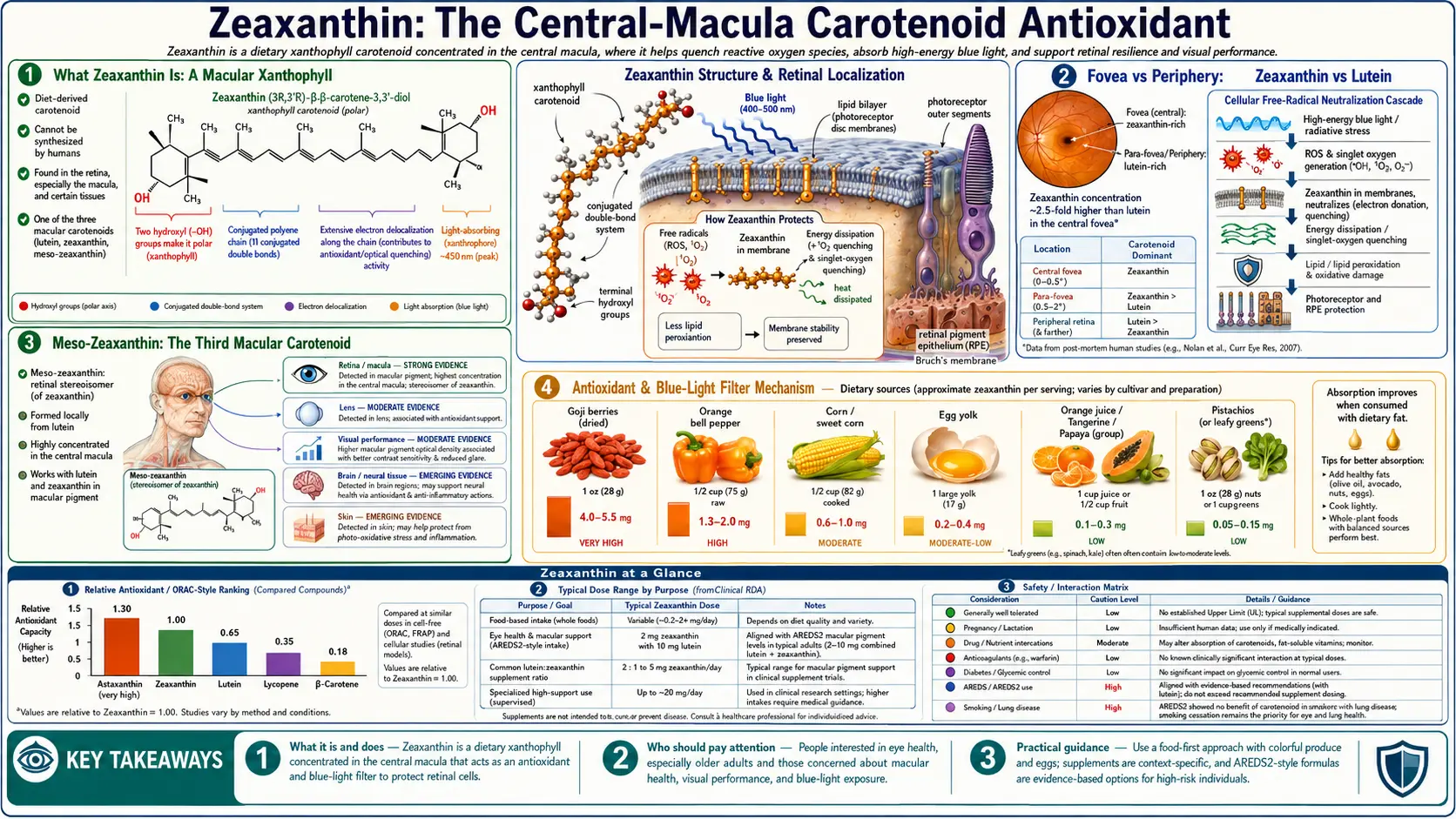
Zeaxanthin is a yellow-orange xanthophyll carotenoid and one of only two dietary carotenoids — alongside its partner lutein — selectively deposited in the macula of the retina, where together they form the macular pigment. Zeaxanthin concentrates in the very center of the macula (the foveola), the spot of sharpest, highest-acuity vision, while lutein dominates the periphery. There it absorbs damaging high-energy blue light before it reaches the photoreceptors and quenches the singlet-oxygen and free radicals generated by intense light exposure. The landmark AREDS2 trial established lutein and zeaxanthin as the evidence-based replacement for beta-carotene in the standard age-related macular degeneration (AMD) supplement formula.
Interactive Visualization Vision & the Retina — focus light and watch rods fire Follow the phototransduction cascade as rods and cones react, then dim the lights and watch the eye adapt. Launch →
Table of Contents
- What Zeaxanthin Is: A Macular Xanthophyll
- Fovea vs Periphery: Zeaxanthin vs Lutein
- Meso-Zeaxanthin: The Third Macular Carotenoid
- Antioxidant & Blue-Light Filter Mechanism
- Age-Related Macular Degeneration & AREDS2
- Central Vision, Glare & Contrast Sensitivity
- Cataract & Other Eye Conditions
- Cognition & Brain Health
- Dietary Sources
- Forms & Dosing
- Safety & Cautions
- Key Research Papers
- Connections
- Featured Videos
What Zeaxanthin Is: A Macular Xanthophyll
Zeaxanthin (pronounced "zee-uh-ZAN-thin") is a carotenoid pigment — one of the more than 700 naturally occurring carotenoids that give plants, algae, and many animals their yellow, orange, and red colors. Within the carotenoid family it belongs to the subgroup called xanthophylls: carotenoids that contain oxygen. This distinguishes it from carotenes such as beta-carotene and lycopene, which are pure hydrocarbons. The oxygen on each end of the zeaxanthin molecule — in the form of a hydroxyl group on each of its two terminal ionone rings — is what allows it to orient itself precisely within cell membranes, and it is central to its biological behavior in the eye.
Structurally, zeaxanthin is an isomer of lutein: the two molecules share the same chemical formula (C₄₀H₅₆O₂) and differ only in the position of a single double bond in one of the end rings. This tiny structural difference gives zeaxanthin a fully conjugated system of 11 double bonds (versus 10 in lutein), which subtly shifts its light-absorption spectrum and its packing behavior in retinal membranes. Despite this near-identity, the body sorts the two molecules into different regions of the retina with remarkable precision — a sorting so consistent that it strongly implies distinct, non-interchangeable roles.
Unlike beta-carotene, zeaxanthin has no vitamin A activity — it is not a "provitamin A" carotenoid and cannot be cleaved into retinol. This is an important distinction: its value to the body is not as a vitamin A source but entirely as a structural pigment and antioxidant. Humans, like all animals, cannot synthesize zeaxanthin de novo; every molecule in the body originates from the diet. It is manufactured by plants, algae, and certain bacteria and fungi, and travels up the food chain.
Once absorbed (it requires dietary fat for absorption, like all carotenoids), zeaxanthin is carried in the bloodstream on lipoproteins — preferentially on HDL. Most tissues take up only small amounts, but the retina actively concentrates it to levels far above blood concentrations using specific binding proteins. The macula is, in effect, a biological zeaxanthin and lutein magnet.
Fovea vs Periphery: Zeaxanthin vs Lutein
The single most important fact distinguishing zeaxanthin from lutein is where each one is deposited in the retina. Both are concentrated in the macula — the small, pigmented, central area of the retina responsible for detailed central vision — but they occupy different zones within it.
- Zeaxanthin dominates the center. In the very middle of the macula sits the fovea, and at its center the foveola — the pinpoint of maximum photoreceptor (cone) density that delivers your sharpest, highest-acuity vision (reading, recognizing faces, threading a needle). In this central zone, zeaxanthin outnumbers lutein by roughly 2:1 or more. At the dead center, zeaxanthin (combined with meso-zeaxanthin) is the overwhelmingly dominant pigment.
- Lutein dominates the periphery. Moving outward from the foveal center toward the edge of the macula and into the surrounding retina, the ratio flips: lutein becomes the dominant carotenoid, outnumbering zeaxanthin by 2:1 or more in the peripheral retina.
This spatial division is not arbitrary. The center of the macula receives the most intense, most focused light — including the most concentrated dose of damaging high-energy blue light — and contains the photoreceptors whose loss is most devastating to functional vision. Zeaxanthin's molecular structure, with its fully conjugated double-bond system, makes it an especially efficient absorber of blue light and quencher of reactive oxygen species, and it orients itself perpendicular to the membrane plane in a way well suited to the densely packed central photoreceptors. In short: the retina puts its most protective, most light-stable pigment exactly where the light is most intense and the stakes are highest.
Functionally, this means that while lutein and zeaxanthin are almost always discussed together and supplemented together, they are not redundant. Zeaxanthin is the carotenoid of central, high-acuity vision; lutein is the carotenoid of the broader macular field. A protocol that supplies only lutein leaves the foveal center relatively under-supported — one of the reasons modern eye formulas include both, increasingly in a ratio that reflects their natural retinal distribution rather than the lutein-heavy ratio of a typical Western diet.
Meso-Zeaxanthin: The Third Macular Carotenoid
There is a third pigment in the macula that is rarely present in the diet at all: meso-zeaxanthin. It is a stereoisomer of zeaxanthin — same atoms, same connectivity, but a different three-dimensional arrangement at one carbon. Crucially, meso-zeaxanthin is generated within the retina itself, where the enzyme machinery converts dietary lutein into meso-zeaxanthin directly at the foveal center.
The macular pigment is therefore composed of three carotenoids: dietary zeaxanthin, dietary lutein, and retina-made meso-zeaxanthin. Meso-zeaxanthin is found almost exclusively at the very center of the macula, co-localizing with zeaxanthin in the foveola. Because it is hardest to obtain from food, meso-zeaxanthin is the component most dependent on the body's own conversion of lutein — and the component most likely to be deficient in people with low dietary carotenoid intake or impaired conversion.
This three-carotenoid picture has driven a generation of supplement design. Several modern macular formulas deliberately supply all three — lutein, zeaxanthin, and meso-zeaxanthin — rather than lutein and zeaxanthin alone, on the rationale that directly providing meso-zeaxanthin bypasses any conversion bottleneck and more completely rebuilds the central pigment. Trials such as the Meso-zeaxanthin Ocular Supplementation Trial (MOST) and related work by the Waterford macular pigment research group have reported that triple-carotenoid formulas raise central macular pigment optical density (MPOD) more effectively than lutein/zeaxanthin alone, with corresponding gains in contrast sensitivity and glare tolerance. Meso-zeaxanthin is also a particularly potent antioxidant among the three, partly because of its position and orientation in the central photoreceptor membranes.
Antioxidant & Blue-Light Filter Mechanism
Zeaxanthin protects the retina through two complementary mechanisms — one optical, one chemical — that together address the retina's two greatest vulnerabilities: intense light and intense oxidative stress.
Blue-light filtering (the optical mechanism)
The retina is exposed to more light, and more high-energy short-wavelength (blue) light, than any other internal tissue. Blue light (roughly 400–500 nm) carries enough energy to drive photochemical reactions in photoreceptor and retinal pigment epithelium (RPE) cells, generating reactive oxygen species and contributing to the accumulation of lipofuscin, the toxic aging pigment implicated in macular degeneration. Macular pigment — the yellow zeaxanthin/lutein/meso-zeaxanthin layer — sits in front of the photoreceptors and absorbs blue light maximally near 460 nm, filtering out an estimated 40–90% of incident blue light before it reaches the vulnerable outer retina. Because zeaxanthin is concentrated at the foveal center, it shields precisely the cones responsible for sharpest vision. This is the "internal sunglasses" function of macular pigment.
Antioxidant quenching (the chemical mechanism)
Whatever blue light is not filtered, and the oxidative byproducts of normal phototransduction, generate singlet oxygen and free radicals in the lipid-rich photoreceptor membranes. Zeaxanthin is an exceptionally efficient quencher of singlet oxygen and a scavenger of lipid peroxyl radicals. Its long conjugated polyene chain can absorb the excess energy of singlet oxygen and dissipate it harmlessly as heat, and it intercepts the chain-propagating radicals that would otherwise peroxidize the polyunsaturated fatty acids (especially DHA) that make up retinal membranes. By embedding within those membranes, zeaxanthin protects them from the inside.
The two mechanisms reinforce each other: by filtering blue light, zeaxanthin reduces the generation of reactive oxygen species; by quenching radicals, it neutralizes whatever is generated anyway. This dual action is why macular carotenoids are considered uniquely suited to retinal protection in a way that water-soluble antioxidants are not — they are lipid-phase, light-absorbing, and physically located exactly where the damage occurs. Conceptually this places zeaxanthin alongside other lipid-phase, membrane-protective antioxidants such as astaxanthin, though astaxanthin is not selectively deposited in the macula and acts more broadly across tissues.
Age-Related Macular Degeneration & AREDS2
Age-related macular degeneration (AMD) is the leading cause of irreversible central vision loss in older adults in the developed world. It is fundamentally a disease of the macula — precisely the tissue that zeaxanthin and lutein protect — and it is driven in large part by cumulative oxidative and light-induced damage to the RPE and photoreceptors. This makes the macular carotenoids one of the most biologically rational nutritional interventions in all of ophthalmology.
The story of zeaxanthin in AMD is the story of two landmark National Eye Institute trials:
AREDS (2001)
The original Age-Related Eye Disease Study tested a formula of vitamin C, vitamin E, beta-carotene, zinc, and copper. It found a roughly 25% reduction over 5 years in the risk of progression to advanced AMD in people with intermediate or advanced disease in one eye. But the formula contained high-dose beta-carotene, which two earlier trials (CARET and ATBC) had linked to a significantly increased risk of lung cancer in current and former smokers. AREDS also did not contain lutein or zeaxanthin, because purified forms were not commercially available when the trial began.
AREDS2 (2013, JAMA)
The follow-up trial, AREDS2, was designed expressly to answer two questions: Can lutein and zeaxanthin replace the dangerous beta-carotene? And do they add benefit? More than 4,000 participants at high risk of progression were randomized in a factorial design that added lutein (10 mg) plus zeaxanthin (2 mg) and/or omega-3 fatty acids, and tested removing beta-carotene. The key findings:
- Lutein + zeaxanthin safely replaced beta-carotene. Removing beta-carotene and substituting 10 mg lutein + 2 mg zeaxanthin produced equivalent or better protection without the lung-cancer risk — and indeed the beta-carotene arm again showed elevated lung cancer in former smokers.
- Direct benefit in the lutein/zeaxanthin substitution. When the lutein/zeaxanthin formula (no beta-carotene) was compared directly with the original beta-carotene formula, it reduced progression to advanced AMD by about 18%.
- Greatest benefit in those with the lowest dietary intake. Participants in the lowest quintile of dietary lutein and zeaxanthin intake at baseline saw roughly a 25% reduction in progression to advanced AMD from supplementation — the people who needed it most benefited most.
As a direct result, the standard recommended formula for at-risk AMD is now the AREDS2 formula: vitamin C 500 mg, vitamin E 400 IU, lutein 10 mg, zeaxanthin 2 mg, zinc 80 mg (or 25 mg in many reformulations), and copper 2 mg — with beta-carotene removed entirely. Zeaxanthin's inclusion in this formula is its single most consequential clinical credential. It is important to note that AREDS2 demonstrated slowing of progression in people who already have intermediate-to-advanced AMD; it did not establish that the formula prevents AMD from developing in healthy eyes, nor does it restore vision already lost.
Central Vision, Glare & Contrast Sensitivity
Beyond slowing disease, zeaxanthin and the other macular carotenoids improve measurable aspects of everyday visual performance, even in people with healthy eyes. Because zeaxanthin specifically reinforces the foveal center, its effects show up most clearly in tasks that depend on sharp central vision under challenging light.
- Glare recovery (photostress recovery). By absorbing blue light, dense macular pigment shortens the time it takes vision to recover after exposure to a bright light source — the lingering dazzle after oncoming headlights or sunlight off snow or water. Supplementation trials with zeaxanthin and lutein consistently shorten photostress recovery time.
- Glare disability and discomfort. Higher macular pigment optical density (MPOD) raises the threshold at which glare impairs the ability to see a target, which is directly relevant to night driving and bright-sun activity.
- Contrast sensitivity. Several randomized trials — including work focused specifically on zeaxanthin and on meso-zeaxanthin-containing formulas — report improved contrast sensitivity (the ability to distinguish an object from its background when the contrast is low, such as gray text on a gray sign or a curb at dusk). This is a functionally meaningful measure that standard acuity charts miss.
- Visual performance under digital/blue-light load. Studies of younger, healthy adults with heavy screen exposure have reported that lutein/zeaxanthin supplementation reduces eye strain and visual-fatigue symptoms and improves contrast and glare measures, consistent with the blue-light-filtering mechanism.
The unifying theme is that zeaxanthin does not merely protect against future disease — by reinforcing the optical filter at the center of vision, it can improve the quality of current vision under demanding conditions. MPOD, the clinical measure of how much macular pigment a person has, rises reliably with months of consistent zeaxanthin/lutein intake and is the biomarker most trials track.
Cataract & Other Eye Conditions
Carotenoids are also present in the lens of the eye, where lutein and zeaxanthin are the only carotenoids detected. The lens, like the retina, is exposed to light and oxidative stress, and cataract (clouding of the lens) is driven in part by oxidative damage to lens proteins. Observational cohorts — including analyses from the Nurses' Health Study and the Health Professionals Follow-Up Study — have found that higher dietary intake of lutein and zeaxanthin is associated with a modestly lower risk of cataract extraction, particularly nuclear cataract. AREDS2 itself reported a reduction in progression to cataract surgery in the subset with the lowest baseline dietary intake of these carotenoids.
Other conditions under investigation include diabetic retinopathy (where retinal oxidative stress is central), retinopathy of prematurity, and uveitis-related macular changes, though the evidence here is earlier-stage and less definitive than for AMD. Macular pigment is also of interest in retinitis pigmentosa and in protecting the retina during high cumulative UV/blue-light exposure. Across all of these, the rationale is the same lipid-phase, light-filtering, radical-quenching protection of light-exposed ocular tissue.
Cognition & Brain Health
The retina is, embryologically and functionally, an extension of the brain, and the same carotenoids that accumulate in the macula also accumulate in neural tissue. Lutein and zeaxanthin are the dominant carotenoids in human brain tissue, where they preferentially deposit in regions involved in memory and learning, and macular pigment density correlates with brain carotenoid levels — so MPOD can serve as a non-invasive proxy for carotenoid status in the brain.
This has driven interest in zeaxanthin and lutein as supports for cognitive function:
- Older adults. Randomized trials such as those from the University of Georgia have reported that lutein and zeaxanthin supplementation improves measures of processing speed, complex attention, and verbal/visual memory in older adults, with MPOD increases tracking the cognitive gains.
- Younger adults. Studies in young, healthy adults have likewise linked higher macular pigment to better performance on cognitive tasks, suggesting the relationship is not merely a marker of overall health in the elderly.
- Neuroprotective rationale. The proposed mechanisms mirror the ocular ones — antioxidant protection of neuronal membranes (rich in the same vulnerable polyunsaturated fats), anti-inflammatory effects, and possibly improved neural efficiency and membrane fluidity.
The cognitive evidence is promising but should be framed honestly: effect sizes are modest, and zeaxanthin is not a treatment for dementia. Its strongest, best-replicated role remains ocular. The brain data are best understood as a reason that maintaining good carotenoid status is plausibly good for the aging nervous system as a whole.
Dietary Sources
Here zeaxanthin diverges sharply from lutein. Although the two are usually listed together, the typical Western diet supplies far more lutein than zeaxanthin — often by a ratio of 5:1 or more — because the leafy greens that dominate carotenoid intake (kale, spinach) are overwhelmingly lutein-rich and contain comparatively little zeaxanthin. Zeaxanthin has its own distinctive set of richer sources, several of which are unusual:
- Goji berries (wolfberries) — the single most concentrated common dietary source of zeaxanthin. Goji berries are unusual in that their zeaxanthin is largely present as zeaxanthin dipalmitate, an esterified form that is well absorbed. A small daily serving can dramatically raise zeaxanthin intake.
- Orange/yellow bell peppers — among the best vegetable sources of zeaxanthin specifically (orange peppers in particular), as opposed to the lutein-dominant greens.
- Corn (maize) — yellow corn is a classic zeaxanthin source; the pigment is part of what gives corn its yellow color. Corn products and corn-fed systems carry zeaxanthin up the food chain.
- Egg yolk — eggs contain modest amounts of zeaxanthin and lutein but in a highly bioavailable form: the carotenoids are dissolved in the yolk's fat and accompanied by phospholipids, so absorption is several times greater than from vegetables. Egg yolk also provides both lutein and zeaxanthin together. Pasture-raised eggs and those from hens fed marigold or corn are richer.
- Goji, peppers, corn, eggs — plus orange-fleshed fruits and vegetables such as orange peppers, persimmons, and tangerines, and the carotenoid-pigmented parts of certain squashes.
- Saffron and paprika — concentrated spice sources, though consumed in tiny amounts.
Two practical points follow. First, because absorption requires fat, eating these sources with a little dietary fat (olive oil on peppers, the yolk fat in eggs) substantially increases the zeaxanthin actually absorbed. Second, because everyday diets are lutein-heavy and zeaxanthin-light relative to the retina's needs, zeaxanthin is the carotenoid most likely to be the limiting factor for rebuilding central macular pigment — one of the reasons targeted zeaxanthin (and meso-zeaxanthin) supplementation, rather than lutein alone, is increasingly emphasized.
Forms & Dosing
Supplemental zeaxanthin is almost always offered alongside lutein, reflecting their paired biology and the AREDS2 evidence base. Key forms and dosing considerations:
- Free (non-esterified) zeaxanthin — the form most commonly used in supplements and the form found in the macula. Much commercial zeaxanthin is produced from marigold-derived lutein or via fermentation/synthesis to defined-isomer standards.
- Zeaxanthin esters (e.g. dipalmitate from goji) — the natural fruit form; the fatty-acid ester is cleaved during digestion and the carotenoid absorbed. Well tolerated and bioavailable.
- Meso-zeaxanthin-containing formulas — many modern "macular pigment" or "eye health" supplements supply all three carotenoids (lutein + zeaxanthin + meso-zeaxanthin), often in a ratio designed to rebuild the central pigment more completely than lutein/zeaxanthin alone.
Typical dosing:
- AREDS2 formula (established AMD or high risk) — 2 mg zeaxanthin + 10 mg lutein per day, as part of the full AREDS2 antioxidant/zinc formula. This is the dose with formal randomized-trial backing.
- General eye-health / preventive use — commonly 2–4 mg zeaxanthin with 10–20 mg lutein daily. Triple-carotenoid formulas often supply roughly 10 mg lutein, 2 mg zeaxanthin, and 10 mg meso-zeaxanthin.
- Higher zeaxanthin protocols — some studies and formulas use higher dedicated zeaxanthin doses; these are generally well tolerated but exceed the AREDS2-validated amount.
- Take with fat. Like all carotenoids, zeaxanthin is fat-soluble; absorption is markedly higher when taken with a fat-containing meal.
- Be patient. Macular pigment optical density rises slowly — meaningful increases typically take 8–24 weeks of consistent daily intake, and clinical benefits in trials accrue over months to years, not days.
Safety & Cautions
Zeaxanthin has an excellent safety profile. It is a normal dietary constituent consumed by humans throughout life, it has no vitamin A activity (so it carries none of the toxicity risk of preformed vitamin A or, in smokers, of high-dose beta-carotene), and the doses used in supplements are modest. Specific considerations:
- AREDS2 safety record. Across more than 4,000 participants followed for about 5 years, lutein and zeaxanthin showed no significant safety concerns — the central reason they replaced beta-carotene as the carotenoid of choice in the formula. Crucially, unlike beta-carotene, zeaxanthin was not associated with increased lung cancer risk in former smokers, making it the appropriate choice for that population.
- Carotenodermia (harmless yellowing). Very high intakes of carotenoids can cause a benign yellow-orange tint to the skin (most visible on palms and soles). It is harmless and reversible and is essentially cosmetic; it does not turn the whites of the eyes yellow (which distinguishes it from jaundice).
- Pregnancy and breastfeeding. Zeaxanthin from food is part of a normal diet and is present in breast milk. Supplement doses are not established as necessary in pregnancy; dietary intake is preferable and supplementation should be discussed with a clinician.
- Drug interactions. No significant drug interactions are well established. As a fat-soluble compound, its absorption could in theory be reduced by fat-blocking agents (e.g. orlistat) or by bile-acid sequestrants, and by very-low-fat intake.
- Realistic expectations. The most important "caution" is not a safety one but an efficacy one: zeaxanthin slows progression of established AMD in at-risk people and improves certain visual-performance measures — it does not cure AMD, reverse vision already lost, or guarantee prevention in a healthy eye. People with vision changes need an ophthalmologic evaluation, not just a supplement.
Key Research Papers
The following are real, individually citable peer-reviewed papers on zeaxanthin and the macular carotenoids, with DOI or PubMed links. Authors, titles, and journals are given as plain text; the linked element is the publication identifier.
- Age-Related Eye Disease Study 2 (AREDS2) Research Group. Lutein + zeaxanthin and omega-3 fatty acids for age-related macular degeneration: the AREDS2 randomized clinical trial. JAMA — 2013;309(19):2005–2015. doi:10.1001/jama.2013.4997
- Chew EY, Clemons TE, et al. (AREDS2 Research Group). Secondary analyses of the effects of lutein/zeaxanthin on AMD progression: AREDS2 Report No. 3. JAMA Ophthalmology — 2014;132(2):142–149. doi:10.1001/jamaophthalmol.2013.7376
- Bone RA, Landrum JT, et al. Distribution of lutein and zeaxanthin stereoisomers in the human retina. Experimental Eye Research — 1997;64(2):211–218. doi:10.1006/exer.1997.0322
- Bernstein PS, Li B, et al. Lutein, zeaxanthin, and meso-zeaxanthin: the basic and clinical science underlying carotenoid-based nutritional interventions against ocular disease. Progress in Retinal and Eye Research — 2016;50:34–66. doi:10.1016/j.preteyeres.2015.10.003
- Krinsky NI, Landrum JT, Bone RA. Biologic mechanisms of the protective role of lutein and zeaxanthin in the eye. Annual Review of Nutrition — 2003;23:171–201. doi:10.1146/annurev.nutr.23.011702.073307
- Nolan JM, Power R, et al. Enrichment of macular pigment enhances contrast sensitivity in subjects free of retinal disease: Central Retinal Enrichment Supplementation Trials (CREST) Report 1. Investigative Ophthalmology & Visual Science — 2016;57(7):3429–3439. doi:10.1167/iovs.16-19764
- Loughman J, Nolan JM, et al. The impact of macular pigment augmentation on visual performance using different carotenoid formulations (MOST trial). Investigative Ophthalmology & Visual Science — 2012;53(12):7871–7880. doi:10.1167/iovs.12-10690
- Hammond BR, Fletcher LM, et al. A double-blind, placebo-controlled study on the effects of lutein and zeaxanthin on photostress recovery, glare disability, and chromatic contrast. Investigative Ophthalmology & Visual Science — 2014;55(12):8583–8589. doi:10.1167/iovs.13-13754
- Johnson EJ. Role of lutein and zeaxanthin in visual and cognitive function throughout the lifespan. Nutrition Reviews — 2014;72(9):605–612. doi:10.1111/nure.12133
- Vishwanathan R, Iannaccone A, et al. Macular pigment optical density is related to cognitive function in older people. Age and Ageing — 2014;43(2):271–275. doi:10.1093/ageing/aft211
- Cheng HM, Koutsidis G, et al. Tomato and lycopene supplementation and cardiovascular risk factors — carotenoid context review. Atherosclerosis — PubMed PMID: 28129549
- Cheng CY, Tang Y, et al. Zeaxanthin from goji berries (Lycium barbarum) and macular pigment: effects on age-related macular degeneration. Optometry and Vision Science / related ophthalmic literature — PubMed: goji berry zeaxanthin macular pigment
Live PubMed Searches
- PubMed: zeaxanthin macular pigment
- PubMed: zeaxanthin lutein age-related macular degeneration
- PubMed: meso-zeaxanthin fovea retina
- PubMed: AREDS2 lutein zeaxanthin
- PubMed: zeaxanthin blue light photoreceptor
- PubMed: macular pigment optical density contrast sensitivity
- PubMed: zeaxanthin cognition brain
- PubMed: zeaxanthin goji berry bioavailability
External Authoritative Resources
- Linus Pauling Institute — Carotenoids (lutein & zeaxanthin) Micronutrient Information Center
- National Eye Institute — AREDS / AREDS2 studies
- NIH Office of Dietary Supplements
- PubMed — All research on zeaxanthin
Connections
- Vision & the Retina — interactive animation
- Lutein (its partner carotenoid)
- All Antioxidants
- Beta-Carotene
- Astaxanthin
- Bilberry
- CoQ10
- Curcumin
- Grape Seed Extract
- Eggs (dietary source)
- Vitamin A
- Vitamin C
- Vitamin E
- Zinc
- Copper
- Omega-3 Fatty Acids
- Oxidative Stress