Kefir: Ancient Fermented Milk with a Microbial Diversity No Yogurt Can Match
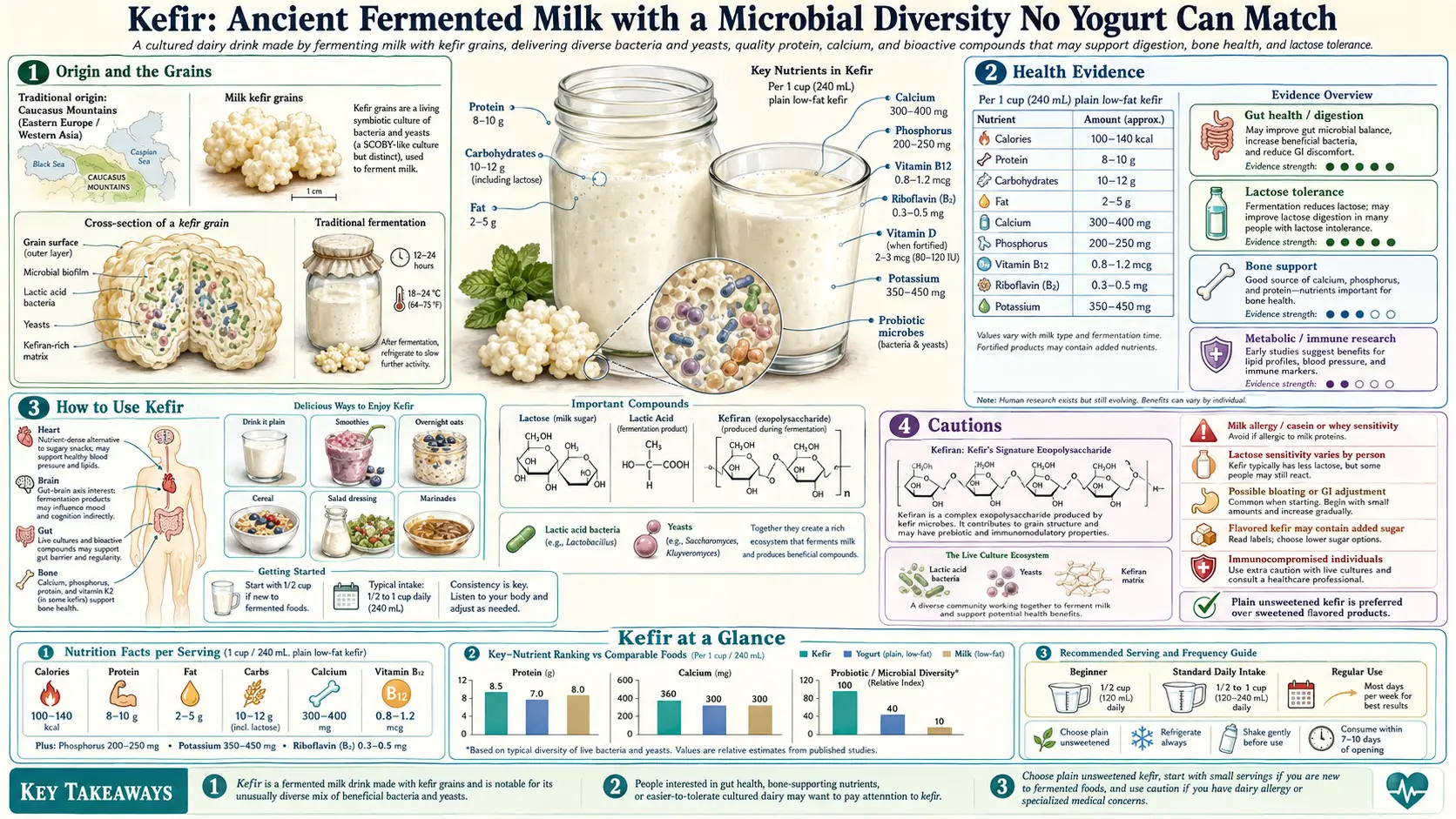

Kefir is a tangy, slightly effervescent fermented milk drink originating in the Caucasus Mountains, where it has been consumed for thousands of years. Unlike yogurt, which is made with a narrow starter culture of 1–3 bacterial species, kefir is fermented with kefir grains — a symbiotic culture of bacteria and yeasts (SCOBY) containing 30 to 60 different microbial species depending on origin. The resulting drink has far greater microbial diversity than yogurt, contains both bacteria and beneficial yeasts, and is typically lower in lactose because the organisms consume much of it during fermentation.
This article covers the origins, microbial composition, health evidence, practical use, and how to make kefir at home.
Table of Contents
Origin and the Grains
Kefir originated in the North Caucasus Mountains, where herding families have fermented milk with curd-like "grains" for centuries — probably millennia, as Bronze Age archaeology of kefir-type dairy attests. Those grains, soft cauliflower-like clumps of kefiran polysaccharide hosting a self-renewing community of bacteria and yeasts, were guarded as inherited treasure and can ferment milk indefinitely when fed fresh milk. — the fuller story is told in the dedicated History article.
Microbial Composition
Typical cultures contain:
- Lactobacillus species — L. kefiri, L. parakefiri, L. acidophilus, L. helveticus, and others
- Lactococcus species — L. lactis, L. cremoris
- Streptococcus species
- Leuconostoc species
- Acetobacter (produces small amounts of acetic acid)
- Kluyveromyces, Saccharomyces, and Candida kefyr yeasts (produce small amounts of ethanol and carbonation)
Commercial kefir made with powdered starter cultures contains fewer strains than traditional grain-based kefir but is still more diverse than yogurt.
Nutritional Profile
A 240-ml (1-cup) serving of plain whole-milk kefir typically provides:
- Calories: ~150
- Protein: ~8 g
- Calcium: ~30% Daily Value (DV)
- Vitamin B12: ~25% Daily Value
- Vitamin K2: small amounts
- Riboflavin, phosphorus, magnesium
- Live probiotic organisms: ~10 billion CFU across 10+ species
Health Evidence
Kefir is genuinely worth eating, and the honest reason is that it is a pleasant, cheap, nutrient-dense fermented food — not that it has been proven to treat anything. The research base is smaller and weaker than the marketing implies, and it is worth knowing where the line falls before you spend money on it.
Start with the overall assessment. The most thorough survey of the human evidence — a 2023 systematic review in Nutrition Reviews covering every randomized controlled trial of drinking fermented-milk kefir for any health outcome — found just 16 studies in total, and rated 12 of the 18 publications at high overall risk of bias. Safety was assessed in only 5 of them. Its conclusion was deliberately narrow: kefir shows potential as a complementary therapy for reducing oral Streptococcus mutans (and so dental-caries risk) and in Helicobacter pylori eradication, and “may further aid” dyslipidemia and hypertension — on evidence the reviewers themselves called very limited (Kairey et al., Nutr Rev. 2023;81(3):267–286; PMID 35913411).
What actually holds up
- Lactose digestion — the strongest single finding. In a controlled feeding study, adults with lactose maldigestion were given 20 g lactose portions of milk, kefir, and yogurt. Kefir cut breath-hydrogen output (the objective measure of undigested lactose reaching colonic bacteria) roughly in half compared with milk, and reduced flatulence, with plain kefir performing about as well as yogurt (Hertzler & Clancy, J Am Diet Assoc. 2003;103(5):582–587; PMID 12728216). This is the claim to trust.
- H. pylori eradication — a real adjunct effect. In a randomized double-blind trial, 82 patients on standard 14-day triple therapy (lansoprazole, amoxicillin, clarithromycin) received either 250 mL of kefir twice daily or a milk placebo. The kefir group had a higher eradication rate and fewer treatment side effects — which matters, because side effects are the main reason people abandon triple therapy (Bekar et al., J Med Food. 2011;14(4):344–347; PMID 21186984). Kefir is an add-on to the antibiotics here, never a replacement for them.
- Insulin resistance — a measured, specific effect. A meta-analysis pooling six randomized trials (314 participants) found kefir significantly lowered fasting insulin (weighted mean difference −3.69 µinternational units (IU)/mL, 95% confidence interval (CI) −6.30 to −1.07) and homeostatic model assessment of insulin resistance (HOMA-IR) (−2.56, 95% confidence interval −3.82 to −1.30) — with essentially no heterogeneity between studies (Yahyapoor et al., Curr Drug Targets. 2023;24(7):599–612; PMID 37102491).
What does not hold up — and this page used to overstate it
- Cholesterol and triglycerides: no effect. The same meta-analysis found no significant change in total cholesterol, triglycerides, high-density lipoprotein (HDL), or low-density lipoprotein (LDL). Kefir is not a lipid-lowering food.
- Fasting glucose, hemoglobin A1c (HbA1c) and body weight: no effect. Also null in that meta-analysis, despite the improvement in insulin resistance. Kefir is not a treatment for type 2 diabetes, and it is not a weight-loss food.
- Blood pressure: possible, on very limited evidence. The 2023 systematic review lists hypertension among the outcomes kefir “may” aid, while explicitly grading the evidence as very limited. Treat any specific millimetre-of-mercury figure you see quoted with suspicion.
- Inflammation and gut-barrier markers: mostly preclinical. Much of what is claimed here comes from cell and animal work, not from human trials with clinical endpoints.
- “Better than yogurt for post-antibiotic microbiome recovery”: not established. This claim is widely repeated and is not supported by head-to-head human trials. Both foods are reasonable; the evidence does not rank them.
The practical bottom line. If you are lactose intolerant and miss dairy, kefir is one of the best-evidenced foods on this site for you. If you are going through H. pylori treatment, adding it is cheap and appears to help you finish the course. Beyond that, drink it because it is a good food with a diverse live culture, and hold expectations loosely.
Lactose Intolerance and Kefir
Kefir fermentation consumes roughly 30 percent of the lactose in fresh milk, and the beta-galactosidase enzymes produced by the culture continue to break lactose down during digestion. Most lactose-intolerant individuals tolerate modest servings of kefir that would otherwise cause symptoms with comparable amounts of milk.
How to Use Kefir
- Drink on its own, plain or lightly sweetened with berries.
- Smoothies — kefir replaces milk or yogurt for a tangier, probiotic-richer drink.
- Salad dressings — kefir thickens dressings and mellows acid.
- Soups — cold cucumber-kefir soup is a summer staple in Eastern European cuisine.
- Soaking oats or overnight chia pudding.
- Replacement for buttermilk in pancakes, biscuits, or baked goods (note: cooking destroys live cultures).
Making Kefir at Home
- Obtain fresh kefir grains (online or from a local fermenter).
- Add about 1 tablespoon of grains to 1 cup of fresh milk in a glass jar.
- Cover loosely with cloth or a lid with gas release.
- Leave at room temperature (65–75 °F) for 24 hours.
- Strain the grains out with a plastic or stainless strainer. The fermented milk is ready to drink.
- Return the grains to fresh milk to start the next batch. Grains will grow; share extras with friends.
Water Kefir and Dairy-Free Options
Water kefir grains are a different culture that ferments sugar water, coconut water, or fruit juice rather than milk. The microbial diversity is different but still substantial, and the beverage is naturally effervescent and lactose-free. Coconut milk kefir is also popular among dairy-avoiders; traditional kefir grains can ferment coconut milk with some adaptation.
Cautions
- Milk allergy. Not suitable.
- Immunocompromised states. Live-culture foods warrant discussion with a clinician in severely immunocompromised individuals.
- Histamine intolerance. Kefir is high-histamine and may trigger symptoms.
- Small amount of ethanol. Traditional kefir contains 0.5–2% alcohol by volume — rarely significant but worth knowing for strict-abstention contexts.
Connections
- All Food
- Yogurt
- Probiotics
- Gut Healing
- Gut-Brain Axis
- Irritable Bowel Syndrome
- Kimchi
- Fermented Foods
- Natto
- Peptic Ulcer Disease
- Lactose Intolerance — where kefir has its best-evidenced benefit
- Helicobacter pylori — kefir as an adjunct to triple therapy
- Milk
- Calcium
- Vitamin B12
- Osteoporosis
- Diabetes
- Inflammatory Markers
- Élie Metchnikoff — the Nobel laureate who launched the fermented-milk longevity idea
- Apple Cider Vinegar
Key Research Papers
- Kairey L, Leech B, El-Assaad F, et al. (2023). The effects of kefir consumption on human health: a systematic review of randomized controlled trials. Nutrition Reviews — PubMed PMID: 35913411
- Hertzler SR, Clancy SM (2003). Kefir improves lactose digestion and tolerance in adults with lactose maldigestion. Journal of the American Dietetic Association — PubMed PMID: 12728216
- Bekar O, Yilmaz Y, Gulten M (2011). Kefir improves the efficacy and tolerability of triple therapy in eradicating Helicobacter pylori. Journal of Medicinal Food — PubMed PMID: 21186984
- Yahyapoor F, Haghighat N, Sohrabi Z, et al. (2023). Effects of Kefir Consumption on Cardiometabolic Risk Factors: A Systematic Review and Meta-analysis of Randomized Controlled Trials. Current Drug Targets — PubMed PMID: 37102491
- Prado MR, Blandón LM, Vandenberghe LP, et al. (2015). Milk kefir: composition, microbial cultures, biological activities, and related products. Frontiers in Microbiology — PubMed PMID: 26579086
- Bourrie BC, Willing BP, Cotter PD (2016). The Microbiota and Health Promoting Characteristics of the Fermented Beverage Kefir. Frontiers in Microbiology — PubMed PMID: 27199969
- Marsh AJ, O'Sullivan O, Hill C, et al. (2013). Sequencing-based analysis of the bacterial and fungal composition of kefir grains and milks from multiple sources. PloS One — PubMed PMID: 23894461
- Marsh AJ, O'Sullivan O, Hill C, et al. (2013). Sequence-based analysis of the microbial composition of water kefir from multiple sources. FEMS Microbiology Letters — PubMed PMID: 24004255
PubMed Topic Searches
The following curated PubMed topic searches lead to the peer-reviewed primary literature and systematic reviews that underpin the health claims discussed on this page. Each link opens PubMed in a new tab.
- PubMed: Kefir grains microbial composition and function
- PubMed: Kefir consumption and lactose digestion
- PubMed: Kefir and blood lipid profile: randomized trial
- PubMed: Kefir and blood pressure: clinical trial
- PubMed: Kefir, gut microbiota and immune function
- PubMed: Kefir and inflammatory markers
- PubMed: Kefir, bone density and osteoporosis
- PubMed: Lactobacillus kefiri and probiotic effects
- PubMed: Kefir and irritable bowel syndrome
- PubMed: Fermented milk products and type 2 diabetes
Browse all PubMed citations for “Kefir”
This content is provided for informational purposes only and does not constitute medical advice. Consult a qualified healthcare provider for personalized dietary guidance.