Giardiasis: Acute and Chronic Diarrhea
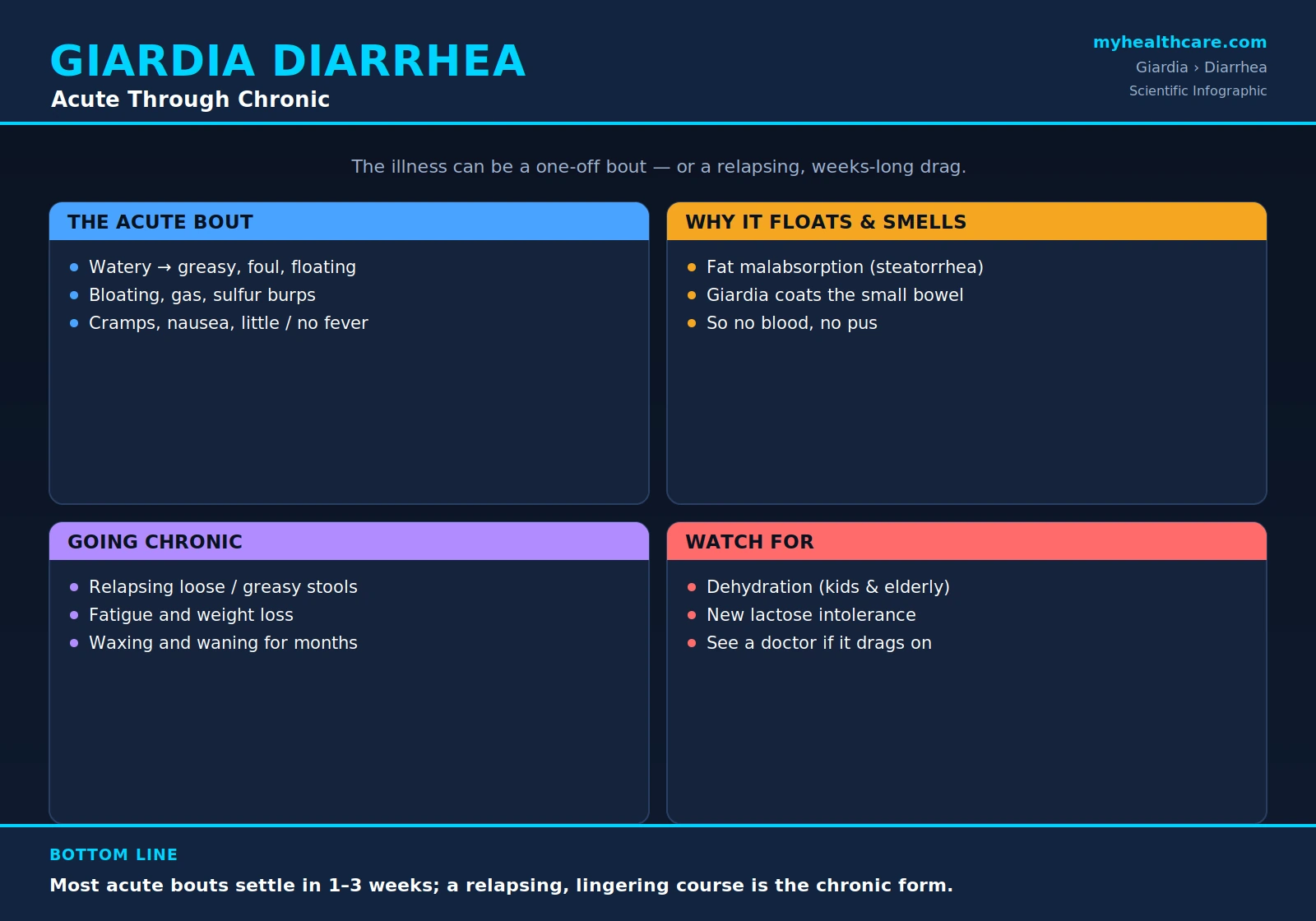
Diarrhea is the signature of giardiasis — the intestinal infection caused by the microscopic parasite Giardia (also written Giardia lamblia, Giardia intestinalis, or Giardia duodenalis). It is one of the most common parasitic causes of diarrhea worldwide, and what makes it distinctive is not a single dramatic symptom but a recognizable pattern: it begins a week or two after you swallow the parasite, the stools turn greasy and foul-smelling, the gas and bloating can be relentless, and — if it is not recognized and treated — the illness can drag on for weeks or settle into a frustrating, on-again-off-again chronic phase. This page walks through that illness from the first watery stools of the acute phase, through why the diarrhea behaves the way it does, into the chronic and relapsing course, the secondary lactose intolerance that often tags along, how to spot dehydration, and how to tell giardiasis apart from the many other things that cause prolonged diarrhea — so you know what is happening and when it is time to push for more testing. The good news is that giardiasis is treatable; for the drugs and how a cure is confirmed, see the Treatment & Prevention hub.
Table of Contents
- The Acute Illness: How It Starts
- Why the Diarrhea Is Non-Bloody and Non-Inflammatory
- Why the Stool Floats and Smells
- How Long the Acute Phase Lasts
- The Transition to Chronic Giardiasis
- Secondary Lactose Intolerance
- Dehydration and How to Recognize It
- When to Seek Further Evaluation: The Differential Diagnosis
- Treatment in Brief
- Key Research Papers
- Featured Videos
1. The Acute Illness: How It Starts
Giardiasis does not announce itself the moment you are exposed. After you swallow Giardia cysts — usually from contaminated water, but also from contaminated food, hands, or surfaces — there is a typical incubation period of about one to three weeks before symptoms appear. During that quiet stretch the cysts hatch in your small intestine, releasing the active feeding form of the parasite (the trophozoite), which then multiplies and attaches to the intestinal lining. By the time you feel ill, the infection is already well established.
The illness commonly begins with diarrhea that is watery at first, then changes character over the following days into the form most associated with giardiasis: greasy, pale or light-colored, foul-smelling stools that tend to float rather than sink. This shift — from watery to greasy — is a useful clue, because it reflects the parasite settling into the upper small intestine and beginning to interfere with the absorption of fat (explained in the next two sections).
Alongside the diarrhea, the acute phase typically brings a cluster of upper-gut complaints:
- Bloating — a sensation of fullness and distension in the abdomen.
- Excessive gas and flatulence — often striking in its quantity, and a frequent reason people remember a giardiasis episode for years afterward.
- Foul, “sulfur” or rotten-egg burps — belching with an unpleasant, sulfurous (hydrogen-sulfide-like) smell that many patients describe vividly. These eggy burps, paired with greasy diarrhea, are a classic combination.
- Upper-abdominal cramps and discomfort — pain felt high in the belly, often worse after eating.
- Nausea — sometimes with a few episodes of vomiting early on, though persistent vomiting is not typical.
- Loss of appetite — food becomes unappealing, which (together with malabsorption) contributes to weight loss when the illness persists.
One feature that helps distinguish giardiasis from many bacterial or viral gut infections is that there is usually little or no fever. People with acute giardiasis generally feel unwell, gassy, and worn down rather than feverish and acutely sick. High fever, severe systemic illness, or blood in the stool point away from giardiasis and toward another cause — a distinction explored in the differential-diagnosis section below.
2. Why the Diarrhea Is Non-Bloody and Non-Inflammatory
To understand giardiasis, it helps to understand what the parasite does not do. Many causes of diarrhea — certain bacteria such as Shigella, invasive E. coli, or the amoeba Entamoeba histolytica, and inflammatory bowel disease — damage the gut by invading and ulcerating the intestinal wall. That invasion tears small blood vessels and provokes intense inflammation, which is why those illnesses often produce bloody, mucus-filled diarrhea, fever, and severe cramping.
Giardia works differently. Its trophozoites do not burrow into or ulcerate the bowel wall. Instead they attach to and carpet the surface of the upper small intestine (the duodenum and jejunum), clinging to the lining with a specialized suction-cup-like adhesive disc and effectively blanketing the absorptive surface. The damage they cause is functional rather than destructive: they blunt and disrupt the tiny finger-like projections (microvilli and villi) that the small intestine uses to absorb nutrients, shorten and injure those structures, and interfere with the enzymes and transport machinery that line them — without producing the deep, bleeding ulcers of an invasive infection.
The consequences flow directly from that mechanism. Because the parasite does not invade and ulcerate, the diarrhea of giardiasis is characteristically non-bloody and non-inflammatory — you do not see blood or large amounts of pus, and there is little fever. The problem is one of absorption: a coated, damaged small-intestinal surface cannot properly take up fats, sugars, and other nutrients, so they pass onward into the bowel and out in the stool. Researchers describe this as a disruption of the intestinal barrier and absorptive function rather than an invasive, blood-drawing assault on the gut wall, and it is the central explanation for the disease's particular signature: greasy, malabsorptive diarrhea without the blood and high fever of invasive infections.
3. Why the Stool Floats and Smells
The most distinctive physical features of giardiasis stools — that they float, look greasy and pale, and smell especially foul — all trace back to the same root cause: fat malabsorption, also called steatorrhea (literally, “fat in the stool”).
Normally, the upper small intestine absorbs nearly all the fat in your diet. When Giardia carpets and damages that surface — and interferes with the bile and pancreatic enzymes needed to break fat down — a portion of dietary fat is no longer absorbed. That unabsorbed fat travels through the intestine and ends up in the stool, and it changes the stool in three recognizable ways:
- It floats. Fat is less dense than water, and stool loaded with unabsorbed fat (and the gas produced as gut bacteria ferment unabsorbed nutrients) becomes buoyant. Stools that consistently float and are hard to flush are a practical bedside sign of steatorrhea.
- It looks greasy and pale. The excess fat gives the stool an oily, shiny, or filmy appearance — sometimes leaving an oily ring in the toilet bowl — and the color is often pale, light tan, or clay-like rather than normal brown.
- It smells exceptionally foul. Steatorrhea produces a strong, rancid, putrid odor. Unabsorbed fat and other nutrients reaching the lower bowel are fermented by gut bacteria, generating malodorous and sulfur-containing gases — the same chemistry behind the “rotten-egg” burps and the abundant, smelly flatulence of giardiasis.
So the greasy, floating, foul-smelling stool is not a random oddity — it is the visible signature of a small intestine that can no longer absorb fat properly because the parasite is coating and disrupting its surface. Persistent steatorrhea is also what links the diarrheal phase to the gradual weight loss and nutritional consequences discussed on the Malabsorption and Weight Loss page.
4. How Long the Acute Phase Lasts
For many people, acute giardiasis is a self-limited illness that improves on its own, but it is typically more prolonged than the usual bout of food poisoning or stomach flu. Where a viral gastroenteritis often runs its course in a few days, the acute diarrheal phase of giardiasis commonly lasts one to three weeks, and it can persist longer than that.
This relatively long duration is one of the practical clues that an illness might be giardiasis rather than a brief viral infection. Diarrhea that drags on for more than a week or two, especially with greasy stools, gas, bloating, sulfurous burps, and weight loss but little fever, should raise suspicion of Giardia — and is a good reason to seek testing rather than waiting it out indefinitely.
Two important caveats follow from the variability in duration. First, because some people clear the parasite without treatment, a person can feel better and assume it is over — yet a meaningful number go on to a chronic or relapsing course (next section), so a return of symptoms after apparent recovery is not unusual. Second, the fact that giardiasis can resolve on its own is not a reason to leave it untreated: treatment shortens the illness, reduces the risk of prolonged malabsorption and weight loss, and lowers the chance of passing the infection to others. The decision to treat is discussed in the Treatment & Prevention section.
5. The Transition to Chronic Giardiasis
When giardiasis is not recognized and treated — or, less often, when it does not clear despite treatment — it can settle into a chronic phase that looks quite different from the dramatic acute illness. Instead of continuous watery diarrhea, chronic giardiasis tends to be intermittent and relapsing, following a characteristic waxing-and-waning pattern that can be confusing for both patients and doctors.
The typical chronic picture, building over weeks to months, includes:
- Intermittent, relapsing loose or greasy stools — the diarrhea comes and goes, with better days and worse days, rather than being constant. People often describe periods of near-normal bowel habits punctuated by flares of greasy, foul stools.
- Persistent bloating and gassiness — abdominal distension, excessive flatulence, and a sense of fullness that linger between flares.
- Fatigue — a deep, ongoing tiredness that is common in chronic giardiasis and is thought to stem partly from poor nutrient absorption and the chronic burden of the infection. This fatigue can be one of the most wearing features of the illness.
- Gradual weight loss — slow, unintended loss of weight over weeks to months, driven by the combination of malabsorption (especially of fat), reduced appetite, and intermittent diarrhea. In children, this can show up as poor weight gain or faltering growth rather than obvious weight loss.
- Soft, malabsorptive stools and abdominal discomfort — ongoing upper-abdominal cramping, nausea, and an aversion to fatty foods that worsen the steatorrhea.
Because this pattern is so non-specific — vague digestive upset, fatigue, and weight loss that ebb and flow — chronic giardiasis is frequently mistaken for other conditions or simply attributed to stress or “a sensitive stomach.” A person may bounce between explanations for months before the parasite is identified. The lesson is that a relapsing, malabsorptive, gassy illness with fatigue and weight loss — particularly after travel, camping, or known water exposure — deserves specific testing for Giardia, because a simple, curable infection can masquerade as a chronic, unexplained problem. The longer-term aftermath of giardiasis, including symptoms that can persist even after the parasite is gone, is covered on the Post-Infectious and Long-Term Effects page.
6. Secondary Lactose Intolerance
A particularly common — and often overlooked — complication of giardiasis is the development of secondary (acquired) lactose intolerance. This is not the inherited form some people are born with; it is a temporary intolerance caused directly by the damage the parasite does to the intestinal lining.
Here is the mechanism. The enzyme that digests lactose — the sugar in milk and dairy — is called lactase, and it lives right on the tips of the microvilli that line the small intestine. When Giardia blunts and injures those microvilli (the same damage that drives fat malabsorption), it knocks out the lactase that sits on them. With too little lactase, lactose passes undigested into the lower intestine, where bacteria ferment it — producing gas, bloating, cramping, and watery diarrhea whenever the person consumes milk, ice cream, or other dairy.
This has two practical consequences worth knowing:
- Symptoms can be triggered or worsened by dairy. Someone with giardiasis who keeps drinking milk may find their diarrhea and gas flare with every dairy meal, which can be mistaken for the infection “getting worse” when it is really an added lactose problem layered on top.
- The intolerance can outlast the infection. Crucially, secondary lactose intolerance can persist for weeks even after the parasite has been successfully treated and cleared, because the gut lining needs time to heal and rebuild its lactase. A person may be cured of Giardia yet continue to react to dairy for a while afterward. Recognizing this prevents needless worry that the treatment failed — and a temporary, low-lactose or dairy-light diet during recovery can ease symptoms while the intestine repairs itself.
7. Dehydration and How to Recognize It
Giardiasis is rarely as explosively dehydrating as cholera or severe rotavirus, but any illness with ongoing diarrhea can lead to dehydration — the loss of more fluid and salts than you are taking in — and the risk is greatest in the two groups least able to tolerate it: young children and older adults. Reduced appetite and nausea make matters worse, because a person who feels too sick to drink can fall behind on fluids even when the diarrhea itself is only moderate.
It is important to be able to recognize dehydration so it can be addressed before it becomes dangerous. Warning signs include:
- Increased thirst and a dry mouth, lips, and tongue.
- Producing little urine, urinating much less often than usual, or passing dark, concentrated urine.
- Fatigue, weakness, dizziness, or lightheadedness, especially on standing up.
- Sunken eyes and, in adults, skin that is slow to spring back when pinched.
- In infants and young children: a dry diaper for many hours, no tears when crying, a sunken soft spot (fontanelle) on the head, unusual sleepiness or irritability, and sunken eyes.
- In older adults: confusion, marked weakness, or a sudden decline in alertness, which can be signs of significant fluid loss.
Most people with giardiasis can stay hydrated by sipping fluids steadily throughout the day; oral rehydration solutions (which contain a balance of salts and sugar) are especially useful when diarrhea is heavy. Seek medical care promptly if there are signs of significant dehydration, if a young child or older adult cannot keep fluids down, if the person is too weak or dizzy to function, or if diarrhea is severe and unrelenting. Severe dehydration is a medical emergency that may need intravenous fluids — though with giardiasis this is uncommon and usually preventable with attentive drinking.
8. When to Seek Further Evaluation: The Differential Diagnosis
Prolonged diarrhea is a symptom, not a diagnosis, and several conditions can produce the kind of weeks-long, relapsing, or malabsorptive bowel trouble that giardiasis causes. Knowing the main alternatives helps you understand why a doctor may test for more than one thing — and why it is worth pushing for evaluation rather than assuming a long bout of diarrhea is “just a stubborn stomach bug.” The leading possibilities to distinguish from giardiasis include:
- Other intestinal parasites. Cryptosporidium, Cyclospora, Entamoeba histolytica (which can cause bloody diarrhea), and others can cause prolonged diarrhea and overlap with giardiasis, especially after travel or water exposure. A stool test panel can look for several parasites at once.
- Post-infectious irritable bowel syndrome (IBS). Giardiasis itself can trigger a lasting IBS-like state — loose stools, cramping, bloating, and urgency — that persists after the parasite is cleared. So can other gut infections. This is one of the most important sequelae of giardiasis and is discussed in detail on the Post-Infectious and Long-Term Effects page.
- Celiac disease. An immune reaction to gluten that injures the same upper small intestine Giardia attacks, celiac disease produces strikingly similar features — greasy, malabsorptive stools, bloating, fatigue, and weight loss. The two can even be confused or coexist, which is why malabsorption that does not resolve after treating Giardia often prompts testing for celiac disease.
- Bacterial infections. Certain bacteria (for example Campylobacter, Salmonella, Shigella, Yersinia, and toxin-producing C. difficile) can cause persistent diarrhea; some, unlike giardiasis, cause fever and blood in the stool.
- Inflammatory bowel disease (IBD). Crohn's disease and ulcerative colitis cause chronic diarrhea, often with blood, weight loss, and abdominal pain. Their inflammatory, sometimes bloody pattern differs from giardiasis, but prolonged symptoms warrant evaluation to exclude them.
- Other causes. Lactose intolerance (primary or secondary), small-intestinal bacterial overgrowth, thyroid disease, medication side effects, and pancreatic problems can all cause lasting diarrhea and may need to be considered.
When to seek further evaluation. See a clinician if your diarrhea lasts more than a week or two; if you notice greasy, pale, floating stools, ongoing gas and bloating, sulfurous burps, fatigue, or unintended weight loss; if you have had recent travel, camping, untreated water, or a known exposure; if there is blood in the stool, high fever, severe or worsening abdominal pain, or signs of dehydration; or if symptoms keep relapsing after seeming to settle. Diagnosis is usually straightforward — modern stool antigen tests and molecular (PCR) panels detect Giardia reliably — and because the infection is curable, identifying it ends a problem that might otherwise be chased for months. Testing and diagnosis are covered on the Symptoms & Diagnosis hub.
9. Treatment in Brief
Giardiasis is a treatable, curable infection. The mainstays of therapy are antiparasitic drugs — most commonly metronidazole or tinidazole — which clear the parasite in the great majority of cases, with alternatives available when those cannot be used or do not work. Treatment shortens the illness, relieves the diarrhea, gas, and malabsorption, and reduces the risk of the prolonged or chronic course described above. Hydration and, during recovery, a temporarily dairy-light diet (to accommodate the secondary lactose intolerance) round out supportive care.
For the specific medications, doses, side effects, and how a cure is confirmed, see the Metronidazole and Tinidazole Treatment page and the Treatment & Prevention hub. If symptoms persist despite standard therapy, the Refractory Giardiasis and Drug Resistance page explains why that happens and what to do next. And because giardiasis spreads through contaminated water and poor hygiene, preventing reinfection — covered on the Prevention: Water and Hygiene page — is an essential part of recovery.
Key Research Papers
Peer-reviewed reviews, cohort studies, and treatment analyses on the clinical course, pathophysiology, and management of giardiasis. Journal names appear as plain text; the year/volume/pages link opens the full citation via DOI.
- Ankarklev J, Jerlström-Hultqvist J, Ringqvist E, Troell K, Svärd SG. Behind the Smile: Cell Biology and Disease Mechanisms of Giardia Species. Nature Reviews Microbiology. 2010;8(6):413–422.
- Einarsson E, Ma'ayeh S, Svärd SG. An Up-Date on Giardia and Giardiasis. Current Opinion in Microbiology. 2016;34:47–52.
- Adam RD. Biology of Giardia lamblia. Clinical Microbiology Reviews. 2001;14(3):447–475.
- Robertson LJ, Hanevik K, Escobedo AA, Mørch K, Langeland N. Giardiasis — Why Do the Symptoms Sometimes Never Stop? Trends in Parasitology. 2010;26(2):75–82.
- Halliez MCM, Buret AG. Extra-Intestinal and Long Term Consequences of Giardia duodenalis Infections. World Journal of Gastroenterology. 2013;19(47):8974–8985.
- Cotton JA, Beatty JK, Buret AG. Host Parasite Interactions and Pathophysiology in Giardia Infections. International Journal for Parasitology. 2011;41(9):925–933.
- Buret AG. Pathophysiology of Enteric Infections with Giardia duodenalis. Parasite. 2008;15(3):261–265.
- Hanevik K, Wensaas KA, Rortveit G, Eide GE, Mørch K, Langeland N. Irritable Bowel Syndrome and Chronic Fatigue 6 Years After Giardia Infection: A Controlled Prospective Cohort Study. Clinical Infectious Diseases. 2014;59(10):1394–1400.
- Litleskare S, Rortveit G, Eide GE, Hanevik K, Langeland N, Wensaas KA. Prevalence of Irritable Bowel Syndrome and Chronic Fatigue 10 Years After Giardia Infection. Clinical Gastroenterology and Hepatology. 2018;16(7):1064–1072.e4.
- Gardner TB, Hill DR. Treatment of Giardiasis. Clinical Microbiology Reviews. 2001;14(1):114–128.
- Granados CE, Reveiz L, Uribe LG, Criollo CP. Drugs for Treating Giardiasis. Cochrane Database of Systematic Reviews. 2012;(12):CD007787.
- Escobedo AA, Cimerman S. Giardiasis: A Pharmacotherapy Review. Expert Opinion on Pharmacotherapy. 2007;8(12):1885–1902.
- Leung AKC, Leung AAM, Wong AHC, Sergi CM, Kam JKM. Giardiasis: An Overview. Recent Patents on Inflammation & Allergy Drug Discovery. 2019;13(2):134–143.
Live PubMed Searches
Each link opens a live PubMed query so results stay current as new papers are indexed.
- Giardiasis diarrhea clinical features
- Giardia steatorrhea and fat malabsorption
- Chronic relapsing giardiasis
- Giardia and secondary lactose intolerance
- Giardia villous injury and pathophysiology
- Giardiasis and post-infectious IBS
- Giardiasis incubation and transmission
- Giardiasis treatment: metronidazole and tinidazole
Connections
- All Parasites
- Symptoms & Diagnosis
- Malabsorption and Weight Loss
- Post-Infectious and Long-Term Effects
- Giardiasis (Giardia lamblia) — the full clinical monograph behind this symptom page — the cyst/trophozoite life cycle, epidemiology, stool antigen and PCR testing, and the metronidazole, tinidazole and nitazoxanide options.
- Treatment & Prevention
- Metronidazole and Tinidazole Treatment
- Prevention: Water and Hygiene
- Refractory Giardiasis and Drug Resistance
- Giardia Overview
- Gastroenterology
- Infectious Disease
- All Conditions