Giardiasis, Malabsorption, and Weight Loss
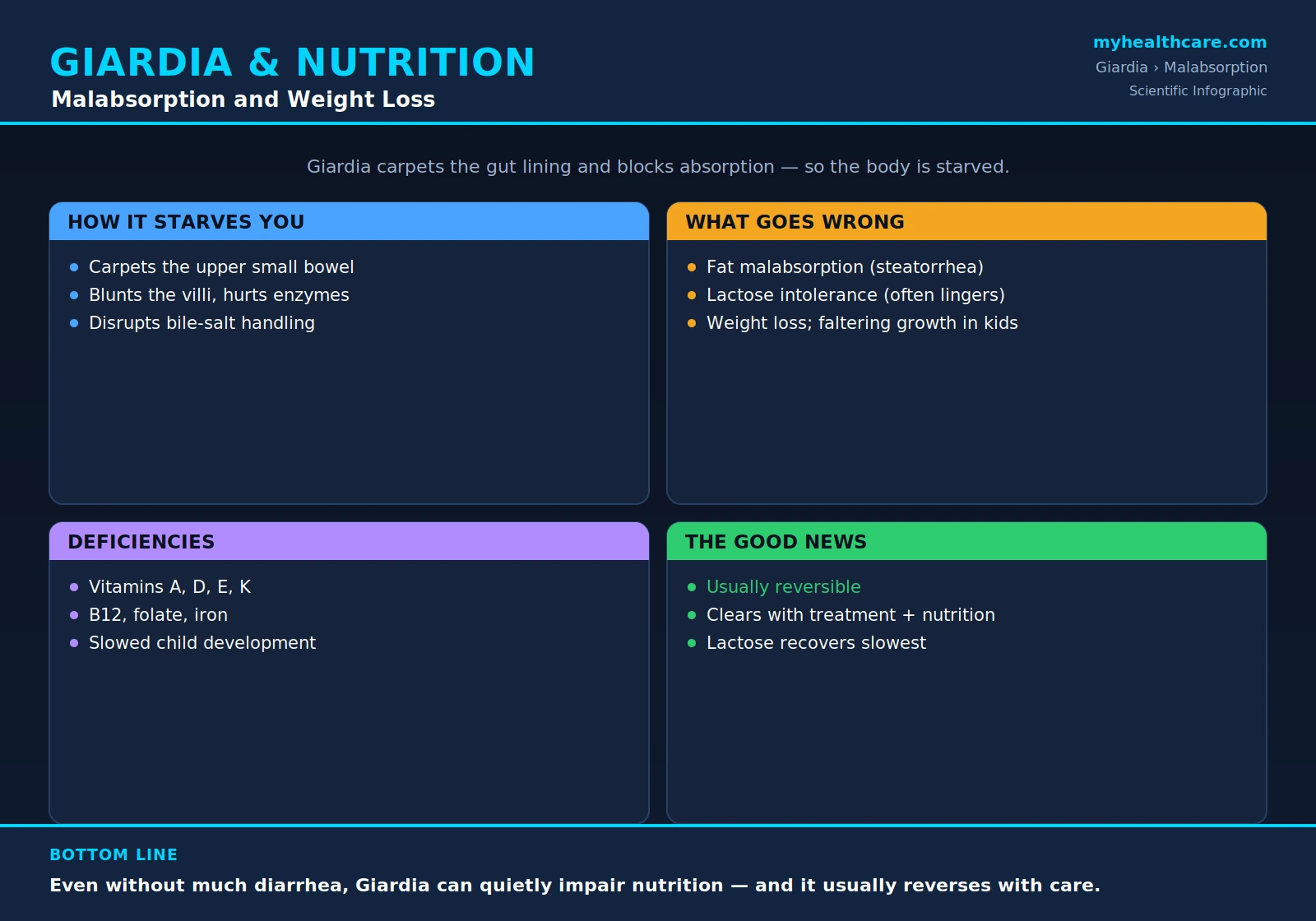
One of the most distinctive things about giardiasis is that it can starve the body even while a person keeps eating. The parasite Giardia duodenalis (also called Giardia lamblia or Giardia intestinalis) settles in the upper small intestine — the very stretch of gut where most food is digested and absorbed — and quietly sabotages that machinery. The result can be greasy stools, slow unexplained weight loss in an adult, poor growth in a child, and shortfalls of specific vitamins and minerals. This page explains, in plain terms, why Giardia interferes with nutrient absorption, what that looks like in the body, who is most affected, and the reassuring fact that these effects are usually reversible once the parasite is treated and good nutrition is restored.
Table of Contents
- How Giardia Causes Malabsorption
- Fat Malabsorption and Steatorrhea
- Secondary Lactose Intolerance
- Weight Loss in Adults
- Failure to Thrive and Growth in Children
- Nutrient Deficiencies That Can Follow
- The "Giardia Paradox": No Diarrhea, Still Malnourished
- Why It Is Usually Reversible
- When Malabsorption Should Prompt Testing
- Key Research Papers
- Featured Videos
1. How Giardia Causes Malabsorption
To understand why Giardia is so good at causing malabsorption, it helps to picture where it lives and what it does there. The feeding form of the parasite — the trophozoite — attaches to the lining of the duodenum and jejunum, the first two parts of the small intestine. This is the prime real estate of digestion: it is where pancreatic enzymes and bile meet your food, and where the absorptive surface is at its richest. By carpeting that surface, Giardia damages the gut precisely where it can do the most nutritional harm. Researchers have identified several overlapping mechanisms, and it is the combination — not any single one — that produces malabsorption.
The trophozoites physically carpet the lining. Vast numbers of trophozoites can blanket the surface of the duodenum and jejunum, attaching by a suction-cup-like ventral disc. Like a tarpaulin thrown over a garden, this layer of parasites forms a partial mechanical barrier between food and the absorptive cells beneath, and it competes with the host for nutrients in the gut lumen. On its own this barrier effect is modest, but it sets the stage for the more damaging changes that follow.
The immune response blunts and shortens the villi. The intestinal lining is folded into millions of tiny finger-like projections called villi, which multiply the absorptive surface enormously. In giardiasis, the body's own immune reaction to the parasite — rather than the parasite directly — causes these villi to shorten and flatten (a change called villous atrophy or villous blunting), while the crypts between them deepen. Studies in animals showed that this villous shortening depends on host T lymphocytes and signalling molecules of the immune system, which is why the damage is best understood as immune-mediated injury. When the villi shrink, the total absorptive surface shrinks with them — fewer cells are available to take up nutrients, so more nutrients pass through unabsorbed.
The brush-border enzymes are disrupted. The outer membrane of each absorptive cell is covered in a dense, hair-like fringe of microvilli known as the brush border. Embedded in it are the final digestive enzymes — including the disaccharidases that split sugars such as lactose, sucrose, and maltose into absorbable units. Giardiasis causes a diffuse shortening of these microvilli and a measurable drop in brush-border enzyme activity. Even where the villi look reasonably intact, the brush border itself is impaired, so the last step of digestion fails. This is the change most directly responsible for the sugar-related symptoms discussed below.
Bile-salt handling is impaired. Fat digestion depends on bile salts, which act like a detergent to break dietary fat into tiny droplets the gut can absorb. In giardiasis, bile-salt handling in the upper small intestine is disturbed — classic work pointed to changes in the bacterial flora and to deconjugation of bile salts in the jejunum, and the parasite itself can take up and interfere with bile salts. With the fat-emulsifying system working poorly, fat is left undigested and unabsorbed, which is the root of the greasy stools described next.
Put together, a carpeted and inflamed lining, blunted villi, a damaged brush border, and disturbed bile-salt chemistry add up to a small intestine that simply cannot finish digesting food or absorb what it does digest. The clinical picture that follows — greasy stools, sugar intolerance, weight loss, and specific deficiencies — flows directly from these mechanisms.
2. Fat Malabsorption and Steatorrhea
Because Giardia disrupts bile-salt handling and damages the absorptive surface, fat is often the first nutrient to be left behind. Fat is the hardest macronutrient to absorb at the best of times — it requires bile salts, pancreatic lipase, and a healthy brush border all working in concert — so it is especially vulnerable when any of those is impaired. When dietary fat is not absorbed, it passes into the stool, producing a characteristic pattern doctors call steatorrhea (literally, "fat in the stool").
People and parents often describe these stools vividly, and the description itself is a useful clue. Stools from fat malabsorption tend to be:
- Greasy or oily — sometimes leaving an oily film or droplets in the toilet bowl.
- Pale — lighter in colour than usual, often clay- or putty-coloured.
- Bulky and floating — the trapped fat and gas make them float rather than sink.
- Foul-smelling — an unusually strong, rancid odour that people frequently single out.
This combination — greasy, pale, floating, foul-smelling stools — is one of the more recognizable signatures of giardiasis, and it points specifically toward the upper small intestine where the parasite lives. It is also why fat malabsorption sits at the centre of the weight loss and fat-soluble-vitamin shortfalls covered later on the page: when fat goes unabsorbed, so do the calories it carries and the vitamins that travel with it.
3. Secondary Lactose Intolerance
One of the most common, and most frequently overlooked, consequences of giardiasis is secondary lactose intolerance. The word "secondary" is important: this is not the genetic, lifelong lactose intolerance many adults have. It is a temporary, acquired intolerance caused directly by the infection — and recognizing the difference can spare a person a lot of confusion.
The mechanism follows straight from the brush-border damage described earlier. Lactase, the enzyme that digests milk sugar (lactose), lives on the very tips of the brush-border microvilli — the part of the gut lining Giardia damages most. Lactase is also one of the most fragile of the brush-border enzymes, so it tends to be the first to fall and the last to recover. When lactase is lost, lactose passes undigested into the large intestine, where gut bacteria ferment it, producing gas, bloating, cramping, and watery diarrhoea after milk, ice cream, or other dairy.
The feature that most often catches people off guard is the timing of recovery. After successful treatment, the parasite may be gone, yet the dairy intolerance can linger for weeks while the brush border slowly rebuilds and lactase production restarts. This delayed recovery is a frequent source of worry — a person finishes their medication, still cannot tolerate milk, and assumes the treatment failed or the infection returned. In reality, it is simply the lining taking its time to heal. Many people benefit from temporarily avoiding or reducing lactose during and shortly after treatment, then gradually reintroducing dairy as the gut recovers. (Note that for someone whose diarrhoea persists for other reasons, see Acute and Chronic Diarrhea and Post-Infectious and Long-Term Effects.)
4. Weight Loss in Adults
In adults, the cumulative effect of poor fat, carbohydrate, and protein absorption is steady, often unintentional, weight loss. The logic is simple: if a meaningful share of every meal passes through unabsorbed, the body is effectively eating less than it appears to — calories go in but exit in the stool rather than being banked as energy. Over weeks of chronic infection, this energy gap shows up on the scale.
Weight loss in giardiasis is frequently gradual and unexplained, which is exactly what makes it worth flagging. Some people notice their clothes loosening, or a number on the scale drifting down, without an obvious cause — appetite may be near normal, and the diarrhoea may be intermittent or even absent. Studies of giardiasis, including outbreak and non-outbreak investigations, have documented weight loss as a recognized feature alongside the more familiar diarrhoea and abdominal symptoms. Because the symptoms can be quiet, the weight loss may be the most concrete sign that something is wrong — and in a person with the right exposure history (travel, contaminated water, a known outbreak, or a household contact), it is a strong reason to think of Giardia. Unexplained weight loss should never be dismissed; in the right setting, testing for Giardia is a reasonable and easily reversible step (see When Malabsorption Should Prompt Testing).
5. Failure to Thrive and Growth in Children
In young children, the stakes of giardiasis-related malabsorption are higher, because the same nutrient losses fall during the years of fastest growth and brain development. In children, malabsorption tends to show up not as dramatic weight loss but as failure to thrive — poor weight gain, slowed growth, and, over time, stunting (being short for age). A child who is quietly absorbing fewer calories and nutrients than they need may simply fail to keep up on the growth chart.
This matters most in endemic, low-resource settings, where Giardia is extremely common in early childhood, infections are often repeated, and children frequently carry the parasite alongside other gut infections and a background of undernutrition. A large birth-cohort study that followed children across several low-resource countries (the MAL-ED study) found that Giardia infection in the first two years of life was very common and was associated with reduced growth, even when it caused no diarrhoea. Reviews of the long-term consequences of Giardia duodenalis infection likewise highlight links between childhood giardiasis in endemic areas and poorer physical growth and impaired cognitive development. The proposed reason is intuitive: a small intestine that cannot absorb nutrients properly, during the critical window when the body and brain are being built, can leave a lasting mark on both growth and learning.
It is worth being honest about the nuance here. The picture is not uniform — some studies in particular communities have found little or no adverse effect on growth from Giardia alone, and untangling the parasite's contribution from the surrounding burden of poverty, diet, and other infections is genuinely difficult. What the body of evidence supports is that, especially with repeated or chronic infection in already-vulnerable children, giardiasis is a meaningful and treatable contributor to growth faltering. That is reason enough to take it seriously and to treat it.
6. Nutrient Deficiencies That Can Follow
Because Giardia damages the upper small intestine — the segment responsible for absorbing many specific nutrients — chronic infection can lead to shortfalls of particular vitamins and minerals. These deficiencies are not random; they track the kinds of absorption the parasite disrupts.
- Fat-soluble vitamins (A, D, E, and K). These four vitamins are absorbed along with dietary fat, so when fat malabsorption occurs, they tend to be lost together. Vitamin A deficiency is of special concern in children in endemic areas, where it compounds the risks of poor growth and weakened immunity. Vitamin D affects bone and immune health, vitamin E is an antioxidant, and vitamin K is needed for normal blood clotting — so a sustained shortfall can have wide-ranging effects. (See Vitamin A, Vitamin D, Vitamin E, and Vitamin K.)
- Vitamin B12 and folate. These two vitamins, both essential for healthy red blood cells and nerves, are absorbed in the small intestine and can be affected when its lining is damaged. A shortfall can contribute to anaemia and fatigue. (See Vitamin B12 and Folate.)
- Iron. Iron is absorbed mainly in the duodenum — right where Giardia lives — so chronic giardiasis can contribute to iron deficiency and the anaemia, pallor, and fatigue that come with it. (See Iron.)
The common thread is the location of the damage: by injuring the duodenum and jejunum, Giardia interferes precisely with the absorption of fat-soluble vitamins, B12 and folate, and iron. None of these deficiencies is inevitable, and their depth depends on how long the infection lasts and how nutritionally robust the person was to begin with — but they explain why some people with chronic giardiasis develop anaemia, bone concerns, or other nutritional problems on top of their gut symptoms.
7. The "Giardia Paradox": No Diarrhea, Still Malnourished
A point that surprises many people — and that is easy for clinicians to miss — is that giardiasis does not always cause diarrhoea, yet it can still impair nutrition. We tend to assume that an intestinal parasite must announce itself with diarrhoea, and that without diarrhoea the gut must be fine. Giardia breaks that assumption.
The reason is that malabsorption and diarrhoea, while related, are not the same thing. A person can have meaningfully blunted villi and a damaged brush border — and therefore real malabsorption — without enough fluid in the stool to register as diarrhoea. The damage is quietly draining nutrients even though the bowel habits look near normal. This is exactly what the childhood studies described above kept finding: Giardia was associated with reduced growth even in the absence of diarrhoea. The infection was silently undercutting nutrition while raising no obvious alarm.
The practical lesson is important. The absence of diarrhoea does not rule out giardiasis, and it certainly does not rule out giardiasis-related malabsorption. A child failing to grow, or an adult slowly losing weight, with greasy stools or new dairy intolerance but little or no diarrhoea, can still have an active Giardia infection that is worth testing for and treating. Keeping this paradox in mind is one of the most useful things a parent or clinician can do.
8. Why It Is Usually Reversible
Here is the genuinely reassuring part: in most people, the malabsorption of giardiasis is not permanent. The lining of the small intestine is one of the most rapidly renewing tissues in the body — its cells are continually replaced — so once the parasite is removed and the immune reaction to it settles, the villi regrow, the brush border rebuilds, and enzyme activity returns. With treatment plus a period of good nutrition, fat absorption recovers, weight is regained, growth in children typically resumes, and nutrient levels come back up.
The main caveat is one of timing, and it bears repeating because it causes so much needless worry. The different problems recover on different schedules. General energy and weight often improve fairly quickly once nutrients are being absorbed again. But lactose intolerance is frequently the slowest to resolve, sometimes persisting for weeks after the parasite is cleared, because lactase is the most fragile brush-border enzyme and the last to come back. A person who still cannot tolerate milk a couple of weeks after finishing treatment is, in most cases, simply waiting for the brush border to finish healing — not failing treatment. Reintroducing dairy gradually, and giving the gut time, usually resolves it. For the specifics of the medicines used, see Treatment and Prevention and Metronidazole and Tinidazole Treatment; for the minority in whom infection or symptoms persist, see Refractory Giardiasis and Drug Resistance.
9. When Malabsorption Should Prompt Testing
Because giardiasis is common, treatable, and reversible — and because it can hide behind quiet symptoms — it deserves to be on the list whenever malabsorption or unexplained weight loss appears in the right context. Consider testing for Giardia when you see:
- Greasy, pale, floating, foul-smelling stools — the steatorrhea pattern pointing at the upper small intestine.
- Unexplained weight loss in an adult, especially with a relevant exposure (travel to or residence in an endemic area, drinking untreated water from streams or wells, a known waterborne outbreak, daycare or household contact, or contact with infected animals).
- Failure to thrive or growth faltering in a child, particularly in or from a high-prevalence setting, even when diarrhoea is mild or absent.
- New, unexplained lactose intolerance appearing alongside other gut symptoms.
- Unexplained iron, B12, folate, or fat-soluble-vitamin deficiency with abdominal symptoms and a fitting exposure history.
- Persistent bloating, gassiness, and upper-abdominal discomfort with a history of possible exposure — remembering that diarrhoea need not be present.
Testing is straightforward — typically a stool test for the parasite's antigen or DNA, which is sensitive and widely available — and the payoff is large: identifying Giardia turns a worrying, unexplained pattern of weight loss or malabsorption into a problem with a short, effective course of treatment and a good chance of full recovery. When the picture fits, the small step of testing for Giardia is well worth taking. For what comes next, see the Treatment and Prevention hub.
Key Research Papers
Peer-reviewed studies and reviews on how Giardia damages the small intestine and impairs the absorption of nutrients, including the brush-border and bile-salt mechanisms, the consequences for growth in children, and the broader nutritional impact. Journal names appear as plain text; the year/volume/pages link opens the full citation via DOI.
- Buret AG. Mechanisms of Epithelial Dysfunction in Giardiasis. Gut. 2007;56(3):316–317.
- Troeger H, Epple HJ, Schneider T, et al. Effect of Chronic Giardia lamblia Infection on Epithelial Transport and Barrier Function in Human Duodenum. Gut. 2007;56(3):328–335.
- Cevallos A, Katelaris P, Farthing MJG. Pathogenesis of Giardiasis. Gastroenterology. 1993;105(1):306–307.
- Buret AG. Pathophysiology of Enteric Infections with Giardia duodenalis. Parasite. 2008;15(3):261–265.
- Buret A, Hardin JA, Olson ME, Gall DG. Pathophysiology of Small Intestinal Malabsorption in Gerbils Infected with Giardia lamblia. Gastroenterology. 1992;103(2):506–513.
- Buret A, Gall DG, Olson ME. Effects of Murine Giardiasis on Growth, Intestinal Morphology, and Disaccharidase Activity. The Journal of Parasitology. 1990;76(3):403–409.
- Tandon BN, Tandon RK, Satpathy BK, Shriniwas. Mechanism of Malabsorption in Giardiasis: A Study of Bacterial Flora and Bile Salt Deconjugation in Upper Jejunum. Gut. 1977;18(3):176–181.
- Solaymani-Mohammadi S, Singer SM. Giardia duodenalis: The Double-Edged Sword of Immune Responses in Giardiasis. Experimental Parasitology. 2010;126(3):292–297.
- Cotton JA, Beatty JK, Buret AG. Host Parasite Interactions and Pathophysiology in Giardia Infections. International Journal for Parasitology. 2011;41(9):925–933.
- Halliez MCM, Buret AG. Extra-Intestinal and Long Term Consequences of Giardia duodenalis Infections. World Journal of Gastroenterology. 2013;19(47):8974–8985.
- Rogawski ET, Bartelt LA, Platts-Mills JA, et al. Determinants and Impact of Giardia Infection in the First 2 Years of Life in the MAL-ED Birth Cohort. Journal of the Pediatric Infectious Diseases Society. 2017;6(2):153–160.
- Cantey PT, Roy S, Lee B, et al. Study of Nonoutbreak Giardiasis: Novel Findings and Implications for Research. The American Journal of Medicine. 2011;124(12):1175.e1–1175.e8.
Live PubMed Searches
Each link opens a live PubMed query so results stay current as new papers are indexed.
- Giardiasis malabsorption
- Giardia brush-border disaccharidase
- Giardia villous atrophy
- Giardiasis and lactose intolerance
- Giardia steatorrhea and fat malabsorption
- Giardia, children, and growth stunting
- Giardia and weight loss in adults
- Giardia, vitamin A, and iron deficiency
Connections
- All Parasites
- Symptoms & Diagnosis
- Acute & Chronic Diarrhea
- Post-Infectious & Long-Term Effects
- Treatment & Prevention
- Metronidazole & Tinidazole Treatment
- Prevention: Water & Hygiene
- Refractory Giardiasis & Drug Resistance
- Giardia Overview
- Gastroenterology
- Infectious Disease
- All Conditions