Refractory Giardiasis and Drug Resistance
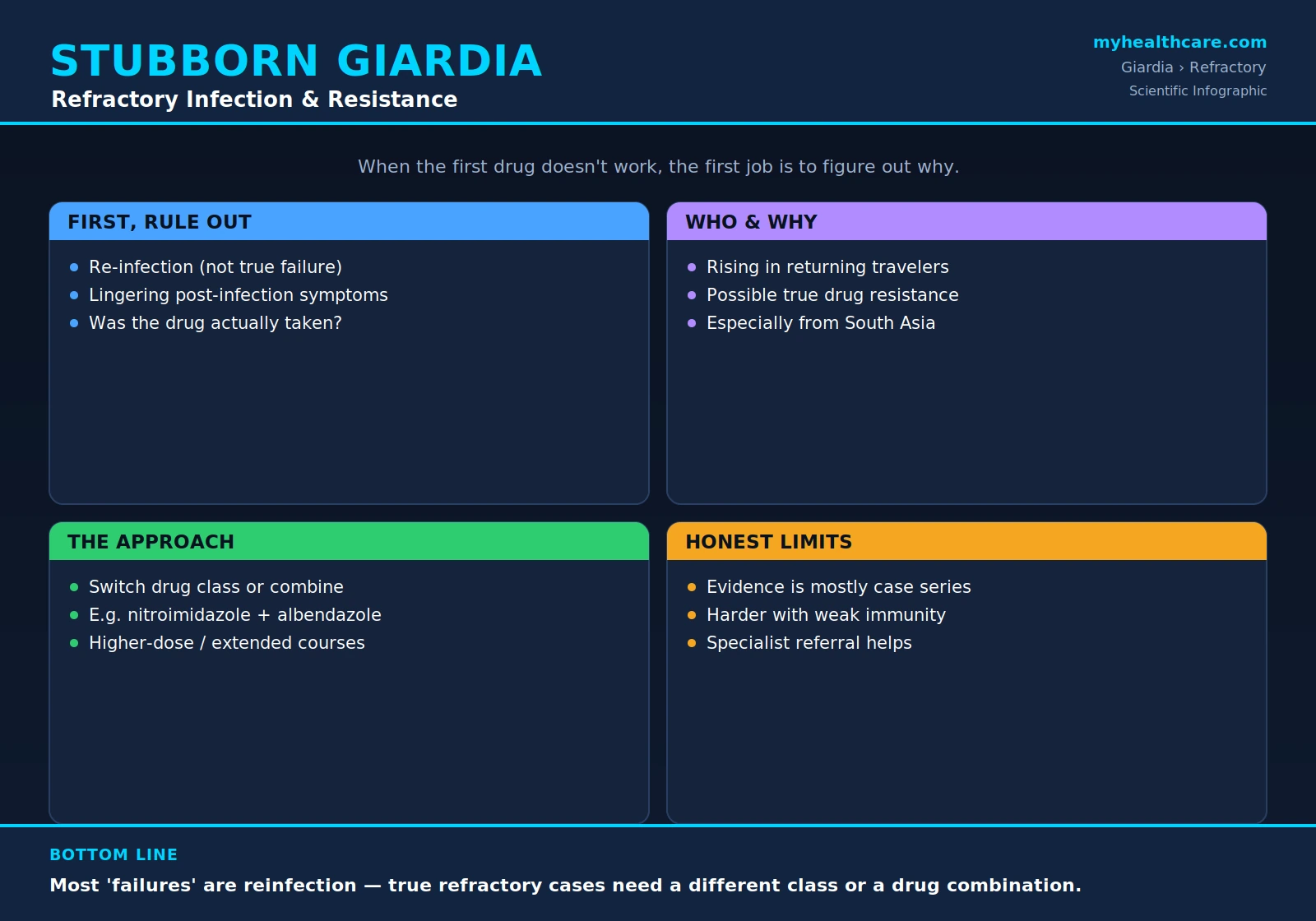
Most cases of giardiasis clear up after a single course of a standard drug such as metronidazole or tinidazole. But a meaningful minority of people get better only partly, or relapse soon after finishing treatment, or never improve at all. When that happens it is tempting to assume the parasite has become "resistant" — and sometimes that is exactly what is going on. Just as often, though, the real story is something else: the person was re-infected from the same contaminated water or household, or the parasite is already gone but the gut is left irritable and inflamed for weeks afterward. Refractory (treatment-refractory) giardiasis is the term for an infection that persists despite appropriate treatment, and sorting out why a person is still sick is the first — and most important — step. This page explains what refractory giardiasis is, why it is being recognized more often (especially in travelers returning from South Asia), what might cause it, and the practical, evidence-based ladder of options when the first drug does not work. Throughout, it is honest about a hard truth: much of what we know about "salvage" treatment comes from case series and small studies, not large randomized trials, so the best path is usually one mapped out with an infectious-disease or tropical-medicine specialist.
Table of Contents
- What "Refractory" Giardiasis Means
- Failure vs. Re-infection vs. Lingering Symptoms
- The Rise of Nitroimidazole-Refractory Giardiasis
- Why Drugs Sometimes Fail: Possible Mechanisms
- The Practical Approach: A Step-by-Step Ladder
- Salvage Regimens and Their Evidence
- Refractory Disease in Weakened Immunity
- When to Refer to a Specialist
- An Honest Word on Uncertainty
- Key Research Papers
- Featured Videos
1. What "Refractory" Giardiasis Means
"Refractory" simply means resistant to treatment — the infection does not resolve the way it normally should. In practical terms, giardiasis is usually called treatment-refractory when a person still has symptoms and still has evidence of the parasite (in stool tests or stool antigen tests) after one or more full, correctly taken courses of a drug that should have worked — most often a nitroimidazole like metronidazole or tinidazole. (Nitroimidazole is the chemical family these first-line drugs belong to; you will see the term used a lot on this page.)
A few points make the definition less tidy than it sounds. First, "persistence" has to be confirmed: feeling unwell after treatment is not the same as the parasite still being there, and the two need to be told apart (the next section explains why). Second, the term covers a spectrum — from someone whose diarrhea improved but never fully stopped, to someone who relapsed two weeks after finishing the tablets, to someone who had no response at all. Third, what counts as "refractory" can depend on how many courses have failed. Doctors often reserve the word for an infection that survives a properly dosed first course, and use "multiply refractory" or "treatment-refractory" more emphatically when a second, different drug has also failed.
The reason the label matters is that it changes the plan. A first relapse might just need a second course or a switch of drug. An infection that has shrugged off two different drug classes raises harder questions — about genuine resistance, about an underlying immune problem, and about whether re-infection is quietly happening in the background. Naming the problem accurately is what opens the door to the right next step.
2. Failure vs. Re-infection vs. Lingering Symptoms
Before anyone reaches for a second drug, the single most valuable thing to do is to work out which of three very different situations is actually in play. They can look identical from the outside — the person is still sick — but they call for completely different responses.
True treatment failure. Here the original parasite was never fully cleared. The drug did not finish the job, whether because of genuine drug resistance, a problem with how the drug reached or acted on the parasite, or a dose or course that fell short. The parasite is still the same infection, and a stool test (microscopy or, more sensitively, a stool antigen or PCR test) will usually still be positive. This is the situation that justifies escalating treatment.
Re-infection. This is when the first infection really was cured, but the person picked up Giardia all over again — from the same well or stream, the same household member who is shedding cysts, the same daycare, the same untreated water supply abroad. Re-infection can look exactly like a relapse, and it is common precisely because the exposures that caused the first infection often have not gone away. The crucial difference is that no amount of stronger medicine fixes a re-infection if the source is still there; the answer is to find and remove the exposure (and sometimes to treat infected household contacts). This is why the practical work-up always circles back to prevention — see Prevention: Water and Hygiene.
Lingering post-infectious symptoms. This is the one that catches the most people out. Giardia can damage the lining of the small intestine, and that damage — along with a temporary loss of the gut enzyme lactase and a bout of post-infectious irritable bowel — can keep symptoms going for weeks after the parasite itself is gone. Here, repeat stool tests are negative: there is nothing left to kill. Loose stools, bloating, and a queasy reaction to dairy in this setting are not a sign of a resistant parasite but of a gut that is still healing. Throwing more antiparasitic drugs at it does not help and may cause harm. This overlap with longer-term effects is covered on Post-Infectious and Long-Term Effects.
The practical lesson is simple but powerful: re-confirm the diagnosis with a repeat stool test before assuming the drug failed. A positive test points toward failure or re-infection (and the exposure history helps separate those two); a negative test points toward post-infectious symptoms and away from more drugs. Skipping this step is how people end up on round after round of antibiotics for a parasite that left weeks ago.
3. The Rise of Nitroimidazole-Refractory Giardiasis
Over roughly the last two decades, clinics that see a lot of returning travelers have reported that nitroimidazole-refractory giardiasis is becoming more common. This is not just an impression. A study from the Hospital for Tropical Diseases in London documented an increasing incidence of nitroimidazole-refractory cases across 2008–2013, and follow-up work from the same group framed it as "a growing problem requiring rational solutions." Specialist travel and tropical-medicine networks across Europe have described similar patterns.
A striking and consistent thread in these reports is geography. A large share of refractory infections occur in travelers returning from the Indian subcontinent and wider South Asia — India, Nepal, Pakistan, Bangladesh — a region where giardiasis is highly endemic. Why this part of the world stands out is not fully settled. It may reflect circulating Giardia strains that respond less well to nitroimidazoles, intense and repeated exposure, or simply that many travelers and the heaviest infections come from there. Whatever the reason, a practical takeaway has emerged: in someone whose giardiasis came back after standard treatment and who was recently in South Asia, the possibility of genuine nitroimidazole-refractory infection should be taken seriously rather than assumed away.
It is worth keeping perspective. Even with the rise, the majority of giardiasis still responds to first-line treatment, and "refractory" remains the exception rather than the rule. But the trend is real enough that the standard advice — "give metronidazole, and if it comes back give it again" — is no longer good enough on its own, and thoughtful, often specialist-guided, alternatives have moved to the foreground.
4. Why Drugs Sometimes Fail: Possible Mechanisms
When treatment genuinely fails, several different mechanisms may be at work — sometimes more than one at once. They are worth understanding because they explain why switching the type of drug often makes more sense than simply giving more of the same.
Genuine drug resistance in the parasite. Nitroimidazoles are "prodrugs": they are inactive until the parasite's own oxygen-poor metabolism chemically activates them inside the cell, turning them into the reactive form that damages the parasite. Laboratory work shows that Giardia can become resistant by dialing down the very enzymes that activate the drug (such as pyruvate:ferredoxin oxidoreductase and related pathways) and by ramping up systems that mop up the toxic by-products. Transcriptomic studies of resistant Giardia lines point to both "active" defenses (boosting antioxidant and detoxifying machinery) and "passive" ones (simply making less of the activating enzymes), which is a clue that resistance is not a single switch but several overlapping adaptations.
Differences in drug activation and efflux. Closely related to the above, a parasite that activates the drug poorly, or that pumps the drug (or its toxic products) back out efficiently, will survive a dose that would kill a more susceptible strain. Because activation depends on the parasite's redox chemistry, even modest shifts in that chemistry can blunt a nitroimidazole's punch.
Sequestration in the gut. Giardia lives in the small intestine and, importantly, can form cysts — a dormant, armored stage. A drug that kills the active, feeding form (the trophozoite) may have far less effect on cysts or on parasites tucked into niches of the gut where drug levels are lower, allowing a residual population to repopulate once treatment stops. Inadequate drug concentration at the actual site of infection is a recurring theme in why a parasite "comes back."
Host immune factors. The drug is only part of the story; the body's own immune response normally helps finish off the infection. People with weakened immunity — particularly certain antibody (immunoglobulin) deficiencies — clear Giardia poorly and relapse repeatedly even when the parasite is not especially drug-resistant. In other words, an infection can be "refractory" because of the host, not the bug (this is important enough to have its own section below).
The honest summary is that these mechanisms are best characterized in the laboratory and in selected patients, and in any individual it is often impossible to say which one is responsible. What is clear is the practical implication: because nitroimidazole failure frequently reflects something specific to that drug class (its activation chemistry, the parasite's defenses against it), moving to a drug that works by a different route — or combining drugs — is a rational next step.
5. The Practical Approach: A Step-by-Step Ladder
Faced with apparent treatment failure, experienced clinicians work through a deliberate sequence rather than immediately reaching for an exotic drug. The order matters, and the first three steps are about verifying the problem before treating it.
- Re-confirm the diagnosis. Repeat stool testing — ideally a sensitive stool antigen test or PCR, and often more than one sample, since Giardia is shed intermittently. A negative result shifts the focus away from the parasite and toward post-infectious symptoms (more drugs are not the answer). A positive result confirms there is still something to treat.
- Check that the first treatment was actually taken correctly. A surprising amount of "resistance" turns out to be a missed or incomplete course, the wrong dose, doses taken without the recommended timing, or vomiting the medication back up. Confirming true adherence and adequate dosing can resolve the puzzle before any escalation.
- Exclude (and address) re-infection. Revisit the exposure history: ongoing untreated water, an infected household member or partner, recurrent travel, a child in daycare. If the source is still active, the right move is to remove it (and consider treating infected contacts) — otherwise even a "successful" retreatment will fail again. See Prevention: Water and Hygiene.
- Then, escalate treatment — once persistence is genuinely confirmed. Broadly there are two strategies, often used in sequence: switch to a different drug class, or combine agents that attack the parasite by different routes. The next section walks through the specific options and how strong (or weak) the evidence for each one is.
This "confirm, then escalate" discipline is not bureaucratic caution — it is what prevents the two most common mistakes in refractory giardiasis: treating a parasite that is already gone, and re-treating an infection whose real cause is an exposure no one has removed.
6. Salvage Regimens and Their Evidence
When persistence is confirmed and re-infection has been addressed, several "salvage" approaches are used. A blunt caveat applies to all of them: the evidence is mostly case series and small studies, not large randomized trials. A 2022 systematic review of treatment strategies for nitroimidazole-refractory giardiasis found that the literature is dominated by case reports and small cohorts, which is why none of these regimens can be presented as a single, definitive "right answer." They are reasonable, experience-backed options — best chosen with specialist input. For the basics of the first-line drugs themselves, see Metronidazole and Tinidazole Treatment.
Switch to a different drug class.
- Albendazole — a benzimidazole that disrupts the parasite's internal "skeleton" (microtubules), a completely different mechanism from the nitroimidazoles. A randomized study found albendazole comparable to metronidazole for ordinary giardiasis with fewer side effects, and it is widely used as an alternative or as part of combination therapy in refractory cases.
- Nitazoxanide — an antiparasitic that interferes with the same oxygen-poor energy metabolism Giardia depends on, but is chemically distinct from the nitroimidazoles. It is a recognized option when first-line drugs fail.
- Paromomycin — an aminoglycoside that is poorly absorbed, so it stays concentrated in the gut where the parasite lives. Because so little enters the bloodstream, it has historically been favored in pregnancy, and it is used as an alternative in difficult cases.
- Quinacrine — an older antimalarial-type drug with long-standing activity against Giardia. It can be very effective in refractory infection but has more troublesome side effects and is not easily available in many countries, so it is generally a specialist, later-line choice. A case series of quinacrine for nitroimidazole-refractory giardiasis reported high cure rates.
Combine agents. When single drugs have failed, attacking the parasite from two directions at once is a common strategy. The best-supported example is a nitroimidazole together with albendazole (combining the nitroimidazole's redox attack with albendazole's microtubule attack). Other combinations reported in refractory cases include quinacrine-containing regimens (for instance quinacrine plus a nitroimidazole, or quinacrine plus albendazole) and albendazole plus chloroquine. A multicenter European (TropNet) study compared quinacrine monotherapy with an albendazole-plus-chloroquine combination in nitroimidazole-refractory patients and found both could achieve cure, helping to define the practical options — though, again, within the limits of relatively small numbers.
Higher-dose or extended courses. Another lever is to give a longer course, a higher dose, or a repeat course of a nitroimidazole — sometimes a different nitroimidazole than the one that failed (for example switching metronidazole to tinidazole, or extending the duration). This is simpler than changing class and sometimes works, but if a properly dosed first course has genuinely failed, many clinicians prefer to change strategy rather than just intensify the same one.
The takeaway is not that any one of these is "the cure," but that there is a real toolkit — switch class, combine, or extend — and that the choice among them is individualized and, given the thin evidence base, best made with a specialist who keeps up with the latest case series and local drug availability.
7. Refractory Disease in Weakened Immunity
Some people relapse again and again not because their parasite is unusually tough, but because their immune system cannot deliver the finishing blow. This matters enormously for how refractory giardiasis is investigated.
The clearest example is antibody (immunoglobulin) deficiency. The gut's first-line defense against Giardia relies heavily on secretory antibodies, so people with conditions such as common variable immunodeficiency (CVID) or selective IgA deficiency are prone to persistent and recurrent giardiasis that responds poorly to standard courses. In someone — particularly an adult — with Giardia that keeps coming back despite correct treatment and despite removing the exposure, an underlying immune problem deserves consideration, because finding it changes the whole management plan (it may call for replacement immunoglobulin therapy and ongoing specialist care, not just stronger antiparasitics). Other forms of weakened immunity can have a similar effect.
The practical point is that "refractory because of the host" and "refractory because of the parasite" are genuinely different problems with different solutions. Recognizing that recurrent, hard-to-treat giardiasis can be the presenting clue to an immune deficiency — rather than just a stubborn infection — is one of the most important reasons to involve a specialist.
8. When to Refer to a Specialist
Refractory giardiasis is exactly the kind of problem where specialist (infectious-disease or tropical-medicine) referral adds real value. The reasons stack up: the diagnosis has to be re-confirmed and re-infection excluded; the salvage drugs (quinacrine in particular, and some combinations) are unfamiliar to many general clinicians, carry more side effects, and may be hard to obtain; the dosing of combination and extended regimens is not standardized; and the possibility of an underlying immune deficiency needs to be assessed. Specialist centers also see enough of these cases to know the current case-series evidence and what is working locally.
In short, after a first course fails it is reasonable for any clinician to confirm the diagnosis, check adherence, exclude re-infection, and try a sensible second-line option. But when a second drug class has also failed, when the picture suggests genuine nitroimidazole-refractory disease (e.g., a returning South Asia traveler), or when recurrence hints at an immune problem, that is the moment to bring in a specialist rather than keep cycling through drugs alone.
This page is educational and not a substitute for individualized medical care. The drugs, doses, combinations, and durations involved in refractory giardiasis should be selected and supervised by a qualified clinician — ideally one with infectious-disease or tropical-medicine expertise — who can weigh the specific situation, the local availability of these medicines, and their side effects.
9. An Honest Word on Uncertainty
It would be more comforting to end with a clean algorithm, but accuracy requires admitting how much is still unsettled. We do not have large randomized trials telling us which salvage regimen is best, in what order, or for how long; most of the guidance comes from case series, small cohorts, and expert experience. The biology of resistance is real and increasingly well-mapped in the laboratory, yet in any individual patient it is usually impossible to prove that resistance — rather than re-infection, poor drug delivery, or lingering post-infectious symptoms — is the reason they are still unwell. Even the geographic signal (the South Asia connection) is better described than explained.
None of this means the situation is hopeless — far from it. Most refractory infections can be cleared with persistence, the right second-line drug or combination, attention to re-infection, and (where relevant) attention to the immune system. But it does mean that anyone reading this should expect a process of careful, sometimes trial-and-error management guided by a clinician, not a guaranteed one-shot fix. Recognizing the uncertainty is not a weakness of the medicine; it is what keeps the treatment honest and the patient safe.
Key Research Papers
Peer-reviewed reviews, cohort studies, treatment series, and laboratory work on refractory giardiasis and Giardia drug resistance. Journal names appear as plain text; the year/volume/pages link opens the full citation via DOI. Where the evidence is limited to small studies or case series, that is noted in the body of the page above.
- Nabarro LEB, Lever RA, Armstrong M, Chiodini PL. Increased incidence of nitroimidazole-refractory giardiasis at the Hospital for Tropical Diseases, London: 2008–2013. Clinical Microbiology and Infection. 2015;21(8):791–796.
- Carter ER, Nabarro LE, Hedley L, Chiodini PL. Nitroimidazole-refractory giardiasis: a growing problem requiring rational solutions. Clinical Microbiology and Infection. 2018;24(1):37–42.
- Lalle M, Hanevik K. Treatment-refractory giardiasis: challenges and solutions. Infection and Drug Resistance. 2018;11:1921–1933.
- Bourque DL, Neumayr A, Libman M, Chen LH. Treatment strategies for nitroimidazole-refractory giardiasis: a systematic review. Journal of Travel Medicine. 2022;29(1):taab120.
- Requena-Méndez A, Goñi P, Lóbez S, et al. A family cluster of giardiasis with variable treatment responses: refractory giardiasis in a family after a trip to India. Clinical Microbiology and Infection. 2014;20(2):O135–O138.
- Mørch K, Hanevik K, Robertson LJ, Strand EA, Langeland N. Treatment-ladder and genetic characterisation of parasites in refractory giardiasis after an outbreak in Norway. Journal of Infection. 2008;56(4):268–273.
- Mørch K, Hanevik K. Giardiasis treatment: an update with a focus on refractory disease. Current Opinion in Infectious Diseases. 2020;33(5):355–364.
- Ansell BRE, Baker L, Emery SJ, et al. Transcriptomics indicates active and passive metronidazole resistance mechanisms in three seminal Giardia lines. Frontiers in Microbiology. 2017;8:398.
- Ydsten KA, Hellgren U, Asgeirsson H. Quinacrine treatment of nitroimidazole-refractory giardiasis. The Journal of Infectious Diseases. 2022;225(10):1773–1776.
- Neumayr A, Schunk M, Theunissen C, et al. Efficacy and tolerability of quinacrine monotherapy and albendazole plus chloroquine combination therapy in nitroimidazole-refractory giardiasis: a TropNet study. Clinical Infectious Diseases. 2021;73(8):1517–1523.
- Karabay O, Tamer A, Gündüz H, Kayas D, Arinc H, Celebi H. Albendazole versus metronidazole treatment of adult giardiasis: an open randomized clinical study. World Journal of Gastroenterology. 2004;10(8):1215.
- Watkins RR, Eckmann L. Treatment of giardiasis: current status and future directions. Current Infectious Disease Reports. 2014;16(2):396.
- Tejman-Yarden N, Eckmann L. New approaches to the treatment of giardiasis. Current Opinion in Infectious Diseases. 2011;24(5):451–456.
Live PubMed Searches
Each link opens a live PubMed query so results stay current as new papers are indexed.
- Refractory giardiasis
- Nitroimidazole-refractory giardiasis
- Giardia metronidazole resistance mechanisms
- Quinacrine for refractory giardiasis
- Albendazole + metronidazole combination giardiasis
- Nitazoxanide giardiasis treatment
- Giardiasis and immunoglobulin deficiency
- Giardia in travelers from South Asia
Connections
- All Parasites
- Symptoms & Diagnosis
- Acute & Chronic Diarrhea
- Malabsorption & Weight Loss
- Post-Infectious & Long-Term Effects
- Treatment & Prevention
- Metronidazole & Tinidazole Treatment
- Prevention: Water & Hygiene
- Giardia Overview
- Gastroenterology
- Infectious Disease
- All Conditions