Post-Infectious and Long-Term Effects of Giardiasis
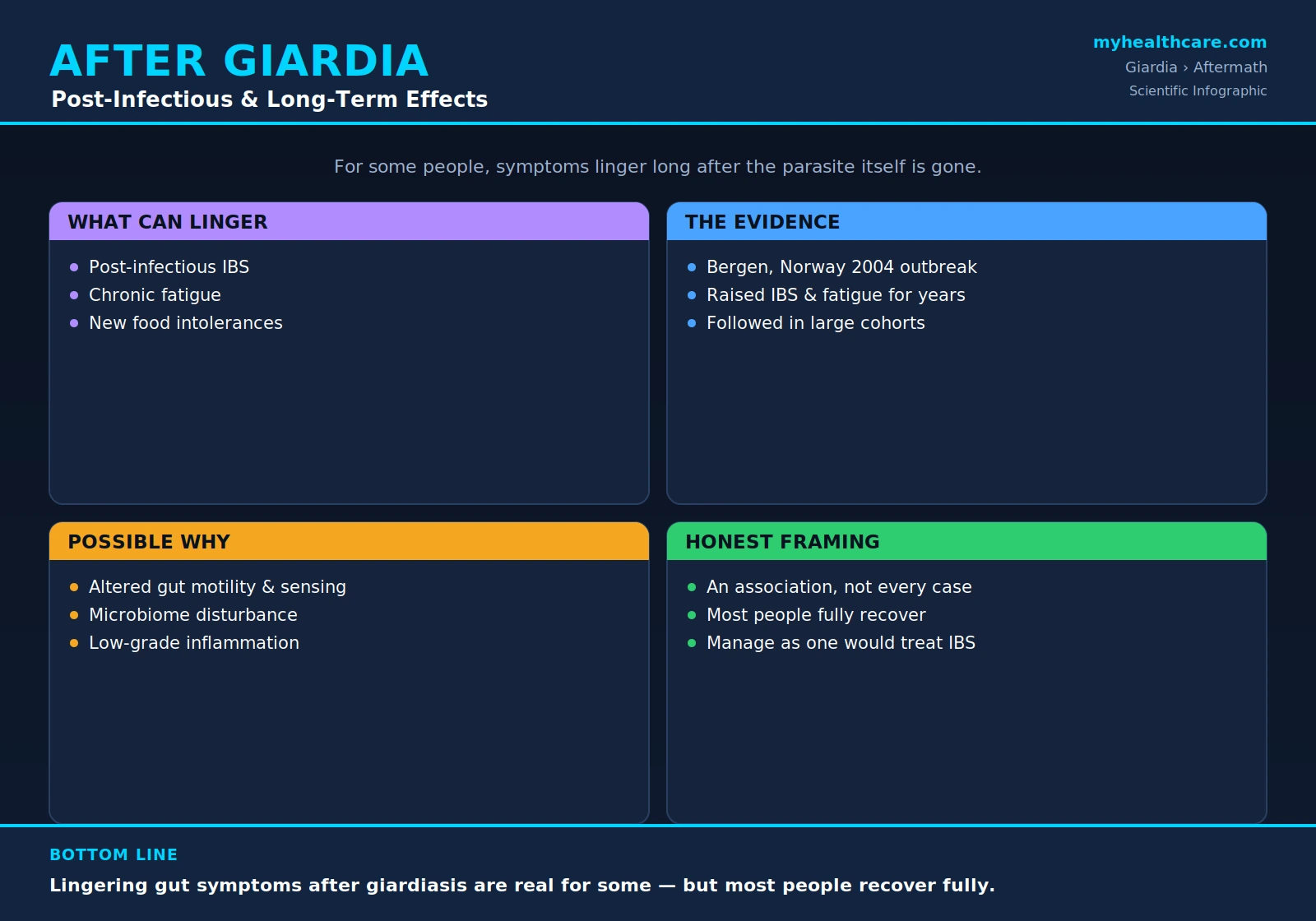
For most people, giardiasis is a passing illness: the parasite is cleared — by the body's own defenses or by a course of treatment — and life returns to normal. But a meaningful minority of people find that their symptoms do not switch off when the infection does. Months or even years after the parasite is gone, some continue to live with an unsettled gut, food intolerances, and a draining tiredness that no test seems to explain. This page is about that lasting aftermath. Much of what we know comes from a single, unusually well-studied event — a large waterborne outbreak in Bergen, Norway, in 2004 — whose survivors have now been followed for more than a decade. Those studies are the backbone of this topic, and they paint an honest, two-sided picture: the long-term effects are real and measurable, but they are associations seen in groups of people, not a fate that befalls everyone who catches Giardia. Throughout, we have tried to describe what the evidence shows without overstating what it proves.
Table of Contents
- When Symptoms Outlast the Parasite
- Post-Infectious Irritable Bowel Syndrome
- Chronic Fatigue After Giardiasis
- Persistent Food Intolerances and Lactose Intolerance
- Reactive Arthritis and Other Extra-Intestinal Associations
- Possible Mechanisms
- Long-Term Effects in Children
- How Solid Is the Evidence? An Honest Framing
- The Approach to Management
- Reassurance and When to Seek Care
- Key Research Papers
- Featured Videos
1. When Symptoms Outlast the Parasite
The first thing to understand is that "the infection is gone" and "the symptoms are gone" are two different events, and they do not always happen together. When stool tests come back clear and the parasite can no longer be found, the giardiasis itself has been cured. Yet a portion of people keep having symptoms — bloating, loose stools, cramping, urgency, and fatigue — well beyond that point. Doctors call this a post-infectious state: a lingering disturbance that the original infection set in motion but that now continues on its own, without any parasite left to fight.
This is not unique to Giardia. Other gut infections — bacterial food poisoning from Campylobacter or Salmonella, for instance — can leave the same kind of aftermath. What makes Giardia special in the medical literature is the Bergen outbreak. In the autumn of 2004, a parasite contamination of the municipal drinking water in Bergen, Norway, infected a large number of city residents at roughly the same time, from the same source. That created a rare natural experiment: a big, well-defined group of previously healthy adults who all became infected together and could be tracked for years afterward, alongside comparison groups who were not infected. Most of what this page describes about long-term effects rests on the follow-up studies of that cohort — which is both their great strength and, as we will discuss, a reason for caution.
2. Post-Infectious Irritable Bowel Syndrome
The most firmly established long-term consequence of giardiasis is post-infectious irritable bowel syndrome (IBS). Irritable bowel syndrome is a common condition in which the gut becomes oversensitive and its muscle activity becomes irregular, producing abdominal pain, bloating, and a change in bowel habit (diarrhea, constipation, or both) — all without any structural damage that a scope or scan can see. "Post-infectious" simply means the IBS began in the wake of a gut infection.
The Bergen follow-up work showed this association strikingly. Three years after the outbreak, the people who had been infected with Giardia had a markedly higher rate of irritable bowel syndrome than uninfected comparison groups — in the landmark cohort study, roughly two to three times the risk, with IBS present in a substantial fraction of the exposed. Crucially, this was not a brief tail of recovery: when the same cohort was examined again at six years and again at ten years, the excess of IBS was still there. Even a decade on, having been infected in 2004 was associated with a significantly higher chance of living with irritable bowel syndrome than not having been infected. That persistence over ten years is what makes giardiasis one of the most convincingly documented triggers of post-infectious IBS in the whole medical literature.
It is worth being precise about what this means for an individual. The studies describe elevated risk across a group: being in the infected group raised the odds of IBS, but plenty of infected people never developed it, and IBS also occurred (less often) in those who were never infected. So a person who had giardiasis and now has IBS-type symptoms has a plausible, evidence-based explanation — but the link is a statistical one, not a certainty stamped on every case. For a deeper look at the bowel symptoms themselves, see Acute and Chronic Diarrhea.
3. Chronic Fatigue After Giardiasis
Alongside the gut symptoms, the Bergen studies turned up a second, less expected aftermath: chronic fatigue. Many people who had been infected reported a deep, persistent tiredness — the kind that rest does not fix — long after their diarrhea had resolved. As with IBS, this was not a fleeting effect. Elevated rates of fatigue were documented at two years, at three years, and remained significantly raised in the infected group at the six- and ten-year follow-ups.
This finding matters for two reasons. First, fatigue is easy to dismiss or to attribute to something unrelated, yet here it was a measurable, group-level consequence of a known infection, which validates the experience of patients who feel exhausted and are told nothing is wrong. Second, the IBS and the fatigue often traveled together: people with post-giardiasis IBS were more likely also to have chronic fatigue, hinting that a shared underlying disturbance — rather than two coincidental problems — may be at work. Researchers have even looked at the immune systems of people with post-giardiasis fatigue and found lingering, Giardia-specific immune activity years after the parasite was cleared, suggesting the body's response to the infection may not fully "stand down." This remains an area of active study, and the mechanisms are far from settled. As always, the honest reading is that giardiasis is associated with later chronic fatigue in cohort data, not that it is proven to directly cause it in any given person.
4. Persistent Food Intolerances and Lactose Intolerance
A more concrete and easily explained aftermath is persistent food intolerance, and the clearest example is lactose intolerance. During an active Giardia infection, the parasite blankets the lining of the small intestine, the very surface where digestive enzymes live. One of those enzymes is lactase, which breaks down the milk sugar lactose. When the intestinal lining is inflamed and its delicate finger-like villi are blunted, lactase production falls — a state called secondary (acquired) hypolactasia. The result is that milk and dairy, previously tolerated, now cause bloating, cramps, gas, and diarrhea.
The important point for this page is that the intestinal lining can take weeks to months to fully heal after the parasite is cleared, and lactase is one of the last functions to recover. So a person can be free of Giardia yet remain temporarily lactose-intolerant while the gut surface regenerates. In most adults this is reversible — tolerance for dairy gradually returns as the lining repairs — and it is worth reassuring patients of that. Lactose intolerance after giardiasis is particularly well documented in children, in whom the loss of lactase and resulting milk intolerance was recognized decades ago. Beyond lactose, some people describe a broader, vaguer sensitivity to fatty or rich foods during the recovery window, which is consistent with a gut that is still healing. The practical takeaway is to ease off the offending foods (especially dairy) for a time, then reintroduce them gradually as the gut recovers. The malabsorption that drives these intolerances is discussed further on the Malabsorption and Weight Loss page.
5. Reactive Arthritis and Other Extra-Intestinal Associations
Although Giardia is fundamentally a gut parasite, a handful of effects reach beyond the intestine. The best-described of these is reactive arthritis — joint pain and swelling that flares after an infection somewhere else in the body, in this case the gut. The immune response mounted against the parasite is thought to spill over and inflame the joints, even though the joints themselves are never infected. Reactive arthritis after giardiasis is uncommon and is reported mainly in scattered case reports rather than large studies, so it should be understood as a recognized but rare association, not a routine outcome.
Other extra-intestinal phenomena that have been linked to Giardia in the literature include certain skin rashes (such as hives), eye inflammation, and assorted allergic-type reactions — again, mostly at the level of case reports and small series. The honest framing here is important: these associations are real enough to be documented, but they are infrequent, and a clear cause-and-effect chain is harder to prove for a rare event seen in a few patients than for the IBS-and-fatigue pattern documented in a whole outbreak cohort. They are worth knowing about — so that a puzzling joint or skin problem after giardiasis is not overlooked — without being overstated.
6. Possible Mechanisms
Why would symptoms persist after the parasite is gone? The honest answer is that nobody fully knows, but several plausible and partly overlapping mechanisms have been proposed, and the truth is probably a combination of them rather than a single cause:
- Altered gut motility and sensation. An infection can leave the gut's nerves and muscles working differently afterward — moving contents along too fast or too slowly, and signaling pain or urgency in response to normal stretching that would previously have gone unnoticed. This visceral hypersensitivity is a core feature of irritable bowel syndrome generally, and it appears to be one route by which a cleared infection leaves lasting symptoms.
- Disturbance of the gut microbiome. The trillions of bacteria that normally live in the intestine can be thrown out of balance by the infection and by any antibiotics used to treat it. A disrupted microbial community (dysbiosis) may take a long time to re-establish and is increasingly suspected of contributing to post-infectious symptoms.
- Low-grade persistent inflammation. Even after the parasite is cleared, subtle immune activity can linger in the intestinal lining. Studies of the Bergen cohort found prolonged changes in the immune cells (lymphocytes) of the duodenal lining in people with post-infectious symptoms, suggesting the gut's immune system does not simply reset to baseline.
- Post-infectious changes to the intestinal barrier and enzymes. Lingering damage to the gut lining — a "leakier" barrier, blunted villi, reduced digestive enzymes — can keep producing symptoms for a time even with no parasite present, as discussed in the lactose-intolerance section above.
The strong caveat is that these mechanisms are incompletely understood and still being worked out. They are reasonable explanations supported by research, not a closed case. This is an area where science is genuinely still learning, and any account of "the cause" of post-giardiasis symptoms should be read as provisional.
7. Long-Term Effects in Children
In children — especially in low-income, high-exposure settings where giardiasis is common and often recurrent — the concern shifts from IBS and fatigue toward growth and development. Persistent or repeated Giardia infection in early childhood damages the very part of the intestine responsible for absorbing nutrients, at exactly the age when a child is growing fastest and the brain is developing most rapidly. Large studies of children in endemic regions have linked early-childhood Giardia (and the broader picture of repeated gut infections and the chronic, low-grade intestinal injury they cause, sometimes called environmental enteropathy) with poorer physical growth — including stunting — and, in some analyses, with weaker performance on later cognitive measures.
Two points deserve emphasis, both of them about honesty. First, in these settings Giardia rarely acts alone: affected children typically face poor sanitation, inadequate diets, and a steady barrage of other infections, all of which independently harm growth and learning. Untangling the specific contribution of Giardia from that tangled background is genuinely difficult, and the research reflects that complexity — some studies find clear harm, others find more modest or mixed effects. Second, these findings come overwhelmingly from endemic, resource-poor populations and should not be read across to a well-nourished child in a high-income country who has a single, treated episode of giardiasis; the long-term growth-and-development concern is fundamentally about chronic, repeated infection against a backdrop of deprivation. The signal is real and important for global child health, but it is an association embedded in a difficult context, not a simple one-cause-one-effect rule.
8. How Solid Is the Evidence? An Honest Framing
Because so much of this page rests on the Bergen outbreak, it is worth stepping back to weigh the evidence plainly. The strengths are real: the outbreak gave researchers a large group, infected at one time from one source, who could be compared against uninfected people and followed for ten years — a far better foundation than scattered anecdotes. That is why the link between giardiasis and later IBS and fatigue is taken seriously.
But there are honest limits, and they matter:
- These are associations, not proof of cause for every patient. Cohort studies show that being infected raised the group risk of later problems. They cannot tell any single person that their current IBS or fatigue was definitely caused by the parasite rather than by something else.
- Not everyone who gets Giardia develops these effects. The great majority of people recover completely. Post-infectious IBS and fatigue affect a minority — an important minority, but a minority.
- Much of the strongest data comes from one outbreak. The Bergen cohort is exceptionally valuable precisely because such events are rare, but it is one population, in one place, with one Giardia strain. Findings may not transfer identically to every setting.
- The mechanisms are still being worked out. As section 6 explains, we have plausible explanations but no complete one.
None of this is a reason to dismiss the long-term effects — they are documented and they are real. It is simply a reason to describe them accurately: a recognized, evidence-based risk that affects some people, drawn largely from outbreak cohorts, with mechanisms not yet fully understood. That honesty is itself reassuring, because it makes clear that a lasting aftermath is the exception, not the rule.
9. The Approach to Management
If symptoms persist after treatment for giardiasis, management follows a logical two-step path: first confirm the parasite is truly gone, then treat the leftover symptoms supportively.
Step one — rule out persistent or repeat infection. Before assuming symptoms are "post-infectious," it is essential to make sure they are not simply ongoing infection. Giardia can be genuinely hard to clear in some people, and it is also easy to catch again from the same source (a contaminated water supply, an infected household member, a returning travel exposure). So the first move is to check whether the parasite is still — or once again — present, typically by repeat stool testing, and to treat it if it is. A drug-resistant or relapsing infection is a different problem with a different solution; that situation is covered on the Refractory Giardiasis and Drug Resistance page. The general principles of clearing the parasite are on the Metronidazole and Tinidazole Treatment page, and avoiding re-exposure is the subject of Prevention: Water and Hygiene.
Step two — once the parasite is confirmed cleared, treat the symptoms as you would irritable bowel syndrome. Importantly, more antiparasitic drugs are not the answer when no parasite remains — repeatedly re-treating an infection that is already gone exposes a person to side effects without benefit. Instead, the post-infectious symptoms are managed supportively, drawing on the well-established toolkit for IBS:
- Dietary adjustment — for example, temporarily limiting dairy while lactase recovers, and for some people a structured low-FODMAP approach (best done with a dietitian) to identify trigger foods.
- Symptom-targeted measures — soluble fiber, antispasmodics for cramping, and treatments aimed at the predominant bowel pattern (whether diarrhea or constipation).
- Attention to the whole person — sleep, stress, and the gut-brain connection all influence IBS symptoms, and addressing them is a legitimate part of recovery, not a suggestion that the problem is "all in the head."
- Time and reassurance — many post-infectious symptoms gradually settle over months as the gut heals, and simply knowing that can reduce the anxiety that otherwise amplifies them.
10. Reassurance and When to Seek Care
The overarching message is a hopeful one. If you have had giardiasis and are still not feeling right, you are not imagining it — lingering gut symptoms and fatigue after this infection are real and recognized. But they are also the exception: most people recover fully, and even among those with a lasting aftermath, symptoms commonly improve over time as the gut heals. A post-infectious aftermath is usually a chapter, not a life sentence.
That said, persistent symptoms always deserve a proper look rather than silent endurance. It is sensible to see a doctor if you have:
- Symptoms that continue well beyond your treatment, so the parasite can be re-checked and re-treated if it is still present.
- Warning signs that point beyond ordinary post-infectious IBS — in particular blood in the stool, unintended weight loss, fever, waking from sleep with diarrhea or pain, anemia, or a strong family history of bowel disease or celiac disease. These should prompt evaluation for other conditions and should never be assumed to be "just" post-giardiasis.
- Fatigue, joint, or skin symptoms that are severe, worsening, or interfering with daily life.
In short: confirm the parasite is gone, give the gut time and supportive care to recover, and seek care for anything that does not fit the expected pattern. For the broader clinical picture, see the Symptoms & Diagnosis hub and the Giardia Overview.
Key Research Papers
Cohort studies, follow-up analyses, and reviews on the post-infectious and long-term consequences of giardiasis — with the Bergen, Norway 2004 outbreak follow-up work as the backbone. Author names and journal titles appear as plain text; the year/volume/pages link opens the full citation via DOI.
- Wensaas KA, Langeland N, Hanevik K, Mørch K, Eide GE, Rortveit G. Irritable bowel syndrome and chronic fatigue 3 years after acute giardiasis: historic cohort study. Gut. 2012;61(2):214–219.
- Hanevik K, Wensaas KA, Rortveit G, Eide GE, Mørch K, Langeland N. Irritable Bowel Syndrome and Chronic Fatigue 6 Years After Giardia Infection: A Controlled Prospective Cohort Study. Clinical Infectious Diseases. 2014;59(10):1394–1400.
- Litleskare S, Rortveit G, Eide GE, Hanevik K, Langeland N, Wensaas KA. Prevalence of Irritable Bowel Syndrome and Chronic Fatigue 10 Years After Giardia Infection. Clinical Gastroenterology and Hepatology. 2018;16(7):1064–1072.e4.
- Litleskare S, Wensaas KA, Eide GE, Hanevik K, Kahrs GE, Langeland N, Rortveit G. Quality of life and its association with irritable bowel syndrome and fatigue ten years after giardiasis. Neurogastroenterology & Motility. 2019;31(5):e13559.
- Mørch K, Hanevik K, Rortveit G, Wensaas KA, Eide GE, Hausken T, Langeland N. High rate of fatigue and abdominal symptoms 2 years after an outbreak of giardiasis. Transactions of the Royal Society of Tropical Medicine and Hygiene. 2009;103(5):530–532.
- Hanevik K, Hæusken T, Morken MH, Strand EA, Mørch K, Coll P, Helgeland L, Langeland N. Persisting symptoms and duodenal inflammation related to Giardia duodenalis infection. Journal of Infection. 2007;55(6):524–530.
- Mørch K, Hanevik K, Rivenes AC, Bødtker JE, Næss H, Stubhaug B, Wensaas KA, Rortveit G, Eide GE, Hausken T, Langeland N. Development of functional gastrointestinal disorders after Giardia lamblia infection. BMC Gastroenterology. 2009;9:27.
- Hanevik K, Kristoffersen E, Mortensen A, Gjøen JE, Sørnes S, Rødahl E, Langeland N. Prolonged Duodenal Mucosal Lymphocyte Alterations in Patients With and Without Postinfectious Functional Gastrointestinal Disorders After Giardia Infection. The Journal of Infectious Diseases. 2019;220(2):321–329.
- Halliez MCM, Buret AG. Extra-intestinal and long term consequences of Giardia duodenalis infections. World Journal of Gastroenterology. 2013;19(47):8974–8985.
- Hanevik K, Mørch K, Eide GE, Langeland N, Hausken T. Giardiasis — why do the symptoms sometimes never stop? Trends in Parasitology. 2010;26(2):75–82.
- Hanevik K, Kristoffersen EK, Sørnes S, Mørch K, Næss H, Rivenes AC, Bødtker JE, Hausken T, Langeland N. Giardia-specific cellular immune responses in post-giardiasis chronic fatigue syndrome. BMC Immunology. 2017;18:5.
- Rana SV, Bhasin DK, Vinayak VK. Lactose-Intolerance and Hypolactasia in Children with Giardiasis. Journal of Pediatric Gastroenterology and Nutrition. 1990;11(3):424–425.
- MAL-ED Network Investigators. Relationship between growth and illness, enteropathogens and dietary intakes in the first 2 years of life: findings from the MAL-ED birth cohort study. BMJ Global Health. 2017;2(4):e000370.
- Nygård K, Schimmer B, Søbøng O, Wahl E, Røttingen JA. Waterborne outbreak of giardiasis in Bergen, Norway. Eurosurveillance Weekly. 2004;8(46):2583.
Live PubMed Searches
Each link opens a live PubMed query so results stay current as new papers are indexed.
- Post-infectious IBS after giardia
- Giardiasis and chronic fatigue follow-up
- Bergen Norway giardia outbreak cohort
- Giardia and lactose intolerance / hypolactasia
- Reactive arthritis and Giardia
- Giardia and gut microbiome disruption
- Giardia, child growth and cognition
- Extra-intestinal manifestations of Giardia
Connections
- All Parasites
- Symptoms & Diagnosis
- Acute & Chronic Diarrhea
- Malabsorption & Weight Loss
- Treatment & Prevention
- Metronidazole & Tinidazole Treatment
- Prevention: Water & Hygiene
- Refractory Giardiasis & Drug Resistance
- Giardia Overview
- Gastroenterology
- Infectious Disease
- All Conditions