Giardiasis Treatment and Prevention
Metronidazole & Tinidazole Treatment
The antiparasitic drugs that clear Giardia — the alternatives, and the safer options in pregnancy.
Read the deep dive →Prevention: Water & Hygiene
"Beaver fever," backcountry water, filters and boiling, and stopping spread in daycares.
Read the deep dive →Refractory Giardiasis & Drug Resistance
When the first drug fails — combination therapy and treatment-resistant infections.
Read the deep dive →The good news about giardiasis is that it is very treatable. A handful of inexpensive, widely available antiparasitic medicines reliably clear the parasite Giardia duodenalis (also written Giardia lamblia or Giardia intestinalis) from the gut, and most people who take a proper course feel dramatically better within days. This page is the hub for understanding both halves of the picture: how giardiasis is treated — which drugs are used, how a single dose can sometimes do the job, and what to do in pregnancy — and how it is prevented, since the parasite spreads through contaminated water and dirty hands and the same simple precautions protect a backcountry hiker, a daycare classroom, and a whole household. Along the way it explains the genuinely tricky parts: telling true treatment failure apart from plain reinfection, deciding whether a person with no symptoms even needs medicine, and why some people feel briefly worse with milk and other foods for a few weeks after the parasite is gone. Treatment information here is presented as reported in the medical literature; actual treatment is clinician-directed.
Table of Contents
- Overview: A Highly Treatable Infection
- The Drugs That Clear Giardia
- Prevention: Water, Hands, and Daycare
- When Treatment Does Not Work
- Reinfection vs. Treatment Failure
- Treatment in Pregnancy
- Treating People Without Symptoms
- Lingering Symptoms After the Parasite Is Gone
- Key Research Papers
- Featured Videos
1. Overview: A Highly Treatable Infection
Compared with many parasitic diseases, giardiasis is refreshingly straightforward to cure. The standard medicines are decades old, cheap, taken by mouth, and effective in roughly 80–95% of people on the first course — figures borne out by systematic reviews and head-to-head trials of the major drugs. For most patients, treating giardiasis means a short course of pills, a noticeable improvement within a few days, and resolution of the diarrhea, bloating, foul-smelling stools, gas, and fatigue that brought them in.
There is, however, an important nuance about who gets treated. In places where giardiasis is uncommon — such as much of the United States, Canada, and Europe — anyone found to carry the parasite is generally offered treatment, whether or not they feel sick, partly because clearing the infection also stops them from passing it to others. But in highly endemic settings — regions of the world where a large fraction of children carry Giardia at any given time and reinfection from contaminated water and food is nearly constant — the calculus changes. There, an otherwise-well person who simply tests positive may be reinfected within weeks of treatment, so treating every asymptomatic carrier can be of limited lasting benefit. The settled principle across the literature is this: symptomatic giardiasis is treated, because clearing the parasite relieves real suffering; the decision about asymptomatic carriage is more individualized and depends heavily on local epidemiology, the person's circumstances, and public-health considerations (discussed further below).
The remainder of this hub walks through the medicines, the prevention measures, the uncommon-but-real problem of infections that resist the first drug, and the practical questions — pregnancy, asymptomatic carriers, and post-treatment symptoms — that come up most often. As always, the specific drug, dose, and duration are matched to the individual by a treating clinician.
2. The Drugs That Clear Giardia
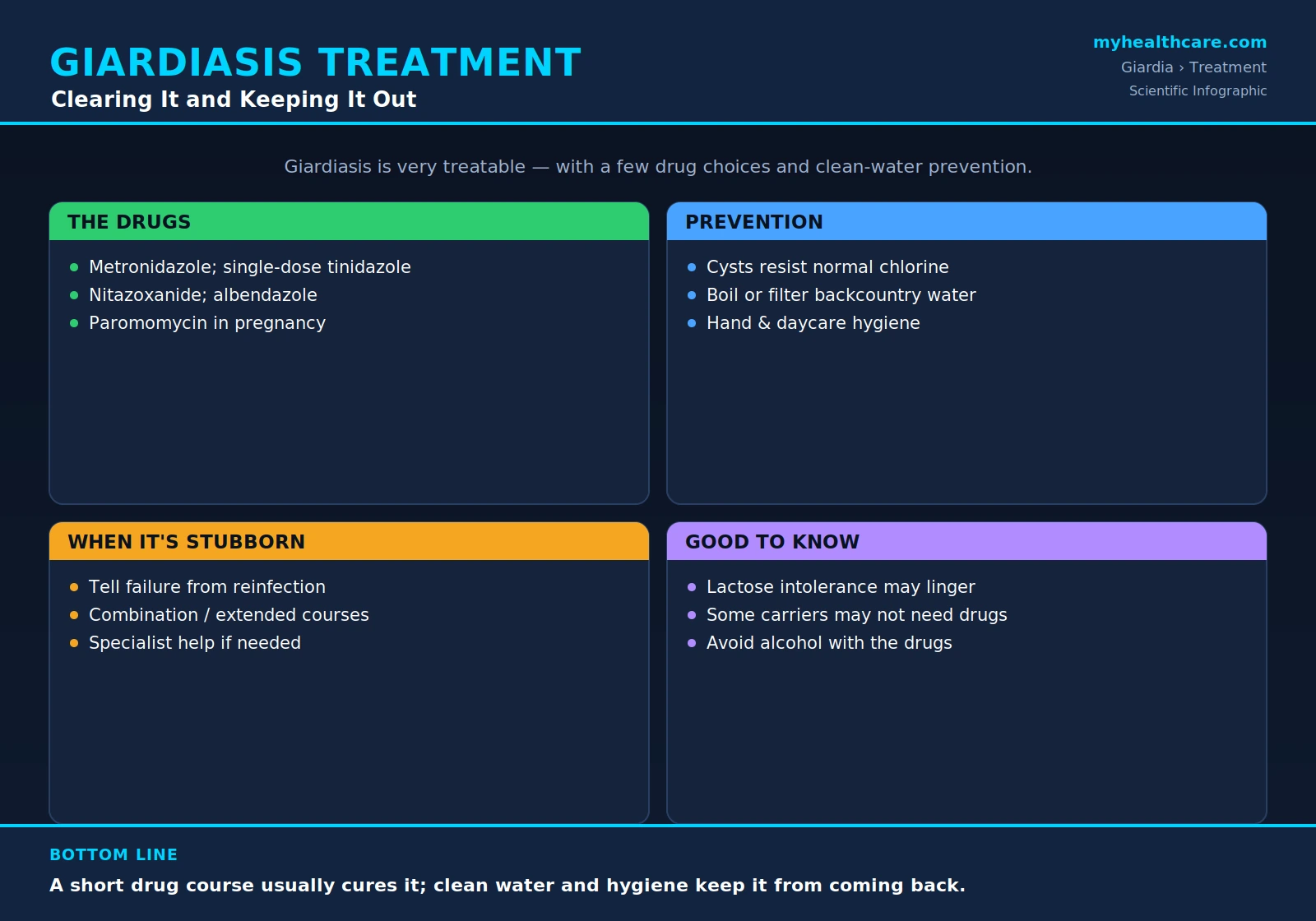
Several effective antiparasitic medicines are used against Giardia, and in most trials they perform similarly well, so the choice often comes down to dosing convenience, side effects, cost, availability, and special situations such as pregnancy. The detailed comparisons, doses, and side-effect profiles are on the dedicated Metronidazole & Tinidazole Treatment page; what follows is the overview.
- Metronidazole — the classic, most widely used first-line drug worldwide. It is taken as a multi-day course (commonly several times a day for 5–7 days). It is cheap and effective, but the multi-day schedule and side effects such as a metallic taste, nausea, and a strong reaction if combined with alcohol mean adherence can be a challenge.
- Tinidazole — a close chemical relative of metronidazole with a major practical advantage: it can often be given as a single dose. One-and-done treatment is far easier to complete, and in comparative reviews tinidazole tends to match or modestly exceed metronidazole's cure rates while being better tolerated. Where available, it is a very attractive option.
- Nitazoxanide — a broad-spectrum antiparasitic effective against Giardia (and a number of other gut bugs), typically given as a short course. It is well tolerated, comes in a liquid form useful for children, and is a good alternative for people who cannot take the nitroimidazole drugs.
- Albendazole — a benzimidazole better known as a deworming drug, which also works against Giardia over a several-day course. It is useful when a person is being treated for intestinal worms at the same time, or as part of a strategy for stubborn infections, though as a single agent it has tended to be slightly less reliable than metronidazole in some studies.
- Paromomycin — an aminoglycoside antibiotic that is poorly absorbed from the gut, so it acts mostly inside the intestine where the parasite lives. It is somewhat less potent than the other agents, but its minimal absorption makes it the preferred choice when systemic drug exposure must be avoided — most notably in pregnancy (see below).
The practical takeaway is that there is no single “best” drug for everyone: a healthy adult who wants the simplest regimen may do best with single-dose tinidazole; a child may receive nitazoxanide liquid; a pregnant woman is often given paromomycin; and someone whose first treatment fails may move to a different drug or a combination. These choices are made by a clinician using the patient's full picture.
3. Prevention: Water, Hands, and Daycare
Because giardiasis spreads when the parasite's hardy environmental form — the cyst — is swallowed, prevention is about keeping those cysts out of the mouth. The full practical guide is on the Prevention: Water & Hygiene page; here is the essential picture.
The classic waterborne route — “beaver fever.” Giardia is famous as a cause of illness in hikers, campers, and backpackers who drink from streams, lakes, or springs that look pristine but carry cysts shed by wildlife (beavers gave the infection its folk name) or by other people. Crystal-clear, cold mountain water can still be contaminated. The reliable defenses are to boil water (bringing it to a rolling boil kills cysts), to use a properly rated filter (one designed to remove particles the size of Giardia cysts), or to use water-treatment products effective against the parasite.
An important catch: ordinary chlorination is not enough. Unlike many bacteria, Giardia cysts are notably resistant to the routine levels of chlorine used to disinfect drinking water and swimming pools. This is precisely why municipal water systems rely on filtration (and sometimes ultraviolet or ozone treatment) rather than chlorine alone, and why Giardia can spread in pools, water parks, and splash pads even when the chlorine is “normal.” The lesson for individuals is that a quick chemical splash will not necessarily make sketchy water safe — boiling or proper filtration is the dependable route.
Person-to-person spread — daycare and households. Giardia also passes directly from person to person by the fecal–oral route, which makes diapered toddlers and the daycare setting a classic hot spot: cysts on hands and surfaces move easily among small children and then home to families. The single most powerful countermeasure is mundane but genuinely effective — thorough handwashing with soap and water, especially after using the toilet, after changing diapers, and before preparing or eating food. Careful diaper handling, cleaning of shared surfaces and toys, and keeping symptomatic children out of childcare while ill all help break the chain. Because cysts shrug off ordinary chlorine, people who are sick (or recently recovered) are also advised to stay out of swimming pools for a period to avoid seeding an outbreak.
4. When Treatment Does Not Work
Most people are cured by their first course of medicine, but in a minority the infection stubbornly persists despite correctly taken treatment — a situation called refractory or treatment-resistant giardiasis. This is the focus of the Refractory Giardiasis & Drug Resistance page; the overview is that genuine refractory disease is real but uncommon, and it has well-described approaches.
When a standard course fails, clinicians first make sure the problem is truly the parasite persisting (and not reinfection or a different diagnosis entirely — see the next section). For confirmed persistent infection, the usual next steps reported in the literature include switching to a different drug class (for example, moving from metronidazole to a benzimidazole such as albendazole, or vice versa), using a higher dose or longer course, and — for the hardest cases — combination therapy, in which two drugs from different classes (such as a nitroimidazole plus albendazole) are given together to overcome resistance. Drug resistance in Giardia is recognized in laboratory studies and is thought to underlie some real-world failures, which is the rationale for combining drugs that attack the parasite by different mechanisms. These are specialist decisions, individualized to the patient.
5. Reinfection vs. Treatment Failure
One of the most practically important distinctions in managing giardiasis is also one of the most commonly muddled: when symptoms return after treatment, is it because the original infection was never fully cleared (treatment failure), or because the person caught the parasite again from a fresh exposure (reinfection)? The two look identical from the outside — the same diarrhea and bloating come back — but they call for different responses.
Reinfection is common wherever the source of exposure is still present: a contaminated home water supply, an ongoing daycare outbreak, an untreated household member who keeps passing cysts around, or repeated drinking from the same unsafe water on continued travel. In this situation the first treatment worked perfectly well — the parasite was cleared — but the person simply swallowed new cysts afterward. The fix is not necessarily a different or stronger drug; it is the same effective treatment again plus removing the source: fixing the water, treating infected contacts, and tightening hygiene. Treating the patient over and over while ignoring an ongoing exposure is a recipe for frustration.
True treatment failure, by contrast, means the original infection persisted through a properly taken course — the scenario that raises the question of refractory disease and drug resistance discussed above. The clues clinicians weigh include the timing of relapse (symptoms that never really cleared, or returned within days, point more to failure; a clean recovery followed weeks later by new symptoms points more to reinfection), whether the person had a plausible new exposure, and whether the household and water source are still contaminated. Distinguishing the two matters because it determines whether the next move is to escalate the drug regimen or to clean up the environment — and often both are needed.
6. Treatment in Pregnancy
Giardiasis in pregnancy deserves special handling, because the goal is to relieve the mother's illness and prevent complications such as dehydration and poor nutrient absorption while minimizing any drug exposure to the developing baby. The detailed discussion lives on the Metronidazole & Tinidazole Treatment page; the headline is that the choice of drug shifts in pregnancy specifically to limit how much medicine reaches the fetus.
The reason paromomycin is often favored in pregnancy is precisely its biggest “weakness” as a drug: it is very poorly absorbed from the gut. Because it stays largely inside the intestine and little of it enters the mother's bloodstream, very little can reach the fetus — an appealing safety profile when treating a pregnant woman. It is somewhat less potent than the nitroimidazoles, but for a mild-to-moderate infection in pregnancy that trade-off is often worth it. Timing also matters: when symptoms are mild, clinicians may defer treatment until after the first trimester (the period of greatest fetal sensitivity) or even until after delivery, treating sooner only when the mother's symptoms are severe enough to require it. As with all treatment decisions, the drug and timing in pregnancy are chosen by the clinician weighing the severity of illness against fetal safety.
7. Treating People Without Symptoms
A surprisingly large share of people carrying Giardia have no symptoms at all — the parasite is found incidentally, or on a test done for another reason. Whether to treat these asymptomatic carriers is a genuine judgment call rather than a fixed rule, and the answer depends heavily on the setting.
In low-prevalence countries (for example, the United States and much of Europe), an asymptomatic person who tests positive is often treated anyway, for two main reasons: it eliminates the small chance the infection will later cause symptoms, and — importantly — it stops the carrier from shedding cysts and infecting others, which is especially relevant for food handlers, childcare workers, and members of households with vulnerable people. Treatment is also commonly recommended for asymptomatic carriers who live with someone at higher risk, such as a pregnant woman or a person with a weakened immune system or cystic fibrosis.
In highly endemic settings, the picture is different. Where a large fraction of the community — particularly young children — is colonized and where reinfection from contaminated water and food is nearly continuous, treating every symptom-free carrier offers little durable benefit, because the person is likely to pick the parasite up again soon after. In those circumstances, scarce treatment is generally directed at people who are actually sick. The unifying principle across all settings is that symptomatic infection is treated, while the decision to treat asymptomatic carriage is individualized — shaped by local prevalence, the likelihood of reinfection, the risk the carrier poses to others, and public-health priorities. This too is decided case by case with a clinician.
8. Lingering Symptoms After the Parasite Is Gone
A point that reassures many patients: it is common to feel not-quite-right for a while even after the medicine has successfully cleared the parasite. The drugs kill Giardia efficiently, but the gut lining needs time to recover from the damage the infection caused, and during that recovery some symptoms can linger or even briefly seem to worsen with certain foods. This usually does not mean the treatment failed.
The best-recognized example is temporary lactose intolerance. Giardia blunts the tiny absorptive projections (microvilli) on the surface of the small intestine, and these surfaces carry the enzyme lactase that digests the milk sugar lactose. When the lining is injured, lactase activity drops, so milk and dairy can suddenly cause bloating, gas, cramps, and loose stools — even though the parasite is already gone. As the gut heals over days to a few weeks, lactase activity returns and dairy is usually tolerated again. In the meantime, temporarily cutting back on milk and lactose-containing foods often eases these symptoms. (This lactose intolerance is the same mechanism that contributes to malabsorption during active infection — see Malabsorption and Weight Loss.)
For a smaller group of people, gut symptoms persist well beyond the expected healing window — a recognized phenomenon in which an episode of giardiasis can be followed by lasting post-infectious irritable bowel syndrome and chronic fatigue in some individuals, documented in long-term follow-up of large outbreaks. These longer-term consequences are covered on the Post-Infectious and Long-Term Effects page. The key message for the typical patient, though, is encouraging: short-lived symptoms after treatment — especially after dairy — are usually a sign of a healing gut, not a sign that the parasite has won. Persistent or worsening symptoms should always be evaluated by a clinician, who can sort out healing from reinfection, treatment failure, or another condition entirely.
Key Research Papers
Peer-reviewed reviews, systematic reviews, randomized comparisons, and long-term cohort studies on the drug treatment of giardiasis, drug resistance, and the consequences that follow infection. Journal names appear as plain text; the year/volume/pages link opens the full citation via DOI.
- Gardner TB, Hill DR. Treatment of Giardiasis. Clinical Microbiology Reviews. 2001;14(1):114–128. — doi:10.1128/CMR.14.1.114-128.2001
- Escobedo AA, Cimerman S. Giardiasis: a Pharmacotherapy Review. Expert Opinion on Pharmacotherapy. 2007;8(12):1885–1902. — doi:10.1517/14656566.8.12.1885
- Granados CE, Reveiz L, Uribe LG, Criollo CP. Drugs for Treating Giardiasis. Cochrane Database of Systematic Reviews. 2012;(12):CD007787. — doi:10.1002/14651858.CD007787.pub2
- Ordóñez-Mena JM, McCarthy ND, Fanshawe TR. Comparative Efficacy of Drugs for Treating Giardiasis: a Systematic Update of the Literature and Network Meta-Analysis of Randomized Clinical Trials. Journal of Antimicrobial Chemotherapy. 2018;73(3):596–606. — doi:10.1093/jac/dkx430
- Solaymani-Mohammadi S, Genkinger JM, Loffredo CA, Singer SM. A Meta-analysis of the Effectiveness of Albendazole Compared with Metronidazole as Treatments for Infections with Giardia duodenalis. PLoS Neglected Tropical Diseases. 2010;4(5):e682. — doi:10.1371/journal.pntd.0000682
- Pasupuleti V, Escobedo AA, Deshpande A, Thota P, Roman Y, Hernandez AV. Efficacy of 5-Nitroimidazoles for the Treatment of Giardiasis: a Systematic Review and Meta-analysis of Randomized Controlled Trials. PLoS Neglected Tropical Diseases. 2014;8(3):e2733. — doi:10.1371/journal.pntd.0002733
- Watkins RR, Eckmann L. Treatment of Giardiasis: Current Status and Future Directions. Current Infectious Disease Reports. 2014;16(2):396. — doi:10.1007/s11908-014-0396-y
- Adam RD. Biology of Giardia lamblia. Clinical Microbiology Reviews. 2001;14(3):447–475. — doi:10.1128/CMR.14.3.447-475.2001
- Halliez MCM, Buret AG. Extra-intestinal and Long-Term Consequences of Giardia duodenalis Infections. World Journal of Gastroenterology. 2013;19(47):8974–8985. — doi:10.3748/wjg.v19.i47.8974
- Litleskare S, Rortveit G, Eide GE, Hanevik K, Langeland N, Wensaas KA. Prevalence of Irritable Bowel Syndrome and Chronic Fatigue 10 Years After Giardia Infection. Clinical Gastroenterology and Hepatology. 2018;16(7):1064–1072.e4. — doi:10.1016/j.cgh.2018.01.022
PubMed Topic Searches
Each link opens a live PubMed query so results stay current as new papers are indexed.
- PubMed: Giardiasis treatment
- PubMed: Giardia metronidazole tinidazole
- PubMed: Giardia nitazoxanide
- PubMed: Refractory giardiasis and drug resistance
- PubMed: Giardia paromomycin in pregnancy
- PubMed: Giardia waterborne transmission and prevention
- PubMed: Giardia cysts and chlorine resistance
- PubMed: Post-infectious IBS after giardiasis
Connections
- All Parasites
- Giardiasis Symptoms & Diagnosis
- Acute & Chronic Diarrhea
- Malabsorption & Weight Loss
- Post-Infectious & Long-Term Effects
- Metronidazole & Tinidazole Treatment
- Prevention: Water & Hygiene
- Refractory Giardiasis & Drug Resistance
- Giardia Overview
- Gastroenterology
- Infectious Disease
- All Conditions