Giardiasis Treatment: Metronidazole, Tinidazole, and Alternatives
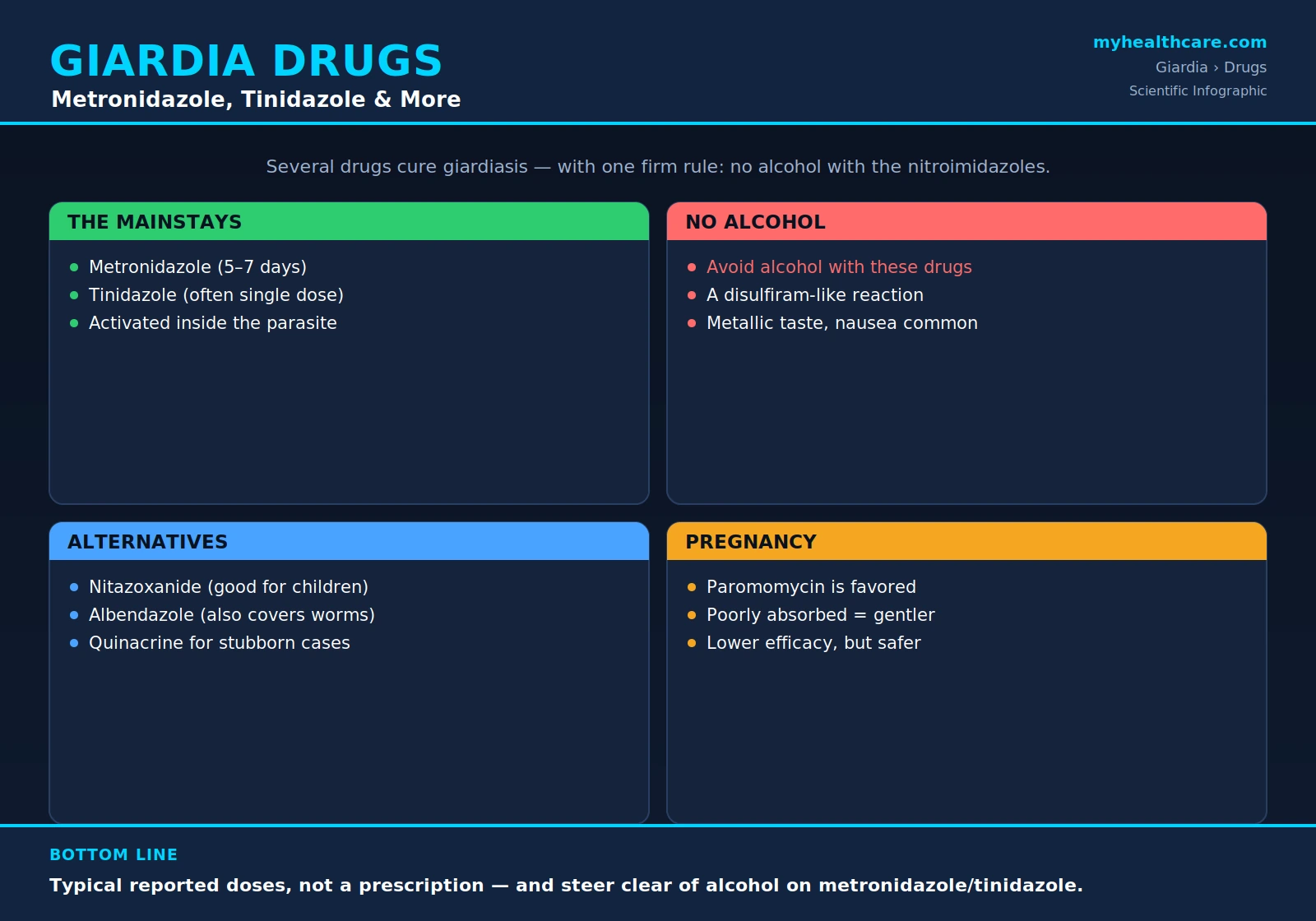
Giardiasis — an intestinal infection caused by the parasite Giardia duodenalis (also called Giardia lamblia or Giardia intestinalis) — is, for most people, a very treatable illness. A short course of the right drug clears the parasite and ends the diarrhea, bloating, gas, and greasy stools it causes. This page is about the medicines themselves: how they are chosen, how they work, how well they work, what side effects to expect, and the few but important counseling points (above all, avoiding alcohol with the most common drugs). The long-standing standard is metronidazole; its close relative tinidazole often cures the infection in a single dose and is usually easier to tolerate. Several good alternatives exist for children, for pregnancy, and for stubborn cases. The doses given below are typical reported ranges as described in the medical literature, not a prescription — actual treatment is clinician-directed, and the right drug and dose depend on your age, your other health conditions, whether you are pregnant, and what is available where you live.
Table of Contents
- Choosing a Drug: The Big Picture
- The Nitroimidazoles: Metronidazole and Tinidazole
- How the Nitroimidazoles Work
- Typical Cure Rates
- Side Effects and Counseling (Including Alcohol)
- Nitazoxanide: A Useful Alternative, Especially in Children
- Albendazole: The Benzimidazole Option
- Paromomycin: The Drug of Choice in Pregnancy
- Quinacrine: An Old Drug for Stubborn Cases
- The Pregnancy Approach
- Dosing in Children
- When First-Line Drugs Fail
- Key Research Papers
- Featured Videos
1. Choosing a Drug: The Big Picture
Several drugs reliably cure giardiasis, and in many head-to-head studies they perform similarly. That is good news: it means a clinician can match the drug to the person rather than being forced into one option. A few simple questions usually drive the choice.
- Is the patient pregnant? This is the single most important question, because it pushes the choice toward paromomycin and away from the usual first-line drugs (see The Pregnancy Approach).
- Is the patient a young child? A liquid that tastes acceptable matters enormously. Nitazoxanide comes as a suspension and is a popular pediatric choice.
- Does the patient also have, or might they have, intestinal worms? Albendazole treats Giardia and, as a bonus, the common soil-transmitted worms (roundworm, hookworm, whipworm) in one drug — handy in regions where these overlap.
- How important is a one-and-done dose? Tinidazole often clears the infection with a single dose, which can dramatically improve the chance the treatment is actually completed.
- Has a previous course already failed? That changes the strategy entirely toward longer or combination regimens (see When First-Line Drugs Fail).
It is also worth saying that not every person who tests positive necessarily needs treatment, and that re-checking after treatment is sometimes appropriate — but those are clinical judgments. The rest of this page focuses on the drugs themselves.
2. The Nitroimidazoles: Metronidazole and Tinidazole
The nitroimidazoles — a small family of related antibiotics — are the mainstay of giardiasis treatment worldwide. Two members dominate: metronidazole and tinidazole.
Metronidazole is the long-standing standard. It has been used against Giardia for decades, it is inexpensive and almost universally available, and clinicians everywhere are familiar with it. The catch is the schedule: metronidazole is typically given as a course lasting about 5 to 7 days (a commonly reported adult regimen is roughly 250–500 mg taken three times a day for 5–7 days). Several days of pills, taken faithfully, is a real-world hurdle — people feel better partway through and stop, or simply forget a dose — and the drug's side effects (see below) can make the full course unpleasant.
Tinidazole is a newer, closely related nitroimidazole that addresses both of those problems. Its great practical advantage is that it is usually given as a single dose (a commonly reported adult dose is 2 g taken once with food). A single supervised or self-administered dose all but guarantees the treatment is completed. In comparative studies, tinidazole's cure rates are at least as good as — and often better than — metronidazole's, and it tends to be better tolerated, with somewhat fewer of the gastrointestinal complaints that plague longer metronidazole courses. For many adults, that combination — comparable or better efficacy, fewer side effects, and one dose instead of fifteen or twenty — makes tinidazole the more attractive of the two where it is available and affordable.
Two other nitroimidazoles, ornidazole and secnidazole, are also used for giardiasis in some countries and behave similarly to tinidazole (often single-dose, generally well tolerated), but they are less widely available than metronidazole and tinidazole.
3. How the Nitroimidazoles Work
The nitroimidazoles are an elegant example of a drug that is, in effect, a prodrug switched on by the target itself. The drug molecule carries a chemical group (a nitro group) that is inert until it is chemically reduced — that is, until it gains electrons. Giardia lives in the oxygen-poor environment of the small intestine and runs an unusual, low-oxygen (anaerobic) energy metabolism. Inside the parasite, electron-shuttling proteins built for that anaerobic metabolism hand electrons to the drug's nitro group, “activating” it and turning it into a short-lived, highly reactive form.
That activated molecule then attacks the parasite's own machinery — most importantly, it damages the parasite's DNA, breaking strands and disrupting the genetic instructions the cell needs to survive and divide. The parasite is essentially poisoned by a weapon it armed itself. Because human cells, bathed in oxygen, do not reduce and activate the drug the same way, the damage is concentrated on the anaerobic parasite rather than on us. This same mechanism is why nitroimidazoles work against other anaerobic organisms (such as Trichomonas, Entamoeba histolytica, and many anaerobic bacteria) and why oxygen-rich human tissues are relatively spared. The detailed chemistry of this activation-and-DNA-damage pathway has been worked out over many years (Edwards, 1993).
4. Typical Cure Rates
For a single, standard course in an otherwise healthy person, the first-line drugs cure giardiasis in the great majority of cases. Reported cure rates for a metronidazole course commonly fall in the range of roughly 80–90%, and single-dose tinidazole is generally reported to be comparable or slightly higher. Nitazoxanide and albendazole, in the studies that compare them head-to-head, land in broadly the same neighborhood, though individual trials vary.
Two points keep these numbers honest. First, study results scatter, because trials differ in the dose used, the population studied (children versus adults, well-nourished versus malnourished), the local parasite strains, and how “cure” was confirmed. Systematic reviews and Cochrane analyses have repeatedly found the underlying trials to be modest in size and quality, so the precise rankings between drugs should be read as “roughly equivalent” rather than as a strict podium (Granados et al., 2012; Solaymani-Mohammadi et al., 2010; Pasupuleti-style comparisons summarized in pharmacotherapy reviews). Second, a single course failing does not usually mean the drugs have stopped working in general — re-treatment, often with a different drug or a longer schedule, succeeds in most of those cases (see When First-Line Drugs Fail).
5. Side Effects and Counseling (Including Alcohol)
The nitroimidazoles are generally safe, but they have a characteristic set of side effects worth knowing in advance, because expecting them makes them easier to tolerate.
- Metallic taste — a persistent, unpleasant metallic or bitter taste in the mouth is the classic, almost signature side effect of metronidazole. It is harmless and fades after the drug is stopped.
- Nausea and stomach upset — queasiness, loss of appetite, and abdominal discomfort are common, and are part of why the longer metronidazole course can be hard to finish. Taking the drug with food often helps.
- Headache and dizziness — frequent and usually mild.
- Dark urine — metronidazole can harmlessly darken the urine; it is not a sign of harm.
- Rare neurological effects — with prolonged or high-dose use, tingling or numbness in the hands and feet (peripheral neuropathy) can occur and is a reason to stop the drug. This is uncommon with the short courses used for giardiasis.
The single most important counseling point is alcohol. Patients must be told to avoid all alcohol while taking metronidazole or tinidazole, and for a short period afterward — commonly advised as at least 48 hours after the last dose of metronidazole, and at least 72 hours after tinidazole (the longer window reflects how much longer tinidazole stays in the body). The reason is a so-called disulfiram-like reaction: these drugs interfere with the body's breakdown of alcohol, allowing a toxic intermediate (acetaldehyde) to build up. The result can be intense flushing, throbbing headache, nausea and vomiting, rapid heartbeat, and a feeling of being acutely unwell — the same kind of reaction the alcohol-deterrent drug disulfiram is designed to produce. This includes hidden sources of alcohol such as some mouthwashes, cough syrups, and “non-alcoholic” preparations that still contain a little ethanol. Tinidazole tends to be better tolerated overall than metronidazole, but the alcohol warning applies fully to both.
By contrast, the alternative drugs below (nitazoxanide, albendazole, paromomycin) do not carry this alcohol interaction, which is occasionally a practical reason to choose one of them.
6. Nitazoxanide: A Useful Alternative, Especially in Children
Nitazoxanide is a broad-spectrum antiparasitic and antiprotozoal drug that is an effective alternative to the nitroimidazoles for giardiasis. It works by a different route — it interferes with an enzyme (pyruvate:ferredoxin oxidoreductase) that anaerobic organisms like Giardia depend on for their energy metabolism — which is part of why it can succeed even in some cases where nitroimidazoles have not.
Its standout practical feature is that it is available as an oral suspension, which makes it especially well suited to children, who often cannot or will not swallow tablets and for whom the metallic taste of metronidazole is a hard sell. A commonly reported regimen is a twice-daily dose for 3 days (in young children, doses are age- or weight-banded; see Dosing in Children). In a randomized trial in Peruvian children, nitazoxanide cured symptomatic giardiasis at rates comparable to metronidazole (Ortiz et al., 2001), and reviews of its use in children have found it effective and well tolerated, with the convenience of a palatable liquid (Bailey & Erramouspe, 2004). Nitazoxanide is generally well tolerated; its side effects are usually mild (abdominal pain, occasional greenish-yellow discoloration of the urine) and it does not require the alcohol restriction of the nitroimidazoles. It has also been used successfully in some nitroimidazole-resistant infections (Abboud et al., 2001).
7. Albendazole: The Benzimidazole Option
Albendazole belongs to a different drug family, the benzimidazoles, which are best known as anti-worm (anthelmintic) medicines. Albendazole also has genuine activity against Giardia: it binds to the parasite's structural protein tubulin, disrupting the cytoskeleton and the parasite's ability to attach to the gut lining and divide.
Albendazole offers two practical attractions. First, it tends to produce fewer gastrointestinal side effects than metronidazole and lacks the metallic taste and the alcohol interaction, which can make it easier to take. Second, and uniquely useful in many parts of the world, it carries a bonus: the very same drug also clears the common soil-transmitted intestinal worms (roundworm, hookworm, whipworm). In settings where Giardia and these worms frequently coexist, a single drug can address both, which is efficient and cost-effective. A randomized study found albendazole comparable to metronidazole for adult giardiasis (Karabay et al., 2004), though a meta-analysis suggested metronidazole may be modestly more effective overall, with albendazole's better tolerability as the trade-off (Solaymani-Mohammadi et al., 2010). A commonly reported adult regimen is 400 mg once daily for 5 days. Albendazole is sometimes used together with a nitroimidazole as combination therapy, a strategy that comes into its own for difficult or treatment-resistant infections (see When First-Line Drugs Fail).
8. Paromomycin: The Drug of Choice in Pregnancy
Paromomycin is an aminoglycoside antibiotic with an unusual and clinically valuable property: when taken by mouth, it is very poorly absorbed from the gut. Most of the dose stays inside the intestine, acting directly on the parasites there, and only a tiny fraction enters the rest of the body and the bloodstream.
That “weakness” is exactly why paromomycin is preferred in pregnancy. Because so little of the drug is absorbed, very little can reach the placenta and the developing baby — which makes it an attractive choice when the goal is to treat the mother's gut infection while minimizing fetal exposure. The trade-off is honest and worth stating: paromomycin is generally considered somewhat less effective than the nitroimidazoles at fully clearing Giardia. In pregnancy, that reduced efficacy is an accepted compromise in exchange for its favorable safety profile, and a course can be repeated or a different approach taken after delivery if needed. A commonly reported regimen is a divided daily dose given for 5 to 10 days. Outside of pregnancy, paromomycin is a second-line agent, used mainly when the first-line drugs are unsuitable.
9. Quinacrine: An Old Drug for Stubborn Cases
Quinacrine (also spelled mepacrine) is one of the oldest drugs used against Giardia — it was a mainstay decades ago, before the nitroimidazoles took over. It is effective, but it fell out of routine use because it can cause more troublesome side effects (nausea and vomiting, headache, dizziness, a harmless yellow discoloration of the skin, and, uncommonly, mood or psychiatric disturbances) and because it became difficult to obtain in many countries.
Today quinacrine is mainly reserved for stubborn, hard-to-cure cases — infections that have already failed standard drugs — where its proven effectiveness justifies tolerating its drawbacks. It is frequently used as part of a combination regimen (for example, quinacrine together with metronidazole or tinidazole) for refractory giardiasis. Classic case series of patients with treatment-refractory disease found that quinacrine-containing combinations succeeded where single first-line drugs had repeatedly failed (Nash et al., 2001), and more recent reports continue to support quinacrine for nitroimidazole-refractory infection (see the refractory-disease reviews cited below). Because availability is limited and monitoring is needed, quinacrine is generally a specialist's tool rather than a first prescription.
10. The Pregnancy Approach
Pregnancy changes the calculus, because the priority shifts to protecting the developing baby while still relieving the mother's illness. Two themes guide the usual approach.
First, clinicians often defer or avoid treatment in the first trimester when symptoms are mild. The earliest weeks are when the baby's organs are forming and when caution about any drug is greatest; if a pregnant woman's giardiasis is only mildly symptomatic, it may be reasonable to manage her supportively (hydration, nutrition) and delay specific antiparasitic treatment until later in pregnancy, when it is needed more clearly and felt to be safer. Severe symptoms — dehydration, an inability to keep down food and fluids, significant weight loss — can change that judgment and prompt treatment regardless of trimester.
Second, when a drug is used, the approach generally favors paromomycin precisely because so little of it is absorbed and reaches the baby (see Paromomycin). Metronidazole has a long record of use in pregnancy and is often considered acceptable in the second and third trimesters when a nitroimidazole is genuinely needed, but many clinicians prefer to avoid it in the first trimester and lean on paromomycin's minimal absorption as the more conservative choice. All of this is individualized: the decision weighs how sick the mother is, how far along the pregnancy is, and what is available — and it is firmly a clinician's call.
11. Dosing in Children
Children get giardiasis often — daycare centers and households with toddlers are classic settings — and the same drug families are used, with the dose scaled to the child's weight and with extra attention to palatability and ease of administration.
- Nitazoxanide is a favorite in young children precisely because it comes as a suspension and is dosed in convenient age bands (for example, a lower dose for ages 1–3, a higher one for ages 4–11), usually twice daily for 3 days. Trials in children have shown good cure rates and good tolerability (Ortiz et al., 2001; Escobedo et al., 2008).
- Tinidazole can be used in children as a single weight-based dose (commonly cited as about 50 mg per kilogram, up to the adult maximum), which shares all the advantages of one-and-done dosing — though the tablet form and taste can be obstacles in the very young.
- Metronidazole is used in children as a weight-based dose divided over a 5–7 day course, with the same caveats about taste and the multi-day schedule that apply in adults.
- Albendazole, given as a short daily course, is another reasonable pediatric option, particularly where intestinal worms may also be present.
The specific milligram amounts are weight-dependent and are set by the prescribing clinician; the figures above are typical reported ranges, not a prescription. The practical theme is consistent: in children, a drug that tastes acceptable and can be finished is often worth as much as one with the highest cure rate on paper.
12. When First-Line Drugs Fail
Most giardiasis is cured by a single course of a first-line drug. But a minority of infections persist or return after treatment — sometimes because of reinfection or incomplete treatment, sometimes because of genuinely drug-tolerant parasites. When that happens, simply repeating the same drug is often not the best move.
Instead, the strategy shifts toward longer courses, switching drug classes, or combining drugs — for example, a nitroimidazole given for a longer period, a nitroimidazole plus albendazole, or quinacrine-based combinations for the most resistant cases. These approaches, the question of true drug resistance, and how clinicians work through a treatment that has not worked are covered in depth on the companion page: Refractory Giardiasis and Drug Resistance. The reassuring bottom line is that even infections that defeat the first attempt are almost always curable with a thoughtfully chosen second or third regimen.
The drugs and doses on this page are described as reported in the medical literature; actual treatment is clinician-directed, and the doses are typical reported ranges, not a prescription. If you think you have giardiasis, see a clinician for diagnosis and an individualized treatment plan.
Key Research Papers
Peer-reviewed reviews, randomized trials, and meta-analyses on the drug treatment of giardiasis. Journal names appear as plain text; the year/volume/pages link opens the full citation via DOI.
- Gardner TB, Hill DR. Treatment of Giardiasis. Clinical Microbiology Reviews. 2001;14(1):114–128.
- Granados CE, Reveiz L, Uribe LG, Criollo CP. Drugs for Treating Giardiasis. Cochrane Database of Systematic Reviews. 2012;(12):CD007787.
- Escobedo AA, Cimerman S. Giardiasis: A Pharmacotherapy Review. Expert Opinion on Pharmacotherapy. 2007;8(12):1885–1902.
- Solaymani-Mohammadi S, Genkinger JM, Loffredo CA, Singer SM. A Meta-Analysis of the Effectiveness of Albendazole Compared with Metronidazole as Treatments for Infections with Giardia duodenalis. PLoS Neglected Tropical Diseases. 2010;4(5):e682.
- Ortiz JJ, Ayoub A, Gargala G, Chegne NL, Favennec L. Randomized Clinical Study of Nitazoxanide Compared to Metronidazole in the Treatment of Symptomatic Giardiasis in Children from Northern Peru. Alimentary Pharmacology & Therapeutics. 2001;15(9):1409–1415.
- Bailey JM, Erramouspe J. Nitazoxanide Treatment for Giardiasis and Cryptosporidiosis in Children. Annals of Pharmacotherapy. 2004;38(4):634–640.
- Escobedo AA, Alvarez G, González ME, Almirall P, Cañete R, Cimerman S, et al. The Treatment of Giardiasis in Children: Single-Dose Tinidazole Compared with 3 Days of Nitazoxanide. Annals of Tropical Medicine & Parasitology. 2008;102(3):199–207.
- Karabay O, Tamer A, Gunduz H, Kayas D, Arinc H, Celebi H. Albendazole versus Metronidazole Treatment of Adult Giardiasis: An Open Randomized Clinical Study. World Journal of Gastroenterology. 2004;10(8):1215–1217.
- Edwards DI. Nitroimidazole Drugs — Action and Resistance Mechanisms I. Mechanism of Action. Journal of Antimicrobial Chemotherapy. 1993;31(1):9–20.
- Nash TE, Ohl CA, Thomas E, Subramanian G, Keiser P, Moore TA. Treatment of Patients with Refractory Giardiasis. Clinical Infectious Diseases. 2001;33(1):22–28.
- Lalle M, Hanevik K. Treatment-Refractory Giardiasis: Challenges and Solutions. Infection and Drug Resistance. 2018;11:1921–1933.
- Mørch K, Hanevik K. Giardiasis Treatment: An Update with a Focus on Refractory Disease. Current Opinion in Infectious Diseases. 2020;33(5):355–364.
- Watkins RR, Eckmann L. Treatment of Giardiasis: Current Status and Future Directions. Current Infectious Disease Reports. 2014;16(2):396.
- Abboud P, Lemée V, Gargala G, Brasseur P, Ballet JJ, Borsa-Lebas F, et al. Successful Treatment of Metronidazole- and Albendazole-Resistant Giardiasis with Nitazoxanide in a Patient with Acquired Immunodeficiency Syndrome. Clinical Infectious Diseases. 2001;32(12):1792–1794.
Live PubMed Searches
Each link opens a live PubMed query so results stay current as new papers are indexed.
- Giardiasis treatment with metronidazole
- Tinidazole single-dose giardiasis
- Nitazoxanide giardiasis in children
- Albendazole versus metronidazole for giardiasis
- Paromomycin for giardiasis in pregnancy
- Quinacrine for refractory giardiasis
- Nitroimidazole mechanism of action
- Giardia duodenalis drug resistance
Connections
- All Parasites
- Symptoms & Diagnosis
- Acute and Chronic Diarrhea
- Malabsorption and Weight Loss
- Post-Infectious and Long-Term Effects
- Treatment & Prevention
- Prevention: Water and Hygiene
- Refractory Giardiasis and Drug Resistance
- Giardia Overview
- Gastroenterology
- Infectious Disease
- All Conditions