Preventing Giardiasis: Water and Hygiene
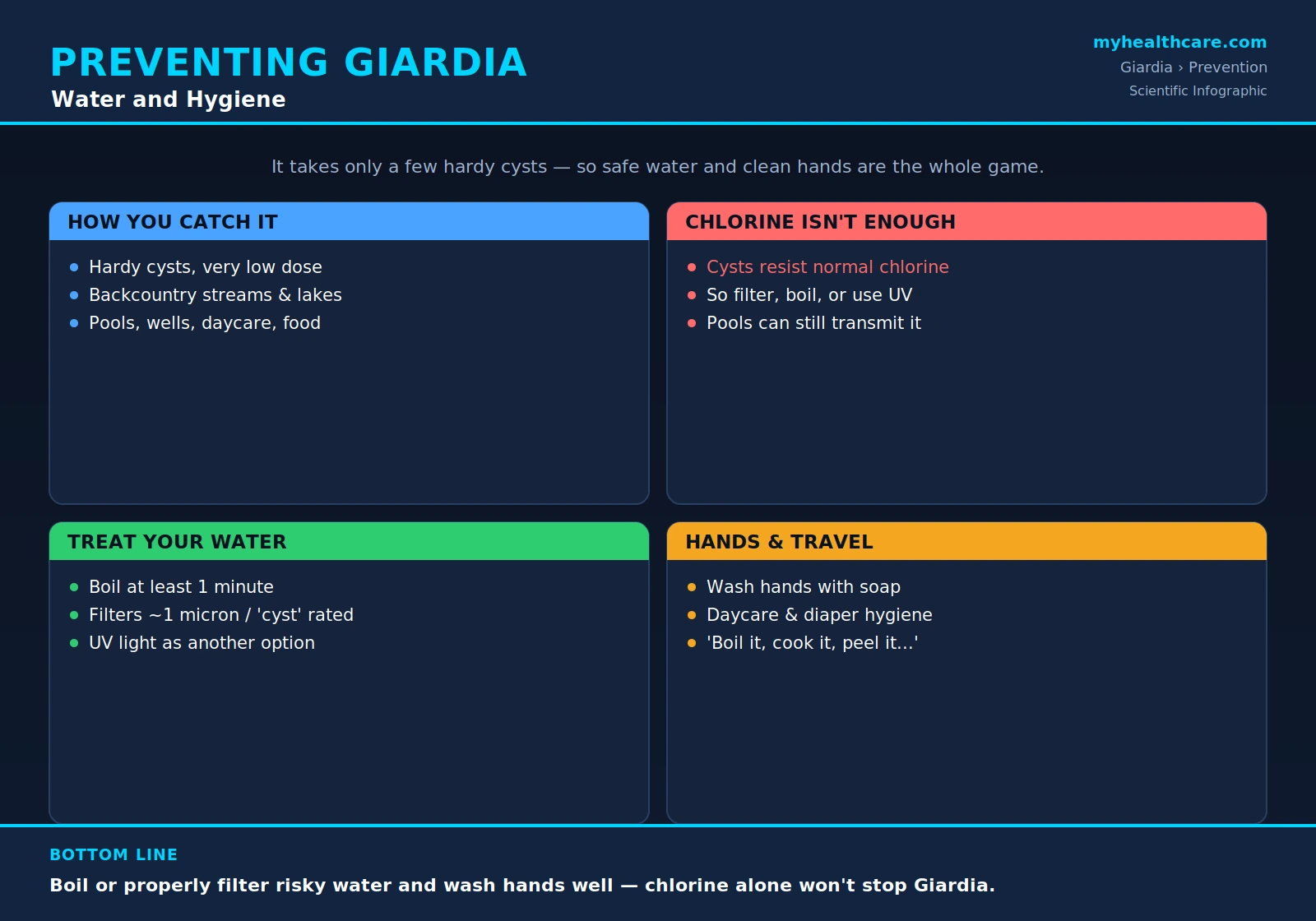
Giardiasis is one of the most common waterborne infections in the world, and the good news is that it is also one of the most preventable. Giardia spreads when tiny, hardy egg-like packages of the parasite — called cysts — are swallowed, usually in water or food contaminated with even traces of stool. Because the cyst is tough enough to survive in cold water and resistant to the chlorine levels used to keep ordinary tap water and swimming pools safe, the practical defenses are not exotic: they are clean water, good handwashing, and a few sensible habits in the kitchen, around children, and while traveling. This page explains exactly what you are trying to avoid, how Giardia reaches people, and the simple, well-established steps — especially around water — that reliably break the chain. None of it requires special equipment, and most of it is free.
Table of Contents
- The Cyst: The Tough, Low-Dose Form You Are Avoiding
- The Waterborne Route: "Beaver Fever" and Beyond
- Why Chlorine Alone Does Not Solve It
- Food-Borne Spread
- Person-to-Person Spread
- Water Treatment That Works Against Giardia
- Handwashing and Everyday Hygiene
- Daycare and Household Hygiene
- Traveler Precautions
- Protecting Community Water Supplies
- Reassurance and Practical Takeaways
- Key Research Papers
- Featured Videos
1. The Cyst: The Tough, Low-Dose Form You Are Avoiding
Giardia lives in the small intestine as a swimming, feeding form called the trophozoite. But the form that actually spreads from person to person — the one all of your prevention efforts are aimed at — is the cyst. As the parasite passes down the gut and out in the stool, it wraps itself in a tough wall and becomes a cyst: a small, oval, environmentally hardy package, roughly the size of a red blood cell, designed to survive outside the body until it is swallowed by the next host.
Two properties of the cyst explain why giardiasis is so easy to catch and so worth preventing. First, the cyst is durable in the environment, especially in cold water. It does not need warmth or a host to stay alive; a cyst shed into a cool mountain stream, a lake, or a contaminated well can remain infectious for weeks. Second, and most important, the infectious dose is very low. In a classic and carefully controlled human study, Rendtorff fed measured numbers of Giardia cysts in capsules to volunteers and showed that swallowing only a small number of cysts — on the order of around ten — was enough to establish infection. You do not need to gulp a mouthful of dirty water; a few accidental sips, or a contaminated bite, can carry more than enough cysts.
This low-dose reality is the single most useful fact for prevention. It means that “the water looked clean” is no defense, because clear, cold, sparkling water can carry an infectious dose of cysts you cannot see, taste, or smell. It also means that small lapses in hygiene — a few unwashed fingers, a shared toy mouthed by a toddler — can be enough to pass the infection along. Prevention is about removing or killing those cysts before they reach your mouth.
2. The Waterborne Route: "Beaver Fever" and Beyond
The classic way people picture catching Giardia is from a wild stream, and that picture has a nickname: “beaver fever.” The name comes from the North American observation that backcountry water sources frequented by beavers and other mammals can be contaminated with Giardia cysts, and that hikers who drank from them sometimes fell ill. Beavers and many other wild and domestic animals can carry and shed the parasite, seeding lakes and streams. The lesson behind the folk name is sound: untreated backcountry streams and lakes are a real source of giardiasis, no matter how pristine they appear.
But the waterborne route is far broader than wilderness creeks. Documented sources include:
- Untreated or under-treated surface water — streams, rivers, ponds, and lakes drunk without proper treatment while hiking, camping, or traveling.
- Contaminated wells and small water systems — private wells or small community supplies that draw from groundwater under the influence of surface runoff, or that lack adequate filtration.
- Municipal-supply outbreaks — uncommon where treatment is robust, but they do happen when filtration fails or a supply is contaminated. Worldwide reviews of waterborne protozoan outbreaks repeatedly identify Giardia alongside Cryptosporidium as a leading cause of drinking-water outbreaks. The dramatic 1993 Milwaukee episode — in which a treatment failure let Cryptosporidium through the public supply and sickened an estimated several hundred thousand people — is the textbook reminder that municipal water is not magically immune, and the same vulnerability applies to Giardia.
- Recreational water — swimming pools, water playgrounds and splash pads, hot tubs, and lakes. People (especially diapered children) shed cysts while swimming, and others swallow contaminated water. Because cysts resist the chlorine levels used in pools, recreational water is a recognized and recurring source of giardiasis outbreaks.
The common thread is simple: anywhere stool can reach water, and that water reaches a mouth, Giardia can spread. Surveillance of giardiasis outbreaks in the United States has consistently found that water — both drinking water and recreational water — is among the leading identified routes of transmission.
3. Why Chlorine Alone Does Not Solve It
It is natural to assume that chlorinated tap water and chlorinated pools are automatically safe from intestinal parasites. For most bacteria, that is largely true. For Giardia, it is not, and understanding why is central to good prevention.
Giardia cysts are relatively resistant to the levels of chlorine used in routine water and pool disinfection. The cyst’s tough wall shields the parasite, so the contact times and chlorine concentrations that quickly kill ordinary bacteria are far less reliable at inactivating cysts. Cryptosporidium oocysts are even more chlorine-resistant; laboratory studies of disinfectant action on these parasites showed that practical chlorine doses are poorly effective against them, which is exactly why protozoan parasites keep causing pool- and tap-water outbreaks that bacteria no longer do.
This single fact drives two practical conclusions. First, in community water treatment, the heavy lifting against Giardia is done not by chlorine alone but by physical removal — coagulation, settling, and especially filtration — backed up by disinfection. Properly run filtration strips cysts out of the water; chlorine is the finishing touch, not the main defense. Second, at the personal level, chemical disinfectants are the weakest of your at-home options against Giardia. Plain chlorine bleach drops or basic chlorine tablets cannot be relied on to inactivate cysts the way boiling or a proper filter can. When you treat your own water, physical removal (filtering) or heat (boiling) should be your first choice, not a chlorine tablet.
4. Food-Borne Spread
Water is the headline, but food is a quieter and very real route — and most food-borne giardiasis traces back to water at some point. The two main pathways are:
- Produce rinsed or irrigated with contaminated water. Fruits and vegetables eaten raw — salad greens, berries, herbs — can carry cysts if they were washed, sprayed, or irrigated with water containing Giardia. Because the cyst survives in cool, moist conditions, a contaminated rinse can leave infectious cysts clinging to produce that is never cooked.
- Infected food handlers. Someone who is shedding cysts — including people who feel fine — can transfer them to food if they prepare it without thorough handwashing after using the toilet. From there, a single contaminated dish can spread the parasite to everyone who eats it.
The defenses are the ordinary rules of food safety, and they work: wash raw produce well with safe water (and peel it when you reasonably can), cook food thoroughly (heat reliably kills cysts), and insist on scrupulous handwashing by anyone preparing food. Someone with active diarrhea should not be preparing food for others until they have recovered.
5. Person-to-Person Spread
Giardia does not need water or food as a middleman at all. Because the infectious dose is so low and cysts are shed in stool, the parasite passes readily by the fecal-oral route — that is, when microscopic traces of an infected person’s stool reach someone else’s mouth, usually by way of unwashed hands and shared surfaces. The main settings are:
- Daycares and settings with diapered children. This is a classic amplifier of giardiasis. Toddlers in diapers, frequent hand-to-mouth behavior, shared toys, and the constant handling of diapers create many chances for cysts to move from child to child and from child to caregiver. Outbreaks in childcare centers are well documented.
- Within households. Once one family member is infected — often a child who picked it up at daycare — the parasite can spread to others at home through shared bathrooms, towels, and close contact, again on the back of imperfect handwashing.
- Oral-anal sexual contact. Sexual practices that bring the mouth into contact with the anal area can transmit Giardia directly, a recognized route particularly described among some groups of men who have sex with men.
The reassuring flip side is that person-to-person spread is exactly the route most thoroughly blocked by one cheap habit: handwashing with soap, especially after using the toilet and after changing diapers. That is the subject of the next two sections.
6. Water Treatment That Works Against Giardia
When you cannot be sure water is safe — backcountry travel, a well of unknown quality, travel abroad, or a local “boil-water” advisory — you have three reliable tools. They are listed here in order of how dependable they are against Giardia.
1. Boiling — the most reliable method. Bringing water to a rolling boil for at least one minute kills Giardia cysts (along with Cryptosporidium, bacteria, and viruses). At high altitude, where water boils at a lower temperature, the usual public-health advice is to extend the boil to about three minutes. Boiling needs no special equipment and leaves nothing to chance, which is why it is the gold standard. Let the water cool naturally; do not add ice made from untreated water.
2. Filtration — effective if the filter is the right type. A portable or household water filter can physically strain cysts out of the water, but only if its pores are small enough. Look for a filter with an absolute pore size of about one micron or smaller, or one specifically labeled for cyst removal — product wording such as “cyst reduction,” “tested and certified to remove Cryptosporidium and Giardia,” or certified to the relevant cyst-removal standard. (During the Milwaukee outbreak, people who used point-of-use water filters had a measurably lower risk of illness — a real-world demonstration that proper filtration removes these parasites.) A coffee filter, a bandana, or a basic pitcher filter not rated for cysts will not do the job.
3. Ultraviolet (UV) light — effective on clear water. Portable UV devices and UV treatment systems inactivate Giardia cysts by damaging their DNA so they cannot reproduce. UV works well but only on clear water — cloudy or silty water shields the cysts from the light, so visibly dirty water should be filtered or allowed to settle first.
The important caution about chemicals. Ordinary chemical disinfectants — household chlorine bleach drops and basic chlorine/iodine tablets — are less reliable against Giardia, and especially against Cryptosporidium. These cysts and oocysts resist the doses such products deliver, so chemical treatment alone should be your last choice, not your first. If chemicals are all you have, combining them with filtration improves the odds — but whenever possible, boil it or filter it.
7. Handwashing and Everyday Hygiene
If there is one habit that prevents more giardiasis than any gadget, it is washing your hands with soap and running water. Because the parasite spreads fecal-orally and the infectious dose is tiny, removing cysts from your hands before they reach your mouth — or anyone else’s — is enormously effective. The key moments to wash:
- After using the toilet — every time.
- After changing a diaper or helping a child use the toilet.
- After contact with animals or animal stool (dogs, cats, livestock, and others can carry Giardia), and after gardening or other contact with soil.
- Before preparing or eating food, and before feeding a child.
Technique matters: wet your hands, lather with soap, scrub all surfaces — backs of hands, between fingers, under nails — for about 20 seconds, rinse, and dry. A note on hand sanitizer: alcohol-based gels are convenient and useful against many germs, but they are not dependable against Giardia cysts (the cyst wall resists alcohol). When hands may be contaminated with stool — after the toilet or a diaper change — soap and water is the method that counts; treat sanitizer as a backup only.
8. Daycare and Household Hygiene
Because childcare centers and homes are where person-to-person spread concentrates, a few targeted habits make a large difference.
In daycare and around diapered children:
- Wash hands — the caregiver’s and, where possible, the child’s — thoroughly after every diaper change and bathroom visit.
- Use a dedicated, easily cleaned diaper-changing area, and clean and disinfect it between children.
- Keep diaper-changing separate from areas where food is prepared or served.
- Clean and disinfect shared toys and surfaces regularly, since toddlers mouth toys constantly.
- Children with active diarrhea should generally be kept home until they recover, per the center’s illness policy, to avoid seeding an outbreak.
In the household: when someone has giardiasis, step up the basics — rigorous handwashing, don’t share towels, clean bathroom surfaces, and have the ill person avoid preparing food for others until they are well. People recovering from giardiasis can keep shedding cysts for a time, so it is also sensible to avoid swimming for about two weeks after diarrhea resolves, to keep cysts out of pools and lakes.
9. Traveler Precautions
Travel — especially to places where water and sanitation are less reliable — is a common way to acquire Giardia, and the precautions are easy to remember with one old travel-medicine motto: “Boil it, cook it, peel it, or forget it.” In practice:
- Drink safe water. Choose sealed bottled water, or water you have boiled or treated with a cyst-rated filter or UV. Use the same safe water for brushing your teeth and for ice.
- Beware of ice and cold drinks. Ice made from untreated tap water carries the same risk as the water itself; “no ice” is a reasonable default where water safety is uncertain.
- Eat food hot and freshly cooked, and be cautious with raw foods. Peel fruits and vegetables yourself; avoid salads and other raw produce that may have been washed in local water.
- Keep washing your hands, and carry soap or a cyst-rated approach for situations where you cannot be sure.
- In the backcountry — at home or abroad — never drink untreated stream or lake water. Boil, filter (one micron / cyst-rated), or UV-treat it first, however clean it looks.
These steps protect against Giardia and, conveniently, against most other causes of travelers’ diarrhea as well.
10. Protecting Community Water Supplies
Individual habits matter, but the broadest protection against Giardia is collective: well-run public water treatment and sanitation. The reason giardiasis is far less common from the tap in countries with strong water systems is precisely that those systems are built to remove and inactivate cysts — chiefly through filtration (physically straining cysts out), supported by disinfection. Worldwide reviews of waterborne protozoan outbreaks make the same point in reverse: when filtration fails, when a supply is contaminated, or where treatment is limited, Giardia and Cryptosporidium are among the first parasites to break through.
This is why protecting source water (keeping human and animal waste out of it), maintaining filtration and treatment, monitoring water quality, and heeding boil-water advisories when they are issued are public-health priorities, not just engineering details. On a personal level, the community angle translates into two habits: support and trust properly treated water where it exists, and treat your own water (boil/filter/UV) whenever you are off that grid — a private well, a campsite, or a place under a contamination advisory.
11. Reassurance and Practical Takeaways
It is easy to read a page like this and feel that Giardia is lurking everywhere. In truth, the parasite is common, but the defenses are simple, cheap, and highly effective — and if you do catch giardiasis, it is treatable (see Metronidazole and Tinidazole Treatment). You do not need to live in fear of every glass of water. You need a handful of habits:
- Don’t drink untreated water from streams, lakes, or wells of unknown quality — no matter how clean it looks.
- When in doubt, boil it (one minute at a rolling boil) — the most reliable method. Or use a cyst-rated filter (about one micron or smaller) or UV on clear water.
- Treat chlorine tablets and bleach as a last resort against Giardia; physical removal and heat are better.
- Wash your hands with soap after the toilet, after diaper changes, after animal contact, and before food — sanitizer is only a backup against cysts.
- Wash produce, cook food, and peel fruit; while traveling, “boil it, cook it, peel it, or forget it.”
- Mind daycare and household hygiene, and avoid swimming for about two weeks after diarrhea resolves.
Follow those, and you have closed nearly every door Giardia uses to get in — with steps that protect you from many other infections at the same time. For the bigger picture of the disease, see the Giardia Overview and the Treatment & Prevention hub.
Key Research Papers
Peer-reviewed reviews, classic human-infection studies, outbreak investigations, and disinfection experiments underpinning the prevention advice on this page. Journal names appear as plain text; the year/volume/pages link opens the full citation via DOI.
- Adam RD. Biology of Giardia lamblia. Clinical Microbiology Reviews. 2001;14(3):447–475.
- Adam RD. Giardia duodenalis: Biology and Pathogenesis. Clinical Microbiology Reviews. 2021;34(4).
- Rendtorff RC. The Experimental Transmission of Human Intestinal Protozoan Parasites. II. Giardia lamblia Cysts Given in Capsules. American Journal of Epidemiology. 1954;59(2):209–222.
- Karanis P, Kourenti C, Smith H. Waterborne Transmission of Protozoan Parasites: A Worldwide Review of Outbreaks and Lessons Learnt. Journal of Water and Health. 2007;5(1):1–38.
- Baldursson S, Karanis P. Waterborne Transmission of Protozoan Parasites: Review of Worldwide Outbreaks — An Update 2004–2010. Water Research. 2011;45(20):6603–6614.
- Efstratiou A, Ongerth JE, Karanis P. Waterborne Transmission of Protozoan Parasites: Review of Worldwide Outbreaks — An Update 2011–2016. Water Research. 2017;114:14–22.
- MacKenzie WR, Hoxie NJ, Proctor ME, et al. A Massive Outbreak in Milwaukee of Cryptosporidium Infection Transmitted through the Public Water Supply. New England Journal of Medicine. 1994;331(3):161–167.
- Addiss DG, Pond RS, Remshak M, Juranek DD, Stokes S, Davis JP. Reduction of Risk of Watery Diarrhea with Point-of-Use Water Filters during a Massive Outbreak of Waterborne Cryptosporidium Infection in Milwaukee, Wisconsin, 1993. The American Journal of Tropical Medicine and Hygiene. 1996;54(6):549–553.
- Korich DG, Mead JR, Madore MS, Sinclair NA, Sterling CR. Effects of Ozone, Chlorine Dioxide, Chlorine, and Monochloramine on Cryptosporidium parvum Oocyst Viability. Applied and Environmental Microbiology. 1990;56(5):1423–1428.
- Adam EA, Yoder JS, Gould LH, Hlavsa MC, Gargano JW. Giardiasis Outbreaks in the United States, 1971–2011. Epidemiology and Infection. 2016;144(13):2790–2801.
- Schnell K, Collier S, Derado G, Yoder J, Gargano JW. Giardiasis in the United States — An Epidemiologic and Geospatial Analysis of County-Level Drinking Water and Sanitation Data, 1993–2010. Journal of Water and Health. 2016;14(2):267–279.
Live PubMed Searches
Each link opens a live PubMed query so results stay current as new papers are indexed.
- Giardia prevention and waterborne transmission
- Giardia cyst infectious dose
- Giardia chlorine resistance and disinfection
- Giardia water filtration and cyst removal
- Giardia recreational-water outbreaks
- Giardia transmission in childcare settings
- Giardia and travelers' diarrhea prevention
- Boiling and UV water treatment for Giardia/Cryptosporidium
Connections
- All Parasites
- Symptoms & Diagnosis
- Acute & Chronic Diarrhea
- Malabsorption & Weight Loss
- Post-Infectious & Long-Term Effects
- Treatment & Prevention
- Metronidazole & Tinidazole Treatment
- Refractory Giardiasis & Drug Resistance
- Giardia Overview
- Gastroenterology
- Infectious Disease
- All Conditions