Giardiasis Symptoms and Diagnosis
Acute & Chronic Diarrhea
Foul, greasy diarrhea, bloating, gas, and "sulfur burps" — and how it can drag on for weeks.
Read the deep dive →Malabsorption & Weight Loss
When the gut can't absorb fat and nutrients — steatorrhea, lactose intolerance, and faltering growth.
Read the deep dive →Post-Infectious & Long-Term Effects
The lasting aftermath — post-giardiasis IBS, fatigue, and new food intolerances.
Read the deep dive →Giardiasis is the illness caused by Giardia duodenalis — also called Giardia lamblia or Giardia intestinalis — the most common protozoan (single-celled) parasite to infect the human intestine. If you have been told you have "giardia," or you are wrestling with bloating, foul-smelling greasy stools, and stubborn diarrhea that will not settle, this page is for you. Giardiasis has an unusually wide range of faces: many people who swallow the parasite never feel sick at all, some develop a sudden, dramatic bout of diarrhea, and others slide into weeks or months of a milder but draining illness with weight loss and gut upset. Below we explain what the parasite does, the classic symptom picture (and why it is typically not bloody), how long it takes to show up, who tends to catch it and how, and — importantly — how it is diagnosed, because the modern stool tests are far more reliable than the older "look under the microscope" approach many people still expect.
Table of Contents
- What Giardiasis Is
- The Spectrum: Silent, Acute, and Chronic
- The Acute Diarrheal Illness
- Malabsorption and Weight Loss
- Long-Term and Post-Infectious Effects
- The Classic Symptom Picture
- The Incubation Period
- Who Gets It and How It Spreads
- How Giardiasis Is Diagnosed
- When to Test
- Key Research Papers
- Featured Videos
1. What Giardiasis Is
Giardiasis is an infection of the upper small intestine by Giardia duodenalis, a microscopic parasite shaped — under the microscope — rather like a teardrop with a "face," because two cell nuclei and a sucking disc give the trophozoite the famous look of a tiny mask. It is the most common disease-causing intestinal parasite of humans worldwide, found on every continent and in both wealthy and developing countries. The same organism is referred to by three names that you may see used interchangeably in test reports and articles: Giardia duodenalis, Giardia lamblia, and Giardia intestinalis. They all mean the same parasite.
The parasite leads a two-stage life. The form that makes you sick is the trophozoite — the active, swimming, feeding stage that attaches to the lining of the small bowel. The form that travels from person to person is the cyst — a tough, dormant, environmentally hardy "egg-like" package that is passed in stool and can survive for weeks in cold water. When someone swallows cysts (from contaminated water, food, or hands), the cysts open in the gut, release trophozoites, and the cycle begins again. Crucially, it takes only a small number of cysts — as few as around ten in human-volunteer experiments — to establish infection, which is part of why giardiasis spreads so readily.
One feature shapes nearly everything about the symptoms: Giardia does not invade or destroy the bowel wall. Instead, the trophozoites blanket the surface of the small intestine, sticking to and crowding the lining where nutrients are normally absorbed. Because the parasite coats rather than burrows, giardiasis is typically a non-inflammatory, non-bloody illness — a key fact that helps doctors tell it apart from dysentery-type infections that do invade and cause bloody, fever-laden diarrhea.
2. The Spectrum: Silent, Acute, and Chronic
Perhaps the most important thing to understand about giardiasis is that it is not one fixed illness but a spectrum. The same parasite can produce three very different outcomes:
- Asymptomatic carriage. A large share of people who become infected feel completely well. They carry and even shed the parasite without any symptoms. This is common, particularly in places where the parasite is widespread, and it means an infected person can pass cysts to others without ever realizing they are sick.
- Acute giardiasis. Others develop a distinct, often sudden illness — diarrhea, bloating, gas, cramps, and nausea — that announces itself one to a few weeks after exposure. This is the picture most people picture when they think of "a parasite."
- Chronic giardiasis. In some people the illness does not resolve cleanly. Instead it settles into a prolonged, lower-grade course lasting weeks to months, with loose or greasy stools, bloating, fatigue, poor appetite, and gradual weight loss. The diarrhea may come and go, and the dominant theme often shifts from "diarrhea" to "I'm not absorbing my food and I feel worn down."
Why the same infection plays out so differently from person to person is not fully understood. It appears to depend on a mix of factors: the particular strain (assemblage) of Giardia, how many parasites were swallowed, the person's immune status and nutrition, and whether they have had giardiasis before. For the patient, the practical takeaway is simple: giardiasis can be loud or quiet, brief or lingering, and the absence of dramatic diarrhea does not rule it out.
3. The Acute Diarrheal Illness
The acute phase is giardiasis at its most recognizable: a bout of diarrhea that typically begins one to three weeks after swallowing the parasite. Stools are characteristically loose, foul-smelling, and greasy rather than bloody, and they are often accompanied by marked bloating, abundant gas, belching, abdominal cramps, and nausea. Many people also feel generally unwell and tired. For most, the acute illness lasts somewhere from a few days to a few weeks; for a meaningful minority it either drags on or evolves into the chronic, malabsorptive form described below.
This overview is intentionally brief, because the acute illness — its timeline, its hallmark "rotten-egg" sulfur burps, why the diarrhea is non-bloody, when symptoms wax and wane, and how to manage hydration — is covered in depth on its own page. For the full account, see Acute and Chronic Diarrhea.
4. Malabsorption and Weight Loss
One of the features that distinguishes giardiasis from an ordinary "stomach bug" is its tendency to interfere with nutrient absorption. Because the trophozoites coat the small intestine — precisely the stretch of gut where fats, sugars, and vitamins are taken up — and because the infection damages and blunts the tiny absorptive projections (villi) of the bowel lining, food can pass through without being properly absorbed. The visible result is steatorrhea: pale, bulky, greasy stools that float and are hard to flush, reflecting unabsorbed fat. Over time this leads to weight loss, and a temporary inability to digest milk sugar (lactose intolerance) is common even after the parasite is gone. In children, repeated or prolonged infection can blunt growth and development.
This nutritional dimension is one of the most important reasons giardiasis is worth diagnosing and treating, especially in children and in anyone losing weight unexpectedly. The mechanisms, the deficiencies that can follow, and what to watch for are explored on the dedicated page: Malabsorption and Weight Loss.
5. Long-Term and Post-Infectious Effects
For most people, treating giardiasis cures it and the gut recovers. But a growing body of research shows that in some people the parasite leaves a lasting mark even after it has been cleared. The best-documented aftermath is post-infectious irritable bowel syndrome (IBS) — ongoing abdominal pain, bloating, and altered bowel habits — together with persistent fatigue and newly acquired food intolerances. Long-term follow-up of people caught up in a large waterborne giardiasis outbreak found that these problems could persist for years after the infection itself was over.
These post-infectious effects are real, can be disabling, and are too often dismissed. Understanding them helps validate the experience of people who "tested negative" yet still feel unwell long after a giardiasis episode. The evidence, the proposed mechanisms, and practical guidance are covered on the dedicated page: Post-Infectious and Long-Term Effects.
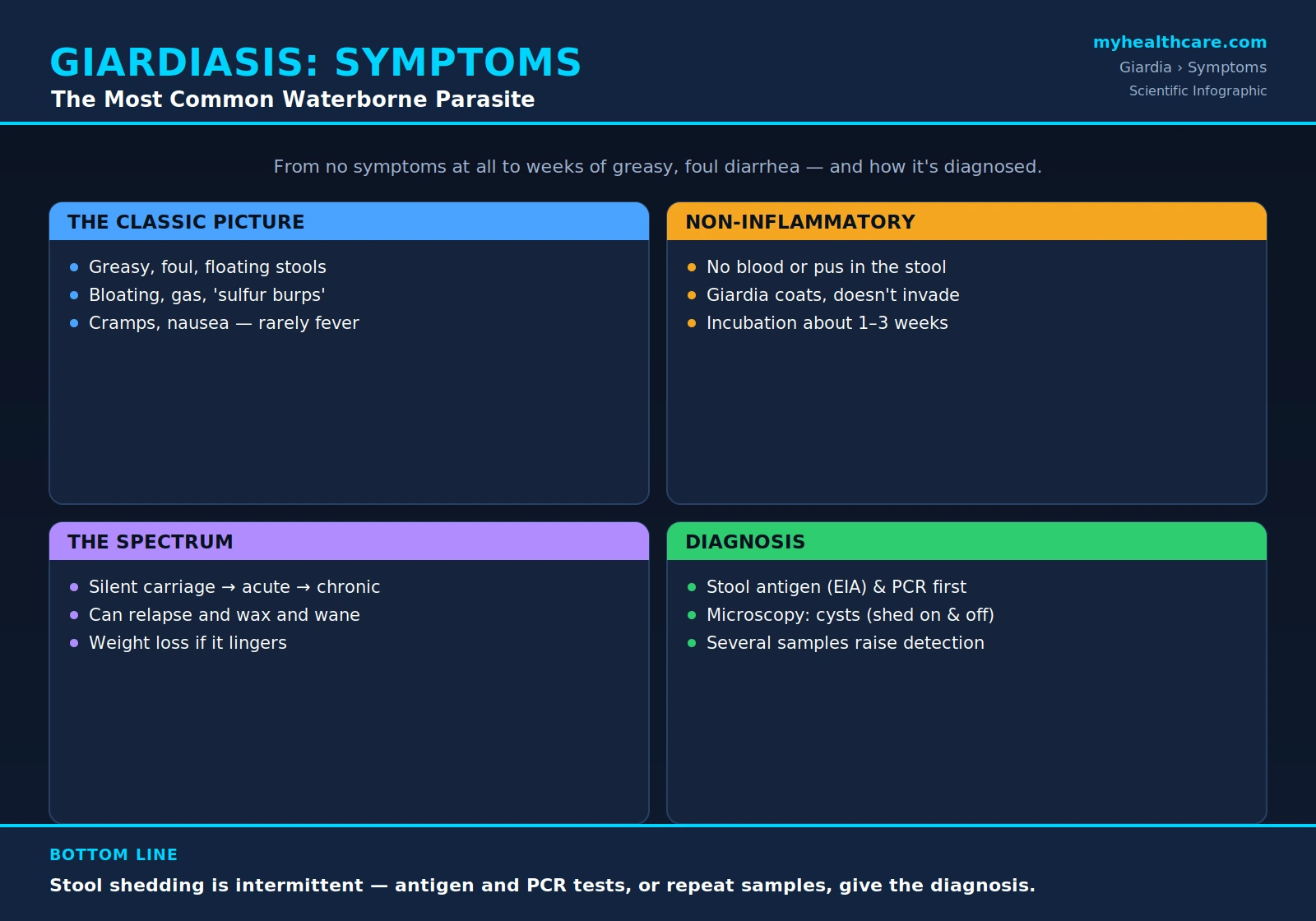
6. The Classic Symptom Picture
Pulling the symptoms together, the "textbook" presentation of giardiasis is distinctive enough that experienced clinicians often suspect it on the story alone. The classic picture includes:
- Foul-smelling, greasy stools that float. Pale, bulky, oily-looking stools that are difficult to flush — the signature of unabsorbed fat (steatorrhea).
- Bloating and abdominal distension. A swollen, full, uncomfortable belly is one of the most consistent complaints.
- Excessive gas (flatulence). Giardiasis is notorious for producing a lot of gas.
- "Sulfur" or "rotten-egg" burps. Belches with an unpleasant sulfurous, rotten-egg smell are a classic and oddly specific clue that points toward giardiasis.
- Cramps and nausea. Crampy upper-abdominal pain and queasiness, sometimes with loss of appetite, are typical.
- Loose stools or diarrhea that may be continuous or come and go.
Equally important is what giardiasis usually is not. Because Giardia coats the small bowel rather than invading it, the illness is typically non-bloody and non-inflammatory. There is usually no blood or mucus in the stool, no high fever, and no severe rectal urgency of the kind seen with invasive, dysentery-causing infections. If a person has bloody diarrhea and high fever, giardiasis is the wrong diagnosis, and a different, invasive cause should be sought. This "watery/greasy but not bloody" quality is one of the most useful bedside discriminators in all of intestinal infection.
7. The Incubation Period
Giardiasis has a relatively long incubation period — the gap between swallowing the parasite and the first symptoms — of roughly one to three weeks (commonly cited as about 7–14 days, sometimes a little longer). This delay matters in everyday life: because symptoms typically begin a week or more after exposure, people often fail to connect their illness to its source. By the time the bloating and diarrhea start, the camping trip, the foreign travel, the untreated stream water, or the daycare exposure may be a fortnight in the past and no longer an obvious suspect. When trying to pin down where an infection came from, it helps to think back two to three weeks, not two to three days.
8. Who Gets It and How It Spreads
Giardiasis spreads by the fecal–oral route: the durable cysts shed in one person's (or animal's) stool are swallowed by another. Because so few cysts are needed to cause infection, and because cysts survive well in cold water and resist ordinary chlorination levels, several routes are especially important:
- Contaminated water. This is the hallmark route. Drinking from untreated lakes, streams, or rivers — the classic "beaver fever" of hikers and campers — and contaminated municipal or recreational water (including swimming pools and water parks where cysts are swallowed) are major sources.
- Person-to-person, especially in daycare. Young children in diapers, and the adults who care for them, readily pass cysts hand-to-mouth. Daycare centers are a well-known setting for outbreaks, and household members of an infected child often become infected too.
- Travel. Giardiasis is a common cause of persistent travelers' diarrhea, particularly after visits to regions with less reliable water and sanitation.
- Food contaminated by infected food handlers or by washing produce in contaminated water, and certain forms of fecal–oral sexual contact, account for additional cases.
Anyone can get giardiasis, but the groups most often affected are young children (and their families and daycare contacts), hikers and campers who drink untreated surface water, international travelers, and people in communities with unsafe water. Prevention — water treatment, handwashing, and hygiene — is covered on the Prevention: Water and Hygiene page.
9. How Giardiasis Is Diagnosed
How giardiasis is diagnosed has changed substantially, and it is worth knowing the modern approach because many people (and some older articles) still assume the only test is "looking for the parasite under a microscope." Today, faster and more sensitive stool tests are first-line.
Stool antigen tests (EIA / immunoassay). These look not for the parasite itself but for Giardia proteins (antigens) shed in the stool, using an enzyme immunoassay (EIA) or a rapid cassette test. They are more sensitive and far less labor-intensive than microscopy, give quick results, and have become a routine, widely used way to confirm giardiasis from a single stool sample.
Stool molecular tests (NAAT / PCR). Nucleic acid amplification tests — PCR-based assays that detect the parasite's DNA — are now considered the most sensitive method, and multiplex "gastrointestinal panels" can test a single stool sample for Giardia alongside many other diarrhea-causing bacteria, viruses, and parasites at once. Where available, NAAT/PCR has become a preferred first-line approach, because it can detect even light infections and does not depend on a skilled microscopist catching the parasite by eye.
Stool ova-and-parasite (O&P) microscopy. The traditional method — a trained technologist examining stool under the microscope for Giardia cysts (and sometimes the active trophozoites) — is still used and still valuable, but it has an important limitation: the parasite is shed intermittently. A person can be genuinely infected yet pass few or no cysts on any given day, so a single microscopy result can miss the diagnosis. The classic workaround is to examine several stool samples collected on different days (often three specimens over several days), which substantially improves the chance of detection. Antigen and molecular tests largely sidestep this problem, which is one reason they have supplanted microscopy as first-line.
Duodenal sampling (occasionally). Rarely, when stool tests are repeatedly negative but giardiasis is still strongly suspected, doctors may obtain a sample directly from the upper small intestine — by sampling duodenal fluid or taking a small biopsy during an upper endoscopy — to look for trophozoites. This is an exception reserved for difficult cases, not a routine step.
10. When to Test
Testing for giardiasis is especially worthwhile when the story and symptoms fit. Reasonable triggers to test include:
- Diarrhea lasting more than a few days to a week, particularly when it is greasy, foul-smelling, and non-bloody and comes with prominent bloating and gas.
- A suggestive exposure in the prior one to three weeks — drinking untreated water while hiking or camping, recent international travel, or close contact with a daycare or an infected household member.
- Unexplained weight loss, steatorrhea, or new lactose intolerance after a diarrheal illness, or faltering growth in a child.
- Persistent gastrointestinal symptoms that have been labeled "IBS" but were never investigated for a treatable parasite, especially with a plausible exposure history.
Because giardiasis is common, treatable, and easy to miss — both because it can be silent and because microscopy misses intermittently shed parasites — a low threshold to send a stool antigen or molecular test is sensible whenever the picture is compatible. Catching it not only relieves the individual but also helps stop onward spread to family, classmates, and daycare contacts. Treatment options once giardiasis is confirmed are covered on the Treatment & Prevention hub and the Metronidazole and Tinidazole Treatment page.
Key Research Papers
Peer-reviewed reviews and studies on the biology, clinical features, malabsorption, long-term consequences, and laboratory diagnosis of Giardia duodenalis (also called G. lamblia / G. intestinalis) infection. Journal names appear as plain text; the year/volume/pages link opens the full citation via DOI.
- Gardner TB, Hill DR. Treatment of Giardiasis. Clinical Microbiology Reviews. 2001;14(1):114–128. — doi:10.1128/CMR.14.1.114-128.2001
- Adam RD. Biology of Giardia lamblia. Clinical Microbiology Reviews. 2001;14(3):447–475. — doi:10.1128/CMR.14.3.447-475.2001
- Ankarklev J, Jerlström-Hultqvist J, Ringqvist E, Troell K, Svärd SG. Behind the Smile: Cell Biology and Disease Mechanisms of Giardia Species. Nature Reviews Microbiology. 2010;8(6):413–422. — doi:10.1038/nrmicro2317
- Einarsson E, Ma'ayeh S, Svärd SG. An Up-Date on Giardia and Giardiasis. Current Opinion in Microbiology. 2016;34:47–52. — doi:10.1016/j.mib.2016.07.019
- Buret AG. Pathophysiology of Enteric Infections with Giardia duodenalis. Parasite. 2008;15(3):261–265. — doi:10.1051/parasite/2008153261
- Nash TE, Herrington DA, Losonsky GA, Levine MM. Experimental Human Infections with Giardia lamblia. The Journal of Infectious Diseases. 1987;156(6):974–984. — doi:10.1093/infdis/156.6.974
- Halliez MCM, Buret AG. Extra-Intestinal and Long Term Consequences of Giardia duodenalis Infections. World Journal of Gastroenterology. 2013;19(47):8974–8985. — doi:10.3748/wjg.v19.i47.8974
- Hanevik K, Wensaas KA, Rortveit G, Eide GE, Mørch K, Langeland N. Irritable Bowel Syndrome and Chronic Fatigue 6 Years After Giardia Infection: A Controlled Prospective Cohort Study. Clinical Infectious Diseases. 2014;59(10):1394–1400. — doi:10.1093/cid/ciu629
- Garcia LS, Shimizu RY, Novak S, Carroll M, Chan F. Commercial Assay for Detection of Giardia lamblia and Cryptosporidium parvum Antigens in Human Fecal Specimens by Rapid Solid-Phase Qualitative Immunochromatography. Journal of Clinical Microbiology. 2003;41(1):209–212. — doi:10.1128/JCM.41.1.209-212.2003
- Verweij JJ, Blangé RA, Templeton K, et al. Simultaneous Detection of Entamoeba histolytica, Giardia lamblia, and Cryptosporidium parvum in Fecal Samples by Using Multiplex Real-Time PCR. Journal of Clinical Microbiology. 2004;42(3):1220–1223. — doi:10.1128/JCM.42.3.1220-1223.2004
- Hiatt RA, Markell EK, Ng E. How Many Stool Examinations Are Necessary to Detect Pathogenic Intestinal Protozoa? The American Journal of Tropical Medicine and Hygiene. 1995;53(1):36–39. — doi:10.4269/ajtmh.1995.53.36
PubMed Topic Searches
Each link opens a live PubMed query so results stay current as new papers are indexed.
- PubMed: Giardiasis clinical manifestations
- PubMed: Giardia duodenalis symptoms and diarrhea
- PubMed: Giardia lamblia malabsorption
- PubMed: Giardia stool antigen (EIA) diagnosis
- PubMed: Giardia PCR / NAAT stool detection
- PubMed: Giardia ova-and-parasite microscopy sensitivity
- PubMed: Post-infectious IBS after Giardia
- PubMed: Giardia waterborne outbreak and transmission