Food Intolerance
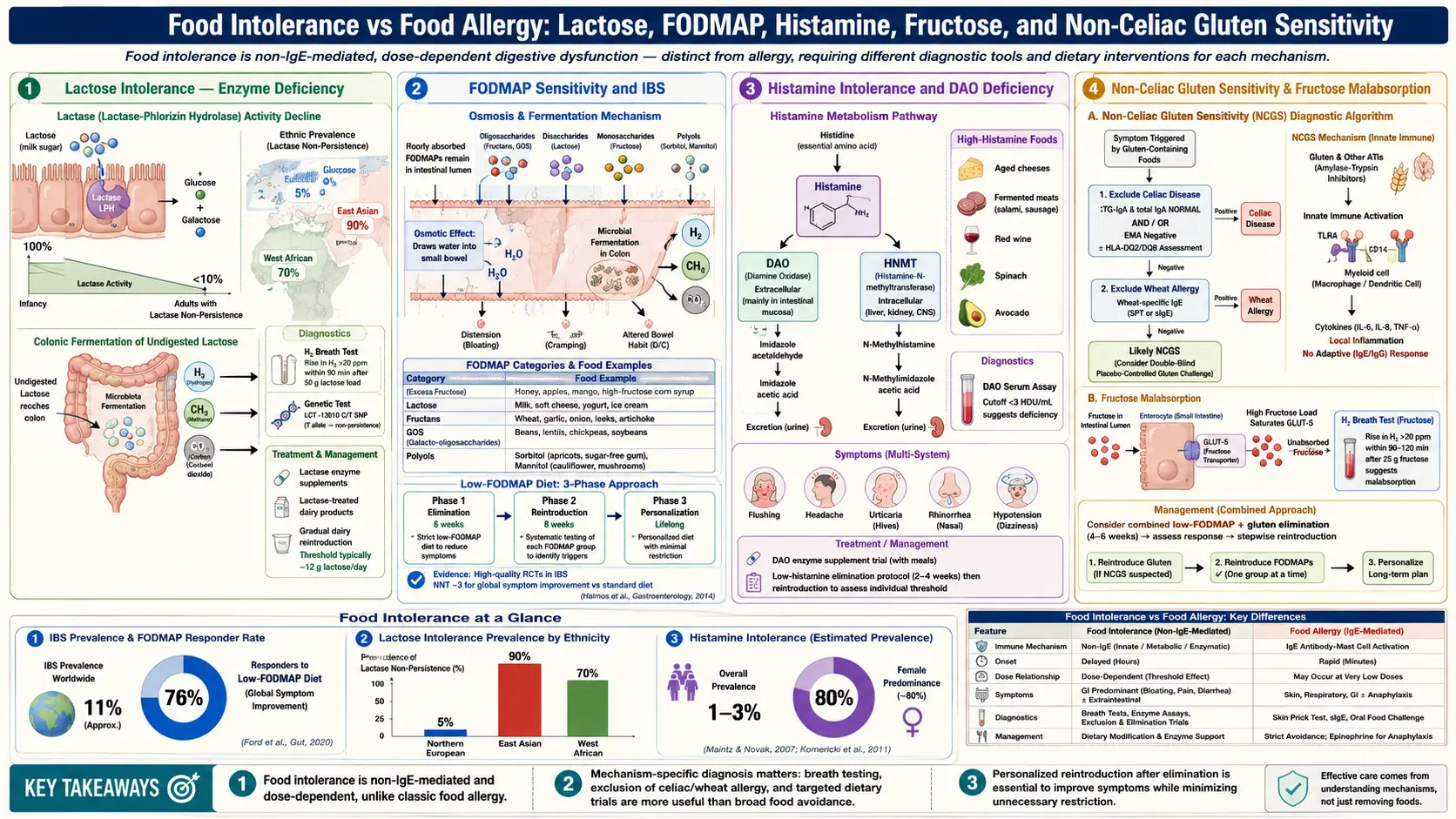
Table of Contents
- What is Food Intolerance?
- Common Types of Food Intolerance
- Common Symptoms of Food Intolerance
- Causes and Risk Factors
- Diagnosis
- Treatment and Management Strategies
- Prevention Tips
- Complications of Food Intolerance
- Research Papers
- Connections
- References & Research
- Featured Videos
What is Food Intolerance?
Food intolerance is a digestive system response that occurs when the body is unable to properly digest certain foods or food components. Unlike food allergies, which involve the immune system, food intolerances are generally less severe and primarily affect the digestive system. They can, however, lead to significant discomfort.
Common Types of Food Intolerance
1. Lactose Intolerance
- Caused by: The body's inability to produce enough lactase, the enzyme needed to digest lactose (the sugar found in milk and dairy products).
- Symptoms: Bloating, diarrhea, gas, and stomach pain after consuming dairy.
2. Gluten Intolerance (Non-Celiac Gluten Sensitivity)
- Caused by: A reaction to gluten, a protein found in wheat, barley, and rye.
- Symptoms: Bloating, stomach pain, fatigue, and headaches.
- Note: Different from celiac disease, which is an autoimmune disorder.
3. Fructose Intolerance
- Caused by: Difficulty digesting fructose, a sugar found in fruits, some vegetables, and honey.
- Symptoms: Bloating, gas, diarrhea, and abdominal pain.
4. Histamine Intolerance
- Caused by: The inability to break down histamine in foods due to low levels of diamine oxidase (DAO), the enzyme that metabolizes histamine.
- Symptoms: Headaches, hives, flushing, and digestive issues.
Common Symptoms of Food Intolerance
- Bloating and gas
- Diarrhea
- Stomach pain and cramps
- Nausea
- Headaches
- Heartburn
- Fatigue
- Skin rashes
Causes and Risk Factors
- Enzyme deficiencies: Lack of specific enzymes needed to break down certain foods (e.g., lactase for lactose intolerance).
- Food additives: Reactions to artificial colors, flavors, or preservatives (e.g., sulfites and MSG).
- Sensitivity to natural food chemicals: Such as caffeine or histamine.
- Underlying conditions: Such as irritable bowel syndrome (IBS), which can exacerbate food intolerance symptoms.
- Genetic predisposition: A family history of food intolerance may increase risk.
Diagnosis
- Medical history and symptom assessment: Discuss symptoms and possible triggers with a healthcare provider.
- Elimination diet: Temporarily remove suspected foods from the diet and reintroduce them gradually to identify the source of symptoms.
- Breath tests: To diagnose lactose intolerance or fructose malabsorption.
- Food diary: Track meals and symptoms to help identify potential food intolerances.
Treatment and Management Strategies
- Dietary adjustments:
- Avoid trigger foods: Identify and eliminate foods that cause symptoms.
- Substitute with alternatives: Use lactose-free dairy products or gluten-free grains.
- Enzyme supplements:
- Lactase supplements: For those with lactose intolerance.
- Portion control: Eating smaller amounts of trigger foods may help reduce symptoms.
- Hydration and a balanced diet: Ensure proper nutrition and hydration to support overall health.
Prevention Tips
- Read food labels: To avoid potential allergens and additives.
- Plan meals: Prepare meals that avoid known triggers.
- Consult with a dietitian: To maintain a balanced diet while avoiding trigger foods.
Complications of Food Intolerance
- Digestive discomfort: Chronic symptoms can impact quality of life.
- Nutritional deficiencies: Avoiding certain foods without proper substitutions can lead to deficiencies.
- Social and emotional impact: Anxiety or stress related to food choices and dining out.
References & Research
Historical Background
The concept of food intolerance was distinguished from food allergy in the mid-20th century. Lactose intolerance was first scientifically described by Abraham Jacobi in the 1900s, while the enzyme lactase and its deficiency were characterized by Auricchio and Dahlqvist in the 1960s. The concept of non-celiac gluten sensitivity was first proposed by Cooper and colleagues in 1980, and histamine intolerance was formally described by Maintz and Novak in 2007.
Key Research Papers
- Cooper BT, et al. Gluten sensitivity and the coeliac spectrum. The Lancet. 1980;1(8170):413-414.
- Maintz L, Novak N. Histamine and histamine intolerance. American Journal of Clinical Nutrition. 2007;85(5):1185-1196.
- Catassi C, et al. Non-celiac gluten sensitivity: the new frontier of gluten related disorders. Nutrients. 2013;5(10):3839-3853.
- Swagerty DL, Walling AD, Klein RM. Lactose intolerance. American Family Physician. 2002;65(9):1845-1850.
- Gibson PR, Shepherd SJ. Evidence-based dietary management of functional gastrointestinal symptoms: the FODMAP approach. Journal of Gastroenterology and Hepatology. 2010;25(2):252-258.
- Halmos EP, et al. A diet low in FODMAPs reduces symptoms of irritable bowel syndrome. Gastroenterology. 2014;146(1):67-75.
- Biesiekierski JR, et al. No effects of gluten in patients with self-reported non-celiac gluten sensitivity after dietary reduction of fermentable, poorly absorbed, short-chain carbohydrates. Gastroenterology. 2013;145(2):320-328.
- Boyce JA, et al. Guidelines for the diagnosis and management of food allergy in the United States: report of the NIAID-sponsored expert panel. Journal of Allergy and Clinical Immunology. 2010;126(6):S1-S58.
- Turnbull JL, Adams HN, Gorard DA. Review article: the diagnosis and management of food allergy and food intolerances. Alimentary Pharmacology & Therapeutics. 2015;41(1):3-25.
- Lomer MCE. Review article: the aetiology, diagnosis, mechanisms and clinical evidence for food intolerance. Alimentary Pharmacology & Therapeutics. 2015;41(3):262-275.
- Elli L, et al. Diagnosis of gluten related disorders: celiac disease, wheat allergy and non-celiac gluten sensitivity. World Journal of Gastroenterology. 2015;21(23):7110-7119.
Research Papers
Explore current literature on food intolerance via PubMed topic searches. These links open live PubMed searches for the listed keywords — results update as new studies are indexed.
- Clinical trials on food intolerance — PubMed search
- Clinical trials on lactose intolerance — PubMed search
- Clinical trials on fructose malabsorption — PubMed search
- Clinical trials on histamine intolerance — PubMed search
- Clinical trials on FODMAP diet IBS — PubMed search
- Clinical trials on non-celiac gluten sensitivity — PubMed search
- Clinical trials on food allergy vs intolerance — PubMed search
Connections
- Pain & Allergy
- Allergies
- Celiac Disease
- Irritable Bowel Syndrome
- Alpha-Gal Syndrome
- Mast Cell Activation Syndrome
- SIBO
- Bloating
- Gluten-Free Diet Practical Guide
- Abdominal Pain
- Elimination Diet
- Food Additives
- Preservatives
- Sulfites
- MSG
- Fatigue
- Gut-Brain Axis
- Eczema
- Asthma