Eczema
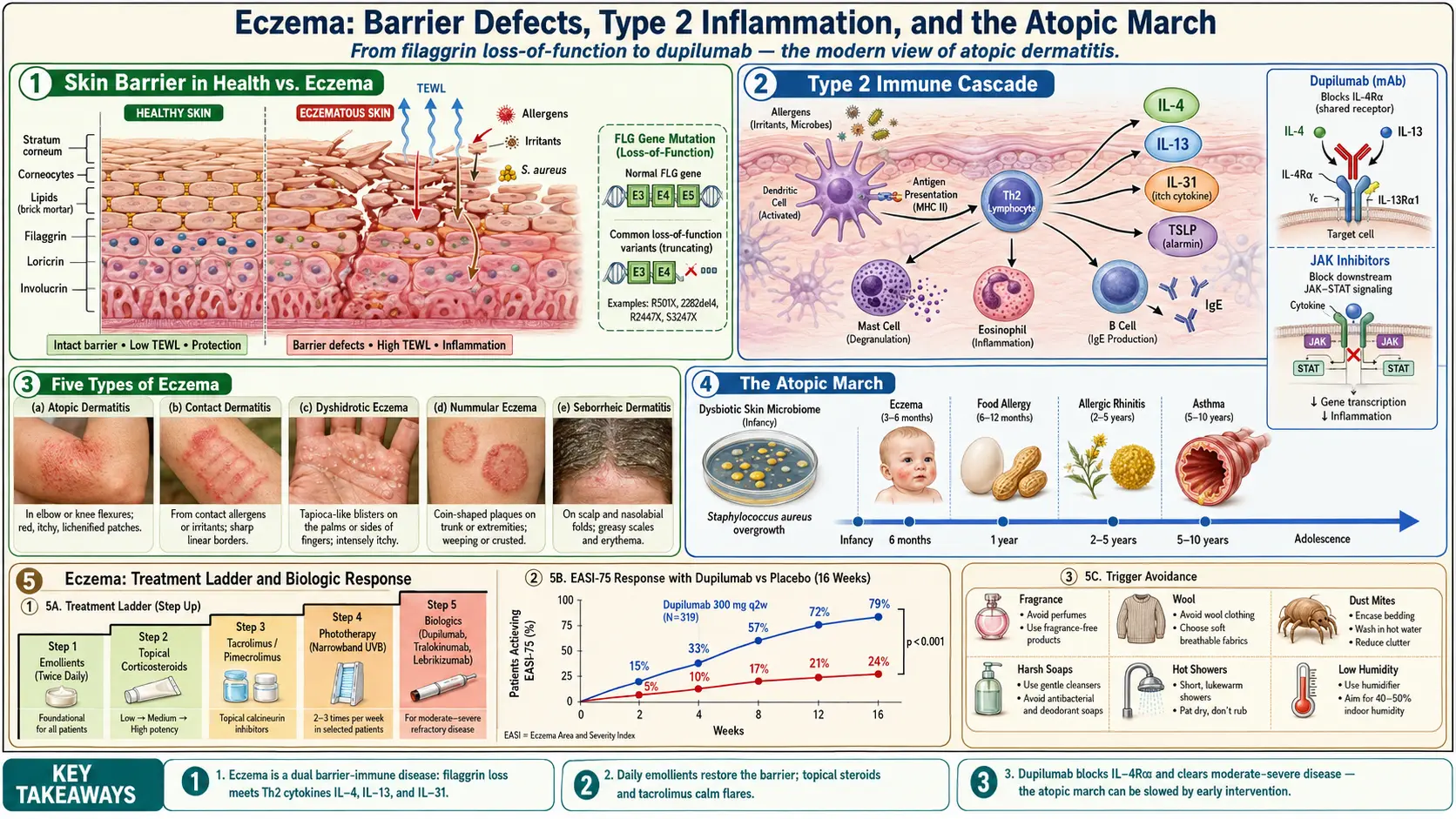
Table of Contents
- What is Eczema?
- Types of Eczema
- Common Symptoms of Eczema
- Causes and Risk Factors
- Diagnosis
- Treatment Options
- Prevention and Management Strategies
- Complications of Eczema
- Research Papers
- Connections
- Featured Videos
What is Eczema?
Eczema, or atopic dermatitis, is a chronic skin condition that causes inflammation, itching, and redness. It often appears in patches and can affect any part of the body. Eczema is common in children but can occur at any age and tends to flare periodically before subsiding.
Types of Eczema
1. Atopic Dermatitis
- Most common type of eczema.
- Associated with other atopic conditions such as asthma and hay fever.
- Symptoms: Red, itchy patches, often in the creases of the elbows, knees, and neck.
2. Contact Dermatitis
- Caused by contact with irritants or allergens such as chemicals, soaps, or plants.
- Symptoms: Red, itchy rash that can blister or become scaly.
3. Dyshidrotic Eczema
- Affects the hands and feet.
- Symptoms: Small, fluid-filled blisters that can be itchy and painful.
4. Nummular Eczema
- Characterized by coin-shaped spots on the skin.
- Symptoms: Round patches that may be scaly and itchy.
5. Seborrheic Dermatitis
- Affects areas with many oil glands, such as the scalp and face.
- Common in infants as cradle cap and in adults as dandruff.
Common Symptoms of Eczema
- Itchy skin, which can become severe, especially at night.
- Red or brownish-gray patches on the skin.
- Dry, scaly, or thickened skin.
- Small, raised bumps that may leak fluid when scratched.
- Cracked or raw skin from scratching.
- Swollen, sensitive skin due to repeated irritation.
Causes and Risk Factors
- Genetics: A family history of eczema, allergies, or asthma increases the risk.
- Immune system response: An overactive immune system can trigger eczema flare-ups.
- Environmental factors: Such as pollen, mold, and exposure to harsh soaps or chemicals.
- Temperature changes: Hot, humid weather or cold, dry air can aggravate eczema.
- Stress: Can exacerbate symptoms and trigger flare-ups.
Diagnosis
- Physical examination: A doctor will review the affected skin and inquire about symptoms and medical history.
- Allergy testing: May be performed to identify triggers or allergens.
- Skin biopsy: Rarely needed but can help rule out other conditions.
Treatment Options
- Topical treatments:
- Corticosteroid creams or ointments: To reduce inflammation and itching.
- Calcineurin inhibitors: Such as tacrolimus and pimecrolimus for sensitive areas.
- Moisturizers: To keep the skin hydrated and prevent dryness.
- Oral medications:
- Antihistamines: To help reduce itching.
- Oral corticosteroids: For severe cases, used short-term.
- Phototherapy: Ultraviolet light therapy to help reduce inflammation and itching.
- Biologic drugs: Such as dupilumab for moderate to severe eczema.
Prevention and Management Strategies
- Maintain skin hydration: Regularly apply fragrance-free moisturizers.
- Avoid known triggers: Such as harsh soaps, fragrances, and certain fabrics.
- Take shorter baths or showers and use lukewarm water.
- Use gentle, unscented cleansers.
- Wear breathable clothing: Opt for cotton and avoid wool or synthetic fabrics.
- Manage stress: Practice relaxation techniques such as meditation or deep breathing.
Complications of Eczema
- Skin infections: Due to scratching and skin damage, which can lead to bacterial or viral infections.
- Chronic itching and scarring: Can result from repeated scratching.
- Sleep disturbances: Itching can interfere with sleep quality.
- Psychological impact: Eczema can lead to anxiety, depression, or social withdrawal due to visible skin symptoms.
10. References & Research
Historical Background
The term "eczema" derives from the Greek word "ekzein" meaning "to boil over," first used by the Byzantine physician Aetius of Amida in the 6th century. Robert Willan, the father of modern dermatology, systematically classified eczema in his 1808 work "On Cutaneous Diseases." The atopic nature of eczema and its association with asthma and hay fever was established by Arthur Fernandez Coca and Robert Anderson Cooke in 1923 when they introduced the concept of "atopy."
Key Research Papers
- Eichenfield LF, Tom WL, Chamlin SL, et al. Guidelines of care for the management of atopic dermatitis. J Am Acad Dermatol. 2014;70(2):338-351.
- Weidinger S, Novak N. Atopic dermatitis. Lancet. 2016;387(10023):1109-1122.
- Palmer CN, Irvine AD, Terron-Kwiatkowski A, et al. Common loss-of-function variants of the epidermal barrier protein filaggrin are a major predisposing factor for atopic dermatitis. Nat Genet. 2006;38(4):441-446.
- Simpson EL, Bieber T, Guttman-Yassky E, et al. Two phase 3 trials of dupilumab versus placebo in atopic dermatitis (SOLO 1 and SOLO 2). N Engl J Med. 2016;375(24):2335-2348.
- Silverberg JI, Hanifin JM. Adult eczema prevalence and associations with asthma and other health and demographic factors: a US population-based study. J Allergy Clin Immunol. 2013;132(5):1132-1138.
- Flohr C, Mann J. New insights into the epidemiology of childhood atopic dermatitis. Allergy. 2014;69(1):3-16.
- Sidbury R, Davis DM, Cohen DE, et al. Guidelines of care for the management of atopic dermatitis: section 3. Management and treatment with phototherapy and systemic agents. J Am Acad Dermatol. 2014;71(2):327-349.
- Boguniewicz M, Leung DY. Atopic dermatitis: a disease of altered skin barrier and immune dysregulation. Immunol Rev. 2011;242(1):233-246.
- Langan SM, Irvine AD, Weidinger S. Atopic dermatitis. Lancet. 2020;396(10247):345-360.
- Bath-Hextall FJ, Jenkinson C, Humphreys R, Williams HC. Dietary supplements for established atopic eczema. Cochrane Database Syst Rev. 2012;(2):CD005205.
- Simpson EL, Chalmers JR, Hanifin JM, et al. Emollient enhancement of the skin barrier from birth offers effective atopic dermatitis prevention. J Allergy Clin Immunol. 2014;134(4):818-823.
- Paller AS, Kong HH, Seed P, et al. The microbiome in patients with atopic dermatitis. J Allergy Clin Immunol. 2019;143(1):26-35.
Research Papers
Curated PubMed topic searches of peer-reviewed literature on Eczema (Atopic Dermatitis). Each link opens a live PubMed query so you always see the most current studies.
- PubMed: Atopic dermatitis pathogenesis
- PubMed: Dupilumab in atopic dermatitis
- PubMed: Filaggrin and skin barrier
- PubMed: Topical corticosteroids
- PubMed: Calcineurin inhibitors
- PubMed: Skin microbiome
- PubMed: JAK inhibitors
- PubMed: Food allergy and AD
- PubMed: Emollient therapy
- PubMed: Pediatric outcomes
- PubMed: Atopic march
- PubMed: Phototherapy for AD
Connections
- Dermatology
- Psoriasis
- Rosacea
- Fungal Infections
- Zinc
- Celiac Disease
- Gut Healing
- Elimination Diet
- Vitamin D3
- Turmeric
- Asthma
- Allergies
- Acne
- Alopecia
- Vitiligo
- Gut-Brain Axis
- Lead
- Stress Management
- Probiotics
- Herpes Simplex