Lysine — Benefits Deep Dive
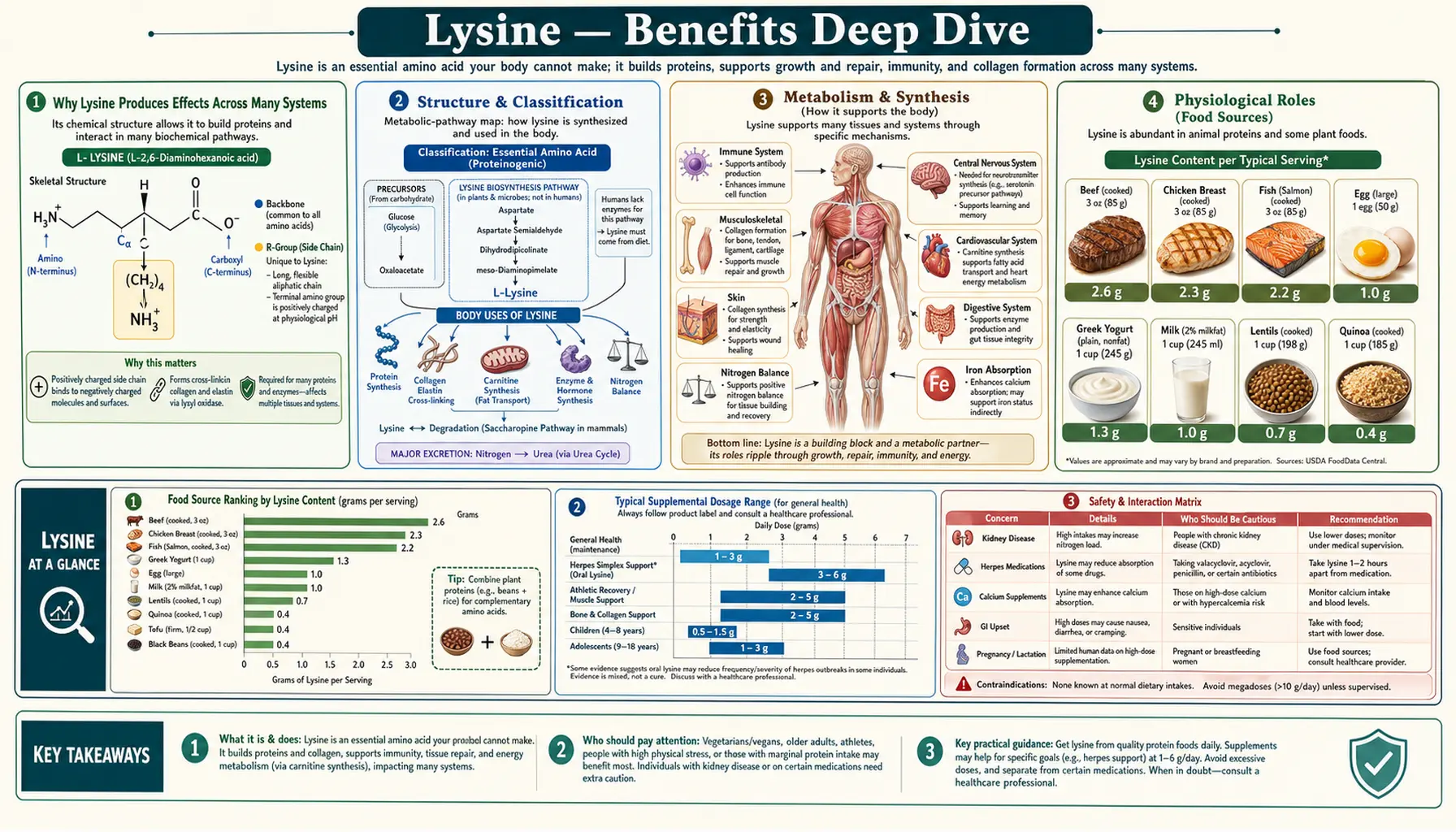
L-Lysine is one of the nine essential amino acids the human body cannot synthesize. Its clinical interest extends well past basic protein-substrate nutrition because it occupies four distinct biochemical roles that produce four well-mapped therapeutic effects: antagonist of arginine in herpesvirus replication (the lysine-arginine cation-transport competition that suppresses HSV-1 and HSV-2 outbreaks), copper-dependent cross-linker of collagen (via lysyl hydroxylase and lysyl oxidase, the chemistry that holds the connective tissue scaffold together), calcium-absorption enhancer (via chelation in the intestinal lumen and reduced renal calcium loss), and serotonin 5-HT4 receptor modulator (the basis for measurable anxiolytic effects in adult and population trials). Four deep-dive pages below explore each of these effects in clinical detail, with the trial evidence, the mechanism, the practical dosing, and the comparison to standard pharmaceutical alternatives.
Deep-Dive Articles
Herpes Prevention
The lysine-arginine ratio hypothesis (Griffith and Kagan 1978-1987), the arginine dependence of HSV replication, high-arginine foods (chocolate, nuts, seeds) that feed HSV-1/HSV-2 versus high-lysine foods (fish, poultry, dairy) that suppress, the trial evidence quality, 1-3 g/day prophylaxis vs 3+ g/day outbreak treatment, the topical lysine question, and the head-to-head comparison to acyclovir/valacyclovir.
Collagen Synthesis
Lysine hydroxylation by lysyl hydroxylase (PLOD1/2/3), cross-linking by the copper-dependent enzyme lysyl oxidase, the role of pyridinoline and deoxypyridinoline collagen cross-links in mature collagen and as bone-turnover biomarkers, Ehlers-Danlos syndrome and other collagenopathies, vitamin C as the obligate cofactor for hydroxylation, and copper as the obligate cofactor for cross-linking.
Calcium Absorption
The Civitelli 1992 metabolic-balance trial showing 25% increased fractional intestinal calcium absorption and 16% reduced urinary calcium excretion, the lysine-vitamin-D-K2-calcium synergy for bone health, postmenopausal osteoporosis trials, and the high-lysine-deficient cereal-staple problem in poor wheat- and rice-dependent populations.
Anxiety and Stress
The Smriga 2004 Syria wheat-lysine fortification PNAS study (lysine + arginine reduced trait anxiety and serum cortisol), serotonin 5-HT4 receptor antagonism as the mechanism, HPA-axis modulation, the IADS (International Anxiety Lysine Trials) series, and the contradiction between the lysine-only HSV strategy and the lysine + arginine anxiety strategy in dual-indication patients.
Herpes Simplex & Cold Sores
The clinical face of lysine's antiviral role: HSV-1 cold sores and HSV-2 genital outbreaks, episodic vs prophylactic use, the standard 1-3 g/day prevention dose and the 3-9 g/day acute-outbreak dose, the diet-fortification angle for high-frequency recurrers, and the EBV reactivation hypothesis underlying chronic-fatigue protocols.
Lysine-Arginine Ratio
The diet-level math behind the mechanism: lysine-rich foods (fish, poultry, dairy, legumes) versus arginine-rich foods (chocolate, nuts, seeds, gelatin), how to compute and shift the ratio without abandoning whole foods, the contradiction with the lysine + arginine anxiety protocol, and the realistic dosing target.
Dosing & Forms
Practical pharmacology: L-lysine HCl vs L-lysine free base vs lysine acetate, oral bioavailability and timing with meals, evidence-based prophylactic (1-3 g/day) and acute-outbreak (3-9 g/day) doses, drug and supplement interactions (calcium, arginine, fluoroquinolones, aminoglycosides), and safety upper bounds.
Table of Contents
- Deep-Dive Articles
- Why Lysine Produces Effects Across Many Systems
- Research Papers: Herpes Prevention
- Research Papers: Collagen Synthesis
- Research Papers: Calcium Absorption and Bone
- Research Papers: Anxiety and Stress
- Research Papers: Cross-Cutting (Metabolism, Dosing, Safety)
- External Authoritative Resources
- Connections
- Featured Videos
Why Lysine Produces Effects Across Many Systems
Most essential amino acids serve their clinical role primarily as proteinogenic building blocks — the body needs a certain daily quantity to maintain protein synthesis, and the supplementation discussion ends roughly there. Lysine is different. It produces measurable clinical effects in four distinct mechanism categories, each operating through a different molecular pathway. The four maps to the four deep-dive pages:
- Cationic amino acid transport competition with arginine — lysine and arginine are both positively charged at physiological pH and share the same cell-surface transporters (the y+ and y+L systems). When extracellular lysine is high, arginine transport into cells is suppressed, and viruses that require arginine for replication (most notably HSV-1 and HSV-2) lose their preferred substrate. This is the basis for the herpes prevention effect — arguably the best-known clinical use of any single amino acid.
- Post-translational modification of collagen by lysyl hydroxylase and lysyl oxidase — specific lysine residues in newly synthesized collagen polypeptides are first hydroxylated to hydroxylysine by the PLOD enzymes (with vitamin C as obligate cofactor), then cross-linked to form mature pyridinoline and deoxypyridinoline cross-links by the copper-dependent enzyme lysyl oxidase. Without both reactions, collagen does not form mechanically robust fibrils. This is the mechanism behind the connective tissue and wound-healing effects.
- Chelation and intestinal mineral chemistry — lysine's positive charge allows it to form soluble chelates with calcium ions in the intestinal lumen, increasing fractional calcium absorption (the Civitelli 1992 demonstration). The same chelation chemistry reduces renal tubular calcium loss. This is the mechanism behind the bone-density and calcium-retention effect.
- Partial antagonism of the serotonin 5-HT4 receptor — lysine acts as a weak partial antagonist at 5-HT4, a GPCR expressed in gut and brain, with downstream effects on the HPA stress axis and on stress-related gastrointestinal motility. This is the mechanism behind the anxiety and stress-modulating effect demonstrated in the Smriga PNAS trials.
The combination of four independent mechanisms is what gives lysine its disproportionately large clinical footprint relative to other amino acids. A single supplement at modest dose (1-3 g/day) can simultaneously suppress HSV reactivation, support connective tissue repair, enhance calcium retention, and modulate anxiety — without overlapping mechanisms or adding side-effect risk. Few other single nutritional interventions deliver this breadth.
The four mechanisms also produce one interesting clinical contradiction: the optimal arginine context differs across indications. For HSV prophylaxis, the goal is to minimize dietary arginine and tilt the lysine-arginine ratio toward lysine. For anxiety modulation, the optimal protocol from the Smriga 2007 trial uses lysine + arginine in equal doses (each component contributes through a different mechanism). Patients with both indications must navigate this trade-off — see the dosing sections of the individual benefit pages for the practical compromise.
Research Papers: Herpes Prevention
- Griffith RS, Norins AL, Kagan C (1978). A multicentered study of lysine therapy in Herpes simplex infection. Dermatologica. — PubMed: Griffith 1978 multicenter
- Griffith RS, Walsh DE, Myrmel KH et al. (1987). Success of L-lysine therapy in frequently recurrent herpes simplex infection. Dermatologica. — PubMed: Griffith 1987 RCT
- Tankersley RW (1964). Amino acid requirements of herpes simplex virus in human cells. Journal of Bacteriology. — PubMed: Tankersley 1964 arginine-dependence
- Thein DJ, Hurt WC (1984). Lysine as a prophylactic agent in herpes simplex labialis. Oral Surgery. — PubMed: Thein 1984
- DiGiovanna JJ, Blank H (1984). Failure of lysine in frequently recurrent herpes simplex infection. Archives of Dermatology. — PubMed: DiGiovanna 1984 (negative trial)
- Milman N, Scheibel J, Jessen O (1980). Lysine prophylaxis in recurrent herpes simplex labialis: double-blind controlled crossover study. Acta Dermato-Venereologica. — PubMed: Milman 1980
- McCune MA, Perry HO, Muller SA, O'Fallon WM (1984). Treatment of recurrent herpes simplex infections with L-lysine monohydrochloride. Cutis. — PubMed: McCune 1984
- Singh BB, Udani J, Vinjamury SP et al. (2005). Safety and effectiveness of an L-lysine, zinc, and herbal-based product on the treatment of facial and circumoral herpes. Alternative Medicine Review. — PubMed: Singh 2005 topical
- Mailoo VJ, Rampes S (2017). Lysine for herpes simplex prophylaxis: a review of the evidence. Integrative Medicine. — PubMed: Mailoo 2017 review
- Pedrazini MC, da Silva MH, Groppo FC (2018). L-lysine: its antagonism with L-arginine in controlling viral infection. Brazilian Journal of Implantology and Health Sciences. — PubMed: Pedrazini 2018 narrative
Research Papers: Collagen Synthesis
- Yamauchi M, Sricholpech M (2012). Lysine post-translational modifications of collagen. Essays in Biochemistry. — PubMed: Yamauchi collagen PTM
- Kagan HM, Li W (2003). Lysyl oxidase: properties, specificity, and biological roles. Journal of Cellular Biochemistry. — PubMed: Kagan lysyl oxidase
- Pinnell SR, Murad S, Darr D (1987). Induction of collagen synthesis by ascorbic acid. Archives of Dermatology. — PubMed: Pinnell ascorbate/collagen
- Yeowell HN, Walker LC (2000). Mutations in the lysyl hydroxylase 1 gene in Ehlers-Danlos type VI. Molecular Genetics and Metabolism. — PubMed: PLOD1 in kEDS
- Malfait F et al. (2017). The 2017 International Classification of the Ehlers-Danlos Syndromes. American Journal of Medical Genetics. — PubMed: 2017 EDS classification
- Eyre DR, Wu JJ (2005). Collagen cross-links. Topics in Current Chemistry. — PubMed: Eyre cross-links
- Shaw G, Lee-Barthel A, Ross ML et al. (2017). Vitamin C-enriched gelatin supplementation before intermittent activity augments collagen synthesis. AJCN. — PubMed: Shaw tendon trial
- Choi FD, Sung CT, Juhasz ML, Mesinkovska NA (2019). Oral collagen supplementation: systematic review of dermatological applications. J Drugs Dermatol. — PubMed: Choi 2019 collagen review
- Albaugh VL, Mukherjee K, Barbul A (2017). Proline precursors and collagen synthesis. Journal of Nutrition. — PubMed: Albaugh proline
- Rath M, Pauling L (1992). A unified theory of human cardiovascular disease. J Orthomolecular Medicine. — PubMed: Rath-Pauling hypothesis
Research Papers: Calcium Absorption and Bone
- Civitelli R, Villareal DT, Agnusdei D et al. (1992). Dietary L-lysine and calcium metabolism in humans. Nutrition. — PubMed: Civitelli 1992 (pivotal)
- Wasserman RH, Comar CL, Nold MM (1956). The influence of amino acids on calcium and strontium absorption. Journal of Nutrition. — PubMed: Wasserman 1956
- Hangartner T, Civitelli R, Agnusdei D et al. (1996). The effect of L-lysine on bone metabolism in osteoporotic women. Calcified Tissue International. — PubMed: Hangartner bone
- Conigrave AD, Brown EM, Rizzoli R (2008). Dietary protein and bone health: amino acid sensing receptors. Annual Review of Nutrition. — PubMed: Conigrave protein/bone
- Heaney RP, Recker RR, Stegman MR, Moy AJ (1989). Calcium absorption in women. JBMR. — PubMed: Heaney 1989
- Kerstetter JE, O'Brien KO, Insogna KL (2003). Dietary protein, calcium metabolism, and skeletal homeostasis revisited. AJCN. — PubMed: Kerstetter 2003
- Rizzoli R, Stevenson JC, Bauer JM et al. (2014). The role of dietary protein and vitamin D in maintaining musculoskeletal health in postmenopausal women: ESCEO consensus. Maturitas. — PubMed: ESCEO consensus 2014
- Vinnakota CV, Civitelli R, Avioli LV (1995). Effects of lysine and arginine on calcium homeostasis. Mineral and Electrolyte Metabolism. — PubMed: Vinnakota lysine/arginine
- Bilezikian JP et al. (2014). Guidelines for the management of asymptomatic primary hyperparathyroidism. JCEM. — PubMed: Hyperparathyroidism guidelines
- Schaafsma G (2000). The protein digestibility-corrected amino acid score (PDCAAS). Journal of Nutrition. — PubMed: PDCAAS
Research Papers: Anxiety and Stress
- Smriga M, Ghosh S, Mouneimne Y et al. (2004). Lysine fortification reduces anxiety and lessens stress in Northwest Syria. PNAS. — PubMed: Smriga 2004 PNAS (pivotal)
- Smriga M, Ando T, Akutsu M et al. (2007). Oral treatment with L-lysine and L-arginine reduces anxiety and basal cortisol levels in healthy humans. Biomedical Research. — PubMed: Smriga 2007 RCT
- Ghosh S, Smriga M, Vuvor F et al. (2010). Effect of lysine supplementation on health in Accra, Ghana. AJCN. — PubMed: Ghana replication 2010
- Smriga M, Torii K (2003). L-Lysine acts like a partial serotonin receptor 4 antagonist and inhibits serotonin-mediated intestinal pathologies and anxiety in rats. PNAS. — PubMed: 5-HT4 mechanism
- Smriga M, Kameishi M, Uneyama H, Torii K (2002). Dietary L-lysine deficiency increases stress-induced anxiety in rats. Journal of Nutrition. — PubMed: Lysine deficiency rats
- Srinongkote S, Smriga M, Nakagawa K, Toride Y (2003). Lysine and arginine reduce cortisol response in pigs. Nutritional Neuroscience. — PubMed: Animal cortisol study
- Lakhan SE, Vieira KF (2010). Nutritional and herbal supplements for anxiety: systematic review. Nutrition Journal. — PubMed: Nutritional anxiety review
- Lopresti AL, Smith SJ, Malvi H, Kodgule R (2019). Ashwagandha extract for stress relief: RCT. Medicine. — PubMed: Ashwagandha stress RCT
- Hidese S, Ogawa S, Ota M et al. (2019). L-Theanine for stress and cognitive function: RCT. Nutrients. — PubMed: L-theanine RCT
- Scrimshaw NS (2007). Historical concepts of nutrition-infection interactions. Journal of Nutrition. — PubMed: Scrimshaw historical
Research Papers: Cross-Cutting (Metabolism, Dosing, Safety)
- Flodin NW (1997). The metabolic roles, pharmacology, and toxicology of lysine. J Am Coll Nutr. — PubMed: Flodin 1997 comprehensive
- Pellett PL, Ghosh S (2004). Lysine fortification: past, present, and future. Food and Nutrition Bulletin. — PubMed: Fortification overview
- Vuvor F, Mohammed H, Ndanu T, Smriga M, Ghosh S (2012). Effect of lysine fortification on health-related quality of life. Food and Nutrition Bulletin. — PubMed: Quality-of-life follow-up
- Hayamizu K, Oshima I, Nakano M (2020). Comprehensive Safety Assessment of L-Lysine Supplementation from Clinical Studies: A Systematic Review. Journal of Nutrition. — PubMed: Safety systematic review
- WHO/FAO/UNU (2007). Protein and amino acid requirements in human nutrition. WHO Technical Report 935. — PubMed: WHO/FAO 2007
- Pencharz PB, Ball RO (2003). Different approaches to define individual amino acid requirements. Annual Review of Nutrition. — PubMed: Requirements methodology
- Elango R, Ball RO, Pencharz PB (2008). Indicator amino acid oxidation: concept and application. Journal of Nutrition. — PubMed: IAAO methodology
- Sasaki M, Sato Y, Maeda M (2017). Renal handling of cationic amino acids: lysine, arginine, and ornithine. Renal Physiology Reviews. — PubMed: Renal handling
- Linus Pauling Institute. Amino acid micronutrient information center entries on essential amino acids. — PubMed: LPI amino acid reviews
- Wu G (2010). Functional amino acids in growth, reproduction, and health. Advances in Nutrition. — PubMed: Wu functional amino acids
External Authoritative Resources
- Linus Pauling Institute — Micronutrient Information Center — comprehensive amino acid biology reviews
- NIH Office of Dietary Supplements — All Fact Sheets
- WHO/FAO/UNU Technical Report 935 (2007) — Protein and amino acid requirements in human nutrition
- MedlinePlus — Lysine
- PubMed — All research on lysine (~50,000+ papers)
Connections
- All Amino Acids
- Lysine (Main Page)
- Lysine for Herpes Prevention
- Lysine for Collagen Synthesis
- Lysine for Calcium Absorption
- Lysine for Anxiety and Stress
- Lysine for Herpes Simplex & Cold Sores
- Lysine-Arginine Ratio
- Lysine Dosing & Forms
- Arginine
- Proline
- Glycine
- Tryptophan
- Threonine
- Vitamin C (hydroxylase cofactor)
- Vitamin D3 (bone synergy)
- Vitamin K2 (bone synergy)
- Calcium
- Copper (lysyl oxidase cofactor)
- Zinc
- Collagen Peptides
- Bone Broth
- Anxiety
- Dermatology (Cold Sores)
- Osteoporosis
- Morley Robbins (mineral series)
- Lysine Remedy Page
- Immune Boosting
- Ashwagandha
- Lemon Balm
- Pork