Lysine: History and Discovery
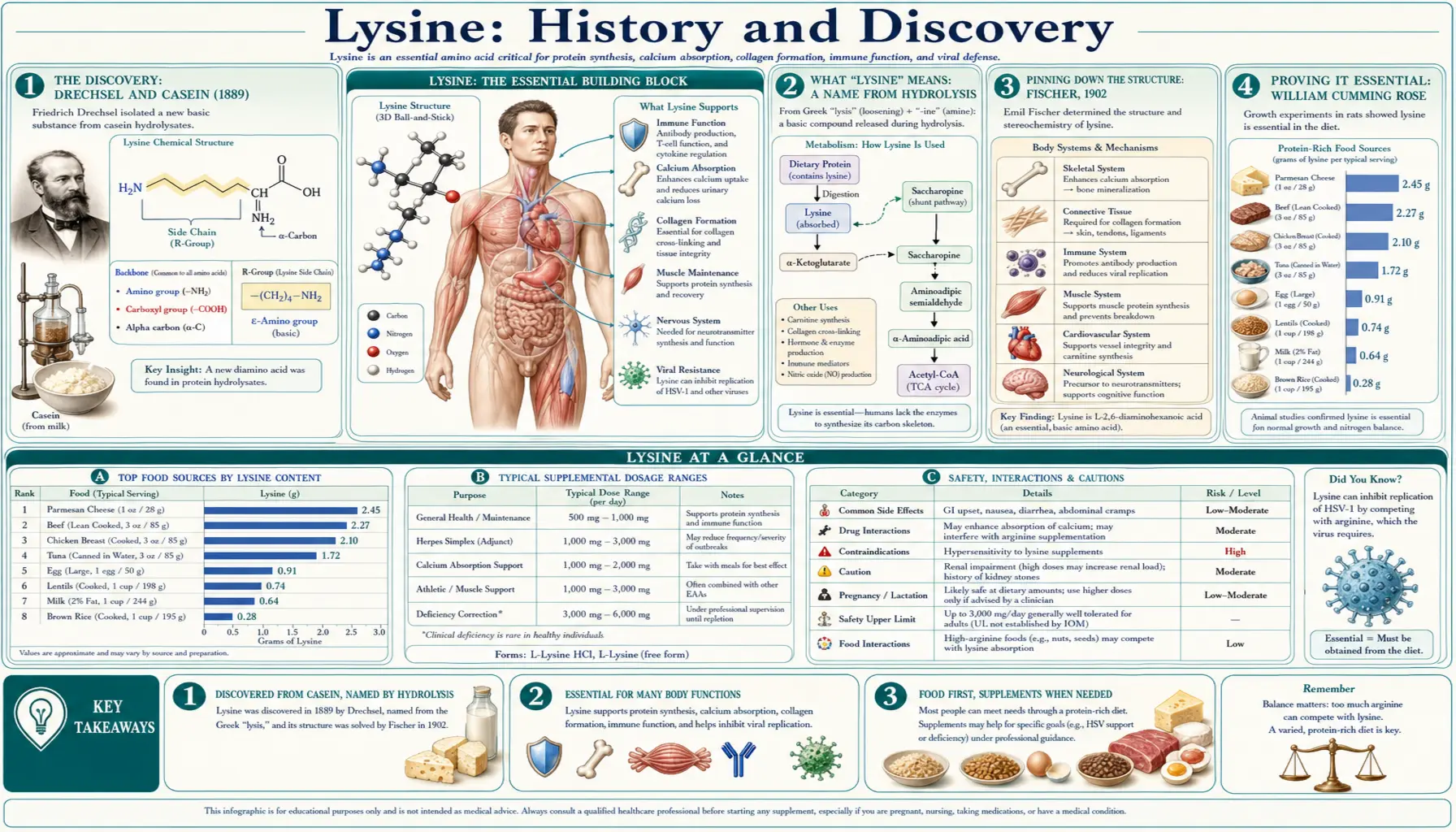
In 1889, a German chemist named Edmund Drechsel boiled the milk protein casein in acid, broke it down into its smallest pieces, and pulled out a substance no one had ever isolated before. Because he had freed it by "loosening" a protein apart, he named it from the Greek word for loosening — and over the next few years that name was shortened to the one we still use: lysine. This article tells the documented story of how lysine was found and understood: who isolated it and from what, where its odd little name comes from, how Emil Fischer pinned down its structure in 1902, how the American chemist William Cumming Rose later proved that humans cannot live without it, why it became known as the amino acid most often missing from the world's grain-based diets, and how a soil bacterium discovered in Japan turned lysine into one of the most-produced fine chemicals on Earth. Where the record is firm we say so; where a detail is uncertain or disputed, we flag it.
Table of Contents
- The Discovery: Drechsel and Casein (1889)
- What "Lysine" Means: A Name from Hydrolysis
- Pinning Down the Structure: Fischer, 1902
- Proving It Essential: William Cumming Rose
- The Missing Link in Bread and Rice
- From Laboratory to Industry: The Lysine Bug
- A Wider Story: Protein, Peptides, and the Amino Acids
- Research Papers and References
- Connections
- Featured Videos
The Discovery: Drechsel and Casein (1889)
Lysine was first isolated in 1889 by Ferdinand Heinrich Edmund Drechsel, a German biological chemist. He obtained it not from a living, intact protein but from the broken-down fragments of one: he subjected casein, the main protein of milk, to acid hydrolysis — essentially boiling it in acid until the long protein chain came apart into its individual building blocks — and from that mixture he separated a new nitrogen-rich substance. This basic identification, "first isolated from casein in 1889," is reported consistently across reference sources, including the Encyclopaedia Britannica.
Drechsel's achievement belongs to a particular moment in chemistry. By the late nineteenth century, chemists understood that proteins were built from smaller amino-acid units, and they were working their way through the proteins of milk, blood, muscle, and plants, hydrolysing them and trying to catch and name each component as it came out. Several amino acids had already been found this way over the preceding decades; lysine was one of the harder ones to corner, because it is a basic amino acid — it carries an extra nitrogen-bearing group that makes it behave differently from most of its neighbours in solution, and that very property is what eventually let chemists fish it out of the hydrolysis mixture.
It is worth being precise about what "discovery" means here. Drechsel did not invent lysine, and milk drinkers had been swallowing it for as long as there had been milk. What he did was the specific, datable scientific act of isolating the compound, recognising it as a distinct chemical individual, and giving it a name — the first time lysine existed as a known substance rather than an anonymous part of a protein.
What "Lysine" Means: A Name from Hydrolysis
The name lysine comes from the Greek word λυσις (lysis), meaning "loosening" or "a setting free." The same root gives English words such as analysis (a loosening-apart) and the biological term lysis (the bursting of a cell). For lysine the logic is direct: the compound was set free by hydrolysis — the loosening-apart of a protein with water and acid — so it was named for the very process that revealed it.
The naming did not arrive in one clean step, and the small detour is part of the story. When Drechsel first analysed his new substance, he suspected it might be chemically related to creatine and creatinine, the muscle compounds, and the early names he floated for it — lysatine and lysatinine — reflected that guessed-at kinship while keeping the lys- prefix that recorded its origin in protein breakdown. As the work continued in the early 1890s, the relationship to creatine did not hold up, and the name was trimmed to the shorter, cleaner lysine, dropping the misleading echo of creatinine. The shape of the final word, then, preserves a fossil of the method: every time we say "lysine," we are naming the act of loosening a protein apart.
(One naming caution worth noting for readers: the word "lysine" the amino acid is unrelated to the "-lysin" ending in words like hemolysin, which are biological agents that dissolve cells. Both ultimately trace back to the same Greek root for loosening, but they are different things; this page is about the amino acid.)
Pinning Down the Structure: Fischer, 1902
Isolating a compound and knowing exactly how its atoms are arranged are two different accomplishments, and the second took another thirteen years. The structure of lysine was settled in 1902, when the towering German chemist Emil Fischer, working with Fritz Weigert, confirmed it the most decisive way available: they synthesised lysine from simpler chemicals in the laboratory. Building the molecule from scratch and showing it matched the natural product proved that the proposed structure — a six-carbon chain (in chemical terms, α,ε-diaminocaproic acid) carrying an amino group at each end — was correct. Their paper, titled in German "Synthese der α,ε-Diaminocapronsäure (Inactives Lysin)," appeared in the Berichte der deutschen chemischen Gesellschaft in 1902.
Fischer is one of the central figures in the whole history of the amino acids, and his involvement places lysine firmly in the mainstream of that story. He had already received the Nobel Prize in Chemistry in 1902 for his work on the sugars and the purines, and in the years around the lysine synthesis he was laying the foundations of protein chemistry itself — above all by working out how amino acids link together through what he called the peptide bond to form chains. The man who established how amino acids join into proteins also nailed down the structure of this particular amino acid; the two strands of work were part of the same great project.
With its structure confirmed, lysine was now fully a known molecule: isolated (1889), named, and structurally defined and synthesised (1902). Everything that followed — its role in nutrition, its industrial manufacture — built on that foundation.
Proving It Essential: William Cumming Rose
Knowing what lysine is did not tell anyone how much we need it, or whether the body can simply make its own. Answering that took the careful, decades-long work of the American biochemist William Cumming Rose (1887–1985) at the University of Illinois. Beginning in the 1930s, Rose set out to sort every amino acid into one of two boxes: those the body can build for itself ("non-essential," or as he preferred, dispensable) and those that must come from food ("essential," or indispensable).
His method was painstaking. Rose fed laboratory rats diets in which the protein was replaced by a defined mixture of purified individual amino acids, then removed one amino acid at a time and watched what happened. When leaving an amino acid out caused the animals to stop growing or lose weight, that amino acid was essential — the body could not make it, so its absence could not be papered over. Through this systematic subtraction Rose mapped out the amino acids essential for the rat, and lysine was unmistakably one of them. (The same line of work is most famous for ending in 1935 with the discovery of threonine, the last of the essential amino acids to be identified; lysine, found decades earlier by Drechsel, was a long-known compound whose essentiality Rose now demonstrated.)
Rose then did something braver: he extended the experiments to humans. In a celebrated series of studies in the late 1940s and 1950s, healthy male volunteers lived on diets in which all the protein was supplied as a precisely measured blend of pure amino acids, and Rose measured nitrogen balance — comparing the nitrogen taken in against the nitrogen lost — as the readout of whether the body was holding its ground or breaking down its own tissue. Dropping an essential amino acid pushed volunteers into negative nitrogen balance; restoring it brought them back. In a 1955 paper devoted specifically to lysine — "The amino acid requirements of man. X. The lysine requirement" — Rose and his colleagues reported the amount of lysine humans need each day to stay in balance, establishing lysine as a true dietary essential for people and putting a number on the requirement. The modern recommendations you see today descend directly from this body of work.
The Missing Link in Bread and Rice
One discovery about lysine had consequences far beyond the laboratory: of all the essential amino acids, lysine is the one most often in short supply in the human diet — specifically, in diets built around cereal grains. Chemists noticed early that the storage proteins of grains are conspicuously poor in lysine. The Encyclopaedia Britannica entry on lysine makes the point plainly: lysine is "present in small amounts or lacking" in certain plant proteins, naming gliadin from wheat and zein from corn (maize), and noting that populations dependent on grains as their sole source of dietary protein can suffer lysine deficiency.
This is the origin of lysine's reputation as the classic "first limiting amino acid" in cereal-based diets. The idea is straightforward: your body can only build protein as long as every essential amino acid is available; the moment one runs out, construction stops, no matter how much of the others is present. In a diet of mostly wheat or rice or maize, lysine is usually the first to run out — so it "limits" how well the rest of the protein can be used. This is also the reasoning behind the age-old folk wisdom of pairing grains with legumes — rice and beans, bread and lentils — because beans and lentils are comparatively rich in the lysine that grains lack, and the two together make a more complete protein than either alone.
That single fact gave lysine an importance in public health and agriculture out of proportion to its quiet chemistry. It drove twentieth-century efforts to fortify cereal foods with added lysine and to breed grains — such as high-lysine "quality protein maize" — with more of it, all aimed at the same target: closing the lysine gap in populations living mainly on grain.
From Laboratory to Industry: The Lysine Bug
If lysine is what grain-based diets lack, the obvious question is whether it can be manufactured cheaply enough to add it back — and the answer turned out to be a striking chapter of twentieth-century biotechnology that begins in Japan. In 1957, Japanese researchers led by Shukuo Kinoshita isolated a soil bacterium that, under the right conditions, naturally pumped out large amounts of the amino acid glutamate. Originally named Micrococcus glutamicus and later reclassified as Corynebacterium glutamicum, this single organism founded the entire industry of making amino acids by fermentation — growing bacteria in tanks and letting them do the chemistry.
Glutamate (for the flavour enhancer MSG) came first; lysine followed almost immediately. By 1958, working from the same bacterium, the Japanese company Kyowa Hakko Kogyo had developed a fermentation process that coaxed mutant strains of C. glutamicum into overproducing lysine and excreting it into the broth, where it could be harvested and purified. Lysine fermentation is often described as the second-oldest amino-acid fermentation process, right after glutamate. It meant that lysine no longer had to be laboriously synthesised by chemists or extracted from protein — it could be brewed, at scale, by bacteria.
The economic result was enormous. Cheap fermented lysine became a global commodity, used above all in animal feed: adding pure lysine to the grain-and-soy rations of pigs and poultry lets the animals grow well on less total protein, the very same "limiting amino acid" principle put to industrial use. Today lysine is produced by the hundreds of thousands of tonnes a year. (Its commercial scale also has a notorious footnote: in the 1990s, lysine sat at the centre of a major international price-fixing scandal involving Archer Daniels Midland and several Japanese and Korean producers — a reminder of just how large this once-obscure protein fragment had become as an article of commerce.)
A Wider Story: Protein, Peptides, and the Amino Acids
Lysine's story is one thread in a much larger tapestry — the slow, century-long effort to understand what proteins are made of — and it helps to see where lysine sits in that weave. The very word protein was coined in 1838: the Dutch chemist Gerardus Johannes Mulder introduced it, on a suggestion from the great Swedish chemist Jöns Jacob Berzelius, from a Greek root meaning "of first importance" — capturing the sense that these were the primary substances of living matter. The first amino acid had been isolated even earlier, in 1806, when the French chemists Louis-Nicolas Vauquelin and Pierre Jean Robiquet obtained asparagine from asparagus juice.
Across the nineteenth century, one amino acid after another was teased out of natural proteins, usually by hydrolysing some plentiful material and isolating what crystallised: glycine from gelatin (Braconnot, 1820), tyrosine from cheese (Liebig, 1846), and many more, with lysine arriving from casein in 1889. The job of explaining how all these units were strung together fell to Emil Fischer — the same chemist who fixed lysine's structure — whose work on the peptide bond showed how amino acids link end-to-end into chains, the chemical basis of every protein, and contributed to the recognition marked by his 1902 Nobel Prize in Chemistry. Rounding out the picture, William Cumming Rose's mid-twentieth-century experiments answered the practical question the early chemists could not: of all these building blocks, which ones must we eat? Lysine, isolated by Drechsel and shown essential by Rose, sits squarely at the meeting point of those two great inquiries — the chemistry of what proteins are, and the nutrition of what we need.
That is the through-line worth carrying away. Lysine began as an anonymous fragment freed from boiled milk protein in 1889; it became a defined molecule in 1902, a proven dietary essential by the 1950s, and a bacterially brewed global commodity soon after — and along the way it brushed up against many of the most important names and ideas in the history of biochemistry.
Research Papers and References
The list below combines key peer-reviewed and reference sources for lysine's discovery and nutritional history with curated PubMed topic-search links. Drechsel's original 1889 isolation and the 1902 Fischer–Weigert synthesis are nineteenth- and early-twentieth-century works named here as historical primary sources; author names, titles, and journals are given as plain text, and only stable, verified DOI, PMID, or archival links are hyperlinked, each opening in a new tab.
- Drechsel E. Zur Kenntniss der Spaltungsprodukte des Caseins. Journal für praktische Chemie. 1889;39:425–429. — Drechsel's report of the basic decomposition products of casein, the work in which lysine was first isolated. (Historical primary source; cited in print.)
- Fischer E, Weigert F. Synthese der α,ε-Diaminocapronsäure (Inactives Lysin). Berichte der deutschen chemischen Gesellschaft. 1902;35(3):3772–3778. — Laboratory synthesis confirming the structure of lysine. (Historical primary source; cited in print.)
- Rose WC, Borman A, Coon MJ, Lambert GF. The amino acid requirements of man. X. The lysine requirement. Journal of Biological Chemistry. 1955;214(2):579–587. — Search PubMed
- Simoni RD, Hill RL, Vaughan M. The discovery of the amino acid threonine: the work of William C. Rose. Journal of Biological Chemistry. 2002;277(37):E25. — PMID: 12218068
- Matthews DE. Review of lysine metabolism with a focus on humans. The Journal of Nutrition. 2020;150(Suppl 1):2548S–2555S. — PMID: 33000162
- Lysine — history, isolation, and discovery PubMed: lysine discovery and isolation history
- Lysine biosynthesis, essentiality, and dietary requirement PubMed: lysine essentiality and requirement
External Authoritative Resources
- Encyclopaedia Britannica — Lysine
- NobelPrize.org — Emil Fischer, Nobel Prize in Chemistry 1902
- MedlinePlus — Herbs and Supplements
- PubMed — All research on Lysine