Sulfur — Benefits Deep Dive
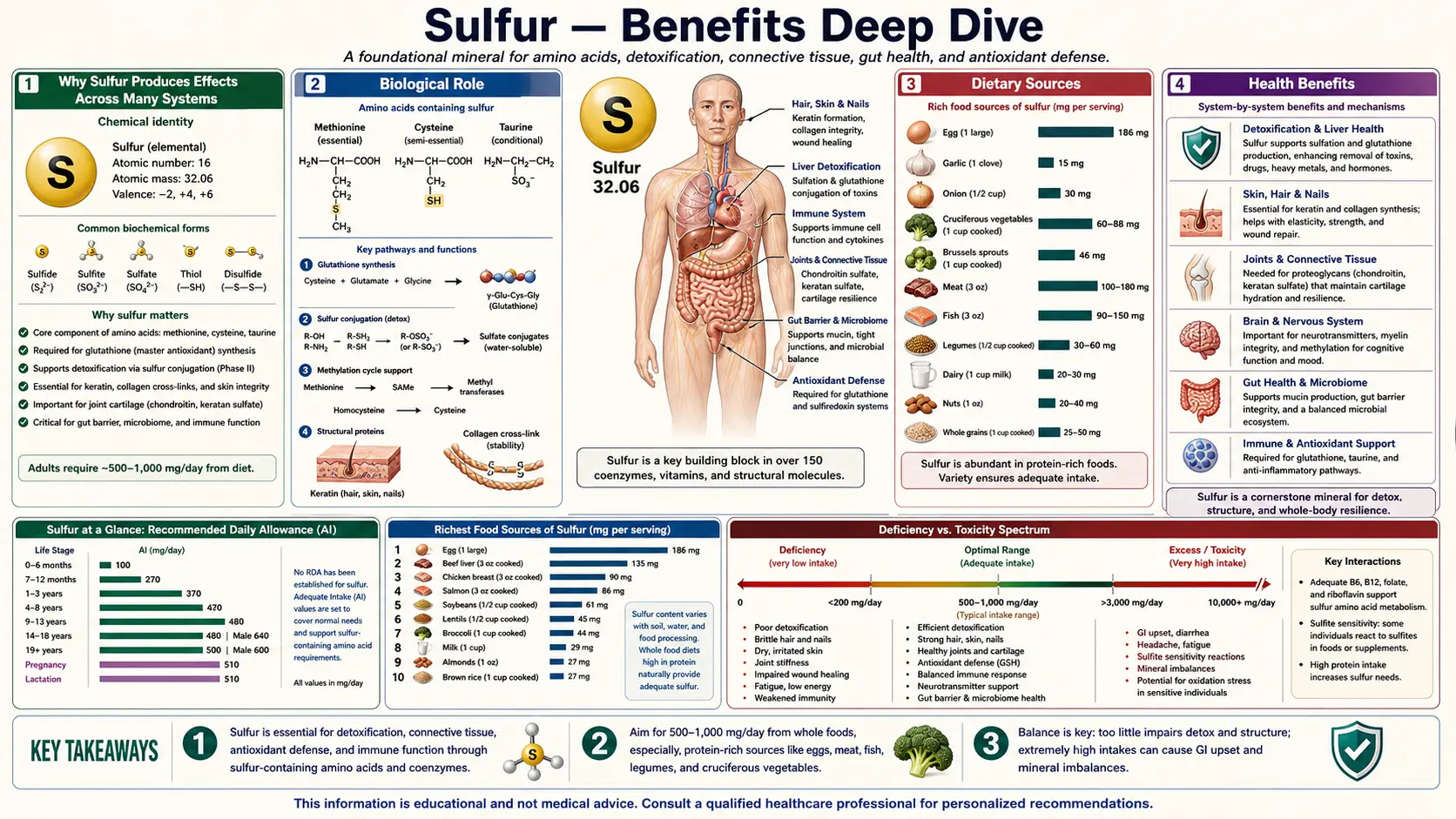
Sulfur is the eighth most abundant element in the human body, after calcium, phosphorus, potassium, sodium, chlorine, and magnesium — but unlike those minerals it is almost entirely organically bound rather than circulating as a free ion. Sulfur lives inside the amino acids cysteine and methionine, the tripeptide glutathione, the bile acid conjugate taurine, the B-vitamins biotin (B7) and thiamine (B1), the metabolic cofactor lipoic acid, and the sulfated glycosaminoglycans — chondroitin, keratan, heparan, and dermatan sulfate — that comprise the structural matrix of cartilage, skin, and connective tissue. Four deep-dive pages below explore the clinical territory where sulfur produces the largest measurable effect: joint and cartilage maintenance via MSM, glucosamine sulfate, and chondroitin sulfate; the trans-sulfuration bridge linking methylation to glutathione antioxidant defense; the keratin-disulfide architecture of skin, hair, and nail; and the phase II sulfation, glutathione conjugation, and hydrogen-sulfide gasotransmitter pathways that govern detoxification.
Deep-Dive Articles
Joint Health
Why sulfated chondroitin and keratan sulfate are the load-bearing molecules of articular cartilage, how the Donnan-effect swelling pressure of negatively charged sulfate groups gives cartilage its compressive resistance, the three sulfur-derived interventions for osteoarthritis — MSM at 1.5-6 g/day, chondroitin sulfate at 800-1200 mg/day, and crystalline glucosamine sulfate at 1500 mg/day with three-year data showing reduced joint-space narrowing — plus the NF-kB and matrix-metalloproteinase suppression that explains the anti-inflammatory effect on chondrocytes and synovial fibroblasts.
Glutathione & Methylation
The sulfur amino acids cysteine and methionine feed two systems simultaneously: glutathione synthesis via gamma-glutamylcysteine synthetase (with cysteine as rate-limiting substrate) and the methionine-SAMe-SAH-homocysteine methylation cycle with its 200+ methyltransferase substrates. The trans-sulfuration pathway (cystathionine beta-synthase, B6-dependent) bridges them by converting homocysteine to cysteine. NAC as cysteine donor for rapid glutathione restoration. The MTHFR-SAMe-glutathione axis explains why folate-cycle dysfunction depletes both pathways together.
Skin Health
Keratin's extraordinarily high disulfide-bond content (~14% cysteine in hair, ~9% in nail) determines the structural integrity of hair, nail, and stratum corneum. MSM trials for rosacea (Berardesca 2008) and photoaging (Anthonavage 2015). Two millennia of topical sulfur use for acne, scabies, and seborrhea. Dead Sea sulfur balneotherapy for psoriasis (PASI reductions of 65-80% in rigorous trials). Garlic and the allium family's allicin, diallyl sulfide, and S-allyl cysteine in dermatologic infections and chemoprevention.
Detoxification
Phase II conjugation via the SULT family of 13 sulfotransferase enzymes using PAPS (3'-phosphoadenosine-5'-phosphosulfate) as the universal sulfate donor. Drug sulfation of acetaminophen, steroids, dopamine, thyroxine, neurotransmitters. The sulfation pathway bottleneck documented by Rosemary Waring in autism (reduced PST activity, ~50% lower plasma sulfate). Glutathione S-transferase conjugation of NAPQI and chemical carcinogens. Hydrogen sulfide (H2S) as the third gasotransmitter alongside NO and CO, its endogenous vascular and anti-inflammatory signaling roles.
Table of Contents
- Deep-Dive Articles
- Why Sulfur Produces Effects Across Many Systems
- Research Papers: Joint Health
- Research Papers: Glutathione & Methylation
- Research Papers: Skin Health
- Research Papers: Detoxification
- Research Papers: Cross-Cutting (Mechanism, Status, Safety)
- External Authoritative Resources
- Connections
- Featured Videos
Why Sulfur Produces Effects Across Many Systems
Most minerals act narrowly: calcium signals at one type of ion channel, iron sits at the center of one type of protein (heme), iodine occupies only one position on thyroid hormone. Sulfur is unusual because the same element appears in every methylation reaction, in every glutathione molecule, in every keratin disulfide bond, in every chondroitin and heparan sulfate, and in every phase-II sulfation conjugation. The pervasiveness is what generates the breadth of clinical effect.
The functional groups that carry sulfur's biological activity are remarkably few:
- Thiol (-SH) groups on cysteine — the most reactive functional group in biology. Forms disulfide bonds (the cross-links that fold and stabilize insulin, antibodies, keratin, collagen-associated proteins, and most secreted proteins), binds soft metal cations (zinc, copper, iron, mercury, lead, cadmium, arsenic, gold), and serves as the redox-active site of glutathione, thioredoxin, peroxiredoxin, glutaredoxin, and the catalytic cysteines of countless enzymes. This single chemistry underwrites the structural integrity of skin, hair, and connective tissue and the entire cellular antioxidant defense system.
- Methyl-bearing sulfur in methionine and SAMe — methionine's methyl group, activated by adenosylation to SAMe, is the universal currency for methylation reactions. Over 200 distinct methyltransferases in the human genome use SAMe to methylate DNA, histones, neurotransmitters, phospholipids, and creatine. The same methionine atom can cycle through SAMe to SAH to homocysteine and back to methionine many times over a cell's lifetime — one of the most elegantly recycled atoms in metabolism.
- Sulfate ester groups in glycosaminoglycans and phase-II conjugates — the highly negatively charged -OSO3- group attached to a sugar (chondroitin sulfate, keratan sulfate, heparan sulfate, dermatan sulfate) or to a drug/hormone/neurotransmitter (acetaminophen sulfate, estrone sulfate, dopamine sulfate, T3 sulfate) is the workhorse of both connective tissue architecture and xenobiotic clearance. Installed by SULT enzymes using PAPS as donor.
- Sulfur in vitamin and cofactor rings — biotin (vitamin B7) and thiamine (vitamin B1) both contain a sulfur atom in their characteristic ring structures. Lipoic acid contains a 1,2-dithiolane ring with two sulfurs. These vitamins and cofactors carry sulfur into the catalytic centers of carboxylases, dehydrogenases, and other key metabolic enzymes.
- Hydrogen sulfide (H2S) as gasotransmitter — the smallest sulfur-containing molecule (one sulfur, two hydrogens, MW 34) is endogenously synthesized at nanomolar concentrations and serves as a signaling gasotransmitter alongside nitric oxide and carbon monoxide, regulating vascular tone, anti-inflammatory responses, mitochondrial respiration, and post-translational protein persulfidation.
Because these five functional chemistries appear in so many places, dietary sulfur deficiency produces a multi-system rather than focal clinical picture: connective tissue fragility, oxidative stress, impaired detoxification of drugs and hormones, methylation impairment with elevated homocysteine, and (in extreme deficiency) impaired wound healing and immune function. Conversely, sulfur supplementation through MSM, NAC, cysteine, glutathione, glucosamine sulfate, or sulfated glycosaminoglycans can ameliorate seemingly unrelated conditions because all of these conditions share the underlying substrate limitation.
The therapeutic complication is that sulfur metabolism has bottleneck points where overload can cause harm. CBS upregulation can drive excessive homocysteine flux toward trans-sulfuration; gut sulfate-reducing bacteria can convert excess sulfur substrate to hydrogen sulfide at gas-producing concentrations; sulfite oxidase (the molybdenum-dependent step that converts sulfite to safe sulfate) can become rate-limiting and allow sulfite accumulation. These nuances mean that sulfur supplementation is rarely "the more the better" and almost always benefits from titration, cofactor balance, and attention to the individual patient's metabolic context.
Research Papers: Joint Health
- Reginster JY et al. (2001). Long-term effects of glucosamine sulphate on osteoarthritis progression: a randomised, placebo-controlled clinical trial. The Lancet. — PubMed: Reginster 2001 Lancet
- Pavelka K et al. (2002). Glucosamine sulfate and delayed knee osteoarthritis progression: 3-year RCT. Arch Intern Med. — PubMed: Pavelka 2002
- Clegg DO et al. (2006). Glucosamine, chondroitin sulfate, and the two in combination for painful knee osteoarthritis (GAIT). NEJM. — PubMed: GAIT trial NEJM
- Kim LS et al. (2006). Efficacy of MSM in osteoarthritis pain of the knee. Osteoarthritis Cartilage. — PubMed: Kim MSM 2006
- Debbi EM et al. (2011). Efficacy of MSM supplementation on osteoarthritis of the knee. BMC Complement Altern Med. — PubMed: Debbi 2011
- Brien S et al. (2011). Meta-analysis of DMSO and MSM in osteoarthritis of the knee. Evid Based Complement Alternat Med. — PubMed: Brien meta-analysis
- Kahan A et al. (2009). Long-term effects of chondroitin 4&6 sulfate on knee OA (STOPP). Arthritis Rheum. — PubMed: STOPP trial
- Reginster JY et al. (2017). Chondroitin sulfate vs celecoxib in knee OA (CONCEPT). Ann Rheum Dis. — PubMed: CONCEPT trial
- Butawan M et al. (2017). Methylsulfonylmethane: applications and safety. Nutrients. — PubMed: Butawan MSM review
- Singh JA et al. (2015). Chondroitin for osteoarthritis. Cochrane Database. — PubMed: Cochrane chondroitin
Research Papers: Glutathione & Methylation
- Mosharov E et al. (2000). Transsulfuration pathway and regulation of glutathione synthesis. Biochemistry. — PubMed: Mosharov 2000
- Vitvitsky V et al. (2006). Functional transsulfuration pathway in the brain. J Biol Chem. — PubMed: Vitvitsky brain
- Prescott LF et al. (1977). N-acetylcysteine for acetaminophen poisoning. The Lancet. — PubMed: Prescott 1977
- Sekhar RV et al. (2011). Cysteine + glycine restore glutathione in aging. Am J Clin Nutr. — PubMed: Sekhar GSH aging
- Kumar P et al. (2021). GlyNAC improves aging hallmarks, mitochondrial function. Clin Transl Med. — PubMed: GlyNAC trial
- Frosst P et al. (1995). MTHFR C677T variant and vascular disease. Nat Genet. — PubMed: Frosst MTHFR
- Selhub J (1999). Homocysteine metabolism. Annu Rev Nutr. — PubMed: Selhub homocysteine
- Lu SC (2009). Regulation of glutathione synthesis. Mol Aspects Med. — PubMed: Lu GSH regulation
- Stipanuk MH (2004). Sulfur amino acid metabolism. Annu Rev Nutr. — PubMed: Stipanuk SAA
- Banerjee R, Zou CG (2005). Cystathionine beta-synthase enzymology. Arch Biochem Biophys. — PubMed: Banerjee CBS
Research Papers: Skin Health
- Lin AN et al. (1988). Sulfur revisited. J Am Acad Dermatol. — PubMed: Lin sulfur revisited
- Berardesca E et al. (2008). MSM + silymarin for rosacea. J Cosmet Dermatol. — PubMed: MSM rosacea
- Anthonavage M et al. (2015). Oral MSM for skin health and wrinkle reduction. Nat Med J. — PubMed: MSM photoaging
- Even-Paz Z, Efron D (2003). UV dose in Dead Sea psoriasis treatment. IMAJ. — PubMed: Dead Sea UV
- Harari M et al. (2012). Dead Sea climatotherapy for psoriasis. JEADV. — PubMed: Dead Sea psoriasis
- Matz H et al. (2003). Balneotherapy in dermatology. Dermatol Ther. — PubMed: Balneotherapy review
- Goldenberg G et al. (2014). Sodium sulfacetamide-sulfur foam for rosacea. J Drugs Dermatol. — PubMed: Sulfacetamide-sulfur
- Ledezma E et al. (1999). Ajoene for tinea cruris vs terbinafine. Arzneimittelforschung. — PubMed: Ajoene tinea
- Ankri S, Mirelman D (1999). Antimicrobial properties of allicin. Microbes Infect. — PubMed: Allicin antimicrobial
- Trueb RM (2016). Serum biotin in women with hair loss. Int J Trichology. — PubMed: Biotin hair loss
Research Papers: Detoxification
- Waring RH, Klovrza LV (2000). Sulphur metabolism in autism. J Nutr Environ Med. — PubMed: Waring autism
- Alberti A et al. (1999). Sulphation deficit in autistic children. Biol Psychiatry. — PubMed: Alberti sulphation autism
- Glatt H, Meinl W (2004). Pharmacogenetics of SULTs. Naunyn Schmiedebergs Arch Pharmacol. — PubMed: SULT pharmacogenetics
- Klaassen CD, Boles JW (1997). PAPS regulation of sulfation. FASEB J. — PubMed: PAPS regulation
- Hayes JD et al. (2005). Glutathione transferases. Annu Rev Pharmacol Toxicol. — PubMed: GST review
- Mitchell JR et al. (1973). Acetaminophen hepatotoxicity I: drug metabolism. J Pharmacol Exp Ther. — PubMed: Acetaminophen mechanism
- Wang R (2002). H2S as third gasotransmitter. FASEB J. — PubMed: H2S gasotransmitter
- Kabil O, Banerjee R (2010). Redox biochemistry of H2S. J Biol Chem. — PubMed: H2S redox
- Yang G et al. (2008). H2S vasorelaxant; CSE knockout hypertension. Science. — PubMed: H2S vasorelaxant
- Strott CA (2002). Sulfonation and molecular action. Endocr Rev. — PubMed: Strott sulfonation
Research Papers: Cross-Cutting (Mechanism, Status, Safety)
- Nimni ME, Han B, Cordoba F (2007). Are we getting enough sulfur in our diet? Nutr Metab. — PubMed: Are we getting enough sulfur
- Parcell S (2002). Sulfur in human nutrition and applications in medicine. Altern Med Rev. — PubMed: Parcell sulfur review
- Drozdz R, Naskalski JW, Sznajd J (1988). Oxidation of amino acids and peptides by myeloperoxidase. Biochim Biophys Acta. — PubMed: SAA oxidation
- Komarnisky LA, Christopherson RJ, Basu TK (2003). Sulfur: its clinical and toxicologic aspects. Nutrition. — PubMed: Komarnisky clinical sulfur
- Wu G et al. (2004). Glutathione metabolism and its implications for health. J Nutr. — PubMed: GSH metabolism review
- Brosnan JT, Brosnan ME (2006). The sulfur-containing amino acids: an overview. J Nutr. — PubMed: Brosnan SAA overview
- Townsend DM, Tew KD, Tapiero H (2004). Sulfur containing amino acids and human disease. Biomed Pharmacother. — PubMed: SAA and human disease
- Reisz JA et al. (2014). Effects of ionizing radiation on biological molecules. Antioxid Redox Signal. — PubMed: Radiation and SAA
- Jensen TG et al. (2018). Hydrogen sulfide donors and their clinical translation. Pharmacol Ther. — PubMed: H2S donor therapeutics
- Selhub J et al. (2008). The use of blood concentrations of vitamins and their respective functional indicators to define folate and vitamin B12 status. Food Nutr Bull. — PubMed: B12/folate status
External Authoritative Resources
- Linus Pauling Institute — sulfur and sulfur amino acids — the most authoritative scientific summary, regularly updated
- NIH Office of Dietary Supplements — fact sheets (includes glucosamine and chondroitin sulfate professional sheets)
- NIH NIAMS — Osteoarthritis Overview (includes supplement evidence)
- MedlinePlus — Methylsulfonylmethane (MSM)
- MedlinePlus — Glucosamine Sulfate
- MedlinePlus — Chondroitin Sulfate
- PubMed — all research on sulfur amino acid nutrition
Connections
- All Minerals
- Sulfur (Main Page)
- Sulfur for Joint Health
- Sulfur for Glutathione & Methylation
- Sulfur for Skin Health
- Sulfur for Detoxification
- Cysteine
- Methionine
- Taurine
- Glycine
- NAC (N-Acetylcysteine)
- Glutathione
- Homocysteine
- Molybdenum (Sulfite Oxidase)
- Selenium
- Copper
- Magnesium
- Zinc
- Arthritis
- Joint Pain
- Acne
- Garlic
- Collagen
- Eggs
- Broccoli
- Kale
- Heavy Metals
- Oxidative Stress
- Detoxification