Sulfur: History and Discovery
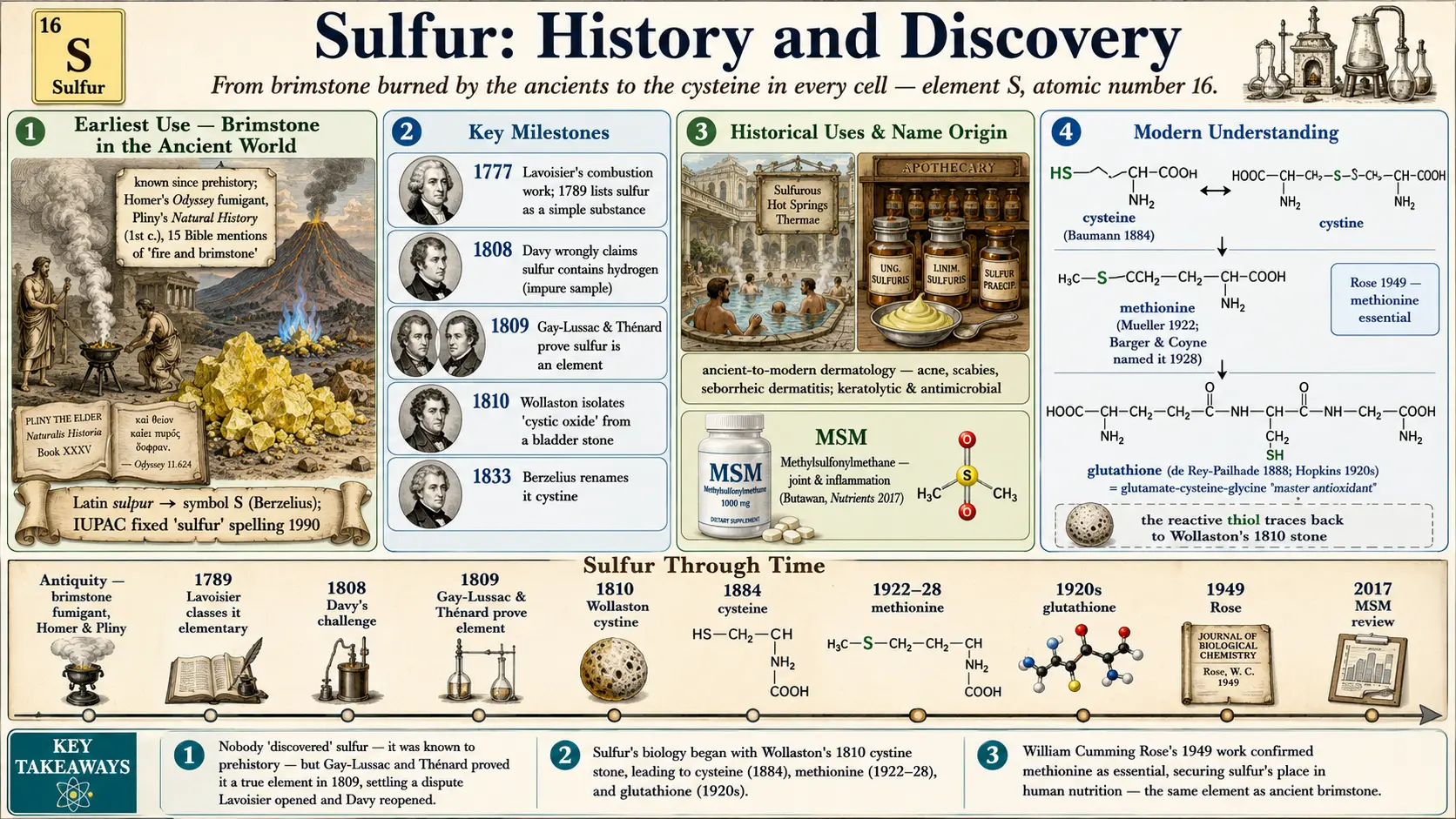
Sulfur is one of a small handful of elements that humanity has known and used for as long as we have written records — the yellow "brimstone" of the ancient world, burned for fumigation, folded into medicine, and woven through scripture. Yet its true history has two very different chapters. The first is a chemistry story: although sulfur itself was never "discovered" by any one person, the question of whether it was a pure element was settled only around 1809, after a sharp disagreement between some of the greatest chemists of the age. The second is a biology story that began in 1810, when an English physician isolated a strange substance from a bladder stone and, without knowing it, opened the door to understanding sulfur's role inside the human body. This article tells both chapters as the historical record actually supports them — naming the people and the dates where they are documented, and saying plainly where a claim is tradition rather than established fact.
Table of Contents
- Brimstone: Sulfur in the Ancient World
- The Name and the Symbol S
- Lavoisier and the Question of an Element
- Davy's Challenge and the Proof of 1808–1809
- Sulfur Inside the Body: Wollaston's Cystine (1810)
- Naming the Sulfur Amino Acids
- Glutathione and the Master Antioxidant
- From Folk Remedy to Modern Supplement
- Research Papers and References
- Connections
- Featured Videos
Brimstone: Sulfur in the Ancient World
Sulfur belongs to the oldest layer of human chemistry. Long before anyone understood what an element was, sulfur was already familiar across the ancient world — bright yellow, easy to find near volcanoes and hot springs, and unmistakable for the way it burns with a blue flame and a sharp, choking smell. Reference histories record its use in ancient India, ancient Greece, China, and Egypt. Its older English name, brimstone, means simply "burning stone," and that is exactly how the ancients knew it: a stone that catches fire.
Because it was so striking, sulfur appears repeatedly in the earliest texts. The Greek poet Homer mentions burning sulfur as a fumigant in the Odyssey, used to purify a hall — one of the oldest written records of the practice. The Roman naturalist Pliny the Elder discussed sulfur in his Natural History in the first century, noting sources such as the volcanic island of Melos and describing medicinal and practical uses. Sulfur is also named many times in the Bible — the Royal Society of Chemistry counts fifteen mentions — most famously in the phrase "fire and brimstone." This early reputation as a purifying, disease-driving-away substance is worth holding onto: the use of sulfur in medicine, especially for skin complaints, is one of the longest-running threads in the whole history of materia medica.
What this ancient record does not contain is any notion of sulfur as a chemical element in the modern sense. To the ancients it was a useful, dramatic mineral. The idea that it might be a fundamental, indivisible substance — a building block of matter — belongs to a much later and very different era, and that is where the story turns next.
The Name and the Symbol S
The word sulfur comes through Latin, where the element was written sulpur or sulphur. From that Latin root we also get the chemical symbol S, assigned in the modern system of element symbols developed by the Swedish chemist Jöns Jacob Berzelius in the early nineteenth century. The two spellings — "sulfur" and "sulphur" — reflect a long-standing difference between American and British usage; in 1990 the International Union of Pure and Applied Chemistry (IUPAC) adopted sulfur as the standard international spelling, which is why most current scientific writing uses the "f."
The older name brimstone survives mainly in religious and literary language rather than in chemistry. It is a plain compound of two ordinary words — "burn" and "stone" — and its long life in English is a small reminder of how completely sulfur was part of everyday experience before it ever had a place in a periodic table. Sulfur sits at atomic number 16, directly below oxygen in the periodic table, a position that hints at the chemical kinship the next sections explore: like oxygen, sulfur readily combines with other elements, and that very reactivity is what made its true nature so hard to pin down.
Lavoisier and the Question of an Element
The modern history of sulfur is really the history of a question: is it a pure element, or is it a compound of something simpler? For most of human history that question could not even be posed clearly, because there was no rigorous idea of a chemical element. That idea took shape in the late eighteenth century, above all in the work of the French chemist Antoine-Laurent Lavoisier — often called the father of modern chemistry — who reorganised the science around careful measurement and the conservation of mass.
Lavoisier worked with sulfur directly. He used it in his famous combustion experiments, writing of some of this work in 1777, and he showed that when sulfur burns it combines with oxygen and gains weight — a result that fit his new theory of combustion and oxidation. On the strength of evidence like this, Lavoisier classed sulfur among the elements: in his landmark 1789 textbook, the Traité élémentaire de chimie, sulfur appears in his table of simple substances that could not be broken down further by the chemistry of the day.
It is important to be precise about what this means. Lavoisier did not "discover" sulfur — it had been known for thousands of years. What he did was place it, for the first time, within a coherent scientific framework that treated it as a candidate element. But a candidate is not a proven case. Lavoisier's judgement that sulfur was elementary was a reasonable conclusion from his experiments, not an airtight proof, and within twenty years it would be openly challenged — by one of the most brilliant chemists of the next generation.
Davy's Challenge and the Proof of 1808–1809
The challenge came from the English chemist Humphry Davy, who in the first decade of the nineteenth century was using the newly invented electric battery to tear apart substances that had resisted every earlier method — isolating potassium and sodium for the first time in 1807, and going on to elemental work on several other elements. Riding this extraordinary run of discoveries, Davy turned a sceptical eye on the accepted list of elements, sulfur among them. In 1808 he reported that sulfur was not a pure element at all but appeared to contain hydrogen (and, in some accounts, oxygen). For a moment, one of chemistry's settled facts was in doubt.
Davy was wrong — but for an understandable reason. His sulfur sample was impure, and the contaminants gave the misleading impression that hydrogen was an ingredient of sulfur itself. The matter was resolved by two French chemists, Joseph Louis Gay-Lussac and Louis-Jacques Thénard, who in 1809 carried out careful work demonstrating that sulfur really is an element, with no hidden hydrogen. Faced with their results, Davy accepted the conclusion. The same Gay-Lussac–Thénard partnership was, in this very period, establishing the elementary nature of other substances too — they are also credited with confirming that phosphorus is an element — making the years around 1808–1810 a kind of high-water mark for sorting the true elements from the false.
So the honest answer to "who discovered sulfur?" is that nobody did — it was known to prehistory. But if the question is "who proved sulfur is a chemical element?", the record points to Gay-Lussac and Thénard in 1809, settling a dispute that Lavoisier had opened and Davy had reopened. That is the closest thing sulfur has to a datable discovery, and it is a useful illustration of how science actually works: a claim is made, challenged on real evidence, and resolved by better experiments rather than by authority.
Sulfur Inside the Body: Wollaston's Cystine (1810)
The moment chemists finished arguing about what sulfur was, a second and entirely separate history began: the slow discovery of what sulfur does inside living bodies. For most elements with a nutritional role, that story starts with a deficiency disease. Sulfur's starts somewhere stranger — with a kidney stone.
In 1810 the English physician and chemist William Hyde Wollaston examined an unusual urinary calculus (a stone formed in the urinary tract) and found it was made of a substance no one had described before. He called it "cystic oxide," from the Greek word for the bladder. The name turned out to be wrong in one respect — the material was not an oxide — and in 1833 Jöns Jacob Berzelius renamed it cystine, keeping the reference to the bladder where it had first been found. Cystine was eventually recognised as a sulfur-containing compound built from two linked units of the amino acid that would later be called cysteine, joined by a bond between their sulfur atoms.
Wollaston had no way of knowing the wider significance of what he had found. He was studying a patient's stone, not the chemistry of nutrition. But his cystine was, in effect, the first sulfur-containing amino-acid material ever isolated from the human body, and historians of nutrition often date the study of sulfur amino acids to exactly this 1810 observation. The rare inherited condition in which such stones form — cystinuria — is itself a landmark in medical history, later identified as one of the original "inborn errors of metabolism." From a single stone, a whole field eventually grew.
Naming the Sulfur Amino Acids
Through the nineteenth century, chemists slowly realised that the sulfur in our bodies is not stored as the yellow element but is carried in specific molecules — above all in the amino acids that make up proteins. Cystine, Wollaston's find, was the first thread. In 1884 the German biochemist Eugen Baumann showed that cystine could be converted to a simpler, related sulfur compound, which became known as cysteine — the building block that, in pairs, forms cystine. With cysteine recognised, one of the two great sulfur amino acids was on the map.
The second arrived decades later. In 1922 the American bacteriologist John Howard Mueller, working on the nutritional requirements of bacteria, isolated a previously unknown sulfur-containing amino acid from the milk protein casein. He had found a new amino acid but not worked out its full structure. That was done in 1928 by the British scientists George Barger and Frederick Coyne, who determined its chemistry and — after consulting Mueller — gave it the name we still use, methionine, in reference to its characteristic methyl–sulfur grouping. Methionine and cysteine remain the two amino acids through which nearly all dietary sulfur enters human metabolism.
The final piece was understanding why these amino acids matter for nutrition. That clarity came from the meticulous human-feeding studies of the American biochemist William Cumming Rose, who in the 1940s worked out which amino acids the human body cannot make for itself and therefore must obtain from food. In his much-cited 1949 summary, Amino Acid Requirements of Man, Rose placed methionine among the essential amino acids and noted that cystine can spare part of the methionine requirement — a finding of real practical importance, since methionine is often the limiting amino acid in diets around the world. With Rose's work, sulfur's essential place in human nutrition was, for the first time, securely established.
Glutathione and the Master Antioxidant
One more discovery completed the early picture of sulfur in the body, and it concerns the molecule now often called the body's "master antioxidant." As early as 1888 the French scientist J. de Rey-Pailhade described a sulfur-bearing substance he isolated from yeast and named "philothion," from Greek roots meaning "sulfur-loving." The substance was not fully understood at the time, and the credit for properly characterising it usually goes to the British biochemist Frederick Gowland Hopkins — a Nobel laureate for his separate work on vitamins — who studied it in the 1920s and gave it the name glutathione. Its three-part structure, a small peptide of glutamate, cysteine, and glycine, was clarified over the following years.
Glutathione mattered enormously to the sulfur story because it showed where so much of the body's sulfur actually goes to work. The reactive heart of the glutathione molecule is the sulfur-bearing thiol group contributed by its cysteine — the same cysteine traced all the way back to Wollaston's stone. Through glutathione, sulfur turned out to be central to how cells defend themselves against oxidative damage and how the liver neutralises toxins. The thread is direct and rather elegant: a curious bladder stone in 1810, the naming of cysteine in 1884, and finally an understanding of glutathione in the 1920s, together revealing sulfur not as an inert mineral but as a working part of the body's chemistry of protection and repair. The detailed biology of these pathways is covered on the companion Sulfur Benefits pages.
From Folk Remedy to Modern Supplement
Sulfur's practical use has never really stopped, and its modern career runs alongside the laboratory discoveries. The ancient reputation of sulfur as a treatment for skin conditions carried straight through into modern dermatology: elemental sulfur and sulfur compounds have long been used in preparations for acne, scabies, seborrheic dermatitis, and similar complaints, valued for their keratolytic (skin-shedding) and antimicrobial effects. The hot-spring and spa tradition — bathing in naturally sulfurous mineral waters for skin and joint complaints — is another old practice that survives to this day, though it is worth being clear that long use is a reason to study a remedy, not by itself proof that it works.
In the twentieth century, sulfur also entered the supplement world in new chemical forms. Methylsulfonylmethane (MSM), an organic sulfur compound, became a widely sold dietary supplement, marketed especially for joint and inflammatory complaints. A 2017 review by Matthew Butawan and colleagues in the journal Nutrients describes MSM as a naturally occurring organosulfur compound that has been investigated in animal and human studies for inflammation, joint and muscle pain, and oxidative stress, and notes it is generally well tolerated at typical doses — while still calling for more and larger trials. Sulfated forms of glucosamine and chondroitin, also taken for joint health, belong to the same broad modern interest in supplying the body with usable sulfur.
Seen as a whole, the history of sulfur is unusually clean in its two halves. The chemistry was effectively settled by 1809, when Gay-Lussac and Thénard proved it an element. The biology unfolded across the next century and a half, from Wollaston's 1810 cystine through the naming of cysteine, methionine, and glutathione to Rose's confirmation of sulfur's nutritional necessity. The yellow brimstone of the ancient world and the cysteine in every cell of your body are, in the end, the same element — and the story of how we came to understand that is one of the more satisfying in the whole history of the minerals. For the present-day science of why sulfur matters to health, see the main Sulfur page and the Sulfur Benefits articles.
Research Papers and References
The list below combines peer-reviewed reviews on sulfur amino acids and organosulfur supplements with curated PubMed topic-search links into the historical and biochemical literature. Historical primary works — the ancient writings of Homer and Pliny the Elder, Lavoisier's Traité élémentaire de chimie (1789), Wollaston's 1810 description of "cystic oxide," and the original papers of Baumann, Mueller, and Barger & Coyne — are named in the article as historical sources rather than as modern citations. Author names, titles, and journals are given as plain text; only the stable DOI or PMID is hyperlinked, and each opens in a new tab.
- Brosnan JT, Brosnan ME. The sulfur-containing amino acids: an overview. Journal of Nutrition. 2006;136(6 Suppl):1636S-1640S. — PMID: 16702333
- Rose WC. Amino acid requirements of man. Federation Proceedings. 1949;8(2):546-552. (Reprinted as a Nutrition Classic in Nutrition Reviews, 1976;34(10):307-309.) — Search PubMed
- Butawan M, Benjamin RL, Bloomer RJ. Methylsulfonylmethane: applications and safety of a novel dietary supplement. Nutrients. 2017;9(3):290. — doi:10.3390/nu9030290
- Sulfur as a chemical element — history of its discovery and recognition PubMed: sulfur amino acid history and metabolism
- Cystine, cysteine, and methionine — biochemistry and discovery PubMed: cysteine and methionine metabolism reviews
External Authoritative Resources
- Royal Society of Chemistry — Sulfur element information and history
- Encyclopædia Britannica — Sulfur
- NobelPrize.org — Frederick Gowland Hopkins (1929)
- PubMed — Sulfur amino acids in human nutrition