Chronic Obstructive Pulmonary Disease (COPD)
Interactive Visualization Breathing & Gas Exchange — move the diaphragm yourself Fill the alveoli and watch oxygen diffuse into the blood while carbon dioxide leaves, with live pO₂/pCO₂ meters and an exercise mode. Launch → Interactive Visualization Blood pH — hold the acid–base balance yourself Keep blood pH between 7.35 and 7.45 — blow off CO₂ with the lungs in minutes, dump acid through the kidneys over hours, then break it with hyperventilation or diabetic ketoacidosis. Launch → Interactive Visualization Hemoglobin & the O₂ Curve — bend the oxygen curve Load oxygen onto hemoglobin one cooperative step at a time to draw the S-curve — then shift it with exercise, watch carbon monoxide lock it shut, or switch to fetal hemoglobin. Launch → Interactive Visualization Lung Surfactant — keep the air-sacs open See why 300 million wet air-sacs don't collapse from surface tension — a soapy surfactant holds them open — then take it away, as in a premature baby, and watch the lungs stiffen and collapse. Launch → Interactive Visualization Asthma — squeeze the airway shut, then open it again Narrow a bronchiole and watch resistance climb with the fourth power of the radius — then fire a rescue inhaler and pull the peak flow back out of the red zone. Launch →
Table of Contents
- What is COPD?
- Types of COPD
- Symptoms of COPD
- Risk Factors
- Diagnosis
- Prevention Strategies
- Treatment Options
- Complications of COPD
- Research Papers
- Connections
- Featured Videos
What is COPD?
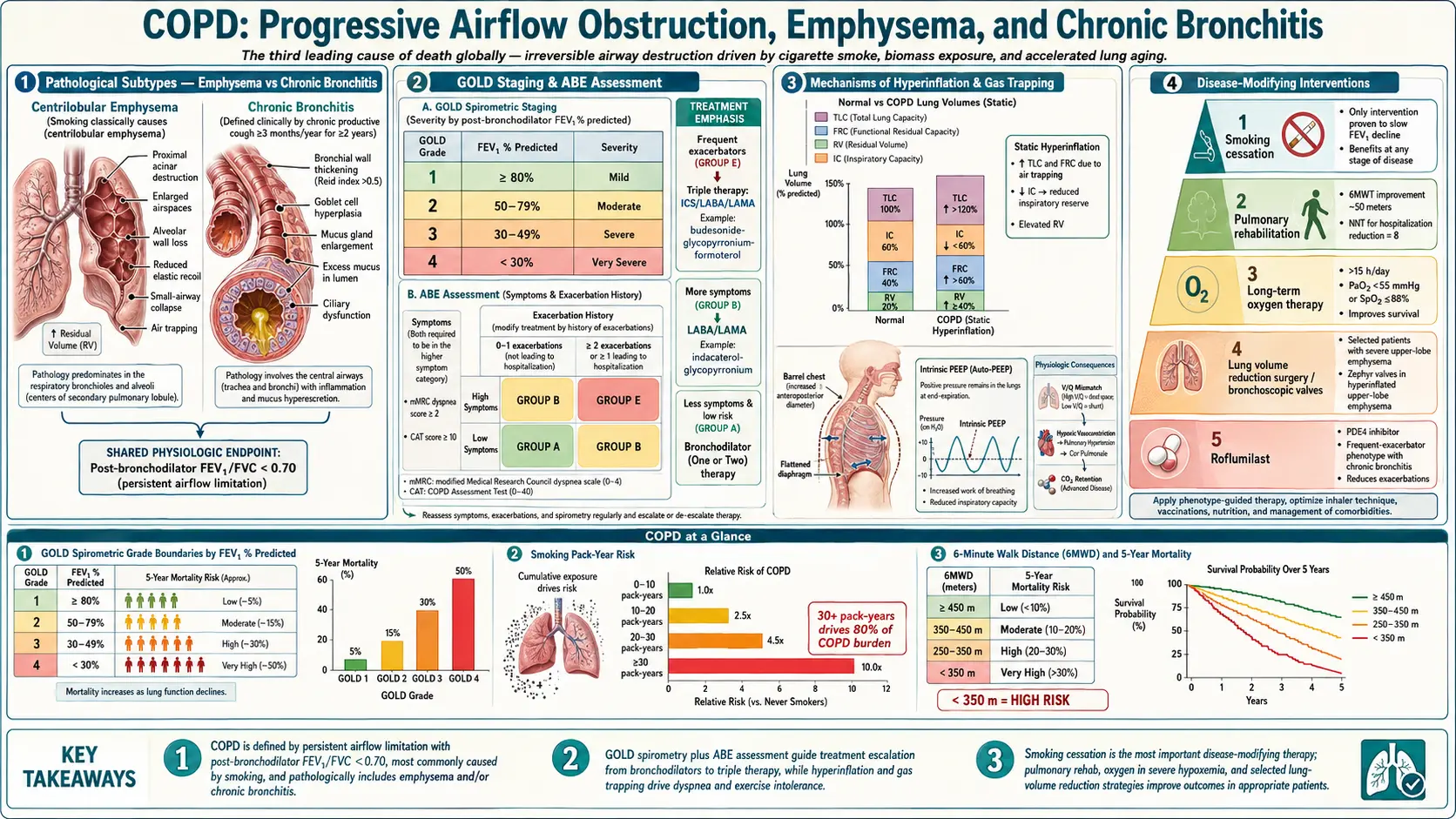
Chronic Obstructive Pulmonary Disease (COPD) is a chronic inflammatory lung disease that obstructs airflow from the lungs. It is characterized by long-term breathing problems and poor airflow, commonly due to damage to the lungs over time.
Types of COPD
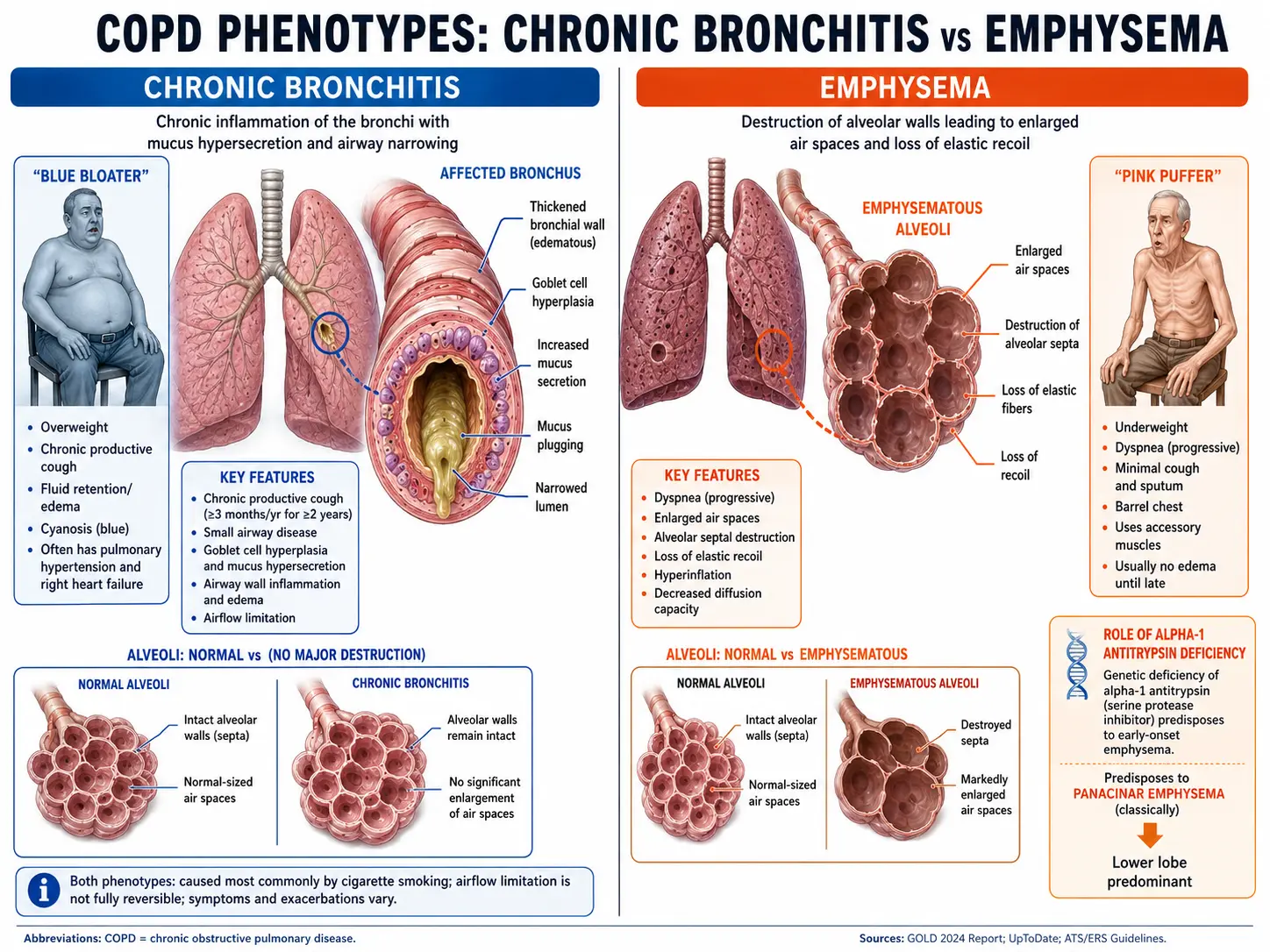
1. Chronic Bronchitis
- Definition: Inflammation of the lining of the bronchial tubes.
- Characteristics: Daily cough and mucus (sputum) production for at least three months in two consecutive years.
2. Emphysema
- Definition: Damage to the air sacs (alveoli) in the lungs.
- Characteristics: The inner walls of the air sacs weaken and rupture, reducing the surface area for gas exchange.
Symptoms of COPD
The symptoms of COPD often do not appear until significant lung damage has occurred and are usually worse in individuals who smoke or have been exposed to irritants for long periods. Common symptoms include:
- Chronic cough
- Increased mucus production (sputum)
- Shortness of breath, especially during physical activities
- Wheezing
- Chest tightness
- Frequent respiratory infections
- Fatigue
Risk Factors
- Smoking: The most significant risk factor for developing COPD.
- Exposure to irritants: Long-term exposure to chemical fumes, dust, and air pollution.
- Genetic factors: Alpha-1 antitrypsin deficiency can cause COPD in non-smokers.
- Age: COPD is more common in people over the age of 40.
- Occupational exposure: Jobs involving exposure to harmful substances increase the risk.
Diagnosis
- Spirometry: A lung function test to measure the amount of air a person can inhale and exhale and how quickly air can be expelled.
- Chest X-ray or CT scan: Helps to identify emphysema or rule out other lung problems.
- Arterial blood gas analysis: Measures how well the lungs are moving oxygen and removing carbon dioxide.
Prevention Strategies
- Quit smoking: The most effective way to prevent COPD or slow its progression.
- Avoid lung irritants: Limit exposure to chemicals, dust, and air pollutants.
- Protect yourself at work: Use safety equipment if exposed to dust and chemicals.
- Maintain a healthy lifestyle: Regular exercise and a balanced diet support overall lung health.
Treatment Options
- Bronchodilators: Medications that help relax muscles around the airways, making breathing easier.
- Inhaled corticosteroids: Reduce airway inflammation and help prevent flare-ups.
- Combination inhalers: Contain both bronchodilators and corticosteroids.
- Oxygen therapy: For patients with low blood oxygen levels.
- Pulmonary rehabilitation: A program that includes exercise training, nutritional advice, and education to improve overall quality of life.
- Surgery:
- Lung volume reduction surgery: Removes damaged lung tissue.
- Bullectomy: Removes large air spaces (bullae) that form in the lungs due to emphysema.
- Lung transplant: An option for severe COPD cases.
Complications of COPD
- Frequent respiratory infections: Increased susceptibility to colds, flu, and pneumonia.
- Heart problems: COPD can increase the risk of heart disease.
- Lung cancer: Higher risk for those with COPD, especially smokers.
- Depression: Chronic illness can lead to emotional and mental health challenges.
- Reduced quality of life: Breathing difficulties can impact daily activities and overall well-being.
References & Research
Historical Background
The concept of COPD evolved over centuries, with Giovanni Battista Morgagni describing emphysematous lungs at autopsy in 1769. René Laënnec further characterized emphysema in 1821 using his invention of the stethoscope. The term "chronic obstructive pulmonary disease" was formally adopted in the 1960s to unify chronic bronchitis and emphysema under a single diagnosis.
Key Research Papers
- Christenson SA, Smith BM, Bafadhel M, Putcha N. Chronic obstructive pulmonary disease. Lancet. 2022;399(10342):2227-2242.
- Global Initiative for Chronic Obstructive Lung Disease (GOLD). Global Strategy for the Diagnosis, Management, and Prevention of COPD. Am J Respir Crit Care Med. 2017;195(5):557-582.
- Calverley PM, Anderson JA, Celli B, et al. Salmeterol and fluticasone propionate and survival in chronic obstructive pulmonary disease (TORCH). N Engl J Med. 2007;356(8):775-789.
- Lipson DA, Barnhart F, Brealey N, et al. Once-daily single-inhaler triple versus dual therapy in patients with COPD (IMPACT). N Engl J Med. 2018;378(18):1671-1680.
- Anthonisen NR, Connett JE, Murray RP. Smoking and lung function of Lung Health Study participants after 11 years (Lung Health Study). Am J Respir Crit Care Med. 2002;166(5):675-679.
- Martinez FJ, Calverley PM, Goehring UM, et al. Effect of roflumilast on exacerbations in patients with severe COPD uncontrolled by combination therapy (REACT). Lancet. 2015;385(9971):857-866.
- Tashkin DP, Celli B, Senn S, et al. A 4-year trial of tiotropium in chronic obstructive pulmonary disease (UPLIFT). N Engl J Med. 2008;359(15):1543-1554.
- Nocturnal Oxygen Therapy Trial Group. Continuous or nocturnal oxygen therapy in hypoxemic chronic obstructive lung disease: a clinical trial. Ann Intern Med. 1980;93(3):391-398.
- Fishman A, Martinez F, Naunheim K, et al. A randomized trial comparing lung-volume-reduction surgery with medical therapy for severe emphysema (NETT). N Engl J Med. 2003;348(21):2059-2073.
- Albert RK, Connett J, Bailey WC, et al. Azithromycin for prevention of exacerbations of COPD. N Engl J Med. 2011;365(8):689-698.
- Vestbo J, Hurd SS, Agustí AG, et al. Global strategy for the diagnosis, management, and prevention of chronic obstructive pulmonary disease: GOLD executive summary. Am J Respir Crit Care Med. 2013;187(4):347-365.
- Wedzicha JA, Banerji D, Chapman KR, et al. Indacaterol-glycopyrronium versus salmeterol-fluticasone for COPD (FLAME). N Engl J Med. 2016;374(23):2222-2234.
Research Papers
The following PubMed topic searches surface the current peer-reviewed literature on COPD. Each link opens a live PubMed query; results update as new papers are indexed.
- PubMed search: chronic obstructive pulmonary disease
- PubMed search: COPD GOLD guidelines
- PubMed search: COPD exacerbation
- PubMed search: COPD bronchodilator
- PubMed search: emphysema
- PubMed search: chronic bronchitis
- PubMed search: pulmonary rehabilitation
- PubMed search: alpha 1 antitrypsin deficiency
- PubMed search: COPD smoking cessation
- PubMed search: long acting muscarinic antagonist COPD
- PubMed search: LABA ICS COPD
- PubMed search: lung volume reduction surgery
Connections
- Pulmonology
- Asthma: What Happens in an Attack — interactive animation
- Surfactant: Why Your Lungs Don’t Collapse — interactive animation
- Hemoglobin & the Oxygen Dissociation Curve — interactive animation
- Blood pH: The Acid–Base Balancing Act — interactive animation
- Breathing & Gas Exchange — interactive animation
- Pneumonia
- Shortness of Breath
- Chronic Cough
- Asthma
- Pulmonary Hypertension
- Vitamin D3
- Eucalyptus
- Breathwork
- Interstitial Lung Disease
- Obstructive Sleep Apnea
- Pulmonary Embolism
- Fatigue
- Depression
- Lead Toxicity
- Magnesium
- Hypertension
- Chest Pain
- Cancer
- Mullein
- Lung Cancer
- RSV