Lung Cancer
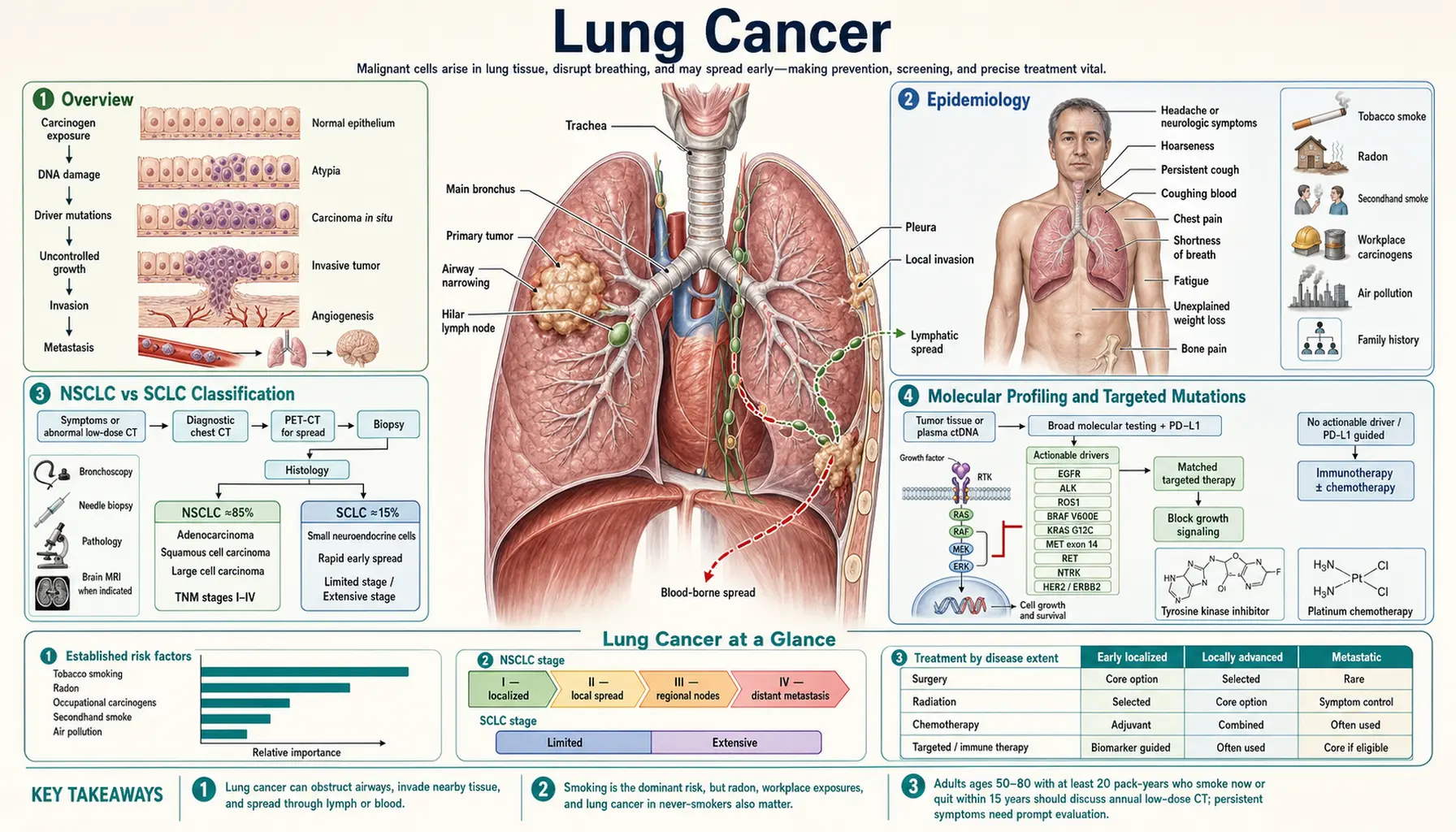
Table of Contents
- Overview
- Epidemiology
- Pathophysiology
- Etiology and Risk Factors
- Clinical Presentation
- Diagnosis
- Treatment
- Complications
- Prognosis
- Prevention
- Recent Research and Advances
- Research Papers
- Connections
- Featured Videos
1. Overview
Lung cancer is a malignancy that begins in the cells lining the airways or air sacs of the lungs. It is the leading cause of cancer death in the United States and worldwide — it kills more Americans every year than breast, colon, and prostate cancers combined. That statistic sounds grim, and historically it has been. But it is important to say up front that the outlook for lung cancer has changed more in the past fifteen years than in the previous fifty. Screening can now catch it early, when it is highly treatable. Targeted pills can hold some advanced cancers in check for years. Immunotherapy has turned a subset of stage IV diagnoses into long-term survivorship stories. If you or someone you love has just been diagnosed, the statistics you may remember from a decade ago are out of date.
Doctors divide lung cancer into two broad families, and almost everything about treatment and prognosis flows from this split:
- Non-small cell lung cancer (NSCLC) — about 85% of cases. It has three main subtypes:
- Adenocarcinoma (roughly 40-50% of all lung cancers) — starts in the mucus-producing gland cells of the outer lung. It is the most common type overall, and by far the most common type in never-smokers, women, and younger patients. Most of the famous “driver mutations” treatable with targeted pills occur in adenocarcinoma.
- Squamous cell carcinoma (about 20-25%) — arises in the flat cells lining the central airways, strongly tied to smoking. It tends to grow centrally, near the large bronchi.
- Large cell carcinoma (about 5-10%) — a less common, undifferentiated type that can appear anywhere in the lung and tends to grow quickly.
- Small cell lung cancer (SCLC) — about 15% of cases, almost exclusively in current or former smokers. SCLC is a neuroendocrine cancer that grows and spreads very fast — it often has already traveled beyond the chest by the time it is found. It responds dramatically to initial chemotherapy but tends to come back, which is why catching lung cancer before it becomes symptomatic matters so much.
Two facts shape everything else on this page. First, lung cancer is largely preventable: roughly 80-90% of cases are caused by cigarette smoking, and the second-leading cause — radon gas in homes — can be detected with a $15 test kit. Second, lung cancer caught at a localized stage has a 5-year survival above 60%, while cancer found after distant spread has a 5-year survival under 10%. The gap between those two numbers is the entire argument for screening, which most eligible Americans still do not receive.
2. Epidemiology
The American Cancer Society estimated about 234,000 new lung cancer cases and about 125,000 lung cancer deaths in the United States in 2024 — roughly one in five of all cancer deaths. Globally, lung cancer accounts for approximately 2.5 million new cases and 1.8 million deaths per year, making it the most commonly diagnosed cancer and the leading cause of cancer death worldwide.
Several trends are worth understanding:
- Deaths are falling — and falling faster than new cases. US lung cancer mortality has declined steadily since the 1990s in men and the 2000s in women, first because of falling smoking rates, and more recently because treatment itself has improved. Population data show survival gains in the targeted-therapy era that go beyond what reduced smoking alone can explain.
- The average patient is older. The median age at diagnosis is about 70. Lung cancer is rare under 45.
- The never-smoker share is growing. Roughly 10-20% of US lung cancers now occur in people who never smoked or smoked fewer than 100 cigarettes in their life. If lung cancer in never-smokers were counted as its own disease, it would rank among the top ten causes of US cancer death on its own. It disproportionately affects women and people of East Asian ancestry, and it is biologically distinct — usually adenocarcinoma, and much more likely to carry a targetable EGFR mutation.
- Smoking history still dominates risk. A lifelong smoker has roughly a 20-fold higher risk of lung cancer than a never-smoker. About 1 in 16 American men and 1 in 17 American women will develop lung cancer in their lifetime; for smokers the odds are far worse, for never-smokers far better.
- Geography matters. US states with historically high smoking rates (Kentucky, West Virginia, Mississippi) have lung cancer death rates more than double those of states like Utah. Radon-prone regions (much of the Upper Midwest, Appalachia, and the Mountain West) add a second, invisible layer of risk.
3. Pathophysiology
Lung cancer is, at its core, a disease of accumulated DNA damage in the cells lining the airways. Understanding the mechanism explains both why smoking is so dangerous and why the new generation of drugs works.
How carcinogens cause the damage
Cigarette smoke contains over 70 known carcinogens, the most important being polycyclic aromatic hydrocarbons (such as benzo[a]pyrene) and the tobacco-specific nitrosamine NNK. When inhaled, these chemicals are metabolized in the lung into reactive forms that physically bond to DNA, forming DNA adducts — molecular graffiti on the genetic code. Most adducts are repaired, but with every pack of cigarettes a few mutations slip through permanently. Over decades, the entire lining of a smoker’s airways becomes a patchwork of mutated cell populations — a phenomenon called field cancerization, which is why smokers can develop second, independent lung cancers even after a first one is cured. Sequencing studies estimate that smoking one pack a day produces roughly 150 extra mutations in every lung cell per year.
Radon works differently but ends in the same place: it is a radioactive gas whose decay products lodge in the airways and emit alpha particles — heavy, high-energy radiation that shatters DNA strands directly. Asbestos fibers cause chronic inflammation and scarring that promotes malignant transformation, and fine particulate air pollution (PM2.5) appears to act partly as a tumor promoter, inflaming lung tissue in a way that awakens cells already carrying dormant mutations.
The mutations that matter
Cancer develops when mutations disable the genes that restrain cell growth and activate the genes that drive it. In lung cancer the key players are:
- TP53 — the “guardian of the genome,” mutated in most smoking-related lung cancers. Its loss lets damaged cells survive and divide when they should self-destruct.
- Driver oncogenes — single mutated genes that act like a stuck accelerator pedal. The most important in adenocarcinoma are KRAS (about 25-30% of US adenocarcinomas, including the targetable G12C variant), EGFR (about 15% of US adenocarcinomas but ~50% in East Asian patients and the most common driver in never-smokers), ALK rearrangements (~4-5%, typically younger patients and light/never smokers), and ROS1 rearrangements (~1-2%). Each of these now has its own dedicated drug — the foundation of modern targeted therapy.
- SCLC biology — small cell lung cancer almost universally loses both TP53 and RB1, the two master brakes on cell division. The result is a neuroendocrine cancer with one of the fastest doubling times in oncology and a strong tendency to metastasize early, especially to the brain, liver, and bone.
Immune evasion
Tumors survive by hiding from the immune system. Many lung cancers display a protein called PD-L1 that plugs into the PD-1 receptor on T cells and switches them off — effectively showing the immune system a forged ID badge. Immunotherapy drugs (checkpoint inhibitors) block this handshake, releasing the T cells to attack. Smoking-related lung cancers, paradoxically, often respond well to immunotherapy because their high mutation count makes them look more foreign to reactivated immune cells.
4. Etiology and Risk Factors
Cigarette smoking — the dominant cause
Smoking causes approximately 80-90% of all lung cancer deaths. Risk scales with both intensity and duration — doctors summarize it as pack-years (packs per day × years smoked) — with duration mattering even more than daily amount. There is no safe level: even light or social smoking raises risk substantially, and so does long-term exposure to secondhand smoke, which raises a nonsmoking spouse’s lung cancer risk by roughly 20-30% and causes an estimated 7,000+ US lung cancer deaths per year. Cigar and pipe smoking also raise risk, somewhat less than cigarettes. The long-term lung cancer risk of e-cigarettes is simply not yet known — they have not existed long enough — though they expose users to far fewer combustion carcinogens than cigarettes.
Radon — the second-leading cause
Radon is an odorless, colorless radioactive gas released by the natural breakdown of uranium in soil and rock. It seeps into homes through foundation cracks and accumulates in basements and lower floors. The EPA attributes about 21,000 US lung cancer deaths per year to residential radon, making it the second-leading cause of lung cancer overall and the leading cause in never-smokers. A pooled analysis of 13 European case-control studies (Darby et al., BMJ 2005) confirmed that risk rises measurably with home radon levels even below common regulatory limits, with about a 16% increase in lung cancer risk per 100 Bq/m³ of long-term exposure. Radon and smoking multiply each other’s risk — a smoker in a high-radon home carries far more than the sum of the two risks. Any home can have a radon problem regardless of age or construction; the only way to know is to test (see Prevention).
Other established causes
- Occupational asbestos exposure — construction, shipyard, insulation, and demolition work. Asbestos alone raises lung cancer risk about 5-fold; combined with smoking the effect is roughly multiplicative, reaching 50-fold or higher. Asbestos also causes mesothelioma, a separate cancer of the lung lining.
- Outdoor air pollution — the WHO’s cancer agency (IARC) classified outdoor air pollution and fine particulate matter (PM2.5) as Group 1 human carcinogens in 2013. Pollution is a meaningful contributor at the population level, particularly to adenocarcinoma in never-smokers.
- Other occupational carcinogens — arsenic, cadmium, chromium VI, nickel compounds, silica dust, diesel exhaust, and ionizing radiation.
- Prior chest radiation — for example after Hodgkin lymphoma or older-era breast cancer radiotherapy.
- Chronic lung disease — COPD and pulmonary fibrosis independently raise lung cancer risk beyond shared smoking history; chronically inflamed, scarred lung tissue is fertile ground for malignant change.
- Family history — having a first-degree relative with lung cancer roughly doubles risk, reflecting both shared environment and inherited susceptibility.
Lung cancer in never-smokers
It deserves repeating, because patients who never smoked often face a hurtful “but did you smoke?” question at every turn: anyone with lungs can get lung cancer. Never-smoker lung cancer is usually adenocarcinoma, is more common in women, and carries an EGFR driver mutation in roughly half of cases (and ALK or ROS1 in a meaningful share of the rest) — which means never-smokers are actually more likely to qualify for highly effective targeted pill therapy. Suspected contributors include radon, secondhand smoke, air pollution, cooking-oil fumes, and inherited susceptibility. No one “deserves” lung cancer, and the stigma attached to this disease measurably delays diagnosis and depresses research funding relative to its death toll.
5. Clinical Presentation
Early lung cancer usually causes no symptoms at all — the lung has no pain nerves in its interior, and a tumor can grow to a substantial size before announcing itself. That is precisely why screening exists. When symptoms do appear, the most common are:
- A cough that won’t quit — new, persistent (more than 3 weeks), or a noticeable change in a smoker’s usual cough. This is the single most common presenting symptom.
- Coughing up blood (hemoptysis) — even a small streak warrants prompt evaluation.
- Shortness of breath — from airway blockage, fluid around the lung, or tumor burden.
- Chest pain — often dull and persistent, worse with deep breathing or coughing, when the tumor involves the chest wall or lining.
- Unexplained weight loss, fatigue, and loss of appetite.
- Hoarseness — a tumor pressing on the recurrent laryngeal nerve, which loops through the chest on its way to the voice box.
- Recurrent pneumonia in the same spot — a tumor partially blocking an airway traps secretions that repeatedly become infected. A pneumonia that does not fully clear on follow-up imaging should always raise the question of an underlying mass.
Signs of regional spread
- Superior vena cava (SVC) syndrome — facial and arm swelling with distended neck veins when a tumor compresses the large vein returning blood to the heart. This is urgent.
- Pancoast tumor / Horner syndrome — a tumor at the very top of the lung can invade the nerves to the arm (severe shoulder/arm pain, hand weakness) and the sympathetic chain (drooping eyelid, small pupil, loss of sweating on one side of the face).
- Pleural effusion — fluid accumulating around the lung, causing progressive breathlessness.
Paraneoplastic syndromes
Lung cancers — especially SCLC and squamous cell carcinoma — can secrete hormones or trigger immune reactions that cause symptoms far from the chest, sometimes before the tumor itself is visible:
- SIADH (low blood sodium causing confusion, weakness) — classic for SCLC.
- Ectopic ACTH / Cushing syndrome — also SCLC.
- Hypercalcemia from PTHrP secretion — classic for squamous cell carcinoma; causes thirst, constipation, confusion.
- Lambert-Eaton myasthenic syndrome — an immune attack on nerve-muscle signaling causing proximal weakness; strongly associated with SCLC.
- Finger clubbing and hypertrophic osteoarthropathy — painful wrists/ankles and bulbous fingertips, more typical of NSCLC.
If cancer has already spread at diagnosis, the first symptom may come from the metastasis itself: bone pain, headaches or seizures (brain), or jaundice (liver). About 40-50% of lung cancers are unfortunately still diagnosed at this distant stage — the number screening aims to shrink.
6. Diagnosis
Screening: the biggest opportunity in lung cancer
Low-dose CT (LDCT) screening is the single most underused lifesaving tool in this disease. The landmark National Lung Screening Trial (NLST), published in 2011, randomized 53,454 heavy smokers to annual low-dose CT versus chest X-ray and found a 20% reduction in lung cancer deaths in the CT group. The Dutch-Belgian NELSON trial (2020) confirmed it, showing a 24% mortality reduction in men over 10 years. Based on this evidence, the US Preventive Services Task Force recommends annual LDCT for adults who meet all three criteria:
- Age 50 to 80;
- A smoking history of at least 20 pack-years (e.g., 1 pack/day for 20 years, or 2 packs/day for 10);
- Currently smoking, or quit within the past 15 years.
The scan takes a few minutes, involves no needles or dye, uses about a fifth of the radiation of a standard CT, and is covered by Medicare and most insurance with no copay as a preventive service. Yet fewer than one in five eligible Americans gets screened. If you qualify, ask your doctor for an LDCT referral — it is the lung cancer equivalent of a mammogram or colonoscopy. The main trade-off to understand: screening frequently finds small benign nodules (most people over 50 have a few), which usually just means a follow-up scan in 6-12 months, not a biopsy. A nodule is not a diagnosis; the great majority are harmless scars.
Working up a suspicious finding
- Imaging — a contrast CT of the chest defines the tumor; a PET-CT (a scan using radioactive glucose that lights up metabolically active tissue) checks lymph nodes and the rest of the body; a brain MRI is standard for most newly diagnosed lung cancers because the brain is a common, often silent, metastatic site.
- Tissue biopsy — the diagnosis must be confirmed under a microscope. Options include bronchoscopy (a camera down the airway, often with EBUS — endobronchial ultrasound — to sample lymph nodes through the airway wall, and increasingly robotic navigation for small peripheral nodules) or a CT-guided needle biopsy through the chest wall.
- Molecular testing — non-negotiable. Every advanced non-squamous NSCLC (and increasingly every NSCLC) should get broad next-generation sequencing for EGFR, ALK, ROS1, KRAS G12C, BRAF, MET, RET, NTRK, HER2 and more, plus PD-L1 immunohistochemistry. These results, not the cancer’s appearance, decide first-line treatment. If your oncologist starts chemotherapy for stage IV adenocarcinoma without molecular results, it is reasonable to ask why. Liquid biopsy — detecting tumor DNA fragments in a blood draw — can return results in about a week and is now widely used alongside tissue testing.
Staging
NSCLC is staged with the TNM system (Tumor size/invasion, lymph Nodes, Metastasis), grouped into stages I-IV:
- Stage I — small tumor confined to the lung, no nodes. Usually curable with surgery or focused radiation.
- Stage II — larger tumor and/or nearby lymph nodes within the lung. Surgery plus additional (adjuvant) therapy.
- Stage III — spread to mediastinal lymph nodes (the central chest) or invasion of nearby structures. Treated with combinations — chemo, radiation, surgery in selected cases, immunotherapy.
- Stage IV — spread to the other lung, the fluid around the lung or heart, or distant organs (brain, bone, liver, adrenal). Treated with systemic (whole-body) therapy.
SCLC is often described more simply as limited stage (confined to one side of the chest, treatable within a single radiation field) or extensive stage (everything else — about two-thirds of SCLC at diagnosis).
7. Treatment
Lung cancer treatment is decided by three things: type (NSCLC vs SCLC), stage, and — for advanced NSCLC — the tumor’s molecular profile. Treatment moves fast in this field; the summary below reflects the established standards.
Early-stage NSCLC (stages I-II): aiming for cure
- Surgery is the cornerstone — usually a lobectomy (removing one of the five lobes of the lung), now most often done minimally invasively (VATS or robotic) with much faster recovery than the old open operations. For very small peripheral tumors (≤2 cm), recent trials support a smaller segmentectomy, preserving more lung. Most people live full lives after losing a lobe; your surgical team will test lung function beforehand to make sure you can tolerate it.
- Stereotactic body radiotherapy (SBRT) — for patients who cannot have or do not want surgery, SBRT delivers a few extremely precise, high-dose radiation treatments and controls the treated tumor in roughly 90% of cases.
- Added (adjuvant/neoadjuvant) therapy — depending on stage and biology: chemotherapy, osimertinib for resected EGFR-mutant tumors (which dramatically reduces recurrence), or chemotherapy-plus-immunotherapy before surgery. The CheckMate 816 trial showed that adding nivolumab to pre-surgical chemotherapy roughly tripled the rate of complete tumor disappearance at surgery and lengthened the time patients stayed cancer-free — perioperative immunotherapy is now standard for many stage II-III cancers.
Stage III NSCLC
Usually treated with concurrent chemotherapy and radiation, followed by one year of the immunotherapy drug durvalumab — the PACIFIC trial showed this consolidation markedly improved survival, with around 43% of patients alive at five years, a figure that would have been unthinkable for stage III disease a generation ago. Selected stage III patients are treated with surgery plus perioperative chemo-immunotherapy instead.
Stage IV NSCLC: biomarker-driven therapy
If the tumor has a driver mutation — targeted pills first:
- EGFR → osimertinib, a once-daily pill. In the FLAURA trial it kept cancer controlled for a median of about 19 months as first-line therapy and extended overall survival versus older EGFR drugs, while penetrating the brain well. Newer combinations (osimertinib plus chemotherapy, or amivantamab-based regimens) push control even longer.
- ALK → next-generation ALK inhibitors (alectinib, brigatinib, lorlatinib). ALK-positive stage IV disease is increasingly a years-long chronic illness: with lorlatinib, more than half of patients in the CROWN trial had still not progressed at five years. (Crizotinib, the first ALK drug, proved the concept by beating chemotherapy head-to-head in 2014.)
- KRAS G12C → sotorasib or adagrasib — the first drugs ever to target KRAS, a gene considered “undruggable” for nearly 40 years. Sotorasib produced responses in about 37% of previously treated patients in the CodeBreaK 100 trial. These are second-line options today, with combination trials ongoing.
- ROS1 → crizotinib, entrectinib, or repotrectinib; BRAF V600E, MET, RET, NTRK, HER2 each have their own approved drugs as well.
If there is no targetable driver — immunotherapy-based treatment:
- High PD-L1 (≥50%) → pembrolizumab alone can outperform chemotherapy. In KEYNOTE-024, pembrolizumab roughly doubled 5-year survival versus chemotherapy (about 32% vs 16%) in this group — with fewer severe side effects. Roughly one in three such patients is alive five years into a stage IV diagnosis, many off all treatment.
- Lower PD-L1 → chemotherapy plus pembrolizumab (or similar chemo-immunotherapy combinations), which beats chemotherapy alone across PD-L1 levels.
Immunotherapy side effects differ from chemotherapy: instead of hair loss and nausea, the risks are inflammatory — the unleashed immune system can attack the thyroid, colon, skin, liver, or lungs (pneumonitis). Most cases are manageable if reported early, so tell your team about any new symptom, even one that seems unrelated.
Small cell lung cancer
- Limited stage → concurrent platinum-etoposide chemotherapy with chest radiation, with curative intent; immunotherapy consolidation is now being added based on recent trial data.
- Extensive stage → platinum-etoposide chemotherapy plus an immunotherapy drug (atezolizumab or durvalumab), which modestly but really extends survival. SCLC typically shrinks dramatically with initial treatment; the challenge is relapse, and newer agents (see Recent Research) are finally moving this needle.
- Because SCLC loves to spread to the brain, brain imaging surveillance — and sometimes preventive cranial radiation — is part of care discussions.
Whatever the stage: supportive care is treatment too
Early involvement of palliative care (symptom-management specialists — not the same thing as hospice) has been shown in randomized trials to improve quality of life and survival in advanced lung cancer. Pulmonary rehabilitation, nutrition support, and treating anxiety and depression are not extras; they measurably change outcomes. And it is never too late to quit smoking: patients who quit at diagnosis tolerate treatment better, have fewer complications, and live longer than those who continue.
8. Complications
- Malignant pleural effusion — fluid around the lung causing breathlessness; managed by drainage, an indwelling tunneled catheter patients can drain at home, or pleurodesis (sealing the space).
- Airway obstruction and post-obstructive pneumonia — tumors blocking a bronchus can cause lung collapse and recurrent infection; bronchoscopic stenting, laser, or radiation can reopen airways.
- Hemoptysis — usually minor, but massive bleeding is an emergency requiring bronchoscopy or artery embolization.
- Superior vena cava syndrome — face/arm swelling from compression of the great vein; treated urgently with stenting, radiation, or chemotherapy depending on the tumor type.
- Brain metastases — common in both NSCLC and SCLC; treated with stereotactic radiosurgery (highly focused radiation), surgery for large solitary lesions, and brain-penetrant drugs (osimertinib and modern ALK inhibitors work in the brain).
- Bone metastases and spinal cord compression — new back pain with leg weakness or numbness in a lung cancer patient is an emergency — same-day imaging and treatment can preserve the ability to walk. Bone-strengthening agents (zoledronic acid, denosumab) reduce fracture risk.
- Blood clots (VTE) — lung cancer significantly raises the risk of deep-vein thrombosis and pulmonary embolism; sudden leg swelling or new sharp chest pain deserves immediate attention.
- Treatment complications — radiation pneumonitis (cough/breathlessness weeks-to-months after chest radiation), immune-related inflammation from checkpoint inhibitors, chemotherapy effects (low blood counts, neuropathy), and post-surgical reduction in exercise capacity.
- Cachexia — cancer-driven weight and muscle loss; early dietitian involvement and resistance exercise blunt it.
9. Prognosis
Honest numbers first, context second. Based on US SEER registry data, 5-year relative survival for lung cancer is approximately:
- NSCLC overall: about 28%
- Localized (still confined to the lung): about 65%
- Regional (nearby nodes/structures): about 37%
- Distant (metastatic): about 9%
- SCLC overall: about 7%
- Localized: about 30%
- Distant: about 3%
Now the context, because these averages hide more than they reveal:
- The averages are backward-looking. A “5-year survival” figure published today describes people diagnosed and treated 5-10 years ago, mostly before current drugs. Patients starting modern therapy today are not bound by those curves.
- Stage dominates everything. The 65% (localized) versus 9% (distant) gap is the whole case for screening. A stage IA cancer treated surgically has cure rates of 80-90%.
- Biology now rivals stage. A stage IV ALK-positive patient on modern inhibitors, or a high-PD-L1 patient responding to pembrolizumab, can have a median survival measured in years — sometimes many — rather than the months that defined stage IV disease in the chemotherapy-only era. Roughly a third of KEYNOTE-024’s pembrolizumab patients were alive at five years with stage IV disease.
- The trend line is genuinely good. US lung cancer mortality is falling faster than incidence, and population studies attribute a meaningful share of that to better treatment, not just less smoking.
- Performance status, weight stability, quitting smoking, and access to molecular testing all independently influence outcomes — several of which are at least partly in the patient’s and care team’s control.
If you have just been diagnosed: ask your oncologist three questions — What is my exact stage? What molecular results do we have (or are pending)? Am I a candidate for a clinical trial? The answers matter more to your personal prognosis than any number on this page.
10. Prevention
Quitting smoking — worth it at any age
Stopping smoking is the most powerful cancer-prevention act available to an individual, and the benefits follow a real timeline:
- Within days-weeks: carbon monoxide clears, cilia (the airways’ cleaning brushes) begin regrowing, and cough and infection risk start to fall.
- By 10 years after quitting: lung cancer death risk falls to roughly half that of someone who kept smoking — and it keeps declining with each additional smoke-free year.
- Quit earlier, gain more: the classic 50-year British Doctors’ Study found that quitting around age 50 halves the eventual tobacco death risk, and quitting around age 30 avoids almost all of it. Risk never falls quite to never-smoker levels — which is why former heavy smokers remain eligible for screening for 15 years after quitting — but every year quit is risk banked.
Most smokers need several attempts — that is normal, not failure. Combining medication (varenicline, or dual-form nicotine replacement — patch plus gum/lozenge) with counseling (free at 1-800-QUIT-NOW) roughly doubles-to-triples quit rates compared with willpower alone.
Test your home for radon
Because radon is the second-leading cause and the leading cause in never-smokers, the EPA recommends every home below the third floor be tested. A do-it-yourself charcoal test kit costs about $15 at hardware stores (many state radon programs offer them free or discounted); you leave it in the lowest lived-in level for a few days and mail it to a lab. If the result is at or above 4 pCi/L, a mitigation system — essentially a pipe and fan that vents sub-slab air outdoors — typically costs $800-$1,500 installed and reliably drops levels. This is one of the cheapest cancer-prevention wins in existence, and most people have never done it.
Other measures, stated honestly
- Avoid secondhand smoke — an established carcinogen; smoke-free homes and cars protect everyone in them.
- Occupational protection — respirators and protocols around asbestos, silica, diesel exhaust, and welding fumes; if you work in older-building renovation or demolition, take asbestos rules seriously.
- Air quality — on high-PM2.5 days, limiting heavy outdoor exertion and using HEPA filtration indoors is reasonable, particularly for people with existing lung disease.
- Diet and exercise — helpful, but modest. Diets rich in fruits and vegetables and regular physical activity are associated with somewhat lower lung cancer risk in observational studies, but the effect is small compared with not smoking and fixing radon, and some of the association likely reflects healthier overall lifestyles. No food or supplement prevents lung cancer.
- One clear warning: high-dose beta-carotene supplements increased lung cancer rates in smokers in two large randomized trials (ATBC and CARET). Smokers and recent quitters should not take beta-carotene supplements. Eating carotenoid-rich foods is fine — the harm was specific to high-dose pills.
- And the third pillar: screening. Prevention and early detection overlap — if you are 50-80 with a 20-pack-year history (current smoker or quit within 15 years), annual low-dose CT is the difference between finding lung cancer at 65%-survivable and 9%-survivable stages.
11. Recent Research and Advances
- Perioperative immunotherapy — giving chemo-immunotherapy before (and sometimes after) surgery is reshaping early-stage care. In CheckMate 816, adding nivolumab to pre-surgical chemotherapy raised complete pathologic response from 2% to 24% and significantly lengthened event-free survival; several perioperative regimens are now FDA-approved.
- Longer-acting targeted therapy — lorlatinib’s CROWN trial reported that over half of ALK-positive stage IV patients remained progression-free at five years — territory no one associated with metastatic lung cancer a decade ago. Combination strategies (osimertinib + chemotherapy in FLAURA2, amivantamab combinations) are extending EGFR-mutant disease control, and trials are testing KRAS G12C inhibitors in the first line.
- First real movement in SCLC in 30 years — tarlatamab, a bispecific T-cell engager that drags T cells onto the DLL3 protein on SCLC cells, won FDA approval in 2024 for previously treated extensive-stage SCLC, with durable responses in a disease that almost never showed them before.
- Antibody-drug conjugates (ADCs) — “smart bomb” drugs that deliver chemotherapy directly into tumor cells via a targeting antibody; trastuzumab deruxtecan is approved for HER2-mutant NSCLC, and several TROP2- and HER3-directed ADCs are in late-stage trials.
- Liquid biopsy everywhere — blood-based tumor DNA testing now guides initial treatment selection, detects emerging drug resistance without repeat biopsies, and is being studied for detecting minimal residual disease after surgery — flagging relapse months before scans can see it.
- AI in screening — deep-learning systems can flag and risk-rank lung nodules on CT, in some studies matching or assisting radiologists, and may eventually personalize screening intervals.
- Expanding screening reach — research continues on risk-prediction models that could extend screening to high-risk people who do not meet pack-year cutoffs (including some never-smokers), and on blood-based multi-cancer early detection tests — promising, but not yet a substitute for low-dose CT.
- Vaccines and cellular therapy — personalized neoantigen mRNA vaccines and engineered T-cell approaches for lung cancer are in early-phase trials; genuinely experimental today, worth watching tomorrow.
Lung cancer has one of the most active clinical-trial pipelines in all of oncology. Trials are not a last resort — many test tomorrow’s standard against today’s, and participants often gain early access to drugs that later win approval. Searching ClinicalTrials.gov or asking for referral to an academic center is worthwhile at any stage.
12. References & Research
Historical Background
Lung cancer was a medical rarity until the 20th century — then cigarette mass-marketing turned it into the world’s deadliest cancer within two generations. The cause was nailed down in 1950, when Richard Doll and Austin Bradford Hill in Britain and Ernst Wynder and Evarts Graham in the United States independently published case-control studies demonstrating the link between cigarette smoking and lung carcinoma; Doll and Hill’s subsequent 50-year cohort study of British doctors quantified the lifetime toll and the benefits of quitting. The 1964 US Surgeon General’s Report made the causal link official policy, beginning the long decline in American smoking rates. Treatment progress lagged for decades — surgery (the first successful pneumonectomy for lung cancer was Graham’s own, in 1933), radiation, and platinum chemotherapy improved survival only modestly. The modern era opened in 2004 with the discovery that EGFR mutations predicted dramatic responses to targeted pills, accelerated in 2011 when the National Lung Screening Trial proved screening saves lives, and transformed again in the mid-2010s when PD-1 checkpoint immunotherapy produced unprecedented long-term survival in metastatic disease.
Key Research Papers
- Doll R, Hill AB. Smoking and carcinoma of the lung: preliminary report. BMJ. 1950;2(4682):739-748.
- Wynder EL, Graham EA. Tobacco smoking as a possible etiologic factor in bronchiogenic carcinoma: a study of six hundred and eighty-four proved cases. JAMA. 1950;143(4):329-336.
- Hecht SS. Tobacco smoke carcinogens and lung cancer. Journal of the National Cancer Institute. 1999;91(14):1194-1210.
- Darby S, Hill D, Auvinen A, et al. Radon in homes and risk of lung cancer: collaborative analysis of individual data from 13 European case-control studies. BMJ. 2005;330(7485):223.
- Lynch TJ, Bell DW, Sordella R, et al. Activating mutations in the epidermal growth factor receptor underlying responsiveness of non-small-cell lung cancer to gefitinib. New England Journal of Medicine. 2004;350(21):2129-2139.
- National Lung Screening Trial Research Team. Reduced lung-cancer mortality with low-dose computed tomographic screening. New England Journal of Medicine. 2011;365(5):395-409.
- Solomon BJ, Mok T, Kim DW, et al. First-line crizotinib versus chemotherapy in ALK-positive lung cancer. New England Journal of Medicine. 2014;371(23):2167-2177.
- Reck M, Rodríguez-Abreu D, Robinson AG, et al. Pembrolizumab versus chemotherapy for PD-L1-positive non-small-cell lung cancer. New England Journal of Medicine. 2016;375(19):1823-1833.
- Antonia SJ, Villegas A, Daniel D, et al. Durvalumab after chemoradiotherapy in stage III non-small-cell lung cancer. New England Journal of Medicine. 2017;377(20):1919-1929.
- Soria JC, Ohe Y, Vansteenkiste J, et al. Osimertinib in untreated EGFR-mutated advanced non-small-cell lung cancer. New England Journal of Medicine. 2018;378(2):113-125.
- de Koning HJ, van der Aalst CM, de Jong PA, et al. Reduced lung-cancer mortality with volume CT screening in a randomized trial. New England Journal of Medicine. 2020;382(6):503-513.
- Skoulidis F, Li BT, Dy GK, et al. Sotorasib for lung cancers with KRAS p.G12C mutation. New England Journal of Medicine. 2021;384(25):2371-2381.
- Forde PM, Spicer J, Lu S, et al. Neoadjuvant nivolumab plus chemotherapy in resectable lung cancer. New England Journal of Medicine. 2022;386(21):1973-1985.
- Siegel RL, Giaquinto AN, Jemal A. Cancer statistics, 2024. CA: A Cancer Journal for Clinicians. 2024;74(1):12-49.
Research Papers
The links below run live searches on PubMed, the National Library of Medicine’s database of biomedical research, so you always see the most current studies on each topic.
- Lung cancer screening with low-dose CT
- EGFR mutations and osimertinib in NSCLC
- KRAS G12C inhibitors in lung cancer
- ALK-positive lung cancer targeted therapy
- Pembrolizumab as first-line NSCLC therapy
- Neoadjuvant immunotherapy in resectable lung cancer
- Immunotherapy for small cell lung cancer
- Residential radon and lung cancer risk
- Smoking cessation and lung cancer risk reduction
- Lung cancer in never-smokers
- Liquid biopsy and circulating tumor DNA in lung cancer
- Stereotactic body radiotherapy for early-stage lung cancer
Connections
- Oncology
- How Cancer Spreads (Metastasis) — interactive animation
- The Cell Cycle & How Cancer Hijacks It — interactive animation
- Cancer
- Thymoma
- Metastatic Cancers
- COPD
- Pneumonia
- Pulmonary Fibrosis
- Interstitial Lung Disease
- Pleural Effusion
- Asthma
- Chronic Cough
- Shortness of Breath
- Heavy Metals
- Cadmium
- NAC (N-Acetylcysteine)
- Sulforaphane
- Bishop & Varmus: why EGFR testing decides the drug — targeted therapy helped EGFR-mutant tumours and did measurably worse than chemotherapy in wild-type ones
- Fischer & Krebs — EGFR and ALK inhibitors — and how much time they actually buy
- Hermann Joseph Muller — CT dose in perspective — and the question to ask before a scan