Depression
Interactive Visualization Serotonin, Mood & SSRIs — build it, fire it, block reuptake Assemble serotonin from tryptophan, fire it across the synapse, then take an SSRI and watch the cleft flood — or starve the tryptophan and watch the signal fade. Launch → Interactive Visualization Dopamine, Reward & How Habits Hijack You Dopamine is not the pleasure chemical. Watch the spike migrate from the reward to the cue — then withhold the reward and see it dip below zero. That dip is craving. Launch → Interactive Visualization The Gut-Brain Axis — hear the gut talk to the brain Follow the vagus nerve carrying signals up from your gut, the gut making most of your serotonin, and the microbiome shaping mood — then flip it and watch stress disrupt the gut. Launch →
Table of Contents
- What is Depression?
- Types of Depression
- Symptoms of Depression
- Causes and Risk Factors
- Diagnosis
- Treatment Options
- Prevention Strategies
- Complications of Depression
- Research Papers
- Connections
- Featured Videos
What is Depression?
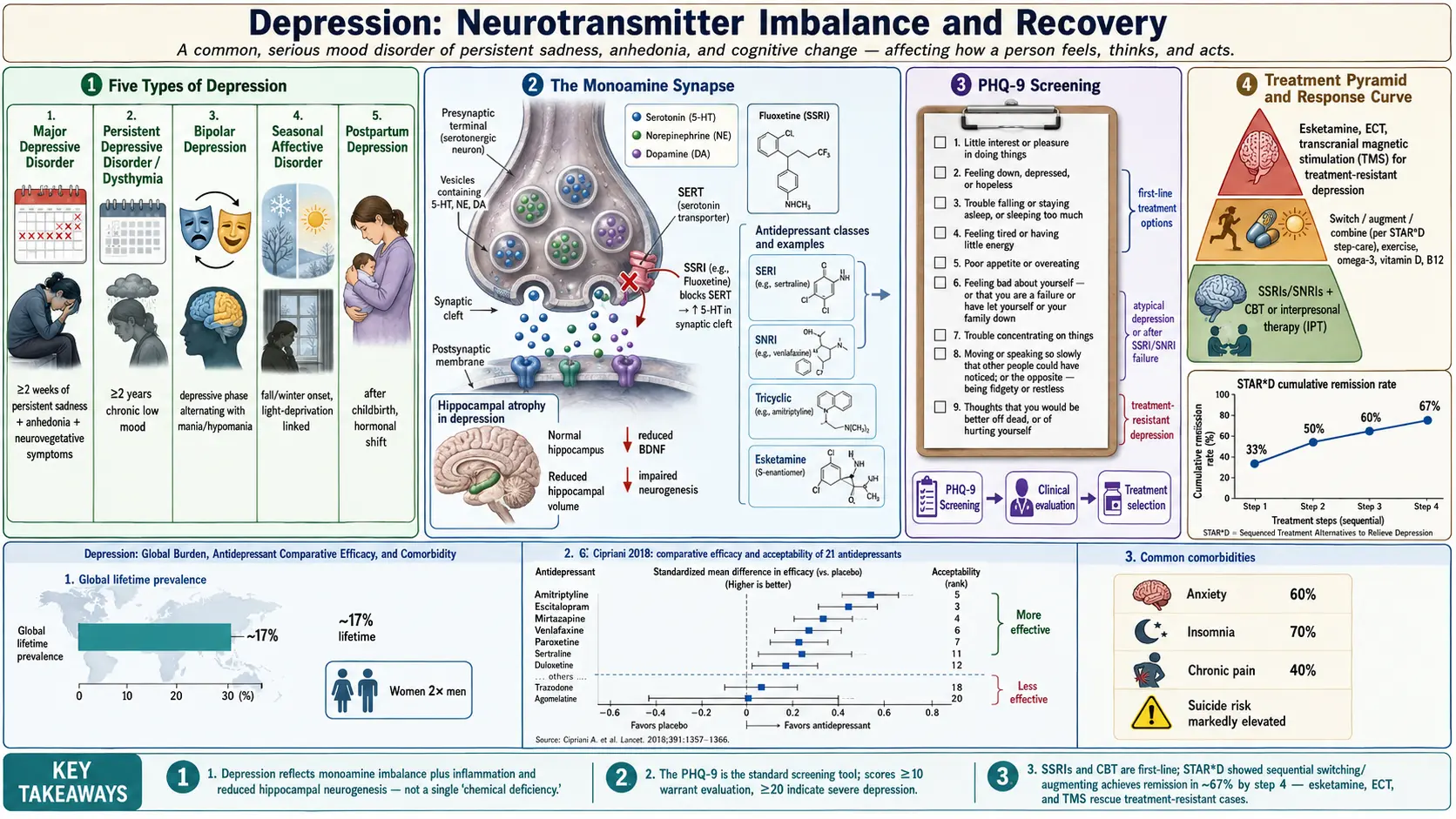
Depression is a common and serious mental health disorder that negatively affects how a person feels, thinks, and acts. It can lead to a variety of emotional and physical problems and can decrease a person’s ability to function at work and home.
Types of Depression
1. Major Depressive Disorder (MDD)
- Characterized by persistent feelings of sadness and loss of interest in activities once enjoyed.
- Symptoms last for at least two weeks and interfere with daily functioning.
2. Persistent Depressive Disorder (Dysthymia)
- Long-term form of depression: Lasts for two years or more.
- Symptoms may be less severe but are more chronic.
3. Bipolar Disorder
- Includes episodes of depression and mania (periods of high energy and activity).
- Formerly called manic-depressive illness.
4. Seasonal Affective Disorder (SAD)
- Related to changes in seasons: Typically occurs during fall and winter when sunlight exposure decreases.
- Symptoms improve during spring and summer.
5. Postpartum Depression
- Occurs after childbirth and is more severe than the “baby blues.”
- Involves emotional, physical, and behavioral changes due to hormonal shifts and other factors.
Symptoms of Depression
Symptoms can vary in severity and may include:
- Persistent sadness or low mood
- Loss of interest or pleasure in activities once enjoyed
- Fatigue and decreased energy
- Changes in appetite: Significant weight loss or gain
- Sleep disturbances: Insomnia or sleeping too much
- Feelings of worthlessness or guilt
- Difficulty concentrating or making decisions
- Thoughts of death or suicide
Causes and Risk Factors
- Genetics: Family history of depression increases the risk.
- Brain chemistry: Imbalances in neurotransmitters can contribute.
- Hormonal changes: Can trigger depression, such as during pregnancy or menopause.
- Trauma and stress: Life events like the loss of a loved one, divorce, or financial problems.
- Medical conditions: Chronic illness, pain, or certain medications can contribute to depression.
Diagnosis
- Clinical evaluation: A healthcare provider will ask about symptoms, medical history, and family history.
- Questionnaires: Standardized tools like the Patient Health Questionnaire (PHQ-9) help assess depression severity.
- Physical exam: To rule out medical conditions that may cause depressive symptoms.
Treatment Options
- Medications:
- Antidepressants: Selective serotonin reuptake inhibitors (SSRIs), serotonin-norepinephrine reuptake inhibitors (SNRIs), tricyclic antidepressants, etc.
- Psychotherapy:
- Cognitive-behavioral therapy (CBT): Focuses on changing negative thought patterns.
- Interpersonal therapy: Helps improve personal relationships and social functioning.
- Lifestyle changes:
- Regular physical activity: Exercise can help reduce symptoms.
- Healthy diet: Nutrient-rich foods can support brain health.
- Sleep hygiene: Ensuring good sleep patterns.
- Alternative therapies:
- Mindfulness and meditation: Helps manage stress and emotional well-being.
- Acupuncture: Some find it helpful for symptom relief.
- Electroconvulsive therapy (ECT): For severe depression when other treatments have not been effective.
Prevention Strategies
- Maintain healthy relationships: Strong support networks can help manage stress and emotions.
- Stay active: Regular physical activity supports mental health.
- Manage stress: Develop coping strategies such as mindfulness or relaxation techniques.
- Seek help early: Addressing early signs of depression can prevent worsening symptoms.
Complications of Depression
- Impaired functioning: Difficulty performing daily tasks and maintaining personal or professional responsibilities.
- Chronic health issues: May worsen conditions like heart disease or diabetes.
- Substance abuse: Higher risk of developing alcohol or drug problems.
- Self-harm: Increased risk of harming oneself or attempting suicide.
- Social isolation: Withdrawal from friends and family can lead to loneliness and worsening symptoms.
Research Papers
Historical Background
Depression has been recognized since antiquity — Hippocrates described "melancholia" around 400 BCE as a condition caused by an excess of black bile. The modern clinical understanding of depression began with Emil Kraepelin's classification of "manic-depressive insanity" in the late 19th century, and the term "major depressive disorder" was formalized in the DSM-III in 1980.
Key Research Papers
- Kessler RC, et al. The epidemiology of major depressive disorder: results from the National Comorbidity Survey Replication (NCS-R). JAMA. 2003;289(23):3095-3105.
- Cipriani A, et al. Comparative efficacy and acceptability of 21 antidepressant drugs for the acute treatment of adults with major depressive disorder: a systematic review and network meta-analysis. The Lancet. 2018;391(10128):1357-1366.
- Malhi GS, Mann JJ. Depression. The Lancet. 2018;392(10161):2299-2312.
- Belmaker RH, Agam G. Major depressive disorder. New England Journal of Medicine. 2008;358(1):55-68.
- Rush AJ, et al. Acute and longer-term outcomes in depressed outpatients requiring one or several treatment steps: a STAR*D report. American Journal of Psychiatry. 2006;163(11):1905-1917.
- Cuijpers P, et al. A meta-analysis of cognitive-behavioural therapy for adult depression, alone and in comparison with other treatments. Canadian Journal of Psychiatry. 2013;58(7):376-385.
- Wray NR, et al. Genome-wide association analyses identify 44 risk variants and refine the genetic architecture of major depression. Nature Genetics. 2018;50(5):668-681.
- Daly EJ, et al. Efficacy of esketamine nasal spray plus oral antidepressant treatment for relapse prevention in patients with treatment-resistant depression (SUSTAIN-1). JAMA Psychiatry. 2019;76(9):893-903.
- Kroenke K, Spitzer RL, Williams JB. The PHQ-9: validity of a brief depression severity measure. Journal of General Internal Medicine. 2001;16(9):606-613.
- Ferrari AJ, et al. Burden of depressive disorders by country, sex, age, and year: findings from the Global Burden of Disease Study 2010. PLoS Medicine. 2013;10(11):e1001547.
- Drevets WC, Price JL, Furey ML. Brain structural and functional abnormalities in mood disorders: implications for neurocircuitry models of depression. Brain Structure and Function. 2008;213(1-2):93-118.
- American Psychiatric Association. Practice guideline for the treatment of patients with major depressive disorder, third edition. American Journal of Psychiatry. 2010;167(10 Suppl):1-152.
PubMed Topic Searches
- PubMed: depression epidemiology global
- PubMed: major depressive disorder SSRI
- PubMed: depression cognitive behavioral therapy
- PubMed: depression exercise treatment
- PubMed: depression omega-3
- PubMed: depression vitamin D
- PubMed: depression magnesium
- PubMed: depression inflammation
- PubMed: depression gut microbiome
- PubMed: depression sleep
- PubMed: depression ketamine esketamine
- PubMed: depression St Johns wort
Connections
- Psychiatry
- Pharmacogenomics — gene-guided antidepressant dosing, evidence honestly framed
- Mucuna Pruriens — dopamine-pathway botanical with thin but real human data
- The Gut-Brain Axis: How Your Gut Talks to Your Brain — interactive animation
- Dopamine, Reward & How Habits Hijack You — interactive animation
- Serotonin, Mood & SSRIs — interactive animation
- Anxiety
- Bipolar Disorder
- Insomnia
- Burnout
- Grief
- PTSD
- Loneliness
- Magnesium
- Vitamin B12
- Vitamin D3
- Omega-3 Fatty Acids
- Sleep Hygiene
- St. John's Wort
- Natural Anxiety Relief
- Insomnia Symptom
- Fatigue
- Zinc
- Irritable Bowel Syndrome
- Addiction
- PMS and PMDD
- Postpartum Depression
- Katz, von Euler & Axelrod: the discovery behind antidepressants — Axelrod found reuptake, which is the thing SSRIs block; the page separates three claims usually conflated and cites both sides of each
- Hess & Moniz — what was done before effective treatment existed, and what that should teach