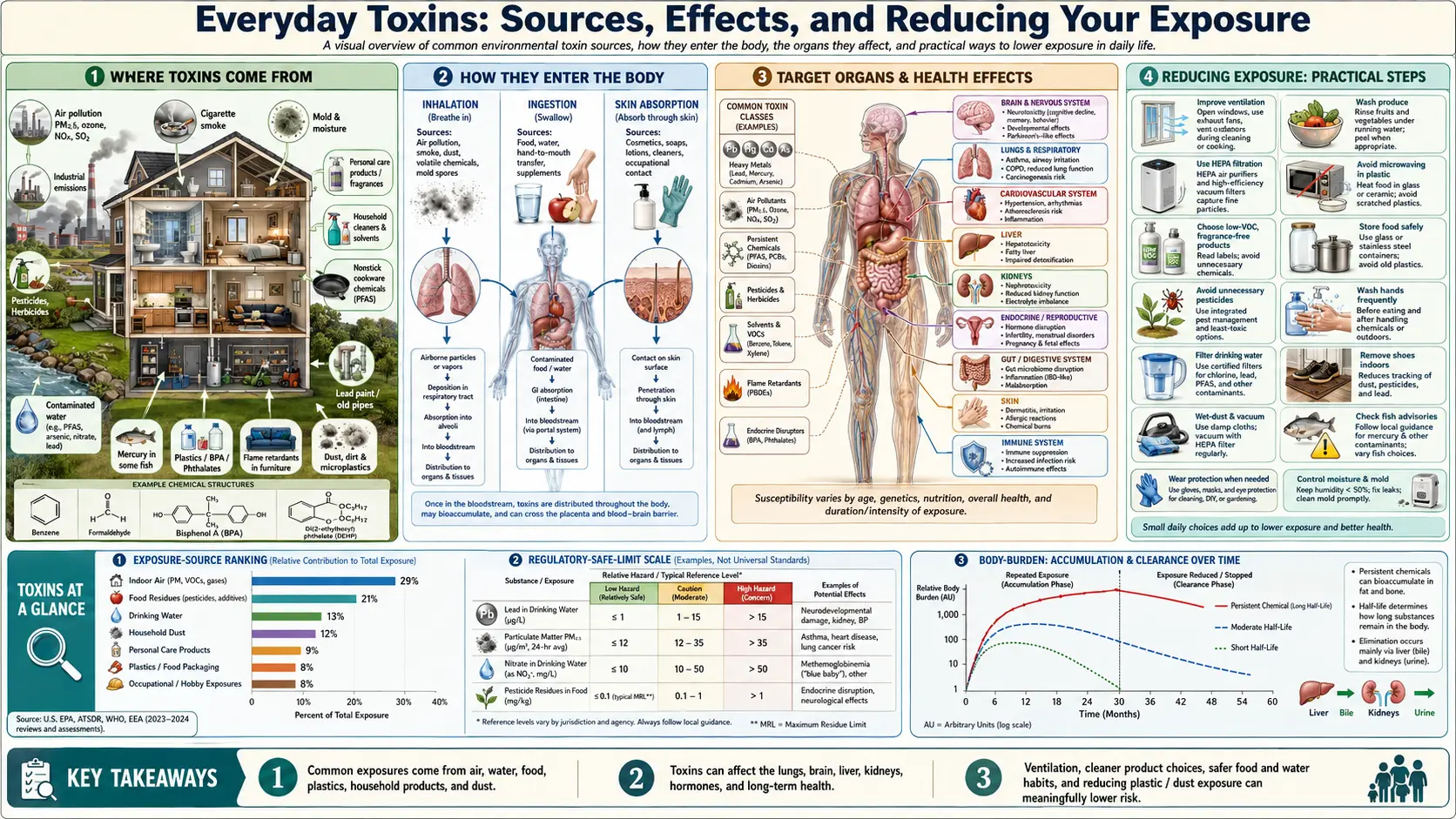
Toxins

The Six Groups
Every topic sits under a group, on disk and in the URL, so a path reads Toxins → group → topic. The axis is where the exposure comes from, because that is the part a reader can act on. A topic appearing here is not a verdict: several of these pages exist to say that a widely feared exposure is not well supported, and each one gives the dose the evidence actually rests on.
Dangerous Supplements keeps its own place outside the groups — it is a product-safety topic with nine sub-articles, organised by risk pattern rather than by where an exposure comes from. The heavy metals live at Toxic Minerals.
A comprehensive guide to hidden toxins in our food supply, homes, and environment. Understanding what you're exposed to is the first step toward reducing your toxic burden and protecting your health.
Food Toxins
Environmental & Lifestyle Toxins
Featured Resource
Lead Safe Mama - Independent Consumer Safety & Childhood Lead Prevention
Run by federal award-winning advocate Tamara Rubin, Lead Safe Mama (tamararubin.com) is a community-funded, independent testing and advocacy organization dedicated to protecting children from Lead poisoning and toxic consumer goods. With over 4,500 free articles, independent third-party lab reports on foods, supplements, and household products, and a track record of triggering six FDA and CPSC product recalls, it is one of the most comprehensive and trusted resources for families seeking science-based consumer safety information.
Connections
- Fake Food — Adulteration, dilution, mislabelling and grade fraud in the food supply
- Toxic Minerals & Heavy Metals — lead, mercury, arsenic and cadmium, and essential minerals in excess.
- Conditions — the diseases these exposures cause, worsen or are suspected in.
- Lab Tests — blood, urine and hair testing for exposure, and what each test can and cannot show.
- Food — where dietary exposure comes from, and the whole foods that displace it.
- Minerals — the essential minerals that toxic metals compete with and displace.
- Antioxidants — the polyphenol and glutathione systems that handle oxidative damage.
- Herbs — the liver-support and binding botanicals used in detoxification protocols.
- Remedies — chelation, sauna and the other practices claimed to reduce body burden.
- Fluoride — water fluoridation, the IQ literature, and the informed-consent argument.
- Glyphosate — the world’s most-used herbicide, its residue routes and its cancer litigation.
- Microplastics — particle exposure, where it is measured in the body, and what is still unknown.
- PFAS — the “forever chemicals”, their half-lives, and how to reduce intake.
- Mold & Mycotoxins — damp-building exposure, testing, and the evidence that is genuinely contested.
- Ultra-Processed Foods — the NOVA classification and the controlled-feeding trial behind it.
- Seed Oils — linoleic acid, oxidation products, and what the trial evidence actually shows.
- Pesticides — organophosphates and the residue data behind produce-washing advice.
- BPA & Plastics — bisphenols, phthalates, and the substitutions that replaced them.
- Arsenic Exposure
- Cadmium Toxicity
- Heavy Metals in Food
- Lead Poisoning
- Mercury Toxicity
Featured Videos