Pinworm in Children and Households
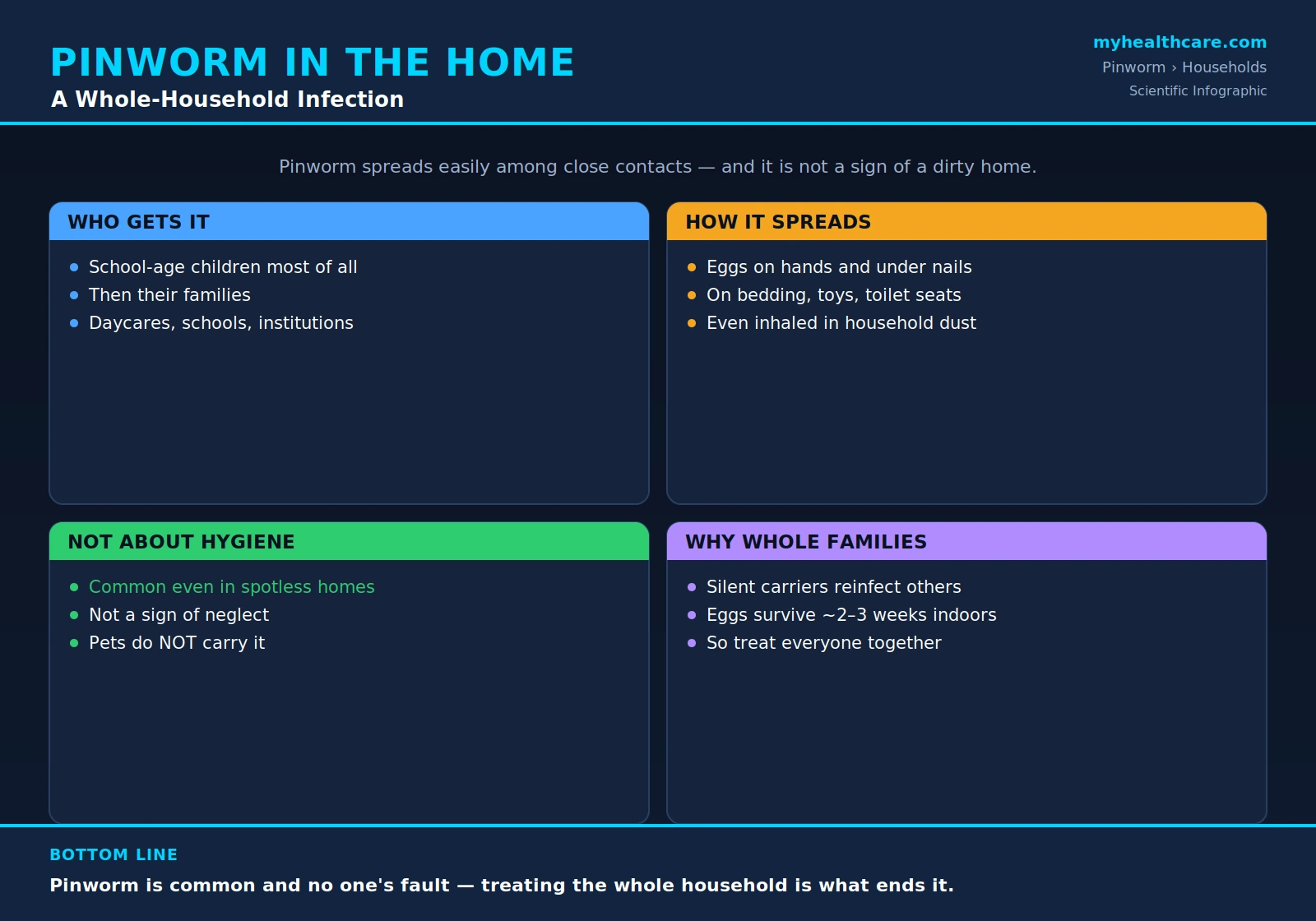
If a doctor has told you your child has pinworm — or you have spotted the tiny white threads yourself — the first thing to know is the most reassuring: this is normal, common, and not your fault. Pinworm (the threadworm Enterobius vermicularis) is the most common worm infection of children in the United States, Europe, and other temperate, high-income countries. It is found in spotlessly clean homes and in immaculate, well-run schools. It is not a sign of dirt, neglect, poor parenting, or a filthy house. It spreads because of how children play, share, and put their hands near their mouths — not because of how a family lives. This page explains who gets pinworm and why, exactly how it travels from one person to the next, why it sweeps through whole families and classrooms rather than picking on one unlucky child, how long the eggs last in the home, why pets are entirely off the hook, and why the only way to truly clear it is to treat and manage the whole household together.
Table of Contents
- The Most Common Worm in Children
- Who Gets It — School-Age Children and Their Families
- How Pinworm Spreads: The Fecal-Oral Route
- Eggs That Travel Through the Air
- Why It Sweeps Through Families, Daycares, and Schools
- How Long Eggs Survive in the Home
- Reassurance: It Is Not a Sign of Poor Hygiene
- Pets Do Not Carry Human Pinworm
- Why Control Means Treating the Whole Household
- Key Research Papers
- Featured Videos
1. The Most Common Worm in Children
Among all the parasitic worms that infect people, Enterobius vermicularis — the pinworm, also called the threadworm or seatworm — is the one most often seen in the temperate, high-income world. While other intestinal worms (such as roundworm, whipworm, and hookworm) are far more common in tropical, lower-income regions with warm soil and limited sanitation, pinworm is different: it does not need warm soil or contaminated water. It spreads directly from person to person, which is why it thrives even in cool climates and modern homes, and why it has remained the dominant childhood worm infection in places like the United States, Canada, the United Kingdom, and much of Europe.
Estimates of how many people carry pinworm are necessarily rough, because most infections are mild and many are never reported or even noticed. But it is widely regarded as affecting a substantial fraction of children at some point, and survey after survey in schools and kindergartens around the world keeps finding it. The global picture of intestinal worms is dominated, in terms of sheer numbers and disease burden, by the soil-transmitted helminths of the tropics; pinworm sits apart from that pattern as the temperate-zone exception, passed hand-to-mouth rather than through soil. The practical message for a worried parent is simply this: of all the worms a child in a cool, clean country might pick up, pinworm is by far the likeliest — and the most harmless.
2. Who Gets It — School-Age Children and Their Families
Pinworm is, above all, an infection of school-age children. The highest infection rates are consistently found in children roughly 5 to 10 years old, with kindergarten and primary-school children topping survey after survey. This is no accident: it reflects exactly the behaviours of that age group — close physical play, shared toys and surfaces, hands that are constantly exploring, and the natural reflex to scratch an itchy bottom and then touch the mouth, food, or another child.
But pinworm rarely stays with one child. Because it passes so readily from person to person, the people who live with and care for an infected child are very often infected too. Surveys repeatedly show that pinworm clusters within families: when one child is positive, siblings, parents, and grandparents who share the home have a far higher chance of carrying it as well. Younger toddlers catch it from older brothers and sisters; parents catch it while changing nappies, doing laundry, or making beds; and the cycle can quietly continue for weeks. This is why clinicians describe pinworm as a household infection rather than an individual one — a point that becomes central when it comes to treatment.
It is worth saying plainly that adults get pinworm too. Some parents feel embarrassed to discover the infection in themselves, as though it were a childhood ailment they should have outgrown. It is not. An adult sharing a home with an infected child is simply on the same transmission chain as everyone else under that roof.
3. How Pinworm Spreads: The Fecal-Oral Route
To understand why pinworm is so contagious, it helps to picture its short, tidy life cycle. At night, the female worm crawls out of the anus and lays thousands of microscopic eggs on the surrounding skin. This is what causes the classic night-time anal itching and sleep disturbance. The itch is the engine of transmission: a child scratches, and eggs are transferred onto the fingers and under the fingernails.
From there, the spread follows what doctors call the fecal-oral route — the eggs travel from the bottom, onto the hands, and back to a mouth. The pathways are everyday and unremarkable:
- Hand to own mouth (self-reinfection). The same child re-swallows eggs from their own fingers, restarting the cycle and keeping the infection going indefinitely unless it is interrupted.
- Hand to other people. Eggs on the fingers transfer directly to playmates, siblings, and parents during ordinary contact — holding hands, sharing food, helping with toileting.
- Hand to surface to mouth. Eggs are deposited onto bedding, pyjamas and clothing, towels, toys, toothbrushes, toilet seats, taps, doorknobs, and tabletops. The next person to touch that surface picks up eggs, and eventually carries them to their own mouth.
A key detail makes this efficient: pinworm eggs become infective within just a few hours of being laid. They do not need to mature in soil for weeks, the way many other worm eggs do. Within hours of a night-time scratch, the eggs on a child's hand are already capable of starting a new infection in whoever swallows them. Studies that have actually sampled the hands of infected children have recovered pinworm eggs from their fingers and fingernails, confirming that the hand really is the vehicle. This fast, hand-borne, person-to-person cycle is precisely why pinworm spreads so quickly and why it is so hard to clear by treating only one family member.
4. Eggs That Travel Through the Air
Hands are the main highway, but they are not the only one. Pinworm eggs are extremely light and small, and they can become airborne. When contaminated bedding, pyjamas, or towels are shaken out — for example, while stripping a bed or sorting laundry — eggs can be lofted into the air along with household dust. Once airborne, they can settle onto other surfaces across the room, or be inhaled and then swallowed, providing yet another way the infection moves from person to person and around the home.
This airborne route helps explain something parents often find baffling: how a child who seems to have had no obvious close contact with an infected person nonetheless becomes infected. It also explains why pinworm eggs can be found in house dust and on surfaces well away from the bathroom. Practically, it is the reason hygiene advice for pinworm emphasises gently handling bedding and nightclothes — washing them rather than shaking them out — and damp-dusting rather than dry-sweeping during a course of treatment. (Those measures are covered in detail on the Hygiene and Preventing Reinfection page.) The airborne potential of the eggs is not a cause for alarm, but it is a reason the practical control measures focus on the whole sleeping and laundering environment, not just on hand-washing.
5. Why It Sweeps Through Families, Daycares, and Schools
Put the pieces together — light eggs that become infective within hours, a powerful night-time itch that loads the fingers, easy transfer to shared surfaces, and the airborne route — and it becomes obvious why pinworm does not behave like an isolated case. It behaves like a shared environmental problem. Wherever people live or spend the day in close contact, touching the same things, the infection circulates among all of them.
That is why the settings with the highest pinworm rates are exactly the crowded, hands-on, shared-surface ones:
- Families and households — shared bedrooms, bedding, bathrooms, and towels, plus constant close contact, especially where young children are toileted by adults.
- Daycares and nurseries — toddlers in close play, shared toys mouthed and handled, and intensive nappy-changing.
- Schools — classrooms, shared toilets, and the close contact of primary-age children, the very group most affected.
- Institutions — residential homes, long-stay facilities, and any setting where many people share living space and surfaces over long periods.
Documented outbreaks — for instance, clusters reported on hospital children's wards — show how readily pinworm passes between people sharing a confined space. The lesson from these clusters is consistent: pinworm is not really transmitted by a single dirty object or a single careless moment, but by the ordinary, repeated, low-level sharing of an environment by people in close contact. That understanding is liberating, not blaming — it means an outbreak in a daycare or a family reflects the nature of the parasite, not a failing of the people involved.
6. How Long Eggs Survive in the Home
One reason pinworm is persistent is that its eggs are hardy enough to wait. In the conditions of a typical indoor environment — moderate temperature and humidity, out of direct sunlight — pinworm eggs can remain viable and infective for roughly two to three weeks. They survive on bedding, clothing, soft furnishings, and in household dust during that window, so a surface contaminated today can still pass on the infection a fortnight or more later.
The eggs are not, however, indestructible. They are sensitive to drying, heat, and sunlight, which is why laundering at hot temperatures and ordinary cleaning are effective at clearing them from the home. Knowing the roughly two-to-three-week survival time is useful for two reasons. First, it explains why reinfection is so easy: even after a person is dewormed, eggs lingering in the bedroom can re-start the cycle. Second, it shapes the practical advice — a concentrated burst of hot-wash laundering, hand-washing, and nail care around the time of treatment is aimed precisely at clearing this reservoir of eggs before it can re-infect anyone. The point is not to scrub the house endlessly forever, but to break the cycle decisively once, in step with the medicine.
7. Reassurance: It Is Not a Sign of Poor Hygiene
This is the single most important message of the whole page, and it deserves its own section: pinworm is not a marker of dirtiness, poor hygiene, or neglect.
Many families feel ashamed when pinworm is diagnosed, and that shame can be more harmful than the infection itself — it makes people hide the problem, delay treatment, or avoid telling the school or daycare, which only lets the parasite spread further. So it bears repeating clearly: pinworm is common in immaculately clean homes and among scrupulously careful families. It spreads because of how young children naturally behave — scratching, exploring with their hands, putting fingers and objects in their mouths, playing in close contact — and because the eggs are so light, so quickly infective, and so easily airborne. None of that is within a parent's power to prevent entirely, no matter how spotless the house.
The parasite does not discriminate by income, cleanliness, or how good a parent someone is. A diagnosis of pinworm says nothing bad about a family. The right response is not embarrassment but a calm, practical one: treat everyone in the home, do a focused round of laundry and hand-washing, and let the relevant carers know so the cycle can be broken everywhere at once. Framing it as a normal, expected part of raising young children — closer to catching a cold at school than to any failing — is both medically accurate and emotionally kinder.
8. Pets Do Not Carry Human Pinworm
A frequent worry — and a frequent source of unnecessary guilt about the family dog or cat — is whether pets are to blame. They are not. The human pinworm, Enterobius vermicularis, is a human-only parasite. Dogs and cats do not carry it, do not pass it to people, and cannot be the source of a child's infection. The cycle runs from person to person, full stop.
This means two things in practice. First, there is no need to treat, blame, or worry about the household pet when pinworm appears — deworming the dog will do nothing for a child's pinworm, because the dog was never part of the chain. Second, the reverse is also reassuring: a child's pinworm is not a threat to the family pet. (Animals do have their own species-specific pinworms, but those are different parasites that stay in their own hosts and are not what causes human enterobiasis.) When the search for a culprit turns to the pets, families can let that worry go entirely and focus where it belongs: on the people who share the home.
9. Why Control Means Treating the Whole Household
Everything on this page points to one conclusion about how to actually get rid of pinworm: you have to treat the household, not just the individual.
Here is the trap that catches so many families. A child is diagnosed, given a deworming dose, and seems cured — only for the itching to return weeks later. The reason is rarely that the medicine failed. It is that other people in the home were quietly infected too, or that eggs were still living on bedding, clothing, and surfaces, and the cycle simply restarted. Because pinworm is a household infection with an environmental reservoir of eggs, treating one person while leaving the others — and the bedroom — untouched is like bailing a boat without plugging the leak.
Effective control therefore combines three things, done together: treating every household member at the same time (so no one is left as a hidden source to re-infect the rest), a focused round of household measures — hot-wash laundering of bedding and nightclothes, hand-washing, keeping fingernails short and clean, and damp-dusting — timed around the medication, and often a second dose two weeks later to catch any newly hatched worms, matched to the lifespan of the eggs. This coordinated, whole-home approach is what reliably breaks the cycle, and it is the heart of managing stubborn or recurring cases. For the full step-by-step strategy — including timing, repeat dosing, and exactly who to treat and when — see Recurrent Pinworm and Whole-Household Treatment. The specific deworming medicines are covered on the Pyrantel and Albendazole Treatment page, and the day-to-day prevention measures on the Hygiene and Preventing Reinfection page.
Approached this way — calmly, together, and without shame — pinworm is straightforward to clear. It is one of the most treatable infections a child can have, and recognising it as a normal, whole-household event rather than a private embarrassment is the surest route to getting rid of it for good.
Key Research Papers
Peer-reviewed reviews, transmission studies, and epidemiological surveys on the spread of Enterobius vermicularis in children and households. Journal names appear as plain text; the year/volume/pages link opens the full citation via DOI.
- Cook GC. Enterobius vermicularis Infection. Gut. 1994;35(9):1159–1162.
- Burkhart CN, Burkhart CG. Assessment of Frequency, Transmission, and Genitourinary Complications of Enterobiasis (Pinworms). International Journal of Dermatology. 2005;44(10):837–840.
- Cranston I, Potgieter N, Mathebula S, et al. Transmission of Enterobius vermicularis Eggs Through Hands of School Children in Rural South Africa. Acta Tropica. 2015;150:94–96.
- Ashford RW, Hart CA, Williams RG. Enterobius vermicularis Infection in a Children's Ward. Journal of Hospital Infection. 1988;12(3):221–224.
- Matsen JM, Turner JA. Reinfection in Enterobiasis (Pinworm Infection). American Journal of Diseases of Children. 1969;118(4):576–581.
- Moussavi K, Houssaini ZS, Salari R, et al. Prevalence of Enterobius vermicularis Among Children in Iran: A Systematic Review and Meta-Analysis. Parasite Epidemiology and Control. 2023;22:e00315.
- Wang S, Hwang KP, Chen YH, et al. Enterobius vermicularis Infection in Schoolchildren: A Large-Scale Survey. Epidemiology and Infection. 2010;138(1):28–36.
- Pirhan Y, Ozen M, Kilinc N, et al. Does the Intestinal Parasite Enterobius vermicularis Cause Acute Appendicitis? Turkish Journal of Parasitology. 2017;41(2):76–79.
- Mascarini-Serra L. Prevention of Soil-Transmitted Helminth Infection. Journal of Global Infectious Diseases. 2011;3(2):175–182.
- Speich B, Moser W, Ali SM, et al. Efficacy and Reinfection with Soil-Transmitted Helminths 18 Weeks Post-Treatment with Albendazole-Ivermectin, Albendazole-Mebendazole, and Other Regimens. Parasites & Vectors. 2016;9:123.
- Pullan RL, Smith JL, Jasrasaria R, Brooker SJ. Global Numbers of Infection and Disease Burden of Soil Transmitted Helminth Infections in 2010. Parasites & Vectors. 2014;7:37.
- Bethony J, Brooker S, Albonico M, et al. Soil-Transmitted Helminth Infections: Ascariasis, Trichuriasis, and Hookworm. The Lancet. 2006;367(9521):1521–1532.
Live PubMed Searches
Each link opens a live PubMed query so results stay current as new papers are indexed.
- Enterobius vermicularis in children
- Pinworm transmission via hands
- Pinworm prevalence in schoolchildren
- Enterobiasis in families and households
- Pinworm eggs in dust and environment
- Pinworm reinfection and treatment
- Pinworm in daycare and kindergarten
- Pinworm diagnosis (tape test)
Connections
- All Parasites
- Pinworm Overview
- Symptoms & Diagnosis
- Anal Itching & Sleep Disturbance
- Complications & Unusual Sites
- Treatment & Prevention
- Pyrantel & Albendazole Treatment
- Hygiene & Preventing Reinfection
- Recurrent Pinworm & Whole-Household Treatment
- Gastroenterology
- Infectious Disease
- All Conditions