Pinworm Symptoms and Diagnosis
Anal Itching & Sleep Disturbance
The hallmark nighttime perianal itch — and the restless sleep and irritability it causes.
Read the deep dive →Pinworm in Children & Households
Why it sweeps through families, schools, and daycares — and why the whole home is treated.
Read the deep dive →Complications & Unusual Sites
Usually harmless — but the rare problems, from vulvovaginitis to the appendix.
Read the deep dive →Pinworm — the threadlike white worm Enterobius vermicularis — is the most common worm infection in the United States and other temperate, high-income countries, and it lives almost entirely around one symptom: an intense itch around the anus that flares at night. It is not a sign of poor hygiene, dirty homes, or "toxins," and despite the alarm it causes, in the great majority of people it is harmless and easily cured. This page is the hub for understanding pinworm: what it feels like, who tends to get it, why the worm behaves the way it does, the rare problems it can cause, and — crucially — how it is actually diagnosed (which is not the routine stool test most people expect). Each major topic links to a dedicated page where you can read more deeply.
Table of Contents
- The Hallmark: Nighttime Anal Itching
- Who Gets It and How Common It Is
- Usually Harmless — and the Rare Exceptions
- Why the Worm Itches at Night (the Mechanism)
- Sleep Disturbance, Restlessness, and Irritability
- Mild and Symptom-Free Infections
- Diagnosis: The Sticky-Tape Test
- Why a Routine Stool Test Usually Misses It
- When to Test and When to Repeat
- Key Research Papers
- Featured Videos
1. The Hallmark: Nighttime Anal Itching
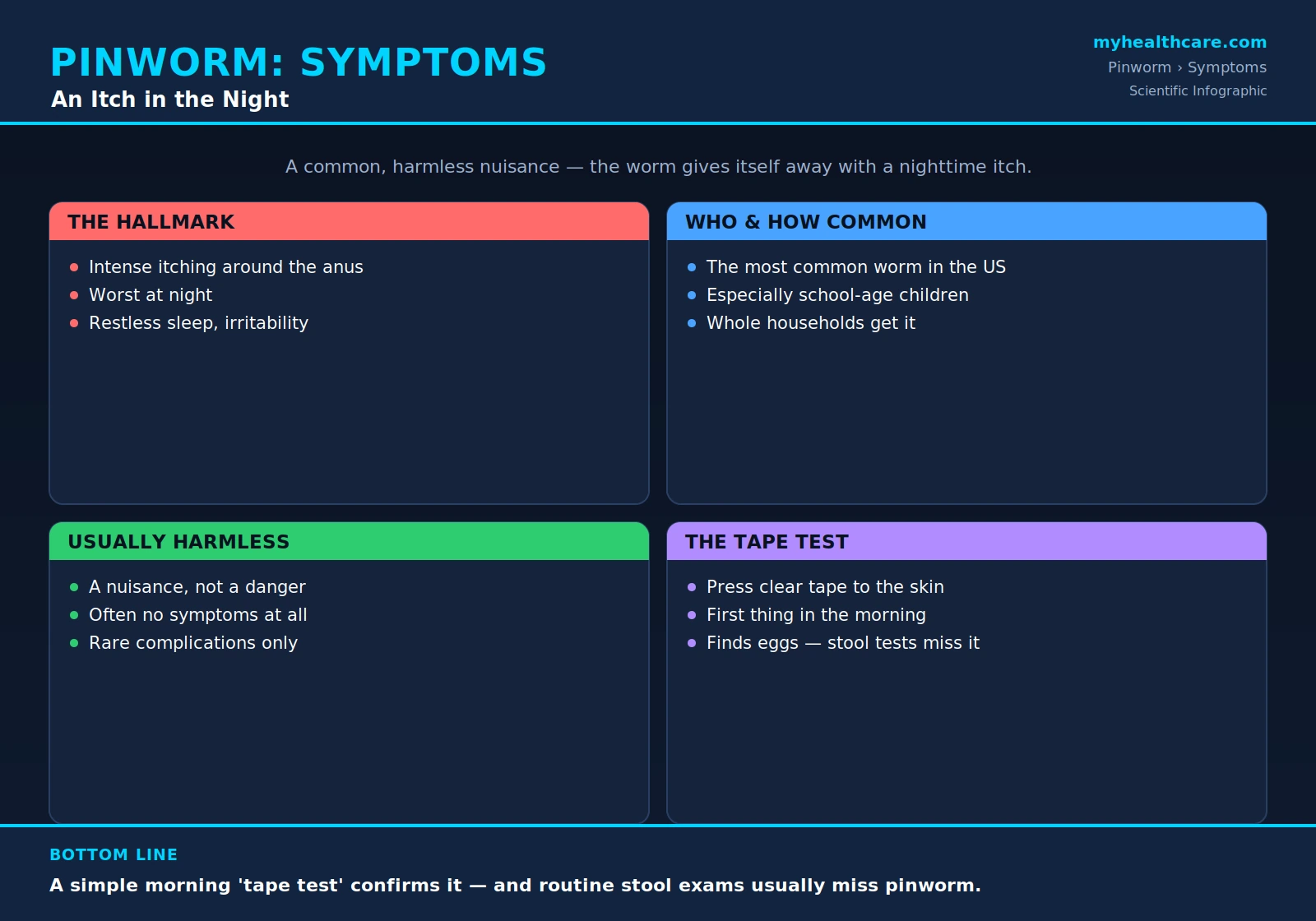
If pinworm has a signature, it is itching around the anus that is worst at night — a symptom doctors call nocturnal pruritus ani. A child (or adult) may seem fine all day and then, after going to bed, begin to scratch, fidget, and complain that their bottom itches. The itch can be mild and merely annoying or intense enough to wake the person repeatedly. In girls and women, the same nighttime irritation can extend forward to the vulva and vaginal area, because the worms and their eggs can spread onto nearby skin.
This nighttime timing is not a coincidence or a quirk — it is the direct result of the worm's life cycle, in which the egg-laying female crawls out of the anus specifically at night (explained in the mechanism section below). Because the itch is so characteristic, a history of new, recurring, after-dark anal itching — especially in a school-age child — is often the first and strongest clue that pinworm is the cause.
The itch deserves a page of its own because of how disruptive it can be and how the scratching it provokes drives the whole cycle of spread and reinfection. For a fuller discussion of the itch, the scratching, and the broken sleep that follows, see Anal Itching and Sleep Disturbance.
2. Who Gets It and How Common It Is
Pinworm is, by a wide margin, the most common worm infection in temperate and high-income countries, including the United States, Canada, and much of Europe. Unlike many intestinal worms that thrive in tropical climates and warm soil, pinworm flourishes precisely in cooler, developed settings — in homes, schools, and daycare centers — because it spreads person-to-person and through shared indoor surfaces rather than through soil or water.
The people most affected are school-age children, roughly ages 5 to 14, in whom infection rates are highest. From an infected child, pinworm readily spreads to family members of all ages — siblings, parents, and grandparents — and to other children in group settings. It is genuinely common: pinworm has historically been one of the most frequently identified human worm infections worldwide, and clusters within a single household or classroom are typical rather than unusual.
A key point for parents to absorb is that catching pinworm is not a marker of being dirty or neglectful. The eggs are microscopic, sticky, and easily transferred from fingers to mouth, from bedding and clothing to hands, and even briefly through the air; an ordinary, clean household can still pass them around. Because the infection spreads so easily among people in close contact, it is best understood as a household and community infection rather than an individual one. This is explored in depth — including why treatment so often has to involve the whole family — on Pinworm in Children and Households.
3. Usually Harmless — and the Rare Exceptions
For all the distress it causes, pinworm is in almost all cases a benign, nuisance infection. The worms do not invade the bloodstream, do not feed on blood, and do not cause the kind of malnutrition or anemia associated with some other intestinal parasites. The dominant problem is the itch and the disturbed sleep it brings; the infection is reliably cured with simple medication and hygiene measures.
That reassuring picture has occasional exceptions. Because the worms live in the lower bowel and the females migrate onto nearby skin, they can — uncommonly — cause trouble at neighboring sites. In girls and women the worms can wander into the vulva and vagina and contribute to vulvovaginitis (genital irritation, redness, and discharge), and they have occasionally been found in the urinary tract. Rarely, large numbers of worms, or a worm that lodges in the opening of the appendix, have been linked to abdominal pain and appendix-like symptoms, and pinworms are sometimes discovered inside appendix specimens removed at surgery. There are also scattered reports of worms reaching truly unusual locations within the abdomen and pelvis.
These complications are the exception, not the rule, and listing them is meant to inform rather than alarm. The full range of unusual presentations — from genital and urinary involvement to the appendix and beyond — is covered on Complications and Unusual Sites.
4. Why the Worm Itches at Night (the Mechanism)
The entire behavior of pinworm makes sense once you understand the worm's nightly routine. Adult pinworms live in the lower part of the human intestine. The female worm is small but visible — white, threadlike, and only about a centimeter long. When she is ready to lay her eggs, she does not release them inside the bowel. Instead, at night, while the person is asleep and still, the gravid (egg-filled) female migrates out through the anus and deposits thousands of sticky eggs on the skin around the anus — the perianal skin — before dying.
This nighttime egg-laying is the engine behind every classic feature of the disease:
- The itch. The worm's movement onto the skin and the irritating, sticky mass of eggs she leaves behind provoke intense local itching — which is why the itch comes on at night and centers on the anus.
- The spread. When the sleeping (or waking) person scratches the itchy area, the microscopic eggs lodge under the fingernails and on the fingers. From there they are carried to the mouth — reinfecting the same person — or onto bedding, underwear, towels, toys, and surfaces, where other people pick them up. The eggs become infectious within hours and can survive in the environment for a couple of weeks.
- The cycle. Swallowed eggs hatch in the intestine, the larvae mature into adult worms over a few weeks, and the new females again crawl out at night to lay eggs — restarting the loop. This self-reinfection through the hand-to-mouth route is exactly why pinworm is so persistent and so prone to coming back unless the cycle is deliberately broken.
Understanding this cycle explains the seemingly odd advice that follows from it: that the worms emerge at night (so that is when to look for them and when to perform the diagnostic test), that fingernail and hand hygiene matter so much, and that reinfection is the central challenge in getting rid of pinworm for good.
5. Sleep Disturbance, Restlessness, and Irritability
Because the itch peaks exactly when a person is trying to sleep, one of the most common and underappreciated effects of pinworm is disturbed sleep. An infected child may be restless, wriggle and squirm in bed, wake repeatedly during the night, or be difficult to settle. Parents sometimes notice the child scratching in their sleep or complaining of an itchy bottom at bedtime night after night.
The downstream consequences are the familiar ones of any broken sleep: daytime tiredness, irritability, poor concentration, and crankiness. In children these can sometimes be mistaken for behavioral problems, attention difficulties, or restlessness with no obvious cause — when the real culprit is a treatable parasite robbing the child of restful nights. Teeth-grinding and bedwetting have also been linked anecdotally to pinworm, although these associations are less certain.
For most families the sleep disruption, rather than any physical danger, is what makes pinworm worth treating promptly. Once the infection is cleared, the nighttime itching and the restless nights resolve. The interplay between the itch and sleep is discussed further on Anal Itching and Sleep Disturbance.
6. Mild and Symptom-Free Infections
It is important to know that many pinworm infections cause few or no symptoms at all. A substantial number of infected people — including children — never develop noticeable itching, or have only occasional, mild irritation that passes unremarked. Surveys that test whole groups of children frequently find that some carry the worm without complaints.
This has two practical implications. First, the absence of dramatic symptoms does not rule pinworm out: a child can be infected, and can be spreading eggs to others, while seeming perfectly well. Second, when one member of a household is diagnosed, it is common for others to be infected without showing symptoms — which is one of the reasons treatment is often extended to the whole family even if only one person has been itching. The silent, symptom-free carrier helps explain why pinworm circulates so persistently through homes and classrooms.
7. Diagnosis: The Sticky-Tape Test
The standard, classic way to diagnose pinworm is the "cellophane tape" test — also called the sticky-tape test, the adhesive-tape test, or the perianal tape test. It is simple, painless, and can be done at home or in the clinic, and it is built directly around the worm's nighttime habits.
The method works like this:
- Timing is everything. The test is performed first thing in the morning, as soon as the person wakes — crucially, before they wash, bathe, wipe, use the toilet, or have a bowel movement. This is because the female worms laid their sticky eggs on the perianal skin during the night, and washing or a bowel movement can remove them before they can be collected.
- Collecting the sample. A piece of clear adhesive (cellophane) tape is pressed, sticky-side down, against the skin folds immediately around the anus and then lifted away, so any eggs deposited overnight stick to the tape. The tape is then smoothed onto a glass microscope slide. A purpose-made plastic device with a sticky paddle — a "pinworm paddle" — is sometimes used in place of tape and works the same way.
- Examining it. The slide is taken to the laboratory and examined under the microscope, where the technician looks for the characteristic pinworm eggs — oval and flattened on one side — and occasionally an adult female worm caught on the tape.
A second route to the diagnosis is even simpler: seeing the worms directly. The adult females are white, threadlike, and just visible to the naked eye, and they can sometimes be spotted moving on the perianal skin if a parent looks a few hours after the child falls asleep, or seen on the surface of stool. Spotting the unmistakable little white "threads" wriggling around a child's anus at night is, in practice, a common and sufficient way that pinworm is recognized at home.
8. Why a Routine Stool Test Usually Misses It
One of the most useful things to understand about pinworm is that the test most people expect — a routine stool sample sent for "ova and parasites" (O&P) examination — is the wrong test, and it usually misses the infection.
The reason follows directly from the worm's biology. The female pinworm deposits her eggs on the skin around the anus, not inside the bowel, so the eggs are generally not passed in the stool. A stool O&P test — which is excellent for many other intestinal parasites whose eggs are shed into the feces — therefore comes back negative in most people who genuinely have pinworm, simply because the eggs are not where that test looks. A normal or "negative" stool ova-and-parasites result does not rule out pinworm.
This is exactly why the sticky-tape (perianal) test exists and is the recommended method: it samples the perianal skin, which is where the eggs actually are. If pinworm is suspected, the right thing to ask for is the perianal tape test, not a routine stool sample. Knowing this spares families the confusion of a "clean" stool test that seems to contradict an obvious nighttime itch.
9. When to Test and When to Repeat
The single best time to test — whether by tape or by simply looking — is shaped entirely by the worm's schedule. Testing should be done in the morning before washing or a bowel movement, or by inspecting the perianal skin at night a few hours after the person has fallen asleep, when the egg-laying females are most likely to be on or near the surface.
Because egg-laying does not happen every single night, a single negative tape test does not reliably exclude pinworm. The standard advice is to repeat the test on several consecutive mornings — commonly three different mornings — to improve the chance of catching the eggs. Each additional morning's sample raises the likelihood of a positive result if pinworm is truly present, which is why repeat testing is built into the recommended approach rather than being an afterthought.
In practice, testing is worth pursuing when there is suggestive nighttime anal itching (especially in a school-age child or a household with an affected member), when worms are seen, or when symptoms persist or recur. And because pinworm spreads so readily within families, a positive result in one person frequently prompts attention to the rest of the household. Once the diagnosis is made, the focus shifts to treatment and — just as importantly — to breaking the reinfection cycle; those steps are covered on the Treatment & Prevention hub and its companion pages on deworming drugs, hygiene and preventing reinfection, and recurrent pinworm and whole-household treatment.
Key Research Papers
Peer-reviewed reviews, epidemiological surveys, diagnostic studies, and treatment and complication reports on pinworm (Enterobius vermicularis) infection. Journal names appear as plain text; the year/volume/pages link opens the full citation via DOI.
- Cook GC. Enterobius vermicularis Infection. Gut. 1994;35(9):1159–1162. — doi:10.1136/gut.35.9.1159
- Burkhart CN, Burkhart CG. Assessment of Frequency, Transmission, and Genitourinary Complications of Enterobiasis (Pinworms). International Journal of Dermatology. 2005;44(10):837–840. — doi:10.1111/j.1365-4632.2004.02332.x
- Georgiev VS. Chemotherapy of Enterobiasis (Oxyuriasis). Expert Opinion on Pharmacotherapy. 2001;2(2):267–275. — doi:10.1517/14656566.2.2.267
- Cho SY, Kang SY. Significance of Scotch-Tape Anal Swab Technique in Diagnosis of Enterobius vermicularis Infection. The Korean Journal of Parasitology. 1975;13(2):102–114. — doi:10.3347/kjp.1975.13.2.102
- Bumbalo TS, Fugazzotto DJ, Wyczalek JV. Treatment of Enterobiasis with Pyrantel Pamoate. The American Journal of Tropical Medicine and Hygiene. 1969;18(1):50–52. — doi:10.4269/ajtmh.1969.18.50
- Wang LC, Hwang KP, Chen ER. Enterobius vermicularis Infection in Schoolchildren: A Large-Scale Survey 6 Years after a Population-Based Control. Epidemiology and Infection. 2010;138(1):28–36. — doi:10.1017/S0950268809002660
- Laoraksawong P, Pansuwan P, Krongchon S, Pongpanitanont P, Janwan P. Prevalence of Enterobius vermicularis Infections and Associated Risk Factors among Schoolchildren in Nakhon Si Thammarat, Thailand. Tropical Medicine and Health. 2020;48:83. — doi:10.1186/s41182-020-00270-3
- Janthu P, Dumidae A, Subkrasae C, et al. Prevalence and Genetic Analysis of Enterobius vermicularis in Schoolchildren in Lower Northern Thailand. Parasitology Research. 2022;121(10):2955–2965. — doi:10.1007/s00436-022-07626-0
- Getzlaff JM, Fulghum GH. Enterobius vermicularis (Pinworm) Appendicitis: The Real Vermiform Appendix. Military Medicine. 2024;189(3–4):e894–e896. — doi:10.1093/milmed/usad357
- Vargas-Arzola J, Segura-Salvador A, Hernández-Osorio LA, et al. Enterobius vermicularis Infection in a Child Population with Evidence of Vulvovaginitis and Bacterial Coinfection in Girls in Oaxaca, México. Advances in Public Health. 2024;2024:8408028. — doi:10.1155/2024/8408028
- Zahariou A, Karamouti M, Papaioannou P. Enterobius vermicularis in the Male Urinary Tract: A Case Report. Journal of Medical Case Reports. 2007;1:137. — doi:10.1186/1752-1947-1-137
PubMed Topic Searches
Each link opens a live PubMed query so results stay current as new papers are indexed.
- PubMed: Enterobius vermicularis infection
- PubMed: Pinworm nocturnal anal itching
- PubMed: Enterobiasis cellophane-tape diagnosis
- PubMed: Enterobius vermicularis prevalence in children
- PubMed: Enterobiasis treatment (mebendazole, pyrantel, albendazole)
- PubMed: Enterobius vermicularis and appendicitis
- PubMed: Enterobius vermicularis vulvovaginitis
- PubMed: Pinworm reinfection and household transmission
Connections
- All Parasites
- Pinworm Overview
- Anal Itching & Sleep Disturbance
- Pinworm in Children & Households
- Complications & Unusual Sites
- Treatment & Prevention
- Pyrantel & Albendazole Treatment
- Hygiene & Preventing Reinfection
- Recurrent Pinworm & Whole-Household Treatment
- Gastroenterology
- Infectious Disease
- All Conditions