Pinworm: Anal Itching and Sleep Disturbance
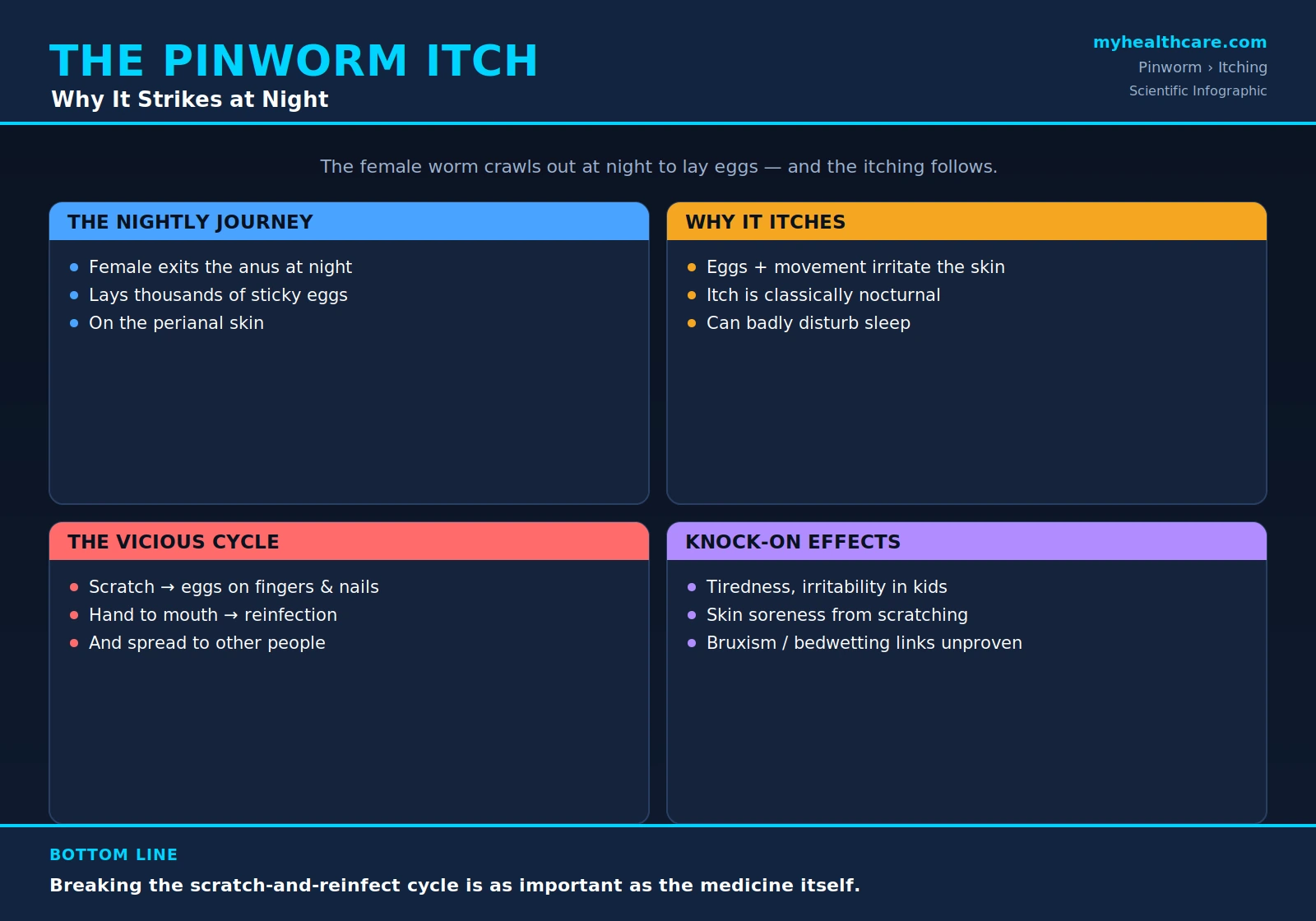
The single most recognizable sign of a pinworm (Enterobius vermicularis) infection is an itchy bottom that flares up at night. For many families, that nighttime itch — in a child who is suddenly restless, scratching, and hard to settle — is the very first clue that anything is wrong. This page explains exactly why the itch happens, why it is so much worse after dark, and how it drives the frustrating cycle that keeps the infection going and spreads it to others. It also walks through the knock-on effects on sleep and daytime behavior, looks honestly at the symptoms that might be linked but are not proven, covers the skin damage that scratching can cause, and finishes with the other, non-pinworm reasons a bottom can itch — so you know when it could be something else. If you already suspect pinworms, relief is straightforward; see Treatment & Prevention.
Table of Contents
- The Female Worm's Nightly Journey
- Why the Itch Is Worse at Night
- The Sticky Eggs and the Intense Local Itch
- The Itch–Scratch–Reinfect Cycle
- Sleep Disturbance, Restlessness, and Daytime Tiredness
- Disputed Associations: Teeth Grinding and Bedwetting
- Perianal Skin Damage from Scratching
- How Relief Comes
- The Differential: Other Causes of an Itchy Bottom
- Key Research Papers
- Featured Videos
1. The Female Worm's Nightly Journey
To understand the itch, it helps to picture what the worms are actually doing. Adult pinworms are tiny — the females are about the length of a staple (roughly 8 to 13 millimeters), thin, and white, like a short thread of cotton. They live mainly in the lower part of the large intestine. By day they generally stay put. The drama happens at night.
When you are asleep and lying still, the pregnant female worm — her body now packed with thousands of eggs — makes a deliberate journey. She crawls down through the rectum, out through the anus, and onto the warm, moist skin around the anal opening (the perianal skin). There, on the surface of the skin and in the nearby folds, she deposits her eggs — a single female can lay on the order of ten thousand eggs in one sitting — and in doing so she usually dies. This is the worm's entire reproductive strategy: leave the gut, lay eggs on the outside skin where they have the best chance of being picked up and passed to a new host, and start the next generation.
This nightly migration is the engine behind every symptom on this page. The eggs are not laid deep inside the body where you would never feel them; they are laid right on the most sensitive skin, on the outside, while you sleep. That single fact — worms and eggs on the perianal skin at night — explains the itch, its timing, and the way the infection spreads.
2. Why the Itch Is Worse at Night
The itch of pinworm infection — medically called perianal pruritus (pruritus ani when it involves the skin around the anus) — is classically nocturnal. It is the textbook description for a reason: parents and patients describe an itch that is mild or absent during the day and then becomes intense in the evening and overnight. There are several reasons the night is when the trouble peaks.
The worms come out at night. The most direct reason is simply that the female worms migrate and lay their eggs at night, when the host is warm, still, and asleep. The crawling of the worm on the delicate perianal skin, and the eggs and sticky material she leaves behind, are physically irritating. The itch tracks the worm's schedule: it is worst at the very time the worms are most active on the skin.
Fewer distractions at night. Itch in general tends to feel worse at night across many skin conditions, not just pinworm. During the day, activity, movement, and a busy mind compete for attention and blunt the perception of itch. At night, lying quietly in a warm bed with nothing else to focus on, the brain has nothing to compete with the itch signal, so it feels far more intense. Warmth itself — a snug bed, bedclothes — also tends to amplify itch.
A self-reinforcing loop. Because the itch is worst at night, the scratching is worst at night too — and scratching, as the next sections explain, both worsens the local irritation and helps the infection persist. The nocturnal timing is therefore not just a curiosity; it is the part of the picture that disrupts sleep and keeps the whole cycle turning.
3. The Sticky Eggs and the Intense Local Itch
The eggs themselves are a big part of why pinworm itch is so intense. When the female worm lays her eggs on the perianal skin, she does not just drop them — she deposits them in a sticky, gelatinous substance that glues them firmly to the skin. This sticky coating serves the parasite's purpose: it keeps the eggs anchored where they are most likely to be picked up on fingers and transferred onward.
For the host, that same sticky material, along with the eggs and the worm's movement, sets off a strong local irritation and itch. It is partly mechanical — foreign material clinging to sensitive skin — and partly a mild inflammatory and possibly allergic-type reaction of the skin to the worms, the eggs, and their secretions. The result is that hallmark intense, focused itch right at the anal opening and in the skin folds around it.
Practically, the stickiness of the eggs is also why pinworm infection is diagnosed with the “tape test” rather than a stool sample. Because the eggs are deposited on the outside skin and stick there, pressing a piece of clear adhesive tape (or a special paddle) against the perianal skin first thing in the morning — before washing or using the toilet — lifts the eggs off and lets them be seen under a microscope. The very feature that drives the itch is the feature that makes the infection easy to confirm.
4. The Itch–Scratch–Reinfect Cycle
This is the heart of why pinworm is so persistent and why it spreads so easily through families and schools. The intense perianal itch makes a person — especially a child, and especially while half-asleep at night — scratch. Scratching the egg-covered skin loads the fingers and the area under the fingernails with sticky, infectious eggs.
From the fingertips, the eggs travel two ways:
- Back to the mouth (autoinfection). If those contaminated fingers later touch the mouth — nail-biting, thumb-sucking, eating finger foods, or simply hand-to-mouth contact — the eggs are swallowed. Once back in the gut they hatch and grow into a new generation of adult worms, and the cycle starts over in the same person. This self-reinfection, called autoinfection, is a major reason a pinworm infection can drag on for weeks or months unless it is treated and hygiene is tightened.
- Onto surfaces and other people. The same contaminated fingers deposit eggs onto bedding, nightclothes, towels, toilet seats, doorknobs, toys, and any shared surface. Pinworm eggs are hardy and can survive on surfaces and in house dust for a couple of weeks. The next person to touch those surfaces — then touch their mouth — can swallow the eggs and become infected. This is exactly how pinworm passes so readily between siblings, classmates, and household members.
Understanding this cycle takes away a lot of the guilt and confusion families feel. Pinworm is not a sign of being dirty — it is one of the most common infections in school-age children precisely because the itch–scratch–mouth route is so efficient and so hard for a young child to avoid. It also explains why effective treatment pairs medication (to clear the current worms) with hygiene measures (to break the egg-to-mouth chain and stop reinfection). Both halves are covered in Hygiene and Preventing Reinfection and, for stubborn cases, Recurrent Pinworm and Whole-Household Treatment.
5. Sleep Disturbance, Restlessness, and Daytime Tiredness
Because the itch peaks at night, its biggest everyday cost is on sleep. The picture is most striking in children, who make up the great majority of pinworm cases. A child with pinworms may be restless and fidgety in bed, wake repeatedly, scratch in their sleep, and be difficult to settle. The discomfort is real and persistent, and it tends to recur night after night until the infection is treated.
Disturbed sleep, in turn, has knock-on effects in the daytime. A child who sleeps poorly because of nighttime itching may be tired, irritable, and cranky during the day, may have trouble concentrating, and may be more emotional or harder to manage than usual. Parents sometimes notice the behavior change — the unexplained crankiness or the poor nights — before they connect it to an itchy bottom. In adults, the same broken sleep can mean daytime fatigue and reduced concentration, though adults are usually better able to describe the itch directly.
It is worth being clear about cause and effect here. The fatigue and irritability of pinworm are driven mainly by lost sleep and ongoing discomfort — the worms are not draining the body of nutrients or causing a serious systemic illness. Pinworm is, for nearly everyone, a nuisance infection rather than a dangerous one. But “just a nuisance” undersells how much a string of broken nights can wear down a child and a household. Recognizing the link between the nighttime itch and the daytime tiredness is what lets families fix the root cause rather than chasing the symptoms.
6. Disputed Associations: Teeth Grinding and Bedwetting
Two symptoms are very commonly mentioned alongside pinworms in popular advice and even in some older medical writing: teeth grinding (bruxism) and bedwetting (enuresis). It is important to present these honestly, because they sit in a different category from everything above.
The idea is intuitive. A child whose sleep is broken by perianal itching, who is restless and irritated at night, might plausibly grind their teeth or have more accidents in bed. The genital and perianal irritation, particularly in girls (where worms can migrate forward toward the vulva and urethra), has been proposed as a trigger for nighttime urinary symptoms. So the suggested links are not absurd; they have a believable story behind them.
But the evidence is weak and inconsistent. Studies that have looked for a clear, reliable association between pinworm infection and bruxism or bedwetting have not consistently found one. Teeth grinding and bedwetting are both common in childhood on their own, with many well-established causes that have nothing to do with parasites, which makes any apparent link easy to imagine and hard to prove. The honest summary is that these are commonly described associations, not proven consequences of pinworm. Treating a child's pinworms is worthwhile in its own right; it may or may not improve grinding or bedwetting, and if those problems persist after the worms are gone, they deserve their own evaluation rather than being blamed on parasites. Be cautious of any source that lists teeth grinding or bedwetting as definite, reliable signs of pinworm — the truth is more uncertain.
7. Perianal Skin Damage from Scratching
Repeated, vigorous scratching of the same patch of sensitive skin, night after night, takes a toll on the skin itself. The perianal skin can become red, raw, sore, and inflamed — a local dermatitis driven by the worms, the egg material, and the mechanical trauma of scratching. The constant rubbing and scratching can break the surface of the skin, producing excoriations: scratch marks, small abrasions, and broken skin around the anus.
Once the skin barrier is broken, two further problems can follow. First, the damaged skin can become a setting for secondary bacterial infection, where ordinary skin or gut bacteria colonize the raw, scratched area and cause a more painful, sometimes weeping or crusted infection on top of the original irritation. Second, the irritation and scratching can feed a vicious circle of their own — the more the skin is scratched, the more inflamed and itchy it becomes, independent of the worms.
In short, while pinworm itself is a mild infection, the scratching it provokes can cause real, visible skin damage: excoriation, local dermatitis, and the risk of secondary infection. This is another reason to treat the infection promptly and to keep fingernails short and clean — not only to limit the spread of eggs, but to limit how much damage the scratching can do to the skin. If the perianal skin is broken, weeping, increasingly painful, or shows spreading redness, that points toward secondary infection and is a reason to seek medical care.
8. How Relief Comes
The reassuring part of the pinworm story is that relief is usually quick and simple once the infection is recognized. Treatment has two parts that work together, and both matter.
Medication clears the current worms. The standard deworming medicines — pyrantel pamoate (available over the counter in many places), mebendazole, or albendazole — are very effective at killing the adult pinworms. Because the medicines do not kill the eggs, and because eggs swallowed just before treatment will still hatch, a second dose about two weeks after the first is standard, to catch any new worms that have since matured. The drug details and dosing are covered on the Pyrantel and Albendazole Treatment page.
Hygiene breaks the reinfection cycle. Medication alone is often not enough if eggs are constantly being swallowed again. The hygiene side — morning washing of the perianal area, keeping fingernails short, frequent handwashing (especially after using the toilet and before eating), washing bedding and nightclothes, and discouraging nail-biting and scratching — is what breaks the itch–scratch–reinfect loop so the treatment can actually stick. Because the whole household is often quietly infected, treating everyone at once is frequently recommended; see the Treatment & Prevention hub and the whole-household treatment guidance for the full plan. Once the worms are gone and reinfection is prevented, the nighttime itch — and the broken sleep that comes with it — settles, usually within days.
9. The Differential: Other Causes of an Itchy Bottom
Pinworm is the most famous cause of an itchy bottom, especially in children, but it is far from the only one. If an itchy anus does not follow the classic pinworm pattern — worse at night, in a child, in a household where it spreads — or if treatment for pinworm does not help and no eggs are ever found on a tape test, it is worth considering other causes. Common alternatives include:
- Hemorrhoids. Swollen veins around the anus are a very common cause of anal itching, discomfort, and sometimes bright-red bleeding, particularly in adults.
- Eczema or contact dermatitis. Sensitive perianal skin can be irritated by soaps, wet wipes, fragranced products, or simply by an underlying eczema tendency, producing a chronic itch unrelated to any parasite.
- Fungal infection. Yeast (such as Candida) or other fungal infections of the warm, moist skin around the anus can cause persistent itching and redness, sometimes after antibiotic use or in skin folds.
- Poor or over-vigorous hygiene. Both extremes can cause itch — residue from incomplete cleaning, or, conversely, irritation from excessive wiping, scrubbing, or harsh products that strip and inflame the delicate skin.
- Other causes. Skin conditions such as psoriasis, anal fissures, certain dietary triggers, and other less common problems can all present as an itchy bottom.
The practical takeaway is this: the nocturnal, child-predominant, household-spreading pattern strongly suggests pinworm, and a simple tape test can confirm it cheaply. But if the itch does not fit that pattern, does not respond to proper pinworm treatment, or comes with other features such as bleeding, pain, or a rash spreading beyond the anal area, it may well be something else — and it is worth seeing a clinician to sort out the real cause rather than repeatedly deworming for a parasite that may not be there. For how pinworm itself is recognized and confirmed, see the Symptoms & Diagnosis page.
Key Research Papers
Peer-reviewed reviews, clinical studies, and treatment reports on pinworm infection, its hallmark perianal itch, the autoinfection cycle, and its skin and clinical consequences. Journal names appear as plain text; the year/volume/pages link opens the full citation via DOI.
- Cook GC. Enterobius vermicularis infection. Gut. 1994;35(9):1159–1162.
- Burkhart CN, Burkhart CG. Assessment of Frequency, Transmission, and Genitourinary Complications of Enterobiasis (Pinworms). International Journal of Dermatology. 2005;44(10):837–840.
- Zuccati G, Lotti T, Mastrolorenzo A, Rapaccini A, Tiradritti L. Pruritus Ani. Dermatologic Therapy. 2005;18(4):355–362.
- Ní Raghallaigh S, Powell FC. Enterobius vermicularis Dermatitis. Clinical and Experimental Dermatology. 2010;35(3):e32–e33.
- Ryang YS, Ahn YK, Lee KW, Kim TS, Han MH. Recent Patterns of Enterobius vermicularis Infection in Some School Children, Korea. The Korean Journal of Parasitology. 1988;26(3):215.
- Bøås H, Tapia G, Rasmussen T, Rønningen KS. Enterobius vermicularis and Allergic Conditions in Norwegian Children. Epidemiology and Infection. 2014;142(10):2114–2120.
- Bumbalo TS, Fugazzotto DJ, Wyczalek JV. Treatment of Enterobiasis with Pyrantel Pamoate. The American Journal of Tropical Medicine and Hygiene. 1969;18(1):50–52.
- Getzlaff S, Fulghum JN. Enterobius vermicularis (Pinworm) Appendicitis: The Real Vermiform Appendix. Military Medicine. 2024;189(3–4):e894–e896.
- Kubiak K, Dzika E, Paukszto Ł. Enterobiasis Epidemiology and Molecular Characterization of Enterobius vermicularis in Healthy Children in North-Eastern Poland. Helminthologia. 2017;54(4):284–291.
- Roodbarani F, Ghasemikhah R. Diagnostic Challenges, Atypical Presentations, and Therapeutic Implications in Ectopic Enterobius vermicularis Infections: A Global Systematic Review. Diagnostic Microbiology and Infectious Disease. 2026;114(2):117136.
- Moussavi K, Houssaini K, Salari M, Hemmati N. Prevalence of Enterobius vermicularis among Children in Iran: A Comprehensive Systematic Review and Meta-Analysis. Parasite Epidemiology and Control. 2023;22:e00315.
Live PubMed Searches
Each link opens a live PubMed query so results stay current as new papers are indexed.
- Enterobius vermicularis perianal itch
- Pinworm nocturnal anal itching
- Pinworm autoinfection and reinfection
- Enterobiasis, children, and sleep
- Pinworm, bruxism, and enuresis
- Pinworm perianal dermatitis
- Enterobiasis drug treatment
- Pruritus ani differential diagnosis
Connections
- All Parasites
- Symptoms & Diagnosis
- Pinworm in Children & Households
- Complications & Unusual Sites
- Treatment & Prevention
- Pyrantel & Albendazole Treatment
- Hygiene & Preventing Reinfection
- Recurrent Pinworm & Whole-Household Treatment
- Pinworm Overview
- Gastroenterology
- Infectious Disease
- All Conditions