Pinworm Treatment and Prevention
Pyrantel & Albendazole Treatment
The simple over-the-counter and prescription cures — and why a second dose two weeks later matters.
Read the deep dive →Hygiene & Preventing Reinfection
Handwashing, short nails, morning showers, and hot-washing bedding to break the cycle.
Read the deep dive →Recurrent Pinworm & the Whole Household
When pinworm keeps coming back — treating everyone at once and outlasting the eggs.
Read the deep dive →Pinworm generally responds well to medicine. A single dose of an inexpensive deworming drug — one of them, pyrantel pamoate, is sold without a prescription in the United States — clears most of the adult worms living in the bowel at that moment: a 2000 review reported an overall cure rate of 98% across 27 studies of the single 400 mg dose of albendazole for pinworm (Horton 2000), and a 2019 review reported success rates of up to more than 90% for the approved pinworm drugs (Wendt 2019).
Pinworm nonetheless has a reputation for “coming back.” Reviews report that recurrence is common even after effective treatment and attribute it mainly to repeated cycles of reinfection, particularly autoinfection (Leung 2025). In CDC’s words, the medications “kill worms but cannot kill eggs” (CDC clinical overview), and the eggs are easily carried — on fingers and under fingernails, and on bedding, clothes, towels and other objects — back to the mouth. Sources therefore describe treatment as two parts done together: medicine for the worms present, and hygiene measures aimed at the eggs. A 2019 review concludes that drug treatment along with attention to hygiene can eradicate the infection and prevent recurrence and autoinfection in nearly all cases (Wendt 2019). This page summarizes the drugs, the repeat dose CDC describes, the hygiene measures, household treatment, and what agencies and labels state about pregnancy and young children, and links to the focused pages on each. (Treatment information here is summarized as reported in the medical literature, by CDC and on US drug labels; decisions about treatment belong with a clinician or pharmacist.)
Table of Contents
- Easy to Cure, Hard to Keep Away
- The Deworming Drugs
- The Crucial Second Dose
- Hygiene and Environmental Measures
- Treating the Whole Household at Once
- The Autoinfection Cycle That Drives Reinfection
- Safety in Pregnancy and Young Children
- Reassurance: This Is Beatable
- Key Research Papers
- Featured Videos
1. Easy to Cure, Hard to Keep Away
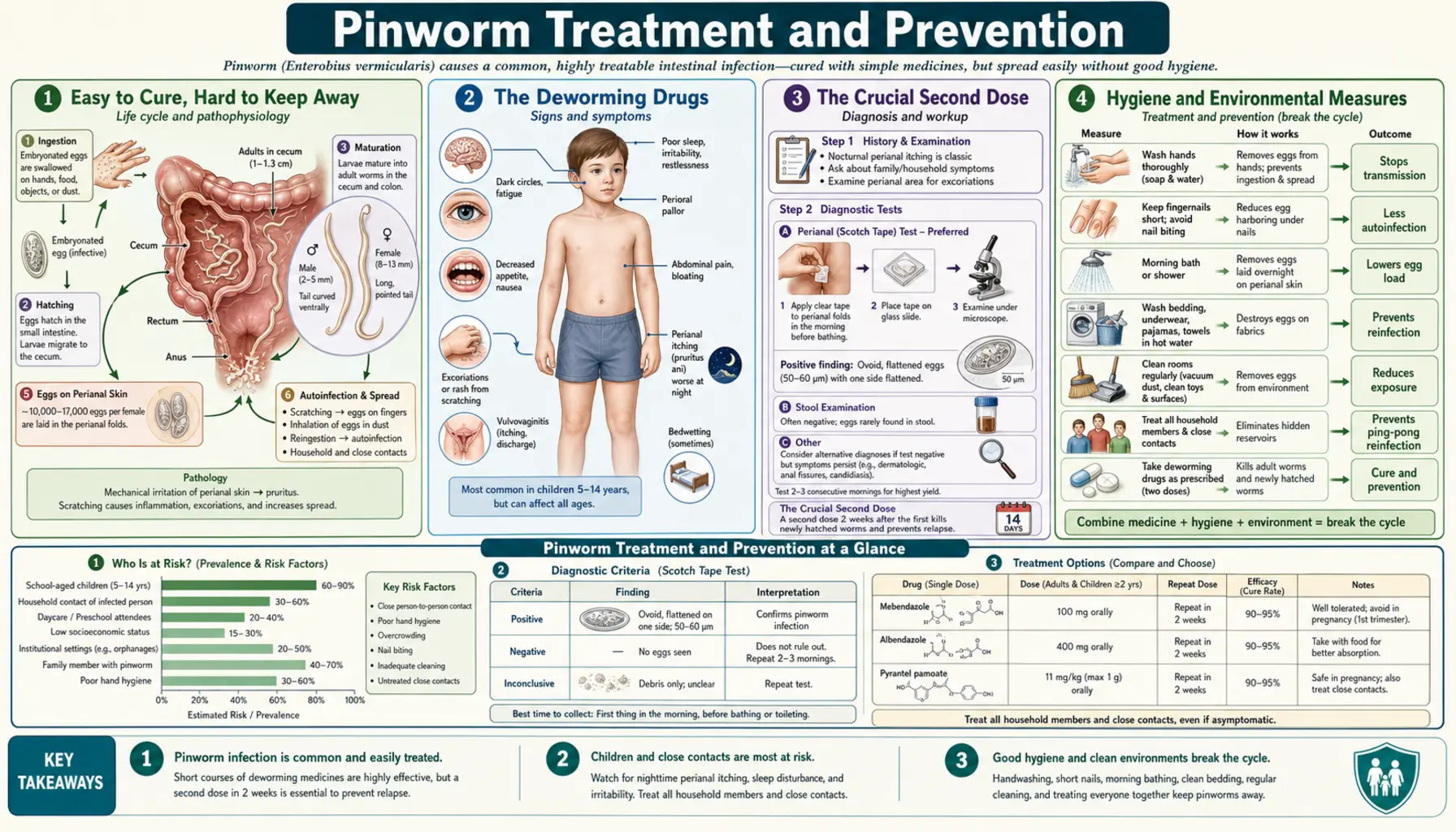
Pinworm (Enterobius vermicularis) is the most common worm infection in the United States (CDC), and a 2005 review describes it as the most common helminth infection in the USA and Western Europe (Burkhart 2005). CDC states that it mainly affects school-aged and preschool-aged children and people in institutional settings, though anyone can get it. CDC describes symptoms as usually mild, with some people having none; the typical symptom is itching around the anus, worse at night, caused by the female worms migrating out to lay their eggs on the surrounding skin while the person sleeps. The worms live in the bowel and do not invade the bloodstream; reviews describe the worm sometimes migrating to other sites, most commonly the female genital tract (Burkhart 2005; Georgiev 2001).
For the adult worms present at the time of treatment, reported cure rates are high (see above). The reputation for persistence comes from the life cycle. The female worms lay their eggs on the perianal skin, and CDC states that two to three hours later the eggs are capable of infecting other people. The eggs are carried — on scratching fingers and under fingernails, on bedclothes, towels and other objects — back to the same person’s mouth or to other people in the home, and a 2005 review also describes inhalation and swallowing of airborne eggs (Burkhart 2005). Swallowed eggs hatch, and about one month passes from swallowing an egg to an adult female laying eggs of her own (CDC DPDx).
This is why sources describe treatment as a two-part strategy: a deworming medicine for the worms that are present, combined with hygiene and environmental measures aimed at the eggs (CDC; Wendt 2019). The sections below take each piece in turn and link to the focused pages that cover the drugs, the hygiene, and the whole-household approach in full detail.
2. The Deworming Drugs
CDC lists three medicines for pinworm. Each is given as a single dose, which CDC’s regimen repeats after two weeks (next section). This is an overview; the doses, how the drugs work, and their side effects are covered in depth on the Pyrantel & Albendazole Treatment page.
- Pyrantel pamoate — the pinworm medicine sold over the counter, without a prescription, in the United States; CDC lists oral suspension, capsules and chewable tablets as its forms. It acts on the worm’s nerve-muscle junctions and paralyzes it, so the worm loses its hold on the gut wall and is passed out in the stool. It is poorly absorbed from the gut, so most of a dose stays in the bowel.
- Mebendazole — a member of the benzimidazole family and a prescription medicine in the United States (CDC); in the United Kingdom it is sold in pharmacies (NHS). CDC lists a 100 mg dose. It binds the worm’s tubulin and cuts the uptake of glucose by the cells lining the worm’s gut; the US labels describe the worm’s energy stores being depleted until it is immobilized and dies. Mebendazole has been used for pinworm for decades.
- Albendazole — a close relative of mebendazole in the same benzimidazole family, also a prescription medicine in the United States, acting by the same mechanism. CDC lists a single 400 mg dose, taken on an empty stomach. A 2000 review reported an overall cure rate of 98% across 27 studies of that dose for pinworm (Horton 2000).
Head-to-head data are limited: a 2019 review notes that no large-scale randomized controlled trials of pinworm treatment are available (Wendt 2019), and a small 2026 randomized trial in children, described on the Pyrantel & Albendazole Treatment page, found no significant difference between the three drugs in reaching remission. Other factors that differ between the drugs are availability without a prescription (pyrantel, in the US), the age limits on their labels, their status in pregnancy, and cost. CDC’s regimen for all three repeats the dose after two weeks, the subject of the next section.
3. The Crucial Second Dose
CDC’s regimen for all three drugs is two doses, the second given two weeks after the first, and CDC describes the second dose as important (CDC clinical overview). The US over-the-counter pyrantel label is worded differently: its directions are a single dose, with the wording “do not repeat treatment unless directed by a doctor” (21 CFR 357.150). So the over-the-counter package describes one dose, and CDC’s two-dose schedule is clinical guidance.
CDC gives the reason: “The medications kill worms but cannot kill eggs. The second dose is important to prevent infection by newly hatched adult worms that were not killed by the first treatment because they were still eggs.” At the time of a first dose, eggs swallowed in the days before and eggs newly laid on the skin are not reached by the medicine. They go on to hatch and grow into new worms, and symptoms can return — which can look as though the first treatment failed, when it cleared the worms that were there.
About one month passes from swallowing an egg to an adult female laying eggs of her own (CDC DPDx). A second dose two weeks after the first falls inside that window: worms that hatched from eggs swallowed around the time of the first treatment have grown to a stage the drug can kill, but have not yet matured enough to lay a new batch of eggs. A 2025 review gives the same drugs as a single dose repeated in two weeks (Leung 2025). The US mebendazole label instead advises a second course if the patient is not cured three weeks after treatment; the differences between CDC’s schedule and the labels are set out on the Pyrantel & Albendazole Treatment page.
4. Hygiene and Environmental Measures
The drugs target the worms; the hygiene measures target the eggs. CDC describes strict hand hygiene, in addition to treatment, as the most effective way to prevent pinworm infection and spread (CDC clinical overview), and states that, if not properly washed or cleaned, pinworm eggs can survive 2–3 weeks on objects (CDC). This is an overview; the full set of measures, the reasoning behind each, and how long sources describe keeping them up are covered on the Hygiene & Preventing Reinfection page.
The CDC prevention page lists these measures:
- Frequent handwashing with soap and warm water — especially after using the toilet, after changing diapers, after touching people who have pinworm or items they have used, and before handling food. Hands carry eggs from the perianal skin to the mouth; CDC calls washing hands with soap and warm water the best way to prevent pinworm infection.
- Fingernails kept clean and short — trimmed and scrubbed after treatment, with no scratching around the anus and no nail-biting. Eggs lodge under the nails during scratching and are swallowed when fingers go to the mouth; a 2020 school survey in Thailand found long fingernails and finger-sucking among the risk factors for infection (Laoraksawong 2020).
- Bathing every morning and changing underwear — which CDC describes as helping remove the eggs deposited overnight. CDC lists a shower instead of a tub bath “because tub water can spread pinworm,” children bathing separately, and no shared or reused washcloths.
- Hot-washing nightclothes, underwear, towels, washcloths and bedding — changed often, handled without shaking, washed in hot water (at least 130°F) and dried in a hot dryer; CDC states that the heat helps kill pinworm eggs. A 2005 review describes inhalation and swallowing of airborne eggs as one route of transmission (Burkhart 2005).
CDC states that it is especially important for everyone in the household to follow these steps for two weeks after the last treatment dose. None of the measures needs special products.
5. Treating the Whole Household at Once
Pinworm infections often occur in more than one person in a household (CDC), and infection passed from one family member to another and back again is sometimes described as “ping-pong” reinfection. This section is an overview; recurring cases — including what sources describe about treating everyone simultaneously and about the eggs in the environment — are covered on the Recurrent Pinworm & the Whole Household page.
Pinworm eggs spread easily among people living together, especially among children sharing bedrooms, bathrooms, and play. Many infected people have no symptoms: CDC’s clinical overview states that most people with the infection have no symptoms or signs, and a 2025 review puts the share without symptoms at about 30–40% (Leung 2025). When one child is diagnosed and treated, household members who are infected without knowing it can continue to shed eggs in the home and reinfect the child who was just treated.
CDC’s patient guidance is to treat everyone in the same household, and caregivers of the person diagnosed, at the same time, with the same two-dose treatment; for facilities and institutions, CDC states that mass and simultaneous treatment, repeated in two weeks, can be effective (CDC clinical overview). The US over-the-counter pyrantel directions likewise call for treating the entire household when one member has pinworms, unless otherwise advised. A 2025 review frames treatment of all household members as something to consider, especially when there are multiple or repeated symptomatic infections, because reinfection is common even when effective medication is given (Leung 2025), and a 2019 review describes involving everyone living in the household, including sexual partners, as a prerequisite to lasting success (Wendt 2019). Simultaneous treatment of family members was the subject of a 1969 study of reinfection in enterobiasis (Matsen 1969).
6. The Autoinfection Cycle That Drives Reinfection
To understand why pinworm is so persistent — and why the two-dose, hygiene-plus-medicine strategy is built the way it is — it helps to see the loop the parasite uses to keep itself going inside a single person. This loop is called autoinfection: self-reinfection, where one person keeps re-seeding their own gut without any new exposure from outside.
The cycle runs like this. Adult female pinworms live in the lower intestine. At night, the females migrate down and out through the anus to lay their eggs on the surrounding perianal skin — and this egg-laying is what causes the hallmark night-time itching. The itch provokes scratching, which loads the eggs onto the fingers and under the fingernails. Then, when the (often sleeping or young) person puts their fingers to their mouth — nail-biting, thumb-sucking, or simply touching food — the eggs are swallowed. The swallowed eggs hatch in the gut, the larvae mature into new adult worms, and those worms migrate down to lay eggs again. Itch, scratch, swallow, repeat — a self-sustaining loop that can keep an infection going indefinitely.
Seeing the loop laid out makes the treatment logic click into place. The night-time itching is not a random symptom; it is the engine of the cycle, the step that moves eggs from skin to fingers. Every element of treatment is aimed at breaking one link in this chain: the medicine removes the adult worms doing the egg-laying; the second dose catches the next generation before it can lay; the morning shower washes away the eggs from the skin before they reach the fingers; handwashing and short nails stop eggs on the fingers from reaching the mouth; and hot-washed bedding removes eggs from the surfaces that would otherwise re-deliver them. Once you can see autoinfection, the whole strategy reads as a deliberate, coordinated attack on a single cycle — which is exactly what it is.
7. Safety in Pregnancy and Young Children
Labels and health agencies treat two groups differently: pregnant women and very young children. What follows is what CDC, US drug labels and reviews state; decisions for any individual belong with a clinician or pharmacist.
In pregnancy, CDC states that the safety of the drugs used to treat pinworm has not been studied in pregnant women, and that if the infection is compromising the pregnancy, treatment can be considered but is to be withheld until the third trimester, when the risk to the fetus, if any, is likely to be reduced (CDC clinical overview). CDC lists all three drugs as pregnancy category C. The US over-the-counter pyrantel label carries a warning against its use during pregnancy unless directed by a doctor. A 2025 review states that pyrantel is preferred to mebendazole and albendazole for pregnant women (Leung 2025); pyrantel pamoate is poorly absorbed from the gut, so little of a dose enters the bloodstream. The US albendazole and mebendazole labels report harmful effects on the fetus in animal studies, while stating that the limited human data have not identified a clear risk of major birth defects or miscarriage; the details are on the Pyrantel & Albendazole Treatment page.
In young children, CDC states that the health risks and benefits of these drugs are for health practitioners and parents to weigh in patients under two years of age. The US over-the-counter pyrantel directions say it is not to be used in children under 2 years or weighing less than 25 pounds unless directed by a doctor; the US mebendazole 100 mg label is approved for patients two years of age and older; and CDC states that the safety of albendazole in children under 6 is not certain, while WHO mass-deworming campaigns give it to children from one year of age.
8. Reassurance: This Is Beatable
It is worth ending where the page began. Discovering worms — in a child, or in oneself — can feel alarming and even shameful, and the frustration of a case that seems to keep returning can make it feel like a problem that will never end; a 2019 review notes that enterobiasis can cause major mental distress (Wendt 2019).
The medical picture is more reassuring. CDC describes the symptoms as usually mild; the complications it lists are red, puffy skin and bacterial skin infection from repeated scratching, and reviews describe the worm sometimes migrating to other sites, most commonly the female genital tract (Burkhart 2005). Pinworm is found across society: a 2001 review states that although infection is more likely in lower socioeconomic groups, it has been reported to affect virtually every level of the general population, especially children (Georgiev 2001), while school surveys link it with personal hygiene habits such as long fingernails and finger-sucking (Laoraksawong 2020) and with socioeconomic status, personal hygiene and sanitary conditions (Wang 2010). And it is curable: a 2019 review concludes that drug treatment along with attention to hygiene can eradicate the infection and prevent recurrence and autoinfection in nearly all cases (Wendt 2019).
In summary, the sources describe pinworm as a common, usually mild infection that responds to medicine, with reinfection rather than the drugs as the main obstacle, and describe a two-part approach — medicine, including the repeat dose CDC gives, together with hygiene. For the specifics, the focused pages — on the deworming drugs, on hygiene and preventing reinfection, and on recurrent pinworm and treating the whole household — carry the detail.
Key Research Papers
Peer-reviewed reviews, clinical studies, and epidemiological surveys on the treatment, reinfection, diagnosis, and complications of pinworm (enterobiasis). Journal names appear as plain text; the DOI or PubMed link at the end of each entry opens the paper. Agency and label sources (CDC, the FDA’s over-the-counter labeling rules) are linked in the text where they are cited.
- Georgiev VS. Chemotherapy of Enterobiasis (Oxyuriasis). Expert Opinion on Pharmacotherapy. 2001;2(2):267–275. — doi:10.1517/14656566.2.2.267
- Cook GC. Enterobius vermicularis Infection. Gut. 1994;35(9):1159–1162. — doi:10.1136/gut.35.9.1159
- Burkhart CN, Burkhart CG. Assessment of Frequency, Transmission, and Genitourinary Complications of Enterobiasis (Pinworms). International Journal of Dermatology. 2005;44(10):837–840. — doi:10.1111/j.1365-4632.2004.02332.x
- Matsen JM, Turner JA. Reinfection in Enterobiasis (Pinworm Infection): Simultaneous Treatment of Family Members. American Journal of Diseases of Children. 1969;118(4):576–581. — doi:10.1001/archpedi.1969.02100040578007
- Keiser J, Utzinger J. Efficacy of Current Drugs Against Soil-Transmitted Helminth Infections: Systematic Review and Meta-Analysis. JAMA. 2008;299(16):1937–1948. (Covers roundworm, hookworm and whipworm; pinworm was not among the infections analysed.) — doi:10.1001/jama.299.16.1937
- Fierlafijn E. Mebendazole in Enterobiasis. JAMA. 1971;218(7):1051. — doi:10.1001/jama.1971.03190200081030
- Singh S, Samantaray JC. Topical Anthelmintic Treatment of Recurrent Genitourinary Enterobiasis. Genitourinary Medicine. 1989;65(4):284–285. — doi:10.1136/sti.65.4.284-a
- McDonald GSA, Hourihane DO'B. Ectopic Enterobius vermicularis. Gut. 1972;13(8):621–626. — doi:10.1136/gut.13.8.621
- Laoraksawong P, Pansuwan P, Krongchon S, et al. Prevalence of Enterobius vermicularis Infections and Associated Risk Factors among Schoolchildren in Nakhon Si Thammarat, Thailand. Tropical Medicine and Health. 2020;48:83. — doi:10.1186/s41182-020-00270-3
- Wang LC, Hwang KP, Chen ER. Enterobius vermicularis Infection in Schoolchildren: A Large-Scale Survey 6 Years after a Population-Based Control. Epidemiology and Infection. 2010;138(1):28–36. — doi:10.1017/S0950268809002660
- Horton J. Albendazole: A Review of Anthelmintic Efficacy and Safety in Humans. Parasitology. 2000;121(Suppl):S113–S132. — PubMed PMID: 11386684
- Wendt S, Trawinski H, Schubert S, Rodloff AC, Mössner J, Lübbert C. The Diagnosis and Treatment of Pinworm Infection. Deutsches Ärzteblatt International. 2019;116(13):213–219. — PubMed PMID: 31064642
- Leung AKC, Lam JM, Barankin B, Wong AHC, Leong KF, Hon KL. Pinworm (Enterobius vermicularis) Infestation: An Updated Review. Current Pediatric Reviews. 2025;21(4):333–347. — PubMed PMID: 38288810
PubMed Topic Searches
Each link opens a live PubMed query so results stay current as new papers are indexed.
- PubMed: Enterobius vermicularis treatment
- PubMed: Pinworm pyrantel pamoate enterobiasis
- PubMed: Mebendazole albendazole enterobiasis cure rate
- PubMed: Enterobiasis reinfection and second dose
- PubMed: Pinworm household and family transmission
- PubMed: Enterobius vermicularis autoinfection life cycle
- PubMed: Pyrantel pamoate pregnancy safety
- PubMed: Enterobiasis children hygiene and prevention
Connections
- All Parasites
- Pinworm Overview
- Symptoms & Diagnosis
- Anal Itching & Sleep Disturbance
- Pinworm in Children & Households
- Complications & Unusual Sites
- Pyrantel & Albendazole Treatment
- Hygiene & Preventing Reinfection
- Recurrent Pinworm & the Whole Household
- Gastroenterology
- Infectious Disease
- All Conditions