Pinworm Complications and Unusual Sites
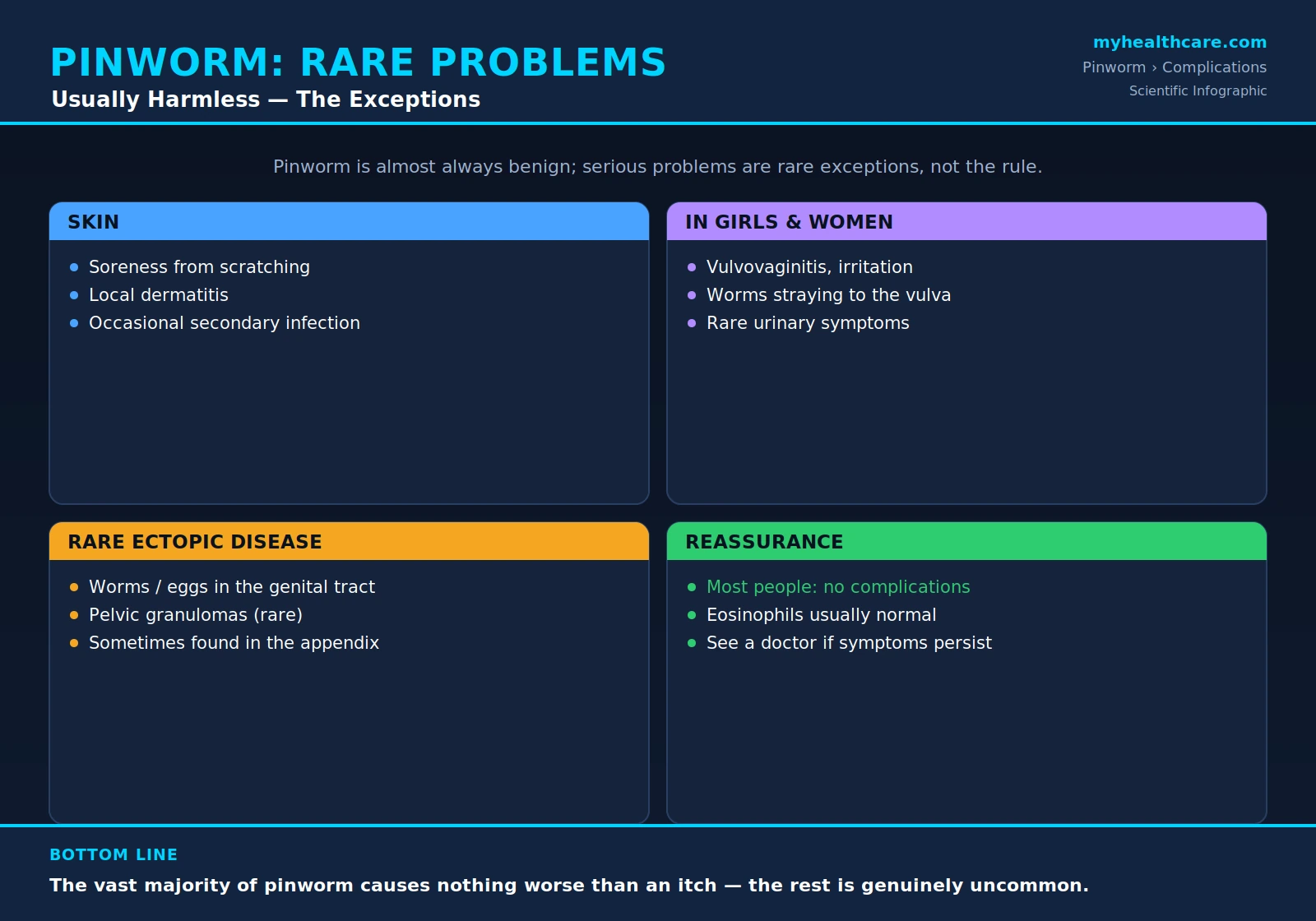
If you or your child has just been diagnosed with pinworm, the single most important thing to know is this: pinworm infection is usually completely harmless. It is the most common worm infection in much of the world, especially among school-age children, and for the overwhelming majority of people it causes nothing worse than an itchy bottom — annoying, sometimes embarrassing, but not dangerous. The pinworm (Enterobius vermicularis) is a tiny, thread-like worm that lives quietly in the lower intestine and does not burrow into tissue or travel through the bloodstream the way some other parasites do. It is easily and reliably cured. This page exists to give an honest, complete picture — including the rare problems that can occasionally arise — but please read it knowing that almost none of these complications will apply to you. They are the uncommon exceptions, described here so the information is complete, not because they are likely.
Table of Contents
- First, the Reassurance: Pinworm Is Usually Benign
- Perianal Skin Problems from Scratching
- In Girls and Women: Vulvovaginitis and Irritation
- Occasional Urinary Symptoms
- Rare Ectopic Disease of the Female Genital Tract
- Pinworms and the Appendix: A Genuine Debate
- Other Very Rare Ectopic Sites
- The Disputed Links to Bedwetting and Disturbed Sleep
- Why Pinworm Usually Does Not Raise the Eosinophil Count
- When Symptoms Warrant Seeing a Doctor
- Key Research Papers
- Featured Videos
1. First, the Reassurance: Pinworm Is Usually Benign
Let us be very clear at the outset, because worry about worms is so common and so out of proportion to the actual risk. In the great majority of cases, pinworm causes no complications at all. Many people who carry pinworm have no symptoms whatsoever and never even know they are infected. Of those who do have symptoms, the usual experience is simple: itching around the anus, most noticeable at night, and perhaps some restlessness in sleep. That is the whole story for almost everyone.
The reason pinworm is so benign comes down to how the worm lives. Unlike the parasites that invade tissue, migrate through the lungs or liver, or feed on blood, the pinworm stays inside the cavity of the intestine. The adult female's only excursion is a brief, harmless nighttime crawl out to the skin around the anus to lay her eggs — which is what causes the itch — before the cycle starts again. The worm does not normally enter the body's tissues, does not normally cause bleeding, and does not normally provoke the kind of body-wide immune reaction that tissue-invading worms do. It is, in the words of clinicians who study it, one of the most innocuous of all the human worm infections, and it is cured by a single, well-tolerated dose of medicine (with a repeat two weeks later). For the everyday symptoms and how the diagnosis is made, see Anal Itching and Sleep Disturbance.
Everything that follows on this page describes the uncommon-to-rare exceptions. They are worth knowing about, because occasionally they explain a symptom that would otherwise be a mystery, and because a few of them — like a worm reaching the female genital tract — are genuinely interesting to doctors. But as you read, keep the proportion in mind: for every person who experiences any of these, there are a great many whose pinworm caused nothing more than an itch.
2. Perianal Skin Problems from Scratching
By far the most common “complication” of pinworm — and really the only one most people will ever encounter — is not caused by the worm itself but by scratching. The intense nighttime itch (medically, pruritus ani) tempts both children and adults to scratch, often in their sleep without realizing it. Repeated scratching can break or inflame the delicate skin around the anus.
This can show up as:
- Excoriation — scratch marks and small raw areas where the skin surface has been rubbed away.
- Local dermatitis — redness, soreness, and inflammation of the perianal skin from the constant irritation.
- Secondary bacterial infection — when broken skin lets ordinary skin bacteria in, an area can become infected, sometimes with weeping, crusting, or increased tenderness. In children especially, scratched perianal skin can develop a superficial bacterial infection (such as perianal streptococcal dermatitis or impetigo-like sores).
The encouraging part is that all of this resolves once the itch is stopped — and the itch stops once the pinworms are cleared. Keeping fingernails short, washing the hands and bottom in the morning, and not scratching all help the skin heal. A secondary bacterial infection may occasionally need a topical or oral antibiotic, but the underlying cause is removed by treating the worms and breaking the scratch–itch cycle. Practical hygiene steps that reduce both the itching and the chance of reinfection are covered on Hygiene and Preventing Reinfection.
3. In Girls and Women: Vulvovaginitis and Irritation
Because the female anatomy places the opening of the vagina close to the anus, pinworms that emerge at night to lay their eggs can sometimes wander the short distance forward to the vulva and into the vagina. When this happens, it can cause vulvovaginitis — irritation, itching, redness, and sometimes a discharge of the vulva and vagina.
This is a recognized and relatively well-known scenario, particularly in young girls, in whom pinworm is actually one of the more common identifiable causes of vulvovaginitis. The picture is usually one of nighttime itching that involves both the bottom and the genital area, sometimes with the parents noticing the child rubbing or complaining of soreness “in front” as well as “behind.” In girls and women, a worm or its eggs found in this area is the explanation for the irritation.
Reassuringly, this kind of vulvovaginitis is almost always a surface irritation caused by the worm's presence and the scratching it provokes — not an invasion of tissue. It resolves with the same standard anti-pinworm treatment that clears the intestinal infection, combined with gentle hygiene. It is not a sexually transmitted infection, and finding pinworm in a child's genital area is a parasitic, not a safeguarding, finding. The relationship between pinworm and girls' vulvovaginitis has been documented for decades, and clinicians evaluating recurrent or unexplained vulvovaginitis in a child will often check for pinworm precisely because it is such a treatable cause.
4. Occasional Urinary Symptoms
Less commonly, the same short nighttime migration can take a worm to the opening of the urethra (the tube that carries urine out), which in women and girls sits just in front of the vagina. A pinworm reaching this area can cause urinary symptoms — a sensation of burning, frequency, urgency, or irritation — that can mimic a urinary tract infection (a worm reaching the urethra). Occasionally, pinworm has been associated with episodes of what looks like recurrent “cystitis” in young girls, especially when urine cultures keep coming back negative.
This is genuinely uncommon, and the symptoms are caused by local irritation at the urethral opening rather than the worm establishing itself inside the urinary tract. The clue is often the combination of urinary discomfort with the more typical nighttime anal and genital itching, and a history of negative urine cultures. As with the other forms of local irritation, it settles with standard pinworm treatment. The general point is simply that, because of where the worm emerges at night, its irritation is not always confined to the anus — in girls and women it can occasionally announce itself as a genital or urinary complaint instead.
5. Rare Ectopic Disease of the Female Genital Tract
Now we move into genuinely rare territory — the kind of thing that makes for an interesting medical case report rather than an everyday occurrence. The word “ectopic” means “in the wrong place.” Ectopic enterobiasis describes the unusual situation in which pinworms or their eggs travel beyond the anus and vulva and reach deeper structures of the female genital tract — the vagina, uterus (womb), fallopian tubes, ovaries, or the pelvic peritoneum (the lining of the pelvic cavity).
When dead worms or eggs lodge in these tissues, the body sometimes walls them off with an inflammatory reaction, forming small nodules called granulomas. A pinworm granuloma might be discovered, for example, on the surface of an ovary or fallopian tube during surgery done for another reason, or on the pelvic lining, where it can look to the surgeon's eye like other conditions (even, on occasion, raising a false worry about something more serious until the tissue is examined under the microscope and the cause is revealed). This is why ectopic enterobiasis is described as a rare cause of pelvic findings — an occasional, unexpected explanation for a nodule, a patch of inflammation, or a granuloma found in the pelvis.
Two points keep this in perspective. First, it is rare: across more than a century of medical literature these are case reports and small series, not common events, even though pinworm itself infects hundreds of millions of people. Second, it is generally not dangerous once recognized — the inflammatory nodules are a reaction to a trapped, often already-dead worm, and the situation is typically resolved by removing or treating the lesion and giving anti-pinworm medication. It does not reflect an aggressive or spreading infection. Still, it is a real phenomenon, and it is the reason pathologists examining pelvic tissue will occasionally identify the unmistakable structure of an Enterobius egg or worm where no one expected one.
6. Pinworms and the Appendix: A Genuine Debate
One of the most discussed questions about pinworm is its relationship to the appendix. It is well established that pinworms are sometimes found inside the appendix when it is removed surgically. In large studies of appendix specimens sent to the laboratory after appendectomy, pinworms turn up in a small but consistent percentage of cases. So the fact that pinworms can be present in the appendix is not in doubt.
What is debated — and it is worth presenting both sides honestly — is whether the pinworm actually causes appendicitis, or whether it is simply an innocent bystander that happened to be living in that part of the gut.
The case that pinworm can cause appendicitis (or appendix-like pain): Some researchers have observed that a worm lodged in the narrow opening of the appendix could block it or irritate its lining, producing the colicky pain of “appendiceal colic” and, in some cases, symptoms that closely mimic acute appendicitis. There are reports of patients with classic appendicitis symptoms whose removed appendix contained pinworms but showed little or no true inflammation — suggesting the worm, rather than infection, drove the symptoms.
The case that pinworm is usually an innocent bystander: On the other hand, many careful studies have compared appendix specimens and found that those containing pinworms are often less likely to show genuine inflammation than worm-free appendices removed for true appendicitis. In other words, when pathologists look closely, the pinworm-containing appendix frequently is not truly inflamed — the worm was simply there. A large cross-sectional study of more than six thousand appendectomy specimens found pinworm in a minority of cases and concluded that its presence was frequently associated with a histologically normal appendix, supporting the “bystander” view rather than a causal one.
The honest, current understanding is a middle ground: pinworm can occasionally provoke appendicitis-like symptoms (and may rarely contribute to true inflammation), but in most cases where it is found in a removed appendix it was an incidental passenger that did not itself cause the disease. This is exactly why it remains a debate rather than a settled fact. The practical message for patients is reassuring: simply having pinworm does not put you at meaningful risk of appendicitis, and the worm is far more often an interesting incidental finding than a culprit.
7. Other Very Rare Ectopic Sites
Beyond the female genital tract and the appendix, the medical literature contains scattered case reports of pinworms or their eggs being found in other unexpected places. These are extraordinarily rare — the rarest of the rare — and are described here only for completeness:
- Peritoneal and abdominal granulomas — just as in the pelvis, worms or eggs that escape the bowel can occasionally provoke small inflammatory nodules on the lining of the abdominal cavity. These have been reported as incidental surgical findings.
- The liver — there are isolated reports of pinworm material reaching the liver and producing a granuloma there, presumably carried via the route that drains the intestine. Such cases are exceptional.
It cannot be stressed enough how unusual these are. Pinworm infects an enormous number of people every year, and these deep ectopic sites account for only a tiny handful of documented cases across the whole of the medical literature. They are mentioned so that the picture is honest and complete — not because they are a realistic concern for anyone with ordinary pinworm. If you have pinworm, the chance that the worm is anywhere other than your lower intestine (and, briefly, the skin around the anus) is vanishingly small.
8. The Disputed Links to Bedwetting and Disturbed Sleep
Two effects often attributed to pinworm sit in a grayer zone, where the evidence is mixed and the truth is probably “sometimes, but not always.”
Disturbed sleep is the more believable of the two. The hallmark of pinworm is itching that is worst at night, when the female worms emerge to lay eggs. It stands to reason that a child kept scratching and uncomfortable in the small hours may sleep poorly, wake frequently, and be irritable or tired the next day. To that extent, sleep disturbance is a genuine and understandable consequence of the nighttime itch — though it is a consequence of the symptom (the itch) rather than any harm from the worm itself, and it resolves when the infection is treated. This is discussed further on Anal Itching and Sleep Disturbance.
Bedwetting (nocturnal enuresis) is more controversial. Pinworm has long been suggested as a contributor to bedwetting in children — the idea being that nighttime genital and urinary irritation, or disturbed sleep, might trigger episodes of wetting. Some studies have reported that treating pinworm improved bedwetting in affected children, while others have found no clear link. The honest position is that pinworm is, at most, an occasional and unproven contributor to bedwetting, not a common cause. Bedwetting in childhood is usually due to other factors entirely (such as a maturing bladder and sleep patterns). It is reasonable for a doctor to check for and treat pinworm in a child with new or persistent bedwetting — it is easy to rule out and easy to cure — but parents should not assume pinworm is the explanation, nor expect that treating worms will reliably stop bedwetting.
9. Why Pinworm Usually Does Not Raise the Eosinophil Count
Here is a point that often surprises people — and it is, in a way, more reassuring evidence of how gentle this infection is. Many worm infections cause the body to raise its level of a particular white blood cell called the eosinophil, a marker the immune system deploys against parasites that invade tissue. A raised eosinophil count (eosinophilia) on a blood test is one of the classic clues that points doctors toward a tissue-invading worm.
Pinworm is different. Because the worm lives in the cavity of the intestine and does not normally invade the body's tissues, it usually does not provoke this immune response — so pinworm infection typically leaves the blood eosinophil count normal. This has two useful implications. First, it underscores just how non-invasive and benign pinworm is compared with worms that burrow through tissue. Second, it means that a normal eosinophil count does not rule pinworm out (the diagnosis is made by finding the eggs or worms, classically with the “tape test” first thing in the morning, not by a blood test), and a raised eosinophil count should prompt a doctor to think about other parasites rather than blaming the pinworm. In the rare ectopic situations described above — where worms or eggs do end up in tissue — a local tissue reaction can occur, but ordinary intestinal pinworm characteristically does not stir up the bloodstream eosinophilia that tissue-invading worms do.
10. When Symptoms Warrant Seeing a Doctor
Because pinworm is so benign and so easily treated, most cases need nothing more than the standard over-the-counter or prescribed deworming medicine (see Pyrantel and Albendazole Treatment) plus good hygiene. But it is worth knowing the handful of situations where a visit to the doctor is sensible — not because pinworm is dangerous, but because these symptoms deserve a proper look:
- Persistent vaginal itching, soreness, or discharge in a girl or woman that does not settle after pinworm treatment — to confirm the cause and rule out other reasons for vulvovaginitis.
- Urinary burning, frequency, or recurrent “bladder infections,” especially in a young girl with negative urine cultures — so the link to pinworm (or another cause) can be sorted out.
- Perianal skin that becomes increasingly red, weepy, crusted, or painful, suggesting a secondary bacterial infection that may need treatment.
- Significant or persistent abdominal pain, particularly pain in the lower right abdomen with fever, nausea, or vomiting — this needs prompt medical assessment to evaluate for appendicitis or another cause, regardless of pinworm.
- Symptoms that keep coming back despite correct treatment of the whole household, which usually means reinfection rather than complications — see Recurrent Pinworm and Whole-Household Treatment.
- An unexpected pinworm finding during surgery or on a tissue sample (for example in the appendix or pelvis) — your doctor can explain what it means; in almost every case it is simply confirmed and treated, and it is not a cause for alarm.
The bottom line remains the one we started with: pinworm is common, harmless for nearly everyone, and reliably cured. The complications and unusual sites on this page are real, but they are the rare exceptions — described so you have the full and honest picture, and so that you know the small set of symptoms worth mentioning to a doctor. For the overall approach to treating and clearing the infection, see the Treatment & Prevention hub.
Key Research Papers
Reviews, cohort and cross-sectional studies, and documented case reports on the complications and unusual (ectopic) sites of pinworm (Enterobius vermicularis) infection. Journal names appear as plain text; the year/volume/pages link opens the full citation via DOI.
- Cook GC. Enterobius vermicularis infection. Gut. 1994;35(9):1159–1162.
- McDonald GSA, Hourihane DO'B. Ectopic Enterobius vermicularis. Gut. 1972;13(8):621–626.
- Burkhart CN, Burkhart CG. Assessment of Frequency, Transmission, and Genitourinary Complications of Enterobiasis (Pinworms). International Journal of Dermatology. 2005;44(10):837–840.
- Abdolrasouli A, Roushan A, Hart J. Enterobius vermicularis Infection of the Female Genital Tract. Sexually Transmitted Infections. 2012;89(1):37.
- Brooks TJ. Pelvic Granuloma Due to Enterobius Vermicularis. JAMA. 1962;179(7):492.
- Erhan Y, Zekioglu O, Ozdemir N, Sen S. Unilateral Salpingitis Due to Enterobius vermicularis. International Journal of Gynecological Pathology. 2000;19(2):188–189.
- Bentick B. Unilateral Salpingitis Due to Enterobius vermicularis. Journal of Obstetrics and Gynaecology. 1986;7(1):71–72.
- Getzlaff CL, Fulghum JT. Enterobius vermicularis (Pinworm) Appendicitis: The Real Vermiform Appendix. Military Medicine. 2024;189(3–4):e894–e896.
- Pirhan Y, Ozen N, Kilinc N, Guckan R. Does the Intestinal Parasite Enterobius vermicularis Cause Acute Appendicitis? Turkish Journal of Parasitology. 2017;41(2):76–79.
- Pogorelic Z, Babic I, Baskovic M, Ercegovic V, Mrklic I. Management and Incidence of Enterobius vermicularis Infestation in Appendectomy Specimens: A Cross-Sectional Study of 6359 Appendectomies. Journal of Clinical Medicine. 2024;13(11):3198.
Live PubMed Searches
Each link opens a live PubMed query so results stay current as new papers are indexed.
- Enterobius vermicularis complications
- Ectopic enterobiasis
- Enterobius vermicularis female genital tract
- Enterobius vermicularis appendicitis
- Pinworm vulvovaginitis in children
- Enterobius vermicularis urinary tract
- Enterobius granuloma (peritoneal)
- Pinworm, enuresis and sleep
Connections
- All Parasites
- Pinworm Overview
- Pinworm Symptoms & Diagnosis
- Anal Itching and Sleep Disturbance
- Pinworm in Children and Households
- Treatment & Prevention
- Pyrantel and Albendazole Treatment
- Hygiene and Preventing Reinfection
- Recurrent Pinworm and Whole-Household Treatment
- Gastroenterology
- Infectious Disease
- All Conditions