Recurrent Pinworm and Whole-Household Treatment
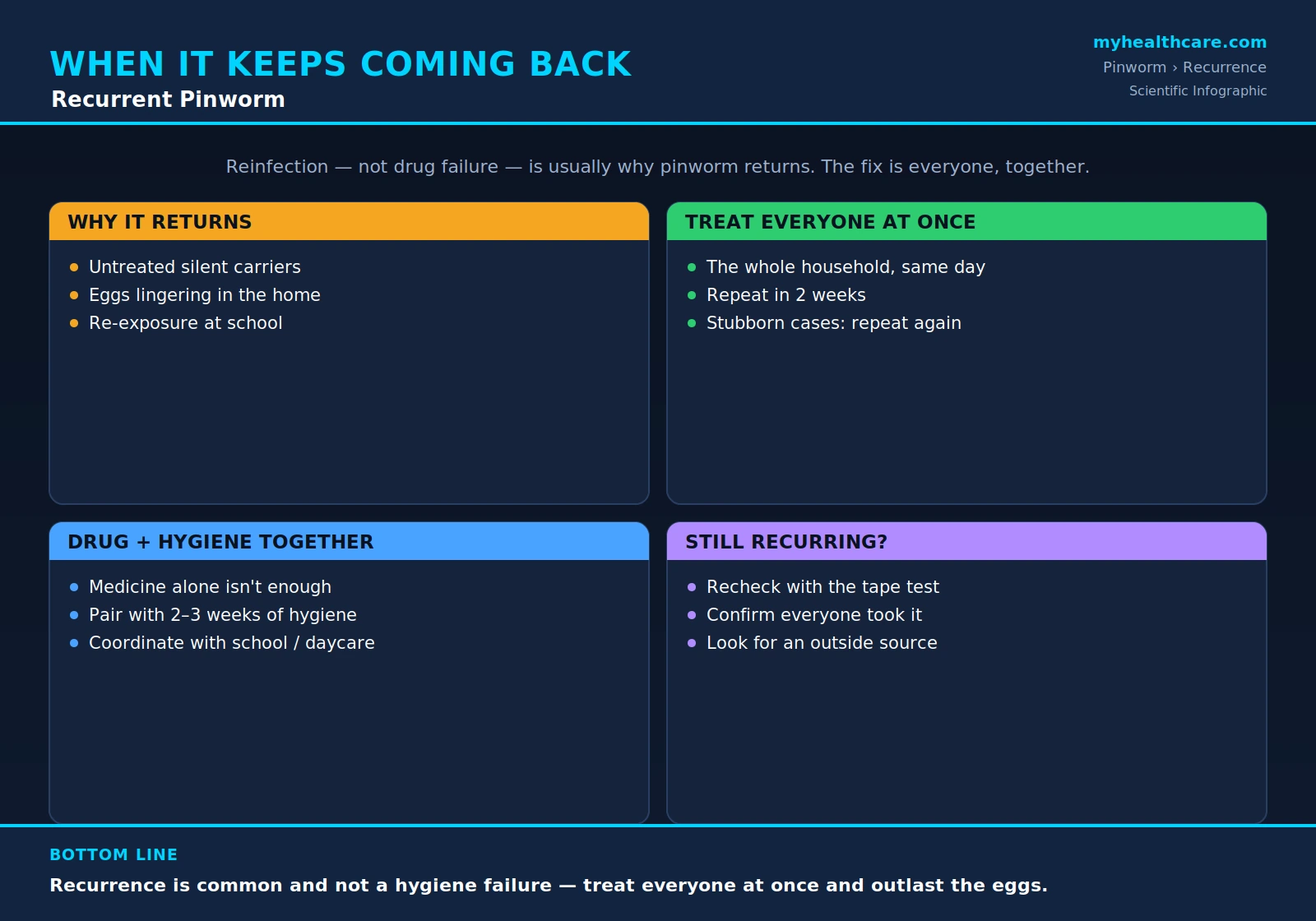
If you have treated a child for pinworm — followed every instruction, given the medicine, washed the sheets — only to find the itching and the squirming worms back a few weeks later, please hear this first: you have done nothing wrong. Recurrent pinworm is one of the most common parasitic experiences in the world, and it is not a sign of a dirty house, neglectful parenting, or poor hygiene. Pinworm comes back for very ordinary, very fixable reasons — usually because someone in the home was carrying it silently, because microscopic eggs lingered in the environment, or because the medicine (which does not kill eggs) needed a second dose that was never given. This page explains exactly why pinworm recurs, why the answer is to treat everyone in the household at the same time rather than just the child who itches, how the two-dose strategy works, and what to do when it still keeps coming back. The good news is that recurrent pinworm is almost always curable once the cycle is understood and broken properly. For the specific drug doses, see Pyrantel and Albendazole Treatment; for the cleaning routine that runs alongside, see Hygiene and Preventing Reinfection.
Table of Contents
- Why Pinworm Keeps Coming Back
- Silent Carriers in the Household
- Why Treat the Whole Household at Once
- The Two-Dose Strategy
- Combining Treatment With Sustained Hygiene
- Classrooms, Daycare, and Institutional Outbreaks
- When It Still Keeps Coming Back
- The Emotional Toll — and Real Reassurance
- When Longer or Repeated Courses Are Needed
- Key Research Papers
- Featured Videos
1. Why Pinworm Keeps Coming Back
To understand recurrence, it helps to picture the pinworm's life cycle. The adult female worm lives in the large intestine, and at night she crawls out through the anus to lay thousands of sticky, microscopic eggs on the surrounding skin. Those eggs become infectious within just a few hours. When they are scratched up onto the fingers — especially under the fingernails — they are then swallowed (often by carrying hand to mouth without anyone noticing), and the cycle begins again. The eggs can also drift onto bedding, underwear, towels, toys, carpets, and bathroom surfaces, where they can survive for around two to three weeks.
Recurrence almost always comes down to one or more of four ordinary causes:
- Untreated household members carrying it silently. Pinworm spreads easily between people who share a home. Other family members — including adults — may carry the worms without any itching at all, and quietly reinfect everyone else. This is the single most common reason a treated child gets pinworm again.
- Eggs persisting in the home environment. Because the eggs survive for weeks on surfaces and fabrics, a person who is cured of their worms can swallow leftover eggs from the bed, the bathroom, or a toy and become reinfected from the environment itself.
- Ongoing autoinfection from scratching. The eggs cause intense nighttime itching. A child who scratches collects eggs under the fingernails and re-swallows them, reinfecting themselves over and over — a self-renewing loop that a single dose of medicine cannot stop, because new eggs keep arriving.
- Re-exposure at school or daycare. Pinworm circulates readily in groups of young children who share spaces, toys, and bathrooms. A child can be fully cured at home and then simply pick the parasite up again from a classmate the following week.
Notice that none of these causes is a moral failing. They are the predictable mechanics of a parasite that is exquisitely adapted to spread between humans, particularly children. Once you see recurrence as a cycle rather than a personal failure, the path to breaking it becomes clear.
2. Silent Carriers in the Household
The idea of a “silent carrier” is the key that unlocks most stubborn cases, so it deserves a section of its own. Pinworm infection often produces no symptoms whatsoever. A great many infected people — by some estimates a substantial fraction of those who carry the worms — never itch, never notice anything, and would be astonished to learn they harbor the parasite. Surveys of households and child-care settings repeatedly find that when one person tests positive, others in the same home frequently test positive too, even though they feel perfectly fine.
This matters enormously for recurrence. Imagine a family where a five-year-old itches at night and is diagnosed with pinworm. The parents treat the child, clean the room, and breathe a sigh of relief. But if an older sibling, a parent, or a grandparent in the same home was also carrying pinworm without symptoms, that untreated carrier keeps shedding eggs — onto shared bedding, bathroom surfaces, and hands — and within a couple of weeks the “cured” child is reinfected. From the outside it looks like the treatment failed. In reality the treatment worked perfectly on the child; the problem was the untreated person standing right next to them.
This is exactly why testing or symptoms in a single household member is not a reliable guide to who is infected. You cannot tell by looking, and you often cannot tell by asking. The only dependable way to clear a household reservoir is to assume that anyone living together may be carrying it and to treat accordingly — which leads directly to the next, central principle.
3. Why Treat the Whole Household at Once
The most important single message of this page is this: to reliably clear recurrent pinworm, treat everyone in the household at the same time — not just the child who has symptoms.
The logic follows directly from silent carriers. If you treat only the symptomatic child, you eliminate the worms in that one person but leave the household reservoir intact. Any silent carrier in the home continues to shed eggs and simply reinfects the child you just cured. Treating one person while others remain infected is like bailing water out of a boat that still has a hole in it. By contrast, when everyone takes the medicine on the same day, all the worms in all the people are cleared together, the reservoir collapses, and there is no longer a silent carrier left behind to restart the cycle.
Who counts as “the household”? In practice, this means everyone who regularly sleeps in or shares the home: all the children, both parents, any other adults, and grandparents or relatives living under the same roof. Many clinicians extend the same logic to close, frequent contacts — a child who sleeps over often, or a caregiver who is in the home daily. The guiding principle is simple: if a person shares the living space and its surfaces, they share the egg pool, and they should be treated with the rest of the group.
The deworming medicines used for pinworm are well tolerated and available without a prescription in many countries, which makes simultaneous family treatment practical. (Pregnancy and very young children are the usual exceptions that need individual medical advice — see the drug details on the Pyrantel and Albendazole Treatment page.) But the strategic point stands regardless of which drug is chosen: treating the whole household at the same time is what turns a recurring nuisance into a one-time cure.
4. The Two-Dose Strategy
The second pillar of breaking the cycle is timing. The deworming drugs used for pinworm — pyrantel pamoate, mebendazole, and albendazole — are highly effective at killing the adult worms, but they do not kill the eggs. This single fact explains why a one-and-done dose so often fails.
Here is why. When you give the first dose, it wipes out the adult worms living in the gut at that moment. But there are almost always eggs that were swallowed shortly before the dose — on the hands, in the environment — that the medicine cannot touch. Those eggs hatch and mature into new adult worms over roughly the following two to four weeks. If no second dose is given, those newly matured worms begin laying eggs again, and the infection appears to come right back.
The solution is built into the standard treatment: give a dose to everyone, then repeat the same dose for everyone about two weeks later. The first dose clears the adults present today; the second dose, timed about two weeks out, kills the new crop of worms that have since matured from leftover eggs — before they can lay a fresh generation. This two-dose schedule, with both doses given to the whole household, is the core regimen for clearing pinworm and is the reason a properly executed course succeeds where a single pill fails.
For especially stubborn or repeatedly recurring cases, clinicians sometimes extend this into a series of doses at roughly two-week intervals — for example three doses spaced two weeks apart — to repeatedly mop up each successive generation of worms emerging from any eggs that survived in the environment. The principle is the same as the two-dose plan, just carried through additional cycles to outlast a persistent egg reservoir. The exact drugs, doses, and intervals are covered on the Pyrantel and Albendazole Treatment page; the strategic takeaway here is that one dose is rarely enough — plan from the start to repeat it.
5. Combining Treatment With Sustained Hygiene
Medicine kills the worms inside people; hygiene removes the eggs from the environment. Recurrent pinworm is cleared most reliably when the two are done together — simultaneous household treatment plus a rigorous, sustained cleaning routine maintained for a couple of weeks around the doses. Doing one without the other leaves a gap the parasite slips through: treat without cleaning and people re-swallow eggs from surfaces; clean without treating and silent carriers keep replenishing the supply.
The hygiene measures that matter most all aim at the same goal — stopping eggs from traveling from the skin back to the mouth, and stripping eggs out of the surroundings before they can be picked up. In brief, this means:
- Frequent, thorough handwashing — especially in the morning (eggs are laid overnight), after using the toilet, and before every meal.
- Keeping fingernails short and discouraging nail-biting and scratching, since the area under the nails is where eggs collect and travel.
- A morning shower or bath to wash away the eggs laid around the anus during the night, before they can be spread.
- Washing bedding, underwear, pajamas, and towels in hot water, particularly on the mornings of the treatment days — and not shaking these items out, which can scatter eggs into the air.
- Wiping down bathroom surfaces and toys, and damp-dusting or vacuuming rather than dry-sweeping, which can aerosolize eggs.
Crucially, this routine should be kept up for about two to three weeks — long enough to outlast the lifespan of any eggs already in the home. A single big clean on the day of treatment is not enough, because eggs survive for weeks and new ones can be deposited before the medicine and the two-dose schedule have finished their work. The complete, step-by-step hygiene plan — including how long to sustain it and which surfaces to prioritize — is on the Hygiene and Preventing Reinfection page. Think of treatment and hygiene as the two blades of a pair of scissors: each one alone barely cuts, but together they snip the cycle cleanly.
6. Classrooms, Daycare, and Institutional Outbreaks
Pinworm thrives wherever young children are gathered closely together, so schools, preschools, and daycare centers are classic settings for ongoing transmission — and a major reason a child cured at home keeps getting reinfected. Within these settings, eggs pass easily by way of shared toys, surfaces, bathrooms, and direct hand-to-hand contact, and a single untreated, symptomless child can keep seeding the whole group.
Managing an outbreak in a group setting follows the same household logic, just scaled up. The most effective approach is coordinated, simultaneous treatment of the affected group — rather than treating one child at a time as each is noticed — combined with intensified environmental cleaning of the shared space. Studies of enterobiasis in closed and semi-closed institutions, such as residential developmental centers, have shown that piecemeal treatment fails to control the problem, whereas coordinated group treatment together with environmental measures can bring an entrenched outbreak under control. The same finding holds, on a smaller scale, in family child-care and classroom clusters: synchronize the treatment, clean the environment, and the chain of transmission breaks.
In practice, this often means working with the daycare, school, or institution rather than fighting the problem from home alone. Informing the facility, encouraging affected families to treat their households together on a coordinated timeline, and supporting good handwashing and cleaning routines on site are what stop a group outbreak from endlessly re-infecting the individuals within it. A child whose own family treats diligently but who returns each day to an untreated outbreak is fighting an unwinnable battle — which is, once again, not a failure of that family's effort, but a feature of how the parasite moves through a community.
7. When It Still Keeps Coming Back
Sometimes a family does everything right — whole-household treatment, the second dose, weeks of careful hygiene — and pinworm still returns. This is frustrating and exhausting, but it is rarely mysterious. When recurrence persists despite a proper effort, three checks usually find the gap:
- Recheck the diagnosis with the tape test. Make sure what is recurring is actually pinworm. The standard confirmation is the adhesive-tape (cellophane-tape) test: first thing in the morning, before bathing or using the toilet, a piece of clear tape is pressed against the skin around the anus and then examined under a microscope for the characteristic eggs. Because the worms lay eggs intermittently, a single negative test does not rule pinworm out — repeating the tape test on several consecutive mornings greatly improves the chance of catching it. Confirming the diagnosis also guards against mistaking another cause of nighttime anal itching for pinworm.
- Confirm that everyone actually took the medicine. A surprising amount of “treatment failure” is really a dose that was skipped, forgotten, spat out by a reluctant toddler, or quietly declined by an adult who felt fine and saw no reason to take a pill. Verify that every household member took both doses on schedule. One missed person or one missed second dose is enough to keep the whole cycle alive.
- Look for an outside source. If the household is genuinely clear, the reinfection is coming from outside it — most often an ongoing exposure at school or daycare, at a relative's or friend's home where the child stays regularly, or another close-contact setting. Identifying and addressing that external reservoir (see the institutional section above) is what finally closes the loop.
Working through these three checks — is it really pinworm, did everyone truly take both doses, and where is the outside source — resolves the large majority of seemingly “unbreakable” recurrences. Persistent recurrence is a sign that one link in the chain is still intact, not that the parasite is invincible.
8. The Emotional Toll — and Real Reassurance
It is worth naming what families rarely say out loud: recurrent pinworm can carry real shame. Parents often feel that worms coming back means their home is dirty, that they have failed to protect their child, or that others will judge them. Children old enough to understand can feel embarrassed or “gross.” The nighttime itching disrupts sleep for the whole family, and the cycle of treat-clean-relapse-repeat is genuinely demoralizing.
So let this be stated as plainly and firmly as possible: recurrent pinworm is extremely common, and it is not a sign of a dirty home, poor hygiene, or bad parenting. Pinworm is among the most widespread human parasitic infections in the world, present in clean homes and careful families everywhere — it is, by some measures, the most common worm infection in many high-income countries, concentrated in exactly the place it is hardest to police: young children who put their hands in their mouths. The eggs are microscopic, they survive for weeks, they spread before anyone has symptoms, and the medicine does not kill them — which is precisely why recurrence is the rule rather than the exception until the full strategy is applied. None of that reflects on a family's cleanliness or care.
If anything, a family fighting recurrent pinworm is usually a family paying more attention to hygiene than most, not less. The recurrence is a property of the parasite, not a verdict on the household. Understanding the cycle — silent carriers, surviving eggs, the need to treat everyone twice — transforms the experience from a source of self-blame into a solvable problem with clear steps. You are not failing. You are dealing with one of the most ordinary infections of childhood, and it can be beaten.
9. When Longer or Repeated Courses Are Needed
In a minority of cases — densely shared housing, institutional settings, families that simply cannot interrupt re-exposure, or individuals with unusually persistent infection — the standard two-dose household approach may need to be extended into a longer or repeated course of treatment. As noted earlier, this can take the form of three or more doses spaced about two weeks apart, sometimes maintained over a couple of months, each round mopping up the latest generation of worms while sustained hygiene grinds down the environmental egg supply.
These extended or repeated regimens should be undertaken under medical guidance. A clinician can confirm the diagnosis, choose the appropriate drug and schedule for the people involved (taking account of age, pregnancy, and any other conditions), coordinate treatment across a household or institution, and rule out other explanations for stubborn symptoms. Self-directed escalation — taking more and more medicine without confirming that pinworm is truly the cause or that the whole reservoir is being addressed — is both less effective and unnecessary when a doctor or pharmacist can help target the effort.
The reassuring bottom line remains: even the most persistent recurrent pinworm is curable. It is not a dangerous infection, it does not cause lasting harm in the vast majority of people, and with the right combination — whole-household treatment, repeated dosing at the proper intervals, sustained hygiene, attention to outside sources, and a clinician's help when needed — the cycle can be broken for good. For the broader picture of management and prevention, see the Treatment & Prevention hub and the Pinworm Overview.
Key Research Papers
Peer-reviewed reviews, treatment analyses, and epidemiological studies on the recurrence, household transmission, and management of pinworm (enterobiasis). Journal names appear as plain text; the year/volume/pages link opens the full citation via DOI.
- St Georgiev V. Chemotherapy of Enterobiasis (Oxyuriasis). Expert Opinion on Pharmacotherapy. 2001;2(2):267–275.
- Cook GC. Enterobius vermicularis Infection. Gut. 1994;35(9):1159–1162.
- Lohiya GS, Tan-Figueroa L, Crinella FM, Lohiya S. Epidemiology and Control of Enterobiasis in a Developmental Center. Western Journal of Medicine. 2000;172(5):305–308.
- Song HJ, Cho CH, Kim JS, Choi MH, Hong ST. Prevalence and Risk Factors for Enterobiasis among Preschool Children in a Metropolitan City in Korea. Parasitology Research. 2003;91(1):46–50.
- Kang S, Jeon HK, Eom KS, Park JK. Egg Positive Rate of Enterobius vermicularis among Preschool Children in Cheongju, Chungcheongbuk-do, Korea. The Korean Journal of Parasitology. 2006;44(3):247–249.
- Sinniah B, Sinniah D, Rajeswari B. Prevalence, Treatment and Reinfection of Intestinal Helminths among Schoolchildren. Public Health. 1984;98(1):38–42.
- Van Riper G. Pyrantel Pamoate for Pinworm Infestation. American Pharmacy. 1993;33(2):43–46.
- Getzlaff JR, Fulghum GH. Enterobius vermicularis (Pinworm) Appendicitis: The Real Vermiform Appendix. Military Medicine. 2024;189(3–4):e894–e896.
- Tariq S, Rafique R. Enterobiasis: Threadworm Infection Presenting as Acute Appendicitis in a 13-Year-Old Girl. BMJ Case Reports. 2015;2015:bcr2014208543.
- Pullan RL, Smith JL, Jasrasaria R, Brooker SJ. Global Numbers of Infection and Disease Burden of Soil Transmitted Helminth Infections in 2010. Parasites & Vectors. 2014;7:37.
- Chen J, Gong Y, Chen Q, Li S, Zhou Y. Global Burden of Soil-Transmitted Helminth Infections, 1990–2021. Infectious Diseases of Poverty. 2024;13(1):77.
Live PubMed Searches
Each link opens a live PubMed query so results stay current as new papers are indexed.
- Enterobius vermicularis recurrence
- Enterobiasis household and family transmission
- Pinworm treatment: mebendazole, albendazole, pyrantel
- Enterobius vermicularis reinfection and autoinfection
- Enterobiasis in daycare and kindergarten children
- Enterobius vermicularis institutional outbreak control
- Enterobiasis cellophane-tape test diagnosis
- Enterobiasis mass treatment and control
Connections
- All Parasites
- Pinworm Overview
- Symptoms & Diagnosis
- Anal Itching & Sleep Disturbance
- Pinworm in Children & Households
- Complications & Unusual Sites
- Treatment & Prevention
- Pyrantel & Albendazole Treatment
- Hygiene & Preventing Reinfection
- Gastroenterology
- Infectious Disease
- All Conditions