Pinworm Treatment: Pyrantel, Mebendazole, and Albendazole
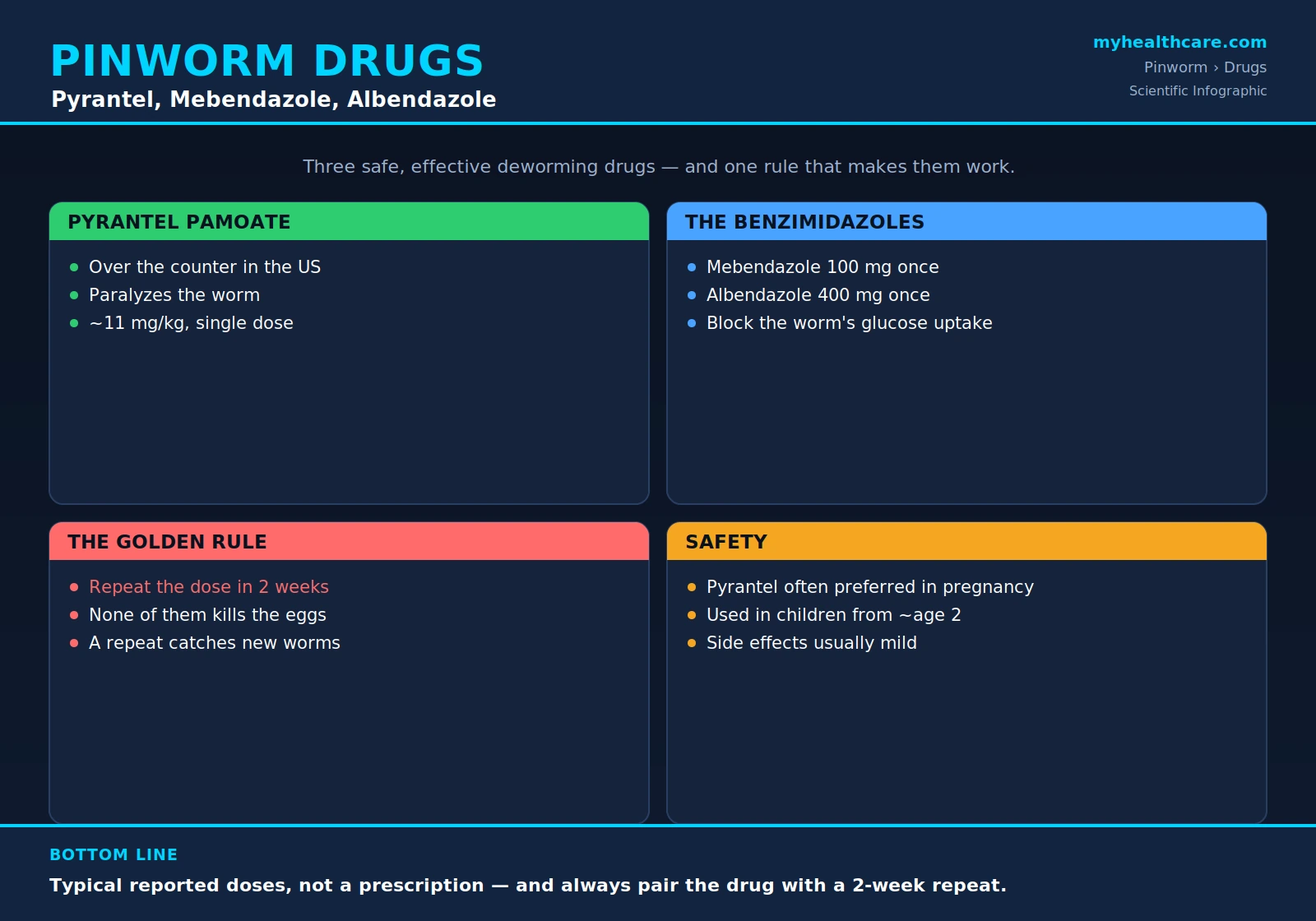
Pinworm (caused by the small white roundworm Enterobius vermicularis) is one of the easiest of all human worm infections to cure with medicine. Three drugs do almost all of the work: pyrantel pamoate, which you can buy without a prescription in many countries including the United States, and two closely related prescription drugs from the benzimidazole family, mebendazole and albendazole. A single dose of any one of them clears the great majority of the worms living in the bowel at that moment. But there is one rule that matters more than which drug you choose, and it is the part people most often get wrong: you almost always have to take a second dose about two weeks later, because none of these medicines kills the eggs — and in pinworm, the eggs are how the infection comes straight back. This page explains how each drug works, how well it works, why the repeat dose is the single most important step, why the whole household is usually treated together, and what is known about safety in pregnancy and in young children. The information here describes treatment as reported in the medical literature; the doses shown are typical reported ranges, not a prescription, and actual treatment is directed by a clinician or pharmacist.
Table of Contents
- Pyrantel Pamoate — The Over-the-Counter Option
- Mebendazole — A Benzimidazole
- Albendazole — A Benzimidazole
- How the Benzimidazoles Work
- How Effective Are They?
- The Most Important Point: Repeat the Dose
- Treat the Whole Household at Once
- Safety: Pregnancy and Young Children
- Why Drugs Alone Fail Without Hygiene
- Key Research Papers
- Featured Videos
1. Pyrantel Pamoate — The Over-the-Counter Option
Pyrantel pamoate is the one pinworm medicine you can usually buy over the counter in the United States, without a prescription, sold as a liquid suspension or chewable tablets specifically labeled for pinworm. That accessibility makes it the drug many families reach for first, especially late at night when a child's itching makes the diagnosis obvious.
Pyrantel works in a clever way that is the near-opposite of how the benzimidazoles work. It is a depolarizing neuromuscular blocker — it floods the worm's nerve-muscle junctions with a steady "on" signal, much as the parasite's own messenger acetylcholine would, but without letting up. The result is a sudden, sustained spastic (rigid) paralysis: the worm's muscles seize up, it can no longer grip the wall of the gut, and it is swept along and passed out of the body in the stool, still alive. Because pyrantel acts on the worm's nervous system rather than on its energy supply, it works quickly. Importantly, pyrantel is very poorly absorbed from the human gut — most of the dose stays in the bowel exactly where the worms are, which is one reason it tends to be gentle on the person taking it.
The typical reported dose is a single dose of about 11 mg/kg of body weight (based on the pyrantel base), usually capped at a maximum of around 1 gram, given by mouth. As with all of these drugs, the dose should be repeated in about two weeks (see the repeat-dose section). Side effects are generally mild and uncommon — occasional nausea, stomach cramps, or headache.
2. Mebendazole — A Benzimidazole
Mebendazole is one of the two benzimidazole drugs used against pinworm and has long been a classic, well-studied choice. Unlike pyrantel, it is typically a prescription medicine (its availability over the counter varies by country and has changed over time). It belongs to the same chemical family as albendazole and shares the same fundamental way of attacking the worm, described in the mechanism section below.
The typical reported regimen for pinworm is a single 100 mg dose by mouth, taken by adults and children alike. The tablet can often be chewed, swallowed whole, or crushed and mixed with food, which makes it practical for young children. As with every pinworm drug, the single dose is repeated about two weeks later to deal with the eggs the first dose could not touch.
Because mebendazole is poorly absorbed from the gut into the bloodstream, it concentrates in the bowel where the worms live and is generally very well tolerated. Reported side effects are usually mild and short-lived — mostly minor abdominal discomfort or, rarely, diarrhea.
3. Albendazole — A Benzimidazole
Albendazole is the other benzimidazole, a close chemical cousin of mebendazole and, worldwide, one of the most widely used of all deworming drugs. Like mebendazole it is generally a prescription medicine, and it works by the same mechanism — binding the worm's structural protein and shutting down its ability to feed.
The typical reported dose for pinworm is a single 400 mg dose by mouth for adults and older children (lower weight-based doses are used in young children — see the safety section). Once again, that single dose is repeated in about two weeks.
Albendazole is somewhat better absorbed than mebendazole, especially when taken with a fatty meal, which is part of why it is so useful against worms that live in body tissues rather than just the gut. For pinworm — a purely intestinal infection — that extra absorption is not really needed, but it does mean albendazole is a versatile, dependable choice. Side effects from a single pinworm dose are generally mild: mostly transient stomach upset or headache.
4. How the Benzimidazoles Work
Mebendazole and albendazole are both benzimidazoles, and understanding their shared mechanism explains both why they are so effective and why they take a little longer to act than pyrantel.
Every cell — in a worm as in a person — relies on tiny internal scaffolding tubes called microtubules, which are built from a protein called tubulin. Microtubules are constantly being assembled and disassembled; they form the worm's internal skeleton, move materials around inside its cells, and are essential to how the lining of the worm's gut absorbs food. Benzimidazoles work by binding selectively to the worm's β-tubulin (beta-tubulin) and jamming this machinery: they stop the tubulin building-blocks from snapping together into microtubules, so the scaffolding falls apart and cannot be rebuilt.
The critical consequence plays out in the cells lining the worm's intestine. With their microtubules disrupted, those cells lose the structures (and the membrane transporters carried on them) that the worm uses to take in glucose — its sugar fuel. In effect, the benzimidazoles block the worm's glucose uptake. The worm cannot absorb sugar, its energy (glycogen) reserves are gradually exhausted, and over a period of days the parasite quietly starves, becomes immobilized, and dies. This is why benzimidazoles do not paralyze the worm in minutes the way pyrantel does — they kill it slowly by cutting off its food supply.
A key reason these drugs are safe for people is selectivity: benzimidazoles bind the worm's β-tubulin with far greater affinity than they bind the equivalent human protein. The drug fits the parasite's tubulin like a wrench thrown into its gears while largely leaving the host's own machinery alone — the foundation of the wide safety margin these medicines have shown in decades of use.
5. How Effective Are They?
For the worms that are actually present in the gut at the time you take the medicine, all three drugs are highly effective, with cure rates for pinworm reported in the high percentages — commonly in the range of roughly 90% or better from a single dose. In practical terms, one dose of pyrantel, mebendazole, or albendazole clears the great majority of adult pinworms living in the bowel.
Head-to-head, the three are broadly comparable for this particular infection, and the choice between them is usually driven less by raw potency than by practical factors — which one is available over the counter (pyrantel), which is easiest to give to a small child, cost, and a clinician's preference. Pinworm has not shown the kind of widespread drug resistance that complicates some other worm infections, so these medicines have remained reliably effective.
The crucial caveat is built into that phrase — "the worms that are present at the time you take the medicine." High cure rates describe the drug's effect on existing adult worms in a single round. They say nothing about the eggs, and in pinworm the eggs are the whole problem, which is why the next section is the most important on this page.
6. The Most Important Point: Repeat the Dose
If you remember only one thing about treating pinworm, remember this: take a second dose about two weeks after the first. This single step is the difference between a cure and an endlessly recurring, frustrating infection — and it is the part people skip most often, because that first dose makes the itching go away and the problem seems solved.
Here is why the repeat dose is non-negotiable. None of these drugs — not pyrantel, not mebendazole, not albendazole — reliably kills pinworm eggs. They are excellent at killing or expelling the adult worms, but the eggs are tough and resistant. In the days around the time of the first dose, a person can easily swallow pinworm eggs — from their own fingers, from bedding, from surfaces around the home — and those eggs ride out the medicine completely unharmed. About two to four weeks later, those swallowed eggs hatch and grow into a fresh crop of adult worms in the gut. The first dose never touched them, because they were still inside their eggshells when it came and went.
The second dose, given roughly two weeks after the first, is timed to catch exactly this new generation: the worms that have since hatched from eggs swallowed around the time of the first treatment, now grown into adults that the drug can kill, but before they have matured enough to lay a new batch of eggs and restart the whole cycle. The repeat dose closes the loop that the eggs would otherwise keep open.
Skipping the second dose is the single most common reason pinworm "comes back." It usually did not come back — it was never fully cleared, because the eggs that were always going to hatch were given a free pass. Both the over-the-counter pyrantel products and the prescription benzimidazoles are intended to be used this way: one dose now, the same dose again in about two weeks.
7. Treat the Whole Household at Once
Pinworm is rarely a problem for just one person. The eggs spread with extraordinary ease — from itchy scratching to fingers to shared surfaces, towels, bedding, bathrooms, and toys — so by the time one family member is diagnosed, others are very often quietly infected too, even if they have no symptoms at all. Many infected people, especially adults, carry pinworms without ever noticing.
For that reason, the standard advice is to treat everyone in the household at the same time, on the same days, with the same two-dose schedule. If only the child with obvious itching is treated, an untreated, symptom-free parent or sibling can simply re-seed the infection within days, and the family ends up trapped in a cycle of one person after another testing the medicine while the worms keep circulating between them. Simultaneous whole-household treatment — both the first dose and the two-week repeat — breaks that ring of reinfection. This is important enough that it has its own page: see Recurrent Pinworm and Whole-Household Treatment.
8. Safety: Pregnancy and Young Children
These are among the safest medicines used in human deworming, but the right choice differs a little for two groups: pregnant women and very young children. As always, these are general patterns reported in the medical literature; the decision for any individual is made with a clinician or pharmacist who knows the specific situation.
In pregnancy. Pinworm itself is a nuisance rather than a danger to a pregnancy, and clinicians often note that because the infection is so harmless, the simplest and safest first step in pregnancy is frequently to rely on hygiene measures alone and, if medicine is used, to be thoughtful about timing and choice. When a drug is considered, pyrantel pamoate is often the preferred option in pregnancy, in part because it is so poorly absorbed from the gut that very little reaches the rest of the body. The benzimidazoles (mebendazole and albendazole) are generally avoided in pregnancy, especially during the first trimester, reflecting long-standing caution and animal data; later in pregnancy they are sometimes used when clearly needed. Reassuringly, follow-up studies of women who took mebendazole during pregnancy — often before they knew they were pregnant — have not shown a clear increase in birth defects, but the conservative, first-trimester-avoidance approach remains the standard.
In young children. Pyrantel pamoate is commonly used from around age 2 and, as an over-the-counter, weight-dosed liquid, is a practical choice for toddlers. For the benzimidazoles, there are age thresholds and extra caution at the youngest ages: mebendazole and albendazole are most established in children from about age 2 onward, and in children under 2 these drugs are used more cautiously and only on specific medical advice, often at reduced, weight-based doses. Across all of these drugs, single-dose treatment in children is generally very well tolerated, with side effects — when they occur at all — usually limited to mild, brief stomach upset. The practical takeaway: pyrantel is the usual go-to for the youngest children and in pregnancy, while the benzimidazoles are excellent, well-tolerated options for older children and non-pregnant adults.
9. Why Drugs Alone Fail Without Hygiene
It is tempting to think of pinworm as a problem the medicine alone will fix. It will not — not reliably. The drugs and the hygiene measures are two halves of one cure, and using either one without the other is the classic recipe for a pinworm infection that never quite goes away.
The reason goes back to the eggs. The medicines clear the adult worms, but the environment around an infected person is seeded with eggs — on the hands and under the fingernails, in bedding and nightclothes, on towels, doorknobs, toilet seats, and toys. Pinworm eggs can survive in the home for a couple of weeks, and it takes only swallowing a few of them, hand-to-mouth, to start a brand-new infection. If those eggs are not cleared away while the worms are being treated, the person simply re-infects themselves, and the second dose — valuable as it is — is fighting a battle the hygiene measures were supposed to help win.
The hygiene side of the cure is straightforward but must be done consistently: thorough and frequent handwashing (especially after using the toilet and before eating), keeping fingernails short and discouraging nail-biting and scratching, a morning shower to wash away eggs laid overnight, daily changing and hot-washing of underwear, nightclothes, towels, and bedding, and general cleaning of high-touch surfaces during the treatment period. Done alongside the two doses of medicine — for the whole household — these steps are what actually break the cycle. The drugs kill the worms; the hygiene stops the eggs. The full set of measures is covered on the Hygiene and Preventing Reinfection page.
Key Research Papers
Peer-reviewed reviews, mechanistic studies, clinical trials, and safety analyses on the drugs used to treat pinworm and related intestinal worms. Journal names appear as plain text; the year/volume/pages link opens the full citation via DOI.
- Georgiev VS. Chemotherapy of Enterobiasis (Oxyuriasis). Expert Opinion on Pharmacotherapy. 2001;2(2):267–275.
- Keiser J, Utzinger J. Efficacy of Current Drugs Against Soil-Transmitted Helminth Infections: Systematic Review and Meta-analysis. JAMA. 2008;299(16):1937–1948.
- Selvaraj K, et al. Comparison of Efficacy of Albendazole, Mebendazole and Pyrantel Pamoate. Indian Pediatrics. 2026;63(6):455–456.
- Atchison WD, Geary TG, Manning B, VandeWaa EA, Thompson DP. Comparative Neuromuscular Blocking Actions of Levamisole and Pyrantel-type Anthelmintics on Rat and Gastrointestinal Nematode Somatic Muscle. Toxicology and Applied Pharmacology. 1992;112(1):133–143.
- Martin RJ. Modes of Action of Anthelmintic Drugs. The Veterinary Journal. 1997;154(1):11–34.
- Lacey E. The Role of the Cytoskeletal Protein, Tubulin, in the Mode of Action and Mechanism of Drug Resistance to Benzimidazoles. International Journal for Parasitology. 1988;18(7):885–936.
- Lacey E, Watson TR. Structure-Activity Relationships of Benzimidazole Carbamates as Inhibitors of Mammalian Tubulin, In Vitro. Biochemical Pharmacology. 1985;34(7):1073–1077.
- Lubega GW, Prichard RK. Specific Interaction of Benzimidazole Anthelmintics with Tubulin: High-Affinity Binding and Benzimidazole Resistance in Haemonchus contortus. Molecular and Biochemical Parasitology. 1990;38(2):221–232.
- McKellar QA, Scott EW. The Benzimidazole Anthelmintic Agents — a Review. Journal of Veterinary Pharmacology and Therapeutics. 1990;13(3):223–247.
- Dayan AD. Albendazole, Mebendazole and Praziquantel. Review of Non-clinical Toxicity and Pharmacokinetics. Acta Tropica. 2003;86(2–3):141–159.
- Diav-Citrin O, Shechtman S, Arnon J, Lubart I, Ornoy A. Pregnancy Outcome after Gestational Exposure to Mebendazole: A Prospective Controlled Cohort Study. American Journal of Obstetrics and Gynecology. 2003;188(1):282–285.
- Prichard RK. Benzimidazole Binding to Haemonchus contortus Tubulin: A Question of Structure. Trends in Parasitology. 2002;18(4):154.
Live PubMed Searches
Each link opens a live PubMed query so results stay current as new papers are indexed.
- Enterobius vermicularis treatment
- Pyrantel pamoate for pinworm
- Mebendazole for enterobiasis
- Albendazole single dose pinworm
- Benzimidazole tubulin mechanism
- Pyrantel neuromuscular mechanism
- Mebendazole safety in pregnancy
- Pinworm reinfection and household treatment
Connections
- All Parasites
- Symptoms & Diagnosis
- Anal Itching & Sleep Disturbance
- Pinworm in Children & Households
- Complications & Unusual Sites
- Treatment & Prevention
- Hygiene & Preventing Reinfection
- Recurrent Pinworm & Whole-Household Treatment
- Pinworm Overview
- Gastroenterology
- Infectious Disease
- All Conditions