Pinworm Hygiene and Preventing Reinfection
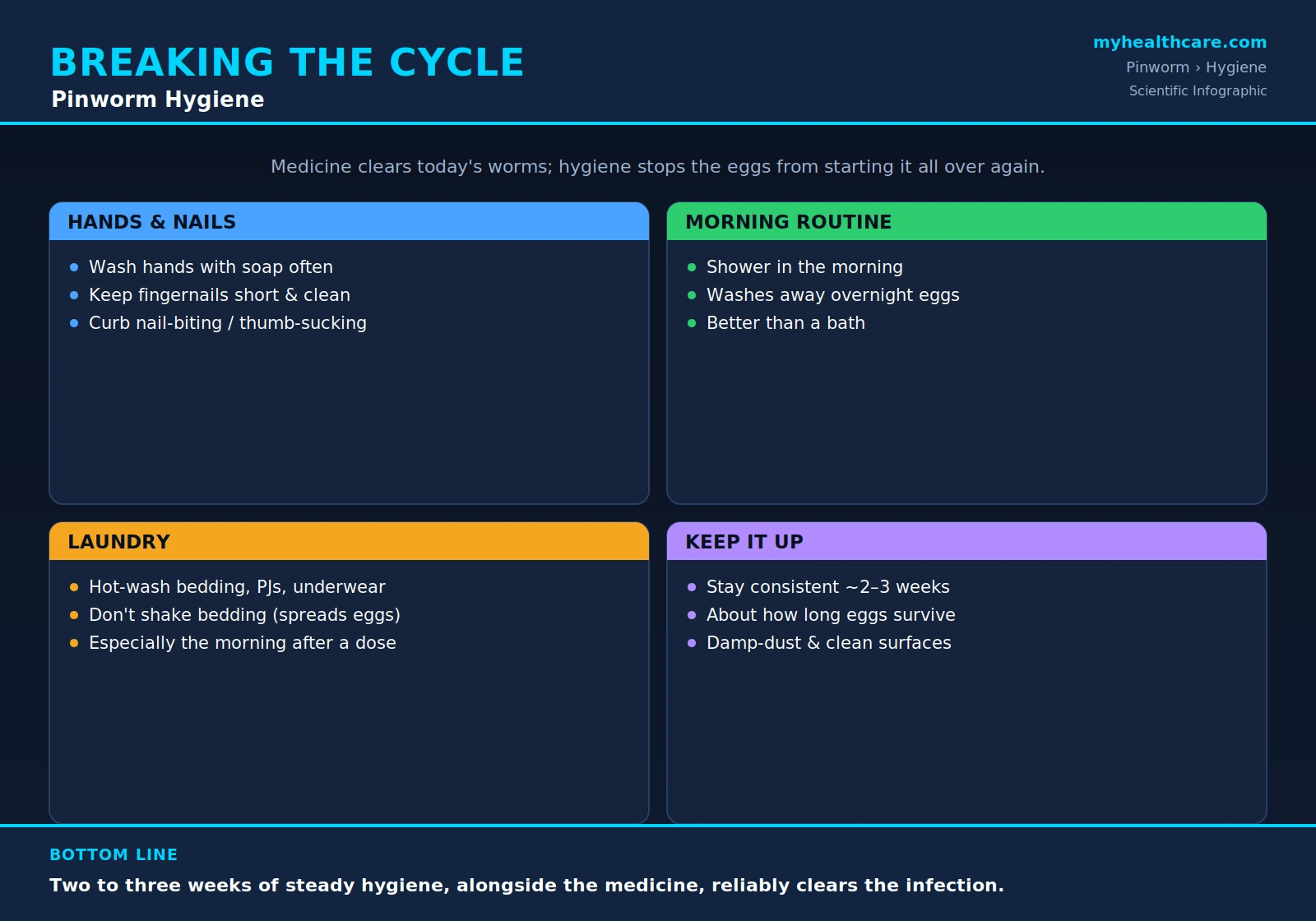
Taking a single dose of a deworming medicine is only half of pinworm treatment. The other half — the part no pill can do for you — is breaking the cycle of reinfection. Pinworms are spread by tiny eggs that a person carries from their own bottom back to their own mouth, and that scatter onto bedding, underwear, towels, and household surfaces. If those eggs are not cleared away, a freshly treated person simply swallows more of them and the worms come right back. This page explains, in plain and practical terms, the hygiene and household measures that actually break that cycle: thorough handwashing, short clean fingernails, a morning shower, hot-water laundering, careful (not dusty) cleaning, and keeping it all up consistently for two to three weeks. None of this is glamorous, but it is reassuringly effective: combined with the right medication timing, a couple of weeks of steady, sensible hygiene reliably clears pinworms for good. For the drug side of the plan — which medicine, and the crucial repeat dose two weeks later — see Pyrantel and Albendazole Treatment.
Table of Contents
- The Reinfection Cycle You Must Break
- Thorough Handwashing With Soap
- Short, Clean Fingernails (and No Nail-Biting)
- The Morning Shower
- Hot-Water Laundering
- Do Not Shake Out Bedding or Clothes
- Damp-Dusting, Vacuuming, and Bathroom Surfaces
- Discouraging Scratching
- Two to Three Weeks of Consistency
- The Reassuring Bottom Line
- Key Research Papers
- Featured Videos
1. The Reinfection Cycle You Must Break
To understand why hygiene matters so much, it helps to picture exactly how a person re-gives pinworms to themselves — a process called autoinfection. At night, the female pinworm crawls out through the anus and lays thousands of microscopic, sticky eggs on the skin around it. Those eggs cause intense itching. The sleeper scratches — often without waking — and the eggs lodge on the fingertips and, especially, under the fingernails. From there it is a short trip: hand to mouth (touching food, biting nails, rubbing the face) carries the eggs back inside, where they hatch and grow into a new generation of worms in the gut. Within a few weeks the new females are crawling out to lay eggs again, and the loop closes.
The same eggs also spread around the home. Scratching, dressing, and shaking out the sheets fling eggs onto bedding, pajamas, underwear, towels, carpets, and surfaces. They can be picked up by anyone in the household, which is why pinworm tends to run through whole families. Pinworm eggs are also fairly hardy in a cool, humid, indoor setting — they remain capable of causing infection for around two to three weeks — so a single round of treatment cannot succeed if the surrounding environment keeps re-supplying eggs.
This is the heart of the matter: medicine kills the worms that are present, but it does nothing to the eggs already on skin, under nails, in clothing, and on surfaces. Every hygiene step below targets one link in this chain — removing eggs from the body, capturing them in the wash, and clearing them from the environment — so that when the worms are gone, no new eggs are waiting to start the cycle over. The classic clinical literature on enterobiasis has long emphasized that reinfection, not treatment failure, is the usual reason pinworms seem to "come back," which is precisely why personal and environmental hygiene are inseparable from the drug.
2. Thorough Handwashing With Soap
Handwashing is the single most important hygiene measure, because the hands are the vehicle that carries eggs from the bottom to the mouth and to everything a person touches. The goal is simple: keep eggs from reaching the mouth, and stop spreading them onto food and surfaces.
Wash hands with soap and warm running water, rubbing all surfaces — palms, backs, between the fingers, and crucially around and under the fingernails — for about twenty seconds, then dry well. The most important moments to wash are:
- After using the toilet — every time, by every member of the household.
- After any scratching — particularly first thing in the morning, when eggs are most likely to be on the skin and fingers.
- Before eating and before preparing or handling food — this is the step that actually blocks the hand-to-mouth journey.
- After changing a young child's nightwear or bedding, and after helping a child with toileting.
Plain soap and water are entirely adequate; there is no need for special antiparasitic cleansers. The point is mechanical — soap and the rubbing action lift the sticky eggs off the skin and rinse them down the drain. Research on intestinal parasites in general supports the practical value of this combination: studies of school-age children have found that regular handwashing together with keeping the nails short and clean is associated with a meaningfully lower risk of intestinal parasite infection, reinforcing that these two simple habits work hand in hand.
3. Short, Clean Fingernails (and No Nail-Biting)
Fingernails deserve their own section because the space beneath them is where pinworm eggs love to hide. Long nails create a sheltered pocket that traps eggs during scratching and shields them from a quick rinse, so they survive to be transferred to the mouth or to food later.
The fix is straightforward: keep fingernails cut short and scrub beneath them when washing, ideally with a nail brush, especially in the morning and before meals. For the same reason, two common childhood habits matter enormously here:
- Nail-biting delivers any eggs trapped under the nail directly into the mouth and should be gently discouraged.
- Thumb-sucking and finger-sucking do the same thing and are an important route of self-reinfection in young children.
Helping a child stop these habits — even temporarily, during the treatment weeks — closes one of the most reliable doors through which eggs travel from fingers to gut. The combination of short, clean nails and keeping fingers out of the mouth is, in practical terms, one of the most powerful things a family can do to stop the cycle.
4. The Morning Shower
Because the female worms lay their eggs on the perianal skin overnight, the skin around the anus carries its heaviest load of fresh eggs first thing in the morning. A shower or bath in the morning, soon after waking, washes that overnight deposit of eggs straight down the drain before they have a chance to be scratched onto the hands, scattered onto clothing, or carried to the mouth.
A shower is better than a bath for this purpose. In a bath, the eggs rinsed off the skin float in the standing water and can simply resettle onto the body, so a bath can spread eggs around rather than remove them. A shower carries them away immediately. Gently washing the perianal area with soap and rinsing thoroughly each morning is a small habit that removes a large share of the night's eggs.
For the same reason, it is sensible to change into clean underwear every morning after the shower, and to put the night's underwear and pajamas straight into the wash rather than back on the body. Morning is the moment of maximum egg load; clearing the skin and changing clothes then is one of the highest-value steps in the whole routine.
5. Hot-Water Laundering
Bedding and nightclothes collect eggs every night, so laundering is how those eggs are captured and destroyed instead of being recirculated. Wash the following in hot water and dry them on a hot setting where possible, since heat reliably kills pinworm eggs:
- Underwear and pajamas / nightclothes
- Bed linen — sheets, pillowcases, and any blankets in direct contact with the skin
- Towels and washcloths (and avoid sharing towels between family members during this period)
Timing makes laundering far more effective. It is especially worth washing all of this on the morning after treatment is taken — that single wash clears away the accumulated eggs from before treatment in one stroke — and then regularly throughout the treatment period, with bedding and nightwear changed and washed frequently (every few days, and underwear daily). Pairing the wash with the medicine's repeat dose is the logic behind the whole-household approach described on the Recurrent Pinworm and Whole-Household Treatment page. Use ordinary laundry detergent; it is the hot water and heat, not any special additive, that does the work.
6. Do Not Shake Out Bedding or Clothes
This is the counter-intuitive step that people most often get wrong. The instinct, when stripping a bed or picking up nightclothes, is to give them a vigorous shake. Do not. Pinworm eggs are light and dust-like, and shaking sheets, blankets, pajamas, or towels launches the eggs into the air, where they settle as household dust on every surface in the room — and can even be inhaled and then swallowed. A single hard shake can undo much of the careful cleaning done elsewhere.
Instead, handle bedding and nightclothes gently: roll or fold them up quietly and carry them directly to the wash without flapping them about. Doing the laundry first thing in the morning, before the room is disturbed, further limits how many eggs get stirred up. Treating contaminated linens as if they were carrying invisible dust — because in effect they are — keeps the eggs contained until hot water can destroy them.
7. Damp-Dusting, Vacuuming, and Bathroom Surfaces
Because eggs end up as dust on surfaces and floors, ordinary cleaning — done the right way — reduces the reservoir of eggs in the home. The guiding principle is the same as for bedding: do not raise dust into the air.
- Damp-dust rather than dry-dust. Wiping surfaces with a damp cloth traps eggs on the cloth (which is then rinsed or washed), whereas a dry duster or feather duster just flings them back into the air to settle elsewhere.
- Vacuum carpets and floors in bedrooms and living areas to lift settled eggs out of the household, especially during the first week or two of treatment.
- Clean bathroom surfaces, toilet seats, and taps. The toilet seat and bathroom door handle are touched by everyone after toileting, so wiping them down regularly with a damp cloth and ordinary cleaner removes a shared transfer point.
You do not need to disinfect the whole house or use harsh chemicals; the eggs naturally die off within a couple of weeks, so the realistic goal is simply to reduce the number of eggs in circulation while the treatment and personal-hygiene measures clear the infection. A focused, damp, dust-conscious clean of bedrooms and bathrooms — especially in the morning — is far more useful than aggressive scrubbing of every surface in the home.
8. Discouraging Scratching
Scratching is the engine of the whole cycle: it loads eggs onto the fingers and under the nails, which then carry them back to the mouth and out into the household. Reducing scratching — and limiting what the hands can pick up when scratching does happen — is therefore a genuine control measure, not just comfort care.
- Treat the itch. The morning shower, clean perianal skin, and the medication itself all reduce the itching over the first days, which in turn reduces scratching.
- Keep the perianal area clean and the hands clean, so that any scratching transfers fewer eggs and they are washed off promptly afterward.
- Use snug, close-fitting nightwear for children — for example, fitted one-piece pajamas or underwear under pajamas. This is a long-standing, gentle measure that makes it harder for little hands to reach bare perianal skin directly during the night, which both eases self-reinfection and helps keep eggs off the fingers. Wash this nightwear in hot water each morning along with the bedding.
- Cover the hands at night if needed. For a young child who scratches heavily in their sleep, soft cotton mittens or gloves can further reduce how many eggs end up under the nails.
None of this needs to be a battle. The aim is simply to interrupt the night-time scratch-and-transfer step for the couple of weeks it takes to clear the infection, combining clean skin, short nails, washed hands, and snug nightwear so that scratching does the least possible to keep the cycle alive.
9. Two to Three Weeks of Consistency
The reason every guideline stresses keeping the routine up for at least two to three weeks comes down to the biology of the egg. Pinworm eggs survive in the indoor environment for roughly that long, and the worms' life cycle — from a swallowed egg to a new egg-laying adult — also runs over a few weeks. If hygiene is excellent for two days and then forgotten, any eggs that were missed are still viable and the cycle restarts. Sustained effort across the whole egg-survival window is what finally exhausts the supply of eggs and lets the infection die out.
In practice this means establishing a simple daily routine and holding it steady: a morning shower, fresh underwear, hot-water washing of nightwear and bedding, hands washed at the key moments, nails kept short, and a damp wipe of bathroom surfaces — every day, for two to three weeks. This window is also exactly why the medicine is usually repeated about two weeks after the first dose: that second dose catches any worms that hatched from eggs swallowed before the household was cleaned up, and the hygiene routine ensures there are no fresh eggs left to start yet another round. The timing of that repeat dose is covered on the Pyrantel and Albendazole Treatment page; the hygiene routine here is what makes that two-dose strategy succeed.
10. The Reassuring Bottom Line
Pinworm can feel embarrassing and stubborn, but it is genuinely one of the most beatable infections there is — and it is not a sign of a dirty home or poor parenting. It is extremely common, especially among young children, precisely because the eggs spread so easily; catching it says nothing bad about a family's cleanliness. What clears it is not perfection but consistency.
The encouraging reality is that the measures on this page are ordinary, low-cost, and within reach of any household: wash hands, keep nails short, shower in the morning, launder in hot water without shaking things out, damp-clean and vacuum, ease the itch, and keep it all up for a couple of weeks. Combined with the right medication — the initial dose and the repeat dose two weeks later — this routine reliably clears the infection. Reinfection is the enemy, and these steps defeat it. A little patience and steadiness over two to three weeks, and pinworms are gone. For the full picture of treatment, prevention, and what to do when it keeps coming back, see the Treatment & Prevention hub and the Recurrent Pinworm and Whole-Household Treatment page.
Key Research Papers
Peer-reviewed reviews, clinical studies, and contamination and hygiene research relevant to pinworm (enterobiasis), its reinfection cycle, and the personal- and environmental-hygiene measures that break it. Journal names appear as plain text; the year/volume/pages link opens the full citation via DOI. The detailed step-by-step hygiene practices on this page reflect standard public-health and pediatric guidance.
- Cook GC. Enterobius vermicularis infection. Gut. 1994;35(9):1159–1162.
- St Georgiev V. Chemotherapy of enterobiasis (oxyuriasis). Expert Opinion on Pharmacotherapy. 2001;2(2):267–275.
- Matsen JM, Turner JA. Reinfection in Enterobiasis (Pinworm Infection): Simultaneous Treatment of Family Members. American Journal of Diseases of Children. 1969;118(4):576–581.
- Husin N, Pasaribu S, Ali M, et al. Comparative Efficacy and Reinfection of Albendazole-Mebendazole, Albendazole-Pyrantel Pamoate, and Mebendazole-Pyrantel Pamoate. Open Access Macedonian Journal of Medical Sciences. 2020;8(B):978–982.
- Moussavi K, Houssaini Z, Salari Z, et al. Prevalence of Enterobius vermicularis among Children in Iran: A Comprehensive Systematic Review and Meta-Analysis. Parasite Epidemiology and Control. 2023;22:e00315.
- Erdoğrul Ö, Şener H. The Contamination of Various Fruit and Vegetable with Enterobius vermicularis, Ascaris Eggs, Entamoeba histolytica Cysts and Giardia Cysts. Food Control. 2005;16(6):557–560.
- Çeliksöz A, Açioğz M, Değerli S, et al. Egg Positive Rate of Enterobius vermicularis and Taenia spp. by Cellophane Tape Method in Primary School Children. The Korean Journal of Parasitology. 2005;43(2):61–64.
- Cho SY, Kang SY. Significance of Scotch-Tape Anal Swab Technique in Diagnosis of Enterobius vermicularis Infection. The Korean Journal of Parasitology. 1975;13(2):102–114.
- Strunz EC, Addiss DG, Stocks ME, Ogden S, Utzinger J, Freeman MC. Water, Sanitation, Hygiene, and Soil-Transmitted Helminth Infection: A Systematic Review and Meta-Analysis. PLoS Medicine. 2014;11(3):e1001620.
- Haas J. Handwashing and Nail Clipping Reduce Risk of Intestinal Parasite Infection in School-Age Children. Evidence-Based Nursing. 2016;19(2):49.
- Beck JW, Saavedra D, Antell GJ, Tejeiro B. The Treatment of Pinworm Infections in Humans (Enterobiasis) with Pyrvinium Chloride and Pyrvinium Pamoate. The American Journal of Tropical Medicine and Hygiene. 1959;8(3):349–352.
Live PubMed Searches
Each link opens a live PubMed query so results stay current as new papers are indexed.
- Enterobius vermicularis reinfection
- Pinworm hygiene and prevention
- Handwashing and intestinal parasites in children
- Fingernail hygiene and parasite infection
- Enterobius egg survival in the environment
- Pinworm household and family transmission
- WASH and soil-transmitted helminths
- Pinworm epidemiology and prevalence in children
Connections
- All Parasites
- Pinworm Overview
- Symptoms & Diagnosis
- Anal Itching & Sleep Disturbance
- Pinworm in Children & Households
- Complications & Unusual Sites
- Treatment & Prevention
- Pyrantel & Albendazole Treatment
- Recurrent Pinworm & Whole-Household Treatment
- Gastroenterology
- Infectious Disease
- All Conditions