Cyclospora (Cyclosporiasis)
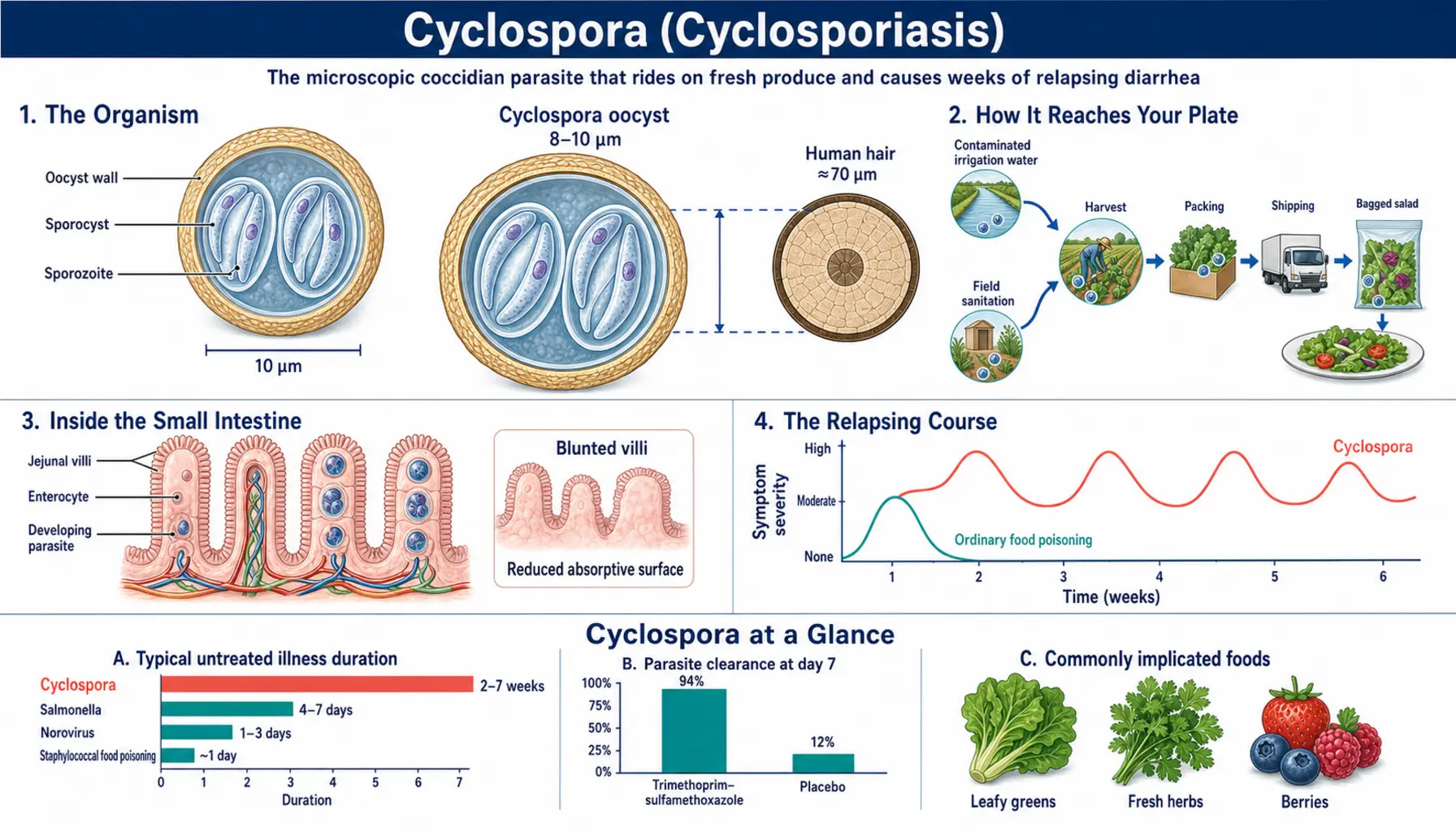
Cyclospora cayetanensis is a microscopic, single-celled parasite that lives in the small intestine and causes an illness called cyclosporiasis. Its hallmark is prolonged, watery diarrhea that can drag on for weeks and come and go in waves. In the United States, Cyclospora is best known as a cause of foodborne outbreaks tied to imported fresh produce — raspberries, basil, cilantro, and bagged salad mixes have all been culprits — and these outbreaks cluster in the spring and summer. What sets this parasite apart from many other intestinal bugs is a quirk of its biology: the form it sheds in stool is not infectious right away and must ripen in the environment for days to weeks first, which means you cannot catch it directly from a sick person. This page explains what Cyclospora is, how its unusual life cycle shapes the way it spreads, what cyclosporiasis feels like, why the diagnosis is so easily missed, how it is treated, and how outbreaks are traced and prevented.
Active Outbreak — July 2026
There is an ongoing multistate Cyclospora outbreak in the United States linked to iceberg lettuce. As of the FDA’s July 24, 2026 update there are 1,947 laboratory-confirmed illnesses across nine states and at least 98 hospitalizations, with no deaths. Taylor Farms de Mexico recalled all iceberg lettuce sourced from central Mexico on July 17, 2026. See the full outbreak dossier for the recalled product details and what to check in your refrigerator, or our news coverage from July 26, 2026.
Deep-Dive Articles
Nine companion articles go considerably deeper than this overview:
The 2026 Iceberg Lettuce Outbreak
The full dossier on the current outbreak: timeline, recall specifics, the nine-versus-twenty-seven state confusion, and why case counts keep rising after a recall.
Read the deep dive →Why Washing Does Not Remove It
The armoured oocyst wall, what the sanitizer research actually shows, and the microscopic geometry of a lettuce leaf that lets rinse water skate straight over.
Read the deep dive →Life Cycle & Sporulation
Freshly shed oocysts are not infectious. Why a mandatory one-to-two-week maturation makes this parasite non-contagious — and nearly impossible to trace.
Read the deep dive →Symptoms & the Relapsing Course
The full symptom picture, the remit-and-relapse waveform that distinguishes it from food poisoning, and the red flags worth acting on.
Read the deep dive →Diagnosis & Testing
Why a routine stool workup misses it, why one negative result proves little, and the exact words to bring to an appointment.
Read the deep dive →Treatment & the Ivermectin Question
The placebo-controlled trial behind TMP-SMX, what to do if you are sulfa-allergic, and the full evidence on whether ivermectin has any role here.
Read the deep dive →Gut Recovery & Malabsorption
What weeks of small-intestine infection cost nutritionally, why rehydration chemistry matters, and how people recover afterward.
Read the deep dive →Produce Safety at Home
Practical steps during an active outbreak — identify, discard, sanitize — without giving up vegetables.
Read the deep dive →Cyclospora vs Other Gut Infections
How it differs from Giardia, Cryptosporidium, norovirus and ordinary food poisoning — and why the time course is the useful clue.
Read the deep dive →Interactive Visualization Cyclospora: From Contaminated Field to Relapsing Illness — watch why washing cannot save the salad Follow the parasite from irrigation water to your gut: rinse the leaves and watch it survive, chill the field so it never ripens, then treat it with the drug that works — and the one that has no target on it. Launch →
Table of Contents
1. What Is Cyclospora?
Cyclospora cayetanensis is a coccidian parasite — a single-celled protozoan belonging to the same broad family (the apicomplexans) as Cryptosporidium, Toxoplasma, and the parasites that cause malaria. It is far too small to see without a microscope, and it makes its home in the lining of the small intestine, where it disrupts the gut's ability to absorb fluid and nutrients. The illness it causes is named cyclosporiasis.
One fact shapes almost everything about this parasite: as far as science can tell, humans are its only natural host. Unlike Cryptosporidium or Giardia, which readily infect cattle, beavers, and many other animals, Cyclospora cayetanensis does not appear to have an animal reservoir. That means the contamination behind an outbreak ultimately traces back to human waste reaching food or water somewhere along the supply chain.
Cyclospora was only recognized as a distinct cause of human diarrhea relatively recently. It was described in the medical literature in the early 1990s — first among travelers and residents in places like Nepal, Haiti, and Peru — and formally named in 1994. The species name cayetanensis honors the Universidad Peruana Cayetano Heredia in Lima, where much of the early work was done. Today it is recognized worldwide, with year-round endemic transmission in parts of Latin America, South Asia, and Southeast Asia, and seasonal, produce-linked outbreaks in wealthier countries such as the United States and Canada.
2. The Organism & Life Cycle
The key to understanding Cyclospora — how it spreads, why some prevention advice works and some does not — lies in one unusual feature of its life cycle. The parasite is passed in stool as an oocyst, a tiny spherical package roughly 8 to 10 micrometers across. But here is the crucial point: the oocyst is not infectious when it leaves the body.
A freshly passed Cyclospora oocyst is immature (unsporulated). Before it can infect anyone, it must spend time in the outside world — in warm, moist conditions — undergoing a maturation process called sporulation. Over a period of days to weeks, the internal contents of the oocyst divide and organize into two sporocysts, each holding two sporozoites, the pieces that actually invade the gut. Only after this ripening in the environment is the oocyst sporulated and able to cause infection.
This single quirk explains one of the most important facts about cyclosporiasis: direct person-to-person spread does not happen. You cannot catch Cyclospora by shaking hands with an infected person, sharing a bathroom, or caring for a sick family member, because the oocysts they shed need days to weeks of maturation outside the body before they are dangerous. This is a striking contrast with Giardia and Cryptosporidium, whose stages are immediately infectious and therefore race through daycares and households by hand-to-mouth contact. With Cyclospora, there is always a delay and a detour through the environment — a stretch of contaminated water or a field of growing produce — between one person's infection and the next.
Once a person swallows a sporulated oocyst, the sporozoites are released in the small intestine, invade the cells lining the gut wall, and multiply inside them. This damages the intestinal lining and interferes with the normal absorption of fluid and nutrients, which is what produces the watery diarrhea and weight loss of cyclosporiasis. New oocysts are eventually formed and shed in the stool — unsporulated and harmless for now — to begin the cycle again only after they have ripened in the environment.
3. How Infection Happens
Because the infectious oocyst has to mature outside the body, cyclosporiasis is acquired by swallowing sporulated oocysts that have had time to ripen in soil, water, or on the surface of growing crops. In practice, that means two main routes: contaminated fresh produce and contaminated water.
In North America, the dominant vehicle by far has been imported fresh produce eaten raw. Over the years, well-documented outbreaks have been traced to:
- Fresh berries — most famously raspberries, the source of the landmark 1996 outbreak.
- Fresh herbs — basil and cilantro have both caused multiple outbreaks.
- Leafy greens and salad mixes — mesclun/spring-mix lettuce and prepackaged salads.
- Other produce — snow peas and pre-cut vegetable trays, among others.
The common thread is that these foods are eaten raw, so there is no cooking step to kill the parasite, and their surfaces (the crevices of a raspberry, the folds of a lettuce leaf, the fine leaves of an herb) are hard to clean. Contamination is thought to occur in the field or at processing — through irrigation or wash water tainted with human sewage, or the hands of infected workers — well before the produce reaches a kitchen.
Cyclosporiasis in the US has a strong seasonal pattern: cases and outbreaks cluster in the late spring and summer, roughly May through August. Travelers to endemic regions of Latin America, South Asia, and Southeast Asia can also acquire it there, where it is a recognized cause of traveler's diarrhea. After swallowing the parasite, the incubation period averages about one week (commonly around 7 days) before symptoms appear — long enough that people often struggle to connect the illness to a specific meal.
4. Symptoms
Symptoms of cyclosporiasis usually begin about a week after exposure. The defining feature is watery diarrhea, which can be frequent and profuse. What makes cyclosporiasis particularly wearing is its tendency to be prolonged and relapsing: rather than a single bad day or two, the diarrhea can wax and wane over weeks, seeming to improve and then flaring again. Left untreated, an episode commonly lasts several weeks and sometimes drags on much longer.
Along with the diarrhea, people commonly experience:
- Loss of appetite and a marked loss of weight, which can be substantial when the illness is prolonged.
- Abdominal cramping, bloating, and increased gas.
- Nausea, and sometimes vomiting.
- Fatigue — often striking and out of proportion to the diarrhea itself.
- A low-grade fever in some people.
- Muscle aches and a general sense of feeling unwell.
The pattern varies from person to person. Some have relatively mild illness; others are laid low for weeks with the exhausting cycle of remitting and returning diarrhea, appetite loss, and steady weight loss that is characteristic of this infection. In people with weakened immune systems — for example, those with advanced HIV — cyclosporiasis tends to be more severe and more prolonged, is more likely to relapse, and can occasionally involve the biliary tract. This is one reason the parasite was first characterized in detail in HIV-affected populations.
5. Diagnosis
Cyclosporiasis is confirmed by testing the stool for the parasite, but there is an important catch that patients and even clinicians should know: routine stool testing frequently misses it. The standard ova-and-parasite (O&P) examination — the general microscopic screen ordered for diarrhea — is not reliable for Cyclospora, because the oocysts are small, are shed intermittently, and do not show up with the ordinary stains and methods used in that test.
For that reason, the single most useful thing a patient can do is specifically ask. If you have unexplained, prolonged, or relapsing watery diarrhea — especially after eating fresh produce or traveling — it is worth requesting that the laboratory test specifically for Cyclospora, rather than assuming a general stool panel will find it. The parasite has to be looked for on purpose.
When Cyclospora is looked for directly, several distinctive features help identify it:
- Autofluorescence. Under an ultraviolet fluorescence microscope, Cyclospora oocysts glow (a blue or green fluorescence) — a quick, characteristic clue that trained laboratories use to spot them.
- Modified acid-fast staining. The oocysts take up special acid-fast stains (variably, so they appear in a range of pink-to-red hues), which distinguishes them on a stained slide.
- Molecular (PCR) testing. Modern multiplex gastrointestinal PCR panels detect Cyclospora DNA alongside many other diarrhea-causing pathogens from a single sample. These panels are sensitive and increasingly serve as a first-line test, which has made the parasite easier to detect than in the past.
Because oocysts are shed on and off rather than steadily, more than one stool specimen collected on different days may be needed to catch the infection. The practical takeaway is the same: with the right test ordered on purpose, cyclosporiasis is very findable; with only a routine screen, it is easy to overlook.
6. Treatment
The good news is that cyclosporiasis responds well to a specific, inexpensive antibiotic. The treatment of choice is trimethoprim-sulfamethoxazole (TMP-SMX) — the same combination sold as co-trimoxazole and under brand names such as Bactrim and Septra. A course taken over roughly a week to ten days typically clears the infection and shortens the illness dramatically compared with waiting it out. Its effectiveness was established in a placebo-controlled trial among travelers and residents in Nepal in the 1990s, and it has remained the standard ever since. As with any prescription, the exact regimen should be directed by a clinician; the description here reflects what is typically reported, not a self-treatment plan.
An honest complication is what to do for people who are allergic to sulfa drugs, since TMP-SMX contains a sulfonamide. Unlike some infections that have many interchangeable options, cyclosporiasis has few well-proven alternatives. Ciprofloxacin has been studied and can help, but the evidence — from work in HIV-affected patients — found it less effective than TMP-SMX. Nitazoxanide has also been used as an alternative. Because none of these substitutes matches TMP-SMX, someone with a true sulfa allergy should work closely with their clinician (and, when appropriate, an infectious-disease specialist) to weigh the options; in some cases a documented sulfa allergy is carefully re-evaluated because the alternatives are limited.
Alongside the antibiotic, supportive care matters: staying well hydrated replaces the fluids lost to diarrhea. People with weakened immune systems often need longer treatment courses and may require ongoing suppressive (maintenance) therapy to prevent relapse, because the infection is harder to clear when the immune system cannot help. Even in healthy people, relapses can occur, so persistent or returning symptoms after treatment are worth reporting back to the clinician.
7. Outbreaks & Public Health
Cyclospora occupies an outsized place in food-safety history because its outbreaks are both memorable and genuinely hard to solve. The turning point was a large 1996 outbreak across the United States and Canada that sickened roughly 1,400 people and was ultimately traced to fresh raspberries imported from Guatemala. It was a landmark: it put a little-known parasite on the map of North American public health and showed how a pathogen on produce grown in one country could cause widespread illness in another.
Since then, the US has seen recurring seasonal outbreaks, usually in spring and summer, linked to a rotating cast of fresh produce — basil, cilantro, mesclun lettuce, snow peas, prepackaged salads, and pre-cut vegetable trays among them. Some years have brought very large multistate outbreaks tied to salad products and restaurant salad mixes. Cyclosporiasis is a nationally reportable disease, and public-health agencies track cases closely during the summer season.
When cases mount, the FDA and CDC (working with state and local health departments) launch traceback investigations — painstakingly reconstructing where suspect produce was grown, processed, and distributed to find the common source. These investigations are notoriously difficult for several reasons unique to this parasite:
- The incubation period plus the sporulation delay mean the contaminating event may have happened days or weeks earlier and far away — often in another country's fields.
- Fresh produce is perishable, so by the time an outbreak is recognized, the actual contaminated lots have usually been eaten or discarded, leaving little to test.
- For much of its history there was no easy laboratory animal or culture model and limited genetic typing, which made it hard to match parasites from patients to a specific source. Newer molecular tools are improving this.
The public-health response combines outbreak detection, produce traceback, import oversight of high-risk items, and guidance to growers and processors on protecting irrigation and wash water from human waste — the ultimate origin of contamination, since humans are the only host.
8. Prevention
Preventing cyclosporiasis is genuinely challenging, and it is important to be honest about why. The usual advice to wash fresh produce thoroughly is still worth following — but for Cyclospora specifically, washing does not reliably remove the parasite. The oocysts cling tightly to the surfaces and crevices of berries, leaves, and herbs, and rinsing reduces but does not eliminate them. There is no home-kitchen step that can be counted on to make contaminated produce safe.
Because washing is imperfect, prevention depends heavily on food safety upstream of the kitchen — on growers and processors keeping human sewage out of irrigation and wash water, on import oversight of higher-risk produce, and on rapid outbreak detection so that contaminated products can be recalled. This is why public-health measures, rather than consumer scrubbing, carry most of the weight for this particular parasite.
That said, a few practical points still help:
- Cooking kills the parasite. Heat reliably destroys Cyclospora, so cooked foods are not a risk. The problem is that the usual vehicles — berries, herbs, salad greens — are eaten raw.
- Follow recalls and outbreak alerts. During a known outbreak, avoiding the specific implicated product (a particular brand of salad mix or bagged greens, for example) is the most effective step you can take.
- Be careful with water and produce when traveling. In regions where cyclosporiasis is endemic, drink safe water and be cautious with raw produce and salads. Note that routine chlorination does not reliably kill Cyclospora, so boiling or a suitable filter is the dependable safeguard for questionable water.
- There is no vaccine, and no routine preventive medication is recommended for general travelers.
The realistic message is one of shared responsibility: individuals can lower their odds by cooking risky foods, heeding recalls, and taking water precautions when traveling, while the larger burden of prevention rests on the food-supply and public-health systems that keep human waste away from the crops in the first place.
Key Research Papers
Peer-reviewed studies and reviews on Cyclospora cayetanensis and cyclosporiasis — covering the parasite's original discovery, its biology and sporulation, the outbreaks that made it a food-safety concern, and the clinical trials that established how it is treated. Journal names appear as plain text; the year/volume/pages link opens the full citation via DOI.
- Ortega YR, Sterling CR, Gilman RH, Cama VA, Díaz F. Cyclospora species — a new protozoan pathogen of humans. New England Journal of Medicine. 1993;328(18):1308–1312. — the report that established Cyclospora as a distinct cause of human diarrhea. — doi:10.1056/NEJM199305063281804
- Hoge CW, Shlim DR, Rajah R, et al. Epidemiology of diarrhoeal illness associated with coccidian-like organism among travellers and foreign residents in Nepal. The Lancet. 1993;341(8854):1175–1179. — early epidemiology describing the seasonal, travel-associated pattern of the illness. — doi:10.1016/0140-6736(93)91002-4
- Pape JW, Verdier RI, Boncy M, Boncy J, Johnson WD Jr. Cyclospora infection in adults infected with HIV: clinical manifestations, treatment, and prophylaxis. Annals of Internal Medicine. 1994;121(9):654–657. — documented severe, relapsing disease in HIV and the value of TMP-SMX. — doi:10.7326/0003-4819-121-9-199411010-00004
- Hoge CW, Shlim DR, Ghimire M, et al. Placebo-controlled trial of co-trimoxazole for Cyclospora infections among travellers and foreign residents in Nepal. The Lancet. 1995;345(8951):691–693. — the randomized trial that established co-trimoxazole (TMP-SMX) as effective treatment. — doi:10.1016/S0140-6736(95)90868-4
- Herwaldt BL, Ackers ML; Cyclospora Working Group. An outbreak in 1996 of cyclosporiasis associated with imported raspberries. New England Journal of Medicine. 1997;336(22):1548–1556. — the landmark investigation linking a large North American outbreak to imported fresh raspberries. — doi:10.1056/NEJM199705293362202
- Herwaldt BL. Cyclospora cayetanensis: a review, focusing on the outbreaks of cyclosporiasis in the 1990s. Clinical Infectious Diseases. 2000;31(4):1040–1057. — a detailed review of the produce-associated outbreaks that defined the parasite in North America. — doi:10.1086/314051
- Verdier RI, Fitzgerald DW, Johnson WD Jr, Pape JW. Trimethoprim–sulfamethoxazole compared with ciprofloxacin for treatment and prophylaxis of Isospora belli and Cyclospora cayetanensis infection in HIV-infected patients. Annals of Internal Medicine. 2000;132(11):885–888. — found ciprofloxacin a useful but less effective alternative for patients who cannot take sulfa drugs. — doi:10.7326/0003-4819-132-11-200006060-00006
- Mansfield LS, Gajadhar AA. Cyclospora cayetanensis, a food- and waterborne coccidian parasite. Veterinary Parasitology. 2004;126(1–2):73–90. — reviews the biology and the environmental sporulation requirement that shapes how the parasite spreads. — doi:10.1016/j.vetpar.2004.09.011
- Ortega YR, Sanchez R. Update on Cyclospora cayetanensis, a food-borne and waterborne parasite. Clinical Microbiology Reviews. 2010;23(1):218–234. — the widely cited comprehensive review of biology, diagnosis, and control. — doi:10.1128/CMR.00026-09
- Chacín-Bonilla L. Epidemiology of Cyclospora cayetanensis: a review focusing in endemic areas. Acta Tropica. 2010;115(3):181–193. — synthesizes global epidemiology, including endemic transmission in Latin America and Asia. — doi:10.1016/j.actatropica.2010.04.001
- Almeria S, Cinar HN, Dubey JP. Cyclospora cayetanensis and cyclosporiasis: an update. Microorganisms. 2019;7(9):317. — a modern review covering molecular detection and produce-safety science. — doi:10.3390/microorganisms7090317
- Giangaspero A, Gasser RB. Human cyclosporiasis. The Lancet Infectious Diseases. 2019;19(7):e226–e236. — a recent clinical and public-health overview of diagnosis, treatment, and outbreaks. — doi:10.1016/S1473-3099(18)30789-8
PubMed Topic Searches
Each link opens a live PubMed query so results stay current as new papers are indexed.
Connections
- All Parasites
- Cyclospora: From Contaminated Field to Relapsing Illness — interactive animation
- Deep Dives: The 2026 Iceberg Lettuce Outbreak · Why Washing Does Not Remove It · Life Cycle & Sporulation · Symptoms & the Relapsing Course · Diagnosis & Testing · Treatment & the Ivermectin Question · Gut Recovery & Malabsorption · Produce Safety at Home · Cyclospora vs Other Gut Infections
- News: Cyclospora in the Lettuce Supply (July 26, 2026)
- Cryptosporidium
- Giardia
- Toxoplasma
- Entamoeba
- Acanthamoeba
- Malaria
- Ascaris
- Infectious Disease
- Chronic Diarrhea
- Gastroenterology
- All Conditions