Cyclospora Symptoms and the Relapsing Illness Pattern
If you are reading this in week three — exhausted, planning your day around bathrooms, quietly wondering whether something is seriously wrong with you — you are in the right place, and you are not imagining it. Cyclosporiasis does not behave like the food poisoning most people have lived through. It does not hit hard and leave. It grinds.
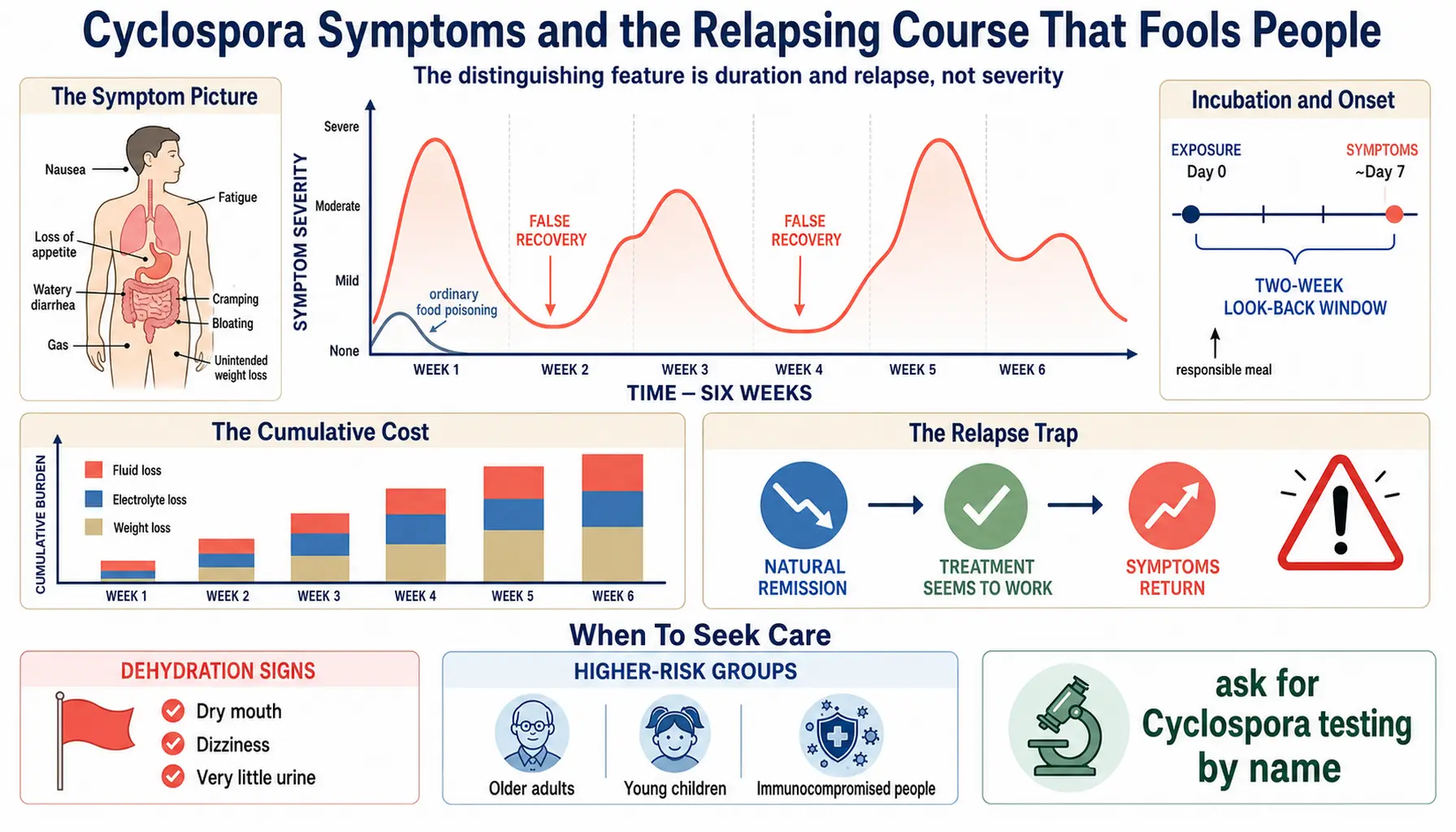
The most important thing here is the shape of the illness over time. A bad meal usually gives you a violent day or two and then releases you. Cyclospora cayetanensis, untreated, can run for weeks — a month or longer is entirely ordinary — and it characteristically fades out and comes back. The U.S. Food and Drug Administration puts it plainly: symptoms “may seem to go away and then return one or more times.” That fade-and-return is not you failing to recover; it is what this parasite does. Knowing it changes two practical things: when to stop waiting and ask for a specific test, and why almost any remedy you try is going to look like it worked. Nothing here is meant to frighten you — most people with this infection recover completely.
Interactive Visualization Cyclospora: From Contaminated Field to Relapsing Illness — watch why washing cannot save the salad Follow the parasite from irrigation water to your gut: rinse the leaves and watch it survive, chill the field so it never ripens, then treat it with the drug that works — and the one that has no target on it. Launch →Table of Contents
- What Cyclospora Actually Does to You
- The Incubation Gap: Why You Blame the Wrong Meal
- Duration Is the Distinguishing Feature
- The Remitting–Relapsing Pattern — and the Trap It Sets
- Why the Cumulative Toll Matters More Than Any Single Day
- Fatigue and Appetite Loss: The Symptoms Nobody Warns You About
- Red Flags: When to Stop Waiting and Get Seen
- Who Gets It Worse
- Reported Complications — Uncommon, and Mostly Case Reports
- The Most Useful Sentence on This Page
- Key Research Papers
- Official Guidance
- Connections
- Featured Videos
1. What Cyclospora Actually Does to You
Here is the FDA's own symptom list, with what each item tends to mean in daily terms. If most of the right-hand column reads like your last two weeks, that is worth taking to a clinician.
| Symptom (FDA list) | What it actually looks like |
|---|---|
| Watery diarrhea, frequent bowel movements | The core symptom. Loose and watery rather than bloody — and frequent, which is what wrecks your sleep and your schedule. |
| Loss of appetite | Food stops appealing. People describe forgetting to eat, or feeling full after three bites. |
| Weight loss | Unintended, and it creeps. A pound here and there does not register until clothes stop fitting. |
| Stomach cramps and pain | Crampy and wave-like, easing after a bowel movement and building again. |
| Bloating and increased gas | A tight, distended, gurgling abdomen — often the symptom people find most socially miserable. |
| Nausea | Usually background queasiness rather than dramatic vomiting. |
| Fatigue | Consistently under-rated. See section 6 — for many people it outlasts everything else. |
The FDA adds that vomiting, body aches, headache and fever “may be noted” — they happen, but they are not the defining picture. Note what is absent: this illness is watery, not bloody, and blood in the stool points somewhere else entirely (section 7). And some infected people have no symptoms at all — so if you shared a meal with someone who got sick and you feel fine, that is genuinely possible; and if a housemate is mildly unwell while you are flattened, you are not being dramatic.
2. The Incubation Gap: Why You Blame the Wrong Meal
You do not get sick the evening you eat it. Incubation is about a week, with the commonly quoted range spanning roughly 2 to 14 days.
That gap is why nearly everyone blames the wrong food. We work backwards from the moment we felt awful — to last night's dinner, not to the previous Tuesday. So the salad goes unsuspected and the innocent chicken gets convicted. Three consequences follow:
- Your instinct about the source is probably wrong. The useful window is the two weeks before symptoms began. FDA advice during the 2026 outbreak told people to seek care if symptomatic, “especially if you ate shredded iceberg lettuce in the two weeks before you got sick.”
- You may have eaten it more than once. A week-long incubation means a contaminated product can reach your plate repeatedly before anyone connects the dots.
- Investigations are slow for the same reason. The FDA noted it can take up to six weeks to confirm a case belongs to an outbreak — which is why counts keep climbing after a recall has already happened.
The delay is biologically built in: freshly shed Cyclospora oocysts are not infectious and must mature in the environment for roughly one to two weeks first (see Life Cycle and Sporulation). That is also why this infection is not passed person-to-person the way norovirus is — you are not going to give it to your family by being in the house with them.
3. Duration Is the Distinguishing Feature
If you take one thing from this page, take this: the length of the illness is the clue.
Most food-borne illness people have personal experience with follows a fast arc — abrupt arrival, genuinely awful, peaks within hours, over in a day or three. That shape is so familiar it becomes the mental model for “food poisoning,” and it sets an expectation: be patient, this passes by the weekend. Cyclosporiasis does not follow that arc. Untreated, it runs for weeks, and a month or longer is entirely ordinary. It also tends to begin less dramatically — a gradual slide into loose stools, cramping and fatigue rather than a sudden violent onset — and then it simply does not stop. That combination is why people go undiagnosed for so long: no single day is severe enough to force the issue, so the familiar model keeps saying give it a few more days while the calendar rolls past two weeks, then three.
So the practical rule:
- Diarrhea for one to three days that then resolves — consistent with the ordinary causes, rarely a puzzle.
- Diarrhea beyond roughly a week, especially watery diarrhea with fatigue, appetite loss and weight loss — this has left “wait it out” territory and deserves a stool workup that specifically includes parasites.
- Diarrhea that seems to end and then restarts — the most characteristic signature of all, and the subject of the next section.
Duration also carries a hopeful message, because the reason untreated cyclosporiasis lasts so long is exactly why pursuing a diagnosis is worth it: there is a known, specific, effective antibiotic behind this infection. In the placebo-controlled trial that established treatment, Hoge and colleagues found that after seven days the parasite was still detectable in 1 of 16 treated patients (6%) versus 15 of 17 on placebo (88%). Weeks of illness, versus a prescription course — see Treatment and the Ivermectin Question.
4. The Remitting–Relapsing Pattern — and the Trap It Sets
The FDA's phrasing is worth quoting exactly, because it is the thing nobody warns you about: symptoms “may seem to go away and then return one or more times (relapse).”
In practice that reads like this. Day nine, you wake up feeling human. You eat a real breakfast, you make plans, you tell people you are over it. Then on day eleven it comes back — cramping, watery stools, flattening fatigue — on a body already a week and a half depleted. Then it eases again. Then it returns.
The demoralization is real, and it is not weakness. A relapsing illness is psychologically harder than a steady one of the same severity. Steady illness lets you brace; relapsing illness repeatedly hands you hope and takes it back, and each crash lands harder because you had already started rebuilding. People feel foolish for having announced they were better, or start doubting themselves — wondering if it is stress, or diet, or something they are doing wrong. It is not. The fade-and-return is the disease, and the next relapse is not a setback you caused.
Now the trap, which is the real reason this section exists: because the illness naturally remits, anything you take during a remission will appear to have worked. Suppose on day ten you are miserable and someone suggests a supplement, a cleanse, a tea, a diet change, or a leftover antiparasitic from a relative. You take it; two days later you feel dramatically better; the conclusion feels like evidence. But this illness was going to remit anyway — that is its documented natural history. The moment of maximum misery is both the moment you are most likely to try something new and the moment from which improvement is most likely regardless of what you do. Every remedy taken at a trough gets credit for a recovery it did not cause; then the illness relapses, the remedy is taken again, remission returns, and the belief hardens.
So personal anecdotes about curing Cyclospora are unreliable — not because anyone is lying, but because this disease is structurally built to manufacture false success stories. It is also why the placebo group in the Hoge trial matters so much: a control arm is the only way to see what an illness does on its own. And the cost is not philosophical — it is weeks of your life, because someone who believes an ineffective remedy is working keeps waiting instead of asking for the test that would identify a treatable infection. The specific case of ivermectin, asked about in good faith by many people, is addressed honestly on the treatment page.
5. Why the Cumulative Toll Matters More Than Any Single Day
Cyclosporiasis is not a dramatic illness. It is an attritional one — a slow leak rather than a burst pipe. Each day's losses look manageable: a bit more fluid out than in, some electrolytes shed, a couple of meals skipped. Multiply by twenty-five days and the arithmetic changes character. Three things stack:
- Fluid. Dehydration developing over three weeks feels different from dehydration developing in six hours. It shows up as lightheadedness on standing, headaches, dark urine, dry mouth and a heart that races on stairs — not as an obvious crisis.
- Electrolytes. Sodium, potassium and other salts leave with the fluid. Persistent low potassium contributes to muscle weakness, cramps and deep tiredness — symptoms people blame on being run-down rather than on chemistry.
- Calories and nutrients. The parasite develops inside the lining of the small intestine, the stretch of gut that does most of the actual absorbing, so food that does get eaten may not be fully taken up. That is why unintended weight loss is on the FDA's list at all, and why some people notice malabsorptive symptoms lingering afterwards (Gut Recovery and Malabsorption).
What follows is unglamorous and genuinely the highest-value self-care here: drink deliberately, and include salt and some carbohydrate — not just plain water. Oral rehydration solutions exist for exactly this and are cheap; broths, salty soups and rehydration sachets all serve, and small amounts sipped often are tolerated far better than a lot at once. Eat what you can keep down rather than what you think you should — bland, low-fat, gently salted food is usually easiest while the small bowel is inflamed. And weigh yourself once, early: unintended weight loss is the least subjective thing you can hand a clinician, and it turns “I have felt terrible for weeks” into something concrete that gets acted on.
6. Fatigue and Appetite Loss: The Symptoms Nobody Warns You About
Two items on the FDA's list have nothing to do with the bathroom, and they are the ones patients most often fail to connect to the infection at all.
Fatigue here is not ordinary tiredness. It is heavy and flattening — sitting down partway through cooking, sleeping nine hours and waking unrefreshed, concentration sliding after an hour of work. Several contributors stack: broken sleep from night-time bowel movements, dehydration, electrolyte depletion, weeks of reduced intake, gut inflammation, and the plain wear of being unwell for a long time. Because it builds gradually it gets blamed on work stress or burnout — worth catching, because fatigue frequently outlasts the diarrhea, and knowing it belongs to the infection stops it becoming a separate and frightening mystery.
Appetite loss is treacherous because it is silent. Nobody notices they are not eating the way they notice running to the bathroom, yet it quietly powers the weight loss above and makes rehydration harder, since much of our daily fluid normally arrives with meals. Two things help: eat on a schedule rather than on appetite, because appetite is a broken signal while you are infected; and drink your calories when solids are unappealing, since broths, diluted juices and nutrition drinks hydrate at the same time. Said once, because it belongs here: persistent fatigue with weight loss over weeks should be evaluated rather than absorbed into life — the point of being seen is to confirm the explanation, not to assume it.
7. Red Flags: When to Stop Waiting and Get Seen
Most people with cyclosporiasis never need emergency care. In the 2026 iceberg-lettuce outbreak, as of the FDA's July 24, 2026 update there were 1,947 laboratory-confirmed illnesses, at least 98 hospitalizations, and no deaths. The great majority of people were ill, not endangered. Hold that proportion in mind while reading the list. These are the specific reasons to seek care promptly rather than keep waiting:
- Signs of real dehydration. Not thirst alone: passing very little urine or none for eight or more hours, dark strongly-coloured urine, dizziness or near-fainting on standing, a racing heart at rest, sunken eyes, no tears, confusion or unusual drowsiness. In infants — fewer wet diapers, no tears when crying, a sunken soft spot, unusual floppiness. Dehydration is the complication most likely to actually put someone in hospital with this illness, and it is very treatable once identified.
- You cannot keep fluids down. If vomiting means nothing stays in for more than a few hours, do-it-yourself rehydration has failed and intravenous fluids may be needed. This is the clearest single trigger for same-day care.
- Blood in the stool. Be clear about this one: bloody diarrhea is not typical of Cyclospora, which characteristically causes watery diarrhea. Blood suggests a different diagnosis — several bacterial infections and inflammatory bowel conditions among them — and deserves prompt assessment on its own merits. Do not let a suspicion of Cyclospora talk you out of having bleeding investigated.
- High or persistent fever, particularly alongside severe or localized abdominal pain rather than generalized cramping. Fever “may be noted” with cyclosporiasis but is not its hallmark.
- Severe pain that is constant rather than crampy and wave-like, or pain concentrated in the upper right abdomen — see section 9 on biliary involvement, which is uncommon but reported.
- You are in a vulnerable group. Go earlier, not later, if you are pregnant, an infant or young child, an older adult, living with HIV, taking immunosuppressive medication, a transplant recipient, or in cancer treatment (section 8).
- Symptoms have run past a week, or went away and came back. Not an emergency — but the point at which continuing to wait stops being reasonable and testing becomes the right move.
One more, aimed at the current outbreak: the FDA advises seeing a clinician if you have symptoms, especially if you ate shredded iceberg lettuce in the two weeks before you got sick. If that is you, say it out loud at the appointment — an explicit exposure history is often what prompts the right test to be ordered.
8. Who Gets It Worse
In a healthy adult, cyclosporiasis is a long, miserable, self-limiting illness that responds to treatment. Where the immune system is suppressed the picture differs meaningfully: illness tends to run longer and more severely, relapse is more likely, and treatment courses are often longer — some patients need ongoing suppressive therapy to stop the infection returning.
People living with HIV. Ramezanzadeh and colleagues assembled the global evidence on Cyclospora cayetanensis in people living with HIV and AIDS and the risk factors involved; this population carries a heavier burden from intestinal coccidian parasites generally. Prolonged, high-volume diarrhea with significant weight loss is the pattern of concern, and a reason for early testing rather than watchful waiting.
Transplant recipients and people in cancer treatment. Solid-organ transplant recipients take immunosuppressive drugs indefinitely, and intestinal parasites — Cryptosporidium, Cyclospora, Giardia and others — are recognized causes of diarrheal illness in this group, reviewed by La Hoz and Morris. If that is you, your team wants to hear early, and there are drug-interaction questions with immunosuppressive regimens that only they can weigh. Intestinal coccidian infections have likewise been described in cancer patients, in a small case series by Einhorn and colleagues.
Earlier care is also sensible for infants and very young children, older adults, the frail, and anyone pregnant — based on tolerance for fluid loss rather than any special susceptibility to the parasite. If you are in none of these categories, the honest summary is reassuring: you are likely to be ill for a long time and then get completely better, faster if the infection is identified and treated.
9. Reported Complications — Uncommon, and Mostly Case Reports
This section exists for completeness, and it needs framing first: the complications below are rare, several resting on individual case reports or small series published across three decades. They are not what happens to most people, and this list is not a forecast of your illness. By far the most common complications of cyclosporiasis are the mundane ones already covered — dehydration, electrolyte loss and weight loss.
Biliary disease. Sifuentes-Osornio and colleagues described Cyclospora cayetanensis infection in patients both with and without AIDS, reporting biliary disease — involvement of the bile ducts and gallbladder rather than the intestine alone — as an additional clinical manifestation. Practically, this is why persistent severe upper-right abdominal pain deserves evaluation rather than being filed under “cramps.”
Reactive arthritis (Reiter syndrome). Two 2001 reports in Emerging Infectious Diseases, by Connor and colleagues and by Sloan and colleagues, described reactive arthritis following protracted symptoms of Cyclospora infection. Reactive arthritis is joint inflammation that can follow certain gut and urinary infections after the infection itself has passed; Zeidler's 2021 review of rare infectious triggers places Cyclospora among the uncommon ones, and Pogreba-Brown and colleagues surveyed chronic gastrointestinal and joint-related sequelae after food-borne illness more broadly. The useful takeaway is narrow: if new joint pain and swelling appear in the weeks after a gut infection, mention the gut infection to whoever assesses the joints. That link is easy to miss and it changes how the joints are investigated.
Guillain-Barré syndrome. There is a single case report, published by Richardson and colleagues in 1998 — one report, in nearly thirty years. It is here for honesty, not because it is a realistic worry. If a rule helps: new progressive weakness or numbness spreading upward from the feet warrants urgent assessment after any infection, not just this one.
If you arrived at this section anxious, take the proportions with you rather than the list: weeks of miserable but ordinary gut symptoms is the overwhelmingly likely course.
10. The Most Useful Sentence on This Page
Here it is: “My diarrhea has lasted more than a week and it keeps coming back. Can you test me specifically for Cyclospora?”
You have to name it. That is the whole point, and it is why people with this infection go undiagnosed for a month. A routine stool test will not find Cyclospora. A standard stool culture looks for bacteria, and this is not a bacterium — it is a single-celled coccidian parasite roughly 8–10 micrometres across. Even a traditional ova-and-parasite examination will typically miss it unless the laboratory has been asked to look, because detection depends on specific techniques: ultraviolet autofluorescence, or modified acid-fast staining in which the oocysts stain only variably. Molecular testing has changed this considerably — multiplex gastrointestinal PCR panels do include Cyclospora — but you cannot assume that is the test being ordered. So the request has to be explicit: “please check for parasites” is not always enough; “please test for Cyclospora” is.
Two more things for that conversation. Bring your exposure history across the full two weeks before onset, not just the day before — during an active outbreak, mentioning shredded iceberg lettuce is often the single sentence that triggers the right test. And be ready for a negative result to be inconclusive: Cyclospora is shed intermittently, so one negative stool sample does not rule it out, and repeat testing over several days may be needed if suspicion is high. Knowing that in advance means a first negative does not send you home believing the question is closed. Details are on Diagnosis and Testing; if your symptoms match but the timeline does not quite fit, Cyclospora vs Other Gut Infections compares this illness with the conditions most often confused with it.
One last thing, and then this page will stop talking. Being ill for a month with something nobody can name is isolating in a way no symptom list captures, and people start to doubt themselves. If that is where you are: the illness you are describing — long, watery, relapsing, exhausting — is a recognized, documented, textbook pattern. It has a name, it has a test, and it has a treatment. You are not being dramatic, and you are very far from the only person going through it right now.
Key Research Papers
- Giangaspero A, Gasser RB. Human cyclosporiasis. Lancet Infectious Diseases 2019;19(7):e226-e236. PMID: 30885589
- Li J, et al. Cyclospora cayetanensis infection in humans: biological characteristics, clinical features, epidemiology, detection method and treatment. Parasitology 2020;147(2):160-170. PMID: 31699163
- Dubey JP, et al. Endogenous Developmental Cycle of the Human Coccidian Cyclospora cayetanensis. Journal of Parasitology 2020. PMID: 32316032
- Hoge CW, et al. Placebo-controlled trial of co-trimoxazole for Cyclospora infections among travellers and foreign residents in Nepal. Lancet 1995. PMID: 7885125
- Ramezanzadeh S, et al. Global Burden of Cyclospora cayetanensis Infection and Associated Risk Factors in People Living with HIV and/or AIDS. Viruses 2022. PMID: 35746750
- La Hoz RM, Morris MI. Intestinal parasites including Cryptosporidium, Cyclospora, Giardia, and Microsporidia, Entamoeba histolytica, Strongyloides, Schistosomiasis, and Echinococcus in solid organ transplant recipients. Clinical Transplantation 2019. PMID: 31145496
- Einhorn N, et al. Intestinal Coccidian Infections in Cancer Patients: A Case Series. Cureus 2023. PMID: 37252590
- Sifuentes-Osornio J, et al. Cyclospora cayetanensis infection in patients with and without AIDS: biliary disease as another clinical manifestation. Clinical Infectious Diseases 1995;21(5):1092. PMID: 8589126
- Connor BA, et al. Reiter syndrome following protracted symptoms of Cyclospora infection. Emerging Infectious Diseases 2001;7(3). PMID: 11384527
- Sloan VS, et al. Reiter syndrome following protracted symptoms of Cyclospora infection. Emerging Infectious Diseases 2001;7(6). PMID: 11747750
- Richardson RF Jr, et al. Guillain-Barré syndrome after Cyclospora infection. Muscle and Nerve 1998;21(5):669-71. PMID: 9572253
- Pogreba-Brown K, et al. Chronic Gastrointestinal and Joint-Related Sequelae Associated with Common Foodborne Illnesses: A Scoping Review. Foodborne Pathogens and Disease 2020. PMID: 31589475
Live PubMed Searches
- cyclosporiasis clinical course
- Cyclospora cayetanensis relapse
- Cyclospora immunocompromised
- Cyclospora reactive arthritis
- cyclosporiasis prolonged diarrhea
- Cyclospora cayetanensis biliary disease
Official Guidance
- FDA — Cyclospora topic page (source of the symptom list above)
- CDC — Cyclosporiasis
- FDA — Investigation of 9-state outbreak of Cyclospora illnesses linked to iceberg lettuce (July 2026)
- CDC — Outbreak advisory
- CDC — Investigation update
Connections
- All Parasites
- Cyclospora: From Contaminated Field to Relapsing Illness — interactive animation
- Cyclospora — Hub
- Diagnosis and Testing
- Treatment and the Ivermectin Question
- Gut Recovery and Malabsorption
- Cyclospora vs Other Gut Infections
- The 2026 Iceberg Lettuce Outbreak
- Life Cycle and Sporulation
- Why Washing Does Not Work
- Produce Safety at Home
- Cryptosporidium — a close coccidian relative
- Giardia — another prolonged watery diarrhea
- Blastocystis
- Chronic Diarrhea — broader causes
- SIBO — symptoms persisting after infection
- Probiotics
- My Healthcare News — July 26, 2026