Cyclospora Treatment: What Works, and Why Ivermectin Does Not
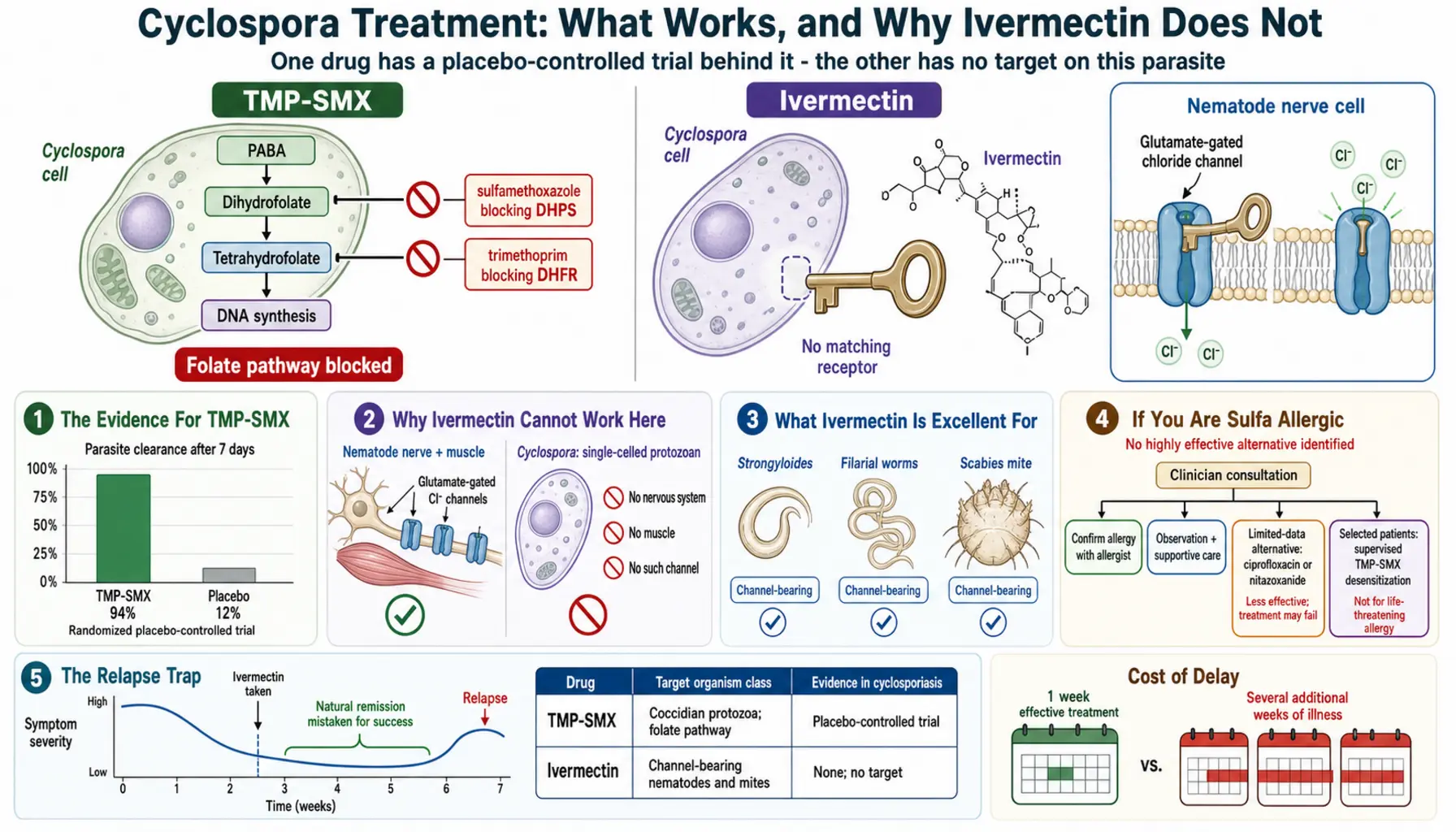
Cyclosporiasis is one of the more satisfying parasitic infections to treat, because there is a real answer. An old, cheap, widely stocked antibiotic combination clears it, and that was shown three decades ago in a properly designed trial with a placebo arm — rarer in parasitology than you might expect.
The other question people bring to this illness is ivermectin, and it deserves a straight answer rather than a brush-off. Ivermectin is a genuinely great drug — the discovery of the avermectins was recognised with a Nobel Prize in Physiology or Medicine, and it has spared millions of people from blindness and disability. Wondering whether it might help with a parasite in your gut is entirely reasonable. The answer is no, and the reason is specific, mechanical, and worth understanding rather than simply being told.
Everything described here is prescription medicine. Doses, durations and drug choices belong to a clinician who can see your test results, your other medicines and your allergy history. What this page can do is make sure you walk into that appointment knowing what the evidence actually says.
Interactive Visualization Cyclospora: From Contaminated Field to Relapsing Illness — watch why washing cannot save the salad Follow the parasite from irrigation water to your gut: rinse the leaves and watch it survive, chill the field so it never ripens, then treat it with the drug that works — and the one that has no target on it. Launch →Table of Contents
- TMP-SMX: The Treatment of Choice, and the Trial That Settled It
- Why It Works: Cutting a Folate Supply Line
- Fluids, Salt and Food: The Supportive Care That Carries You Through
- The Sulfa-Allergy Problem — the Real Clinical Difficulty
- When the Immune System Is Not Doing Its Share
- The Ivermectin Question, Asked in Good Faith
- What PubMed Actually Contains
- The Mechanism: A Superb Key With No Lock to Fit
- What Ivermectin Is Genuinely Excellent For — and One Honest Complication
- At a Glance: Four Drugs, Four Targets
- The Relapse Trap and the Real Cost of Choosing Wrong
- Key Research Papers
- Connections
- Featured Videos
1. TMP-SMX: The Treatment of Choice, and the Trial That Settled It
The treatment of choice for cyclosporiasis is trimethoprim–sulfamethoxazole. You will see it written several ways and they all mean the same thing: TMP-SMX, co-trimoxazole, Bactrim, Septra. It is not a new drug, it is not expensive, and it is not exotic. Most pharmacies have it on the shelf.
The evidence behind it comes from a study by Hoge and colleagues, published in The Lancet in 1995, carried out in Kathmandu among travellers and foreign residents in Nepal. It was randomized, double-blind and placebo-controlled — meaning patients were assigned to real drug or dummy tablets by chance, and neither they nor the researchers knew which was which until the end. That design is the whole point, and it is why this small trial still anchors treatment three decades later.
The result was unusually clean for a parasitic disease trial:
- After seven days, Cyclospora was still detectable in 1 of 16 treated patients — about 6%.
- In the placebo group, it was still detectable in 15 of 17 — about 88%.
Read those two numbers next to each other, because they carry two separate messages. The first says the drug works, and works quickly. The second says something people often miss: this infection does not simply go away in a week on its own. Nearly nine out of ten untreated patients were still carrying the parasite at day seven. Left alone, cyclosporiasis commonly runs for weeks, sometimes a month or longer, with symptoms that fade and return.
Later work has not overturned this. TMP-SMX stayed first-line through the treatment reviews of the following decades — Farthing on eradicating intestinal protozoa (PMID 16883348), both of Li and colleagues' 2020 cyclosporiasis reviews (PMID 32117814, PMID 31699163), Madico and colleagues in Peruvian children rather than travellers (PMID 9142805), and general primary-care references on intestinal parasites (PMID 37983700).
Treatment is a short oral course — the Kathmandu trial measured its outcome at seven days. Exact dose and duration are a prescribing decision that shifts with your kidney function, your other medicines and how sick you are. That is a clinician's call, not a number to copy off a web page.
2. Why It Works: Cutting a Folate Supply Line
TMP-SMX is two drugs in one tablet, and the pairing explains why an old antibiotic beats anything newer for this particular parasite.
Both halves attack folate. Folate is not a structural material; it is a delivery vehicle. Inside every dividing cell, folate-derived molecules ferry small carbon fragments to the assembly line that builds the letters of DNA. Cut off the folate and the cell cannot copy its own genome. It does not explode — it simply stops dividing, and a parasite that cannot divide cannot maintain an infection.
Here is the selectivity trick. You do not make your own folate. You eat it — leafy greens, legumes, fortified flour — and your intestine has dedicated transporters that pull the finished vitamin out of your food. Cyclospora, like many bacteria and like its coccidian relatives, cannot do that. It has to build folate from raw ingredients, step by step, using its own enzymes. Those enzymes are the target: the drug walks into a factory you do not operate.
And it blocks that factory twice. Sulfamethoxazole jams an early step in the pathway; trimethoprim jams the step immediately after it. Two roadblocks on the same one-way street are much harder to route around than one, which is why the combination is used rather than either drug alone.
Note the shape of that argument, because the ivermectin question below turns on exactly the same kind of question — does the drug's target exist in this organism at all? — and gets the opposite answer.
3. Fluids, Salt and Food: The Supportive Care That Carries You Through
Antibiotics do not rehydrate you. In a 24-hour stomach bug, supportive care barely matters — you feel awful, you drink some water, it ends. Cyclosporiasis is not that illness. The FDA's own description lists watery diarrhea with frequent bowel movements, loss of appetite, weight loss, cramping, bloating, gas, nausea and fatigue, and notes that untreated it can cause dehydration and severe complications. This can run for weeks, and over that timescale fluid, electrolyte and calorie losses compound.
Three practical points that matter more here than in a short illness:
- Plain water alone is not the best replacement. Watery stool carries out sodium and potassium along with the fluid. Oral rehydration solutions pair salt with a small amount of sugar on purpose — the gut absorbs sodium far more efficiently when glucose is transported alongside it, so the sugar is there to pull the salt and water across, not for calories.
- Weigh yourself. It is the least dramatic and most useful measurement available at home. Steady weight loss over days is objective evidence to bring to an appointment, in a condition where "I still feel terrible" is otherwise easily waved through as viral.
- Expect appetite to lag behind. Cyclospora develops inside the lining of the small intestine — Dubey and colleagues described that endogenous cycle in detail (PMID 32316032). That injury makes this a malabsorption illness as well as a fluid-loss one, and absorption takes time to recover even after the parasite is gone. See Gut Recovery and Malabsorption.
This is the one place on this page where the standard advice is not filler. Signs you should be seen rather than waiting it out: unable to keep fluids down, passing very little urine, dizziness on standing, confusion, or continued weight loss. Dehydration is what actually harms people in this infection, and it is entirely treatable if someone is watching for it.
4. The Sulfa-Allergy Problem — the Real Clinical Difficulty
If TMP-SMX worked for everyone, this page would be much shorter. The genuine clinical problem in cyclosporiasis is not resistance or cost. It is that sulfonamide allergy is among the more commonly reported drug allergies, and for someone who cannot take sulfa drugs the alternatives are limited and weaker. Reviews of the field say this plainly rather than pretending there is an equivalent second choice.
Ciprofloxacin — the studied fallback
The best-studied alternative is ciprofloxacin, which works by an entirely different route: it blocks the enzymes that unwind and re-seal DNA during copying. Verdier and colleagues ran a randomized controlled trial in HIV-infected patients in Haiti comparing TMP-SMX with ciprofloxacin for treatment and prevention of Cystoisospora (Isospora) belli and Cyclospora cayetanensis, in Annals of Internal Medicine in 2000 (PMID 10836915).
State the finding carefully, because it is genuinely mixed and often quoted as though it were purely positive. Ciprofloxacin was effective — and it was less effective than TMP-SMX. That makes it a real option for someone who cannot take sulfa, and not a reason to prefer it for someone who can.
Nitazoxanide, and one study that is not human evidence
Nitazoxanide is the other alternative that appears in the cyclosporiasis literature, including both of Li and colleagues' 2020 reviews (PMID 32117814, PMID 31699163). It is a broad antiprotozoal that interferes with an enzyme parasites use for anaerobic energy metabolism — again, a target humans do not rely on in the same way. Its support in this specific infection is review-level and clinical-experience-level; there is no nitazoxanide trial for cyclosporiasis with the design or clarity of Hoge 1995.
Go looking and you will quickly hit Hagras and colleagues, 2023, in PLOS Neglected Tropical Diseases (PMID 38100538), reporting strong efficacy of a nitazoxanide-loaded nanostructured lipid carrier. Read the label carefully: it is experimental work in an animal model, testing a new drug-delivery formulation that no pharmacy dispenses. A promising laboratory result, not a treatment option, and not human evidence. We flag it because it looks impressive in a results list and is easy to misread.
One thing worth raising if you carry a sulfa-allergy label: a good many people who believe they are sulfa-allergic turn out on formal assessment not to be — the label was often applied in childhood to a rash of uncertain cause. Where the first-line drug is this much better than the alternatives, that label is worth asking about.
5. When the Immune System Is Not Doing Its Share
In a person with a healthy immune system, the antibiotic and the immune response finish the job together. When the immune contribution is missing, treatment has to work harder and for longer.
People with advanced HIV, transplant recipients on immunosuppression, and patients on cancer chemotherapy get longer, more severe and more relapse-prone cyclosporiasis. The literature reflects this: Ramezanzadeh and colleagues on the global burden in people living with HIV and AIDS (PMID 35746750); La Hoz and Morris on intestinal parasites in solid organ transplant recipients (PMID 31145496); Einhorn and colleagues' case series of intestinal coccidian infections in cancer patients (PMID 37252590).
Two ordinary consequences follow:
- Longer courses. A duration that clears the parasite in an otherwise healthy traveller may not be enough when the immune system cannot mop up the remainder.
- Suppressive maintenance therapy. In some immunocompromised patients a lower ongoing dose is continued after the acute course to prevent relapse. The Verdier trial was built around exactly this question — it examined both treatment and prophylaxis.
If you are immunocompromised and a diarrheal illness has lasted more than a few days, the single most useful thing you can do is make sure Cyclospora is tested for by name. Routine stool culture does not find it. See Diagnosis and Testing.
6. The Ivermectin Question, Asked in Good Faith
Now the question the site is asked most often about this outbreak: does ivermectin treat Cyclospora?
First, give the question its due. Ivermectin is one of the most successful medicines ever developed. It came out of soil bacteria, its discovery earned a Nobel Prize in Physiology or Medicine, and it has been distributed by the hundreds of millions of doses in campaigns that pushed river blindness out of whole regions. It is cheap, remarkably well tolerated, and does things no other drug does. Nobody asking about it is being foolish.
The reasoning is also sound on its face: ivermectin is an antiparasitic, Cyclospora is a parasite, so ivermectin might help. The catch is that "parasite" is not a biological category the way "bacterium" is — it is a lifestyle description. It lumps together single-celled protozoa, half-metre-long roundworms, flatworms and mites, organisms about as closely related to each other as you are to a mushroom. A drug that is devastating to one branch of that group can be completely inert against another, which is exactly what happens here.
Two independent lines of argument point the same way: what the published evidence contains, and why it contains that. In order.
7. What PubMed Actually Contains
Rather than assert a conclusion, here are the actual searches, run against PubMed on 26 July 2026, and what came back. You can run them yourself in about thirty seconds — the links are in the Live PubMed Searches section below.
| Search terms | Records returned | What those records actually are |
|---|---|---|
| ivermectin AND Cyclospora | 2 | Neither is a treatment study. One is a case report about Strongyloides stercoralis, a roundworm (PMID 28366929). The other is a French-language overview of diagnosing and treating intestinal parasitosis, in which both words happen to appear (PMID 23266344). Both are incidental co-mentions. |
| ivermectin AND cyclosporiasis | 1 | Liu and Weller, "Antiparasitic drugs," New England Journal of Medicine 1996 (PMID 8602186) — a broad review covering many drugs and many parasites. It does not report ivermectin treating Cyclospora. The two terms simply both appear in a survey of the field. |
| avermectin AND coccidia | 0 | Nothing at all. Not a single record links the drug family to the parasite class Cyclospora belongs to. |
So: PubMed contains zero studies of ivermectin as a treatment for cyclosporiasis. Not a negative trial. Not a small trial. Not a case series. Nothing.
Ordinarily "absence of evidence is not evidence of absence" is a fair objection, and plenty of things are untested simply because nobody got around to them. That objection is much weaker here, for three reasons.
- Both drugs are old and cheap. Ivermectin has been in wide human use for decades; Cyclospora has caused recognised outbreaks since the 1990s. There has been ample time, ample motive and no cost barrier for someone to try the combination and publish it.
- The zero result is the informative one. "Avermectin AND coccidia" is deliberately broad — the whole drug family against the whole parasite class, including the veterinary literature, where Eimeria coccidiosis in poultry is a multi-billion-dollar problem that people have thrown every available compound at. If avermectins did anything against coccidia, the poultry industry would have found out decades ago.
- The gap is explained. Absence of evidence is weak when it stands alone; it is much stronger when a mechanism predicts exactly that absence. Here the empty search result and the molecular biology agree with each other — which is the next section.
8. The Mechanism: A Superb Key With No Lock to Fit
This is the heart of the matter, and it is genuinely elegant once you see it.
Ivermectin works by binding a structure called the glutamate-gated chloride channel, or GluCl — a gated pore through a cell's outer membrane. This particular channel sits in the nerve and muscle cells of nematodes (roundworms) and arthropods (mites, lice, insects), where it normally opens briefly in response to the signalling chemical glutamate.
Ivermectin binds it and holds it open. Chloride, a negatively charged ion, pours into the cell. The cell's internal voltage drops so far it can no longer fire, muscle stops responding to nerve signals, and the worm is paralysed, unable to feed or hold position, and dies. The pharmacology is well characterised: Wolstenholme and Rogers reviewed GluCl channels as the mode of action of the avermectin and milbemycin anthelmintics (PMID 16569295), McCavera and colleagues characterised an ivermectin-sensitive GluCl channel from the parasitic nematode Haemonchus contortus (PMID 19336526), and Kaji and colleagues worked out structural detail of how ivermectin and moxidectin act differently on a GluCl channel from C. elegans (PMID 34749053).
Now look at what Cyclospora cayetanensis is: a single-celled apicomplexan protozoan, one cell, in the same group as Cryptosporidium, Toxoplasma, Eimeria and the malaria parasites. It has no nervous system (no neurons, because there is only one cell), no muscle to paralyse, no neuromuscular junction, and no glutamate-gated chloride channel of the kind ivermectin binds.
Ivermectin is a key, and a beautifully made one. In this organism there is no lock. This is not a weak drug or the wrong dose — the molecular target it is built to engage is simply not part of this creature's anatomy.
And here is what makes the argument satisfying rather than merely negative: this same selectivity is exactly why ivermectin is so safe in humans. We do have distant relatives of those chloride channels in our nervous system, but they sit behind the blood–brain barrier, which at normal doses keeps the drug out of the compartment where it could do harm (PMID 35225114). Ivermectin's remarkable tolerability and its inactivity against protozoa are the same fact seen from two sides. You cannot keep the safety and wish away the narrow spectrum.
9. What Ivermectin Is Genuinely Excellent For — and One Honest Complication
None of the above is a knock on the drug. It is worth being concrete about what ivermectin does superbly, because the pattern makes the argument visible.
- Strongyloidiasis. Ivermectin is the treatment of choice for Strongyloides stercoralis, a roundworm that can persist in a person for decades and turn lethal under immunosuppression. Gordon and colleagues' 2024 review in Nature Reviews Disease Primers covers it in full (PMID 38272922).
- Soil-transmitted helminths. Hookworm, whipworm and their relatives — Hürlimann and colleagues reviewed ivermectin and moxidectin against these infections (PMID 36804383).
- Onchocerciasis and lymphatic filariasis. River blindness and elephantiasis, both caused by filarial worms, and both targets of the mass drug administration campaigns that made ivermectin famous.
- Scabies. The Sarcoptes scabiei mite, covered in Fernando and colleagues' 2024 review (PMID 39362885) — and Demodex, the mite implicated in some forms of rosacea and blepharitis.
Every single one of those is a worm or a mite. Every single one has the glutamate-gated chloride channel. The drug's spectrum is not arbitrary; it maps exactly onto which organisms carry its target.
The honest complication: apicomplexans are not entirely off the table
Here is where an argument like this usually gets overstated, so we will not overstate it. It would be tidy to say "ivermectin cannot possibly affect any apicomplexan parasite." That claim would be too strong, and it is not what the literature shows.
There is real experimental interest in ivermectin against Plasmodium, the malaria parasite — itself an apicomplexan, in the same broad group as Cyclospora. Three examples, all in Antimicrobial Agents and Chemotherapy:
- Activity of ivermectin and its metabolites against P. falciparum liver stages in primary human hepatocytes in the laboratory (PMID 38904389).
- High-dose ivermectin combined with chloroquine against the liver stage of P. cynomolgi in rhesus macaques (PMID 32660993).
- Activity of ivermectin and its metabolites against asexual blood-stage P. falciparum in vitro (PMID 37338381).
These are legitimate studies and we are not going to pretend otherwise; reviews have catalogued interest in ivermectin well beyond its classical antiparasitic uses (PMID 38606261). The honest statement is that at high concentrations, in laboratory and animal systems, ivermectin can do things to at least one apicomplexan.
Now read the qualifiers, because they are the whole story:
- Cell-culture and animal studies, not treatments given to patients for that indication.
- High doses — concentrations chosen to probe an effect, not doses established as safe and effective therapy.
- A different genus with a very different life cycle: Plasmodium lives partly in liver and red blood cells and partly in a mosquito. Cyclospora does neither.
- No human cyclosporiasis data whatsoever — which is where this section started.
The practical conclusion is unchanged. "Not literally impossible in every apicomplexan under laboratory conditions" is a very long way from "a reason to take it for your gut infection instead of the drug with a placebo-controlled trial behind it."
10. At a Glance: Four Drugs, Four Targets
Putting the logic side by side makes it visible in one look. Notice that the last column follows from the second: a drug's evidence in cyclosporiasis tracks whether its target exists in the organism at all.
| Drug | Target organism class | Mechanism | Evidence in cyclosporiasis |
|---|---|---|---|
| TMP-SMX (co-trimoxazole, Bactrim, Septra) |
Bacteria and coccidian protozoa — organisms that must build their own folate | Blocks two consecutive steps of folate synthesis, starving the cell of the material it needs to copy DNA | Strongest. Randomized, double-blind, placebo-controlled trial: parasite still detected in 1 of 16 treated versus 15 of 17 on placebo at day 7 (Hoge 1995) |
| Ciprofloxacin | Bacteria; used as a fallback for coccidian protozoa | Blocks the enzymes that unwind and re-seal DNA during replication | Moderate. Randomized controlled trial in HIV-infected patients: effective, but less effective than TMP-SMX (Verdier 2000) |
| Nitazoxanide | A broad range of protozoa and some helminths | Interferes with an enzyme parasites use for anaerobic energy metabolism | Limited. Used as an alternative and described in review-level literature; no trial comparable to Hoge 1995. A 2023 nanocarrier study is animal/experimental only |
| Ivermectin | Nematodes (roundworms) and arthropods (mites, lice) | Locks open glutamate-gated chloride channels in nerve and muscle, paralysing the animal | None. Zero PubMed studies as a treatment for cyclosporiasis. The molecular target does not exist in a single-celled protozoan |
11. The Relapse Trap and the Real Cost of Choosing Wrong
Cyclosporiasis naturally remits and relapses. That is not a rare quirk but a defining feature, and the FDA states it in its own patient information: symptoms "may seem to go away and then return one or more times." Someone can feel genuinely, convincingly better for several days in the middle of an untreated infection that has weeks left to run.
Now put a person into that pattern. They feel awful for two weeks. They take something — any something. Three days later they feel dramatically better. What would anyone conclude? They will believe the remedy worked, and they will not be lying, exaggerating or trying to mislead when they tell a friend or post about it. They will be reporting their experience accurately. It is the inference that is wrong, not the person.
This is exactly why personal testimony is close to worthless for this particular illness, and exactly why the design of Hoge 1995 matters. Look again at the placebo arm: 15 of 17 people on dummy tablets still had the parasite at day seven, and some of them will certainly have felt better along the way. Without a placebo group you cannot tell a working drug from a natural remission. With one, you can — and the answer was unambiguous.
What choosing wrong actually costs
This is not a philosophical point. The cost is concrete and paid in weeks:
- More diarrhea — untreated, the illness commonly runs for weeks and can run past a month, in a remitting pattern that repeatedly raises and dashes hopes of recovery.
- Dehydration and electrolyte loss, compounding across that whole period rather than a day or two.
- Weight loss and malabsorption, because the parasite is damaging the small-bowel lining the entire time it is there. Longer infection means more injury and a longer recovery afterwards.
- More time off work, and for immunocompromised patients a materially higher risk of the illness turning severe or prolonged.
All of that in exchange for a roughly week-long course of a cheap, old, unremarkable antibiotic that reliably ends it.
The conversation worth having
If you have cyclosporiasis, or suspect it after eating implicated produce, the useful conversation with a clinician is short:
- Ask for Cyclospora to be tested for by name, and mention recent fresh-produce or restaurant exposure. Routine stool culture does not find it, and ova-and-parasite microscopy misses it unless specifically requested — see Diagnosis and Testing and the 2026 lettuce outbreak page.
- Ask about TMP-SMX. That is the drug with the trial behind it.
- If you are sulfa-allergic, say so early and ask about ciprofloxacin or nitazoxanide — and whether the allergy label is worth formally re-checking.
- If you are immunocompromised, say so early too. It changes treatment length and whether maintenance therapy is considered.
- Ask what to watch for. Dehydration is what actually causes harm here.
Ivermectin is a magnificent drug. Keep it for the worms.
Key Research Papers
- Hoge CW, et al. Placebo-controlled trial of co-trimoxazole for Cyclospora infections among travellers and foreign residents in Nepal. Lancet 1995. PMID: 7885125
- Verdier RI, et al. Trimethoprim-sulfamethoxazole compared with ciprofloxacin for treatment and prophylaxis of Isospora belli and Cyclospora cayetanensis infection in HIV-infected patients. Ann Intern Med 2000;132(11):885-8. PMID: 10836915
- Madico G, et al. Epidemiology and treatment of Cyclospora cayetanensis infection in Peruvian children. Clin Infect Dis 1997;24(5):977. PMID: 9142805
- Li J, et al. Advances in Cyclosporiasis Diagnosis and Therapeutic Intervention. Front Cell Infect Microbiol 2020;10:43. PMID: 32117814
- Li J, et al. Cyclospora cayetanensis infection in humans: biological characteristics, clinical features, epidemiology, detection method and treatment. Parasitology 2020;147(2):160-170. PMID: 31699163
- Farthing MJ. Treatment options for the eradication of intestinal protozoa. Nat Clin Pract Gastroenterol Hepatol 2006. PMID: 16883348
- Hagras NA, et al. Potent efficiency of the novel nitazoxanide-loaded nanostructured lipid carriers against experimental cyclosporiasis. PLoS Negl Trop Dis 2023. PMID: 38100538 — experimental animal-model study, not human evidence
- Liu LX, Weller PF. Antiparasitic drugs. N Engl J Med 1996;334(18):1178-84. PMID: 8602186 — the single record returned by "ivermectin AND cyclosporiasis"; a drug-class review, not a treatment report
- Wolstenholme AJ, Rogers AT. Glutamate-gated chloride channels and the mode of action of the avermectin/milbemycin anthelmintics. Parasitology 2005. PMID: 16569295
- McCavera S, et al. An ivermectin-sensitive glutamate-gated chloride channel from the parasitic nematode Haemonchus contortus. Mol Pharmacol 2009. PMID: 19336526
- Gordon CA, et al. Strongyloidiasis. Nat Rev Dis Primers 2024. PMID: 38272922
- Annamalai Subramani P, et al. Efficacy of ivermectin and its metabolites against Plasmodium falciparum liver stages in primary human hepatocytes. Antimicrob Agents Chemother 2024. PMID: 38904389 — laboratory study in a different genus; cited here for the honest nuance, not as cyclosporiasis evidence
Live PubMed Searches
- ivermectin AND Cyclospora
- ivermectin AND cyclosporiasis
- avermectin AND coccidia
- trimethoprim-sulfamethoxazole cyclosporiasis treatment
- nitazoxanide Cyclospora cayetanensis
- ivermectin glutamate-gated chloride channel
Official Guidance
- CDC — Cyclosporiasis (main topic page)
- FDA — Cyclospora topic page
- CDC — 2026 cyclosporiasis outbreak advisory
- CDC — outbreak investigation update
- FDA — investigation of the 9-state Cyclospora outbreak linked to iceberg lettuce
Connections
- All Parasites
- Cyclospora: From Contaminated Field to Relapsing Illness — interactive animation
- Cyclospora — main hub
- The 2026 iceberg lettuce outbreak
- Symptoms and the relapsing course
- Diagnosis and testing — ask for it by name
- Gut recovery and malabsorption after treatment
- Life cycle and sporulation
- Why washing produce does not work
- Produce safety at home
- Cyclospora vs other gut infections
- Cryptosporidium — a close coccidian relative
- Giardia — another treatable protozoan diarrhea
- Blastocystis
- Chronic diarrhea — when it lasts
- SIBO — small intestinal bacterial overgrowth
- Probiotics
- News — July 26, 2026
- Satoshi Ômura — the Nobel laureate behind ivermectin, and what the drug does and does not treat
- Ivermectin Pharmacology & Safety — why the mechanism only touches certain parasites