How Cyclospora Is Diagnosed: Why the Standard Stool Test Misses It
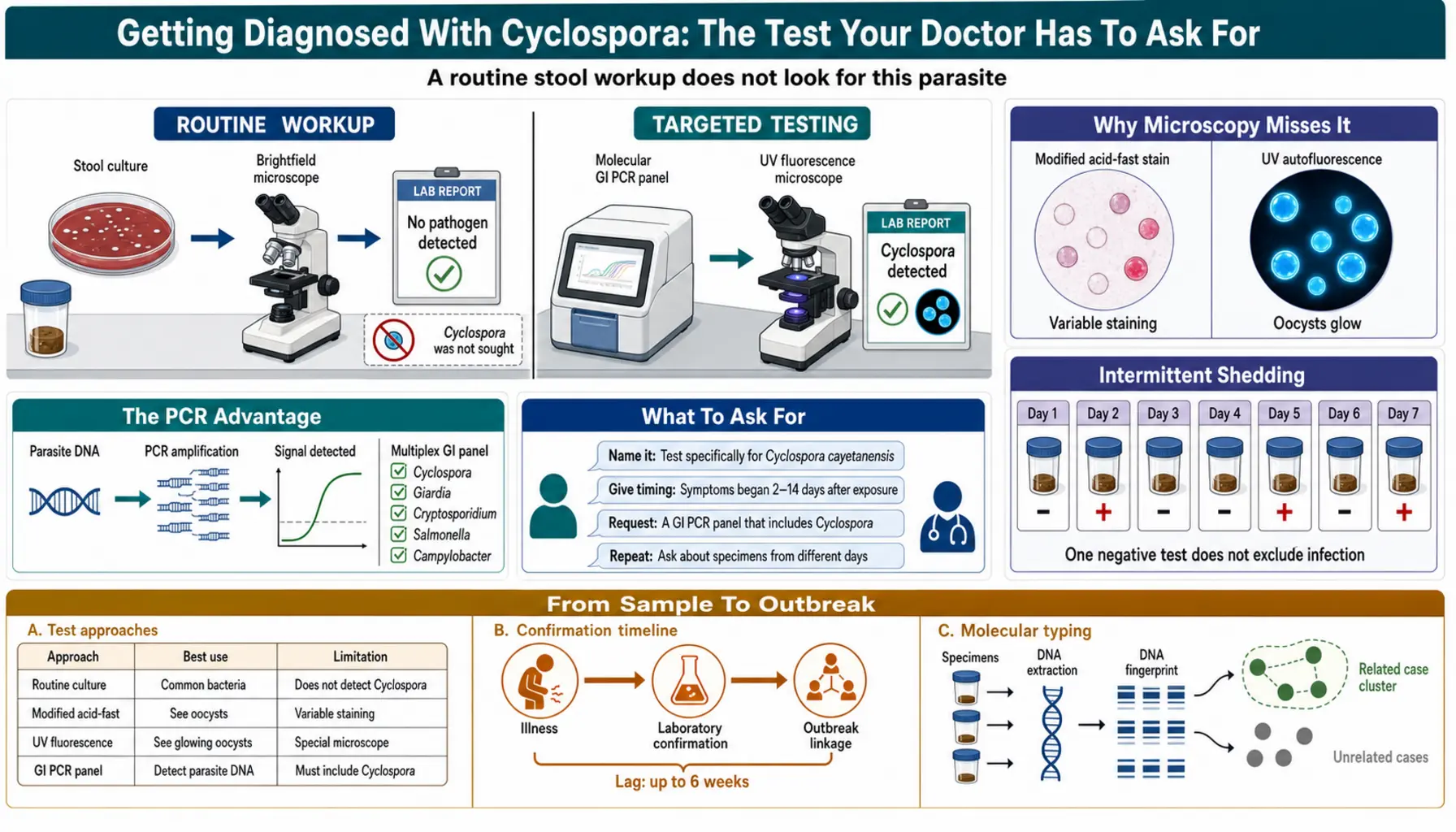
If you have been sick for weeks — watery diarrhea that eases off and then comes back, appetite gone, weight dropping — and someone told you your stool test was normal, please read this before you accept that answer. A routine stool workup will very likely miss Cyclospora cayetanensis. Not because your laboratory was careless, and not because you are imagining things, but because of how the tests are built. Standard bacterial stool culture does not look for this organism at all. Ordinary ova-and-parasite (O&P) microscopy will only find it if the laboratory is specifically asked to look. A result that reads "no pathogens isolated" or "no ova or parasites seen" is a true statement about what was examined. It is not a statement about Cyclospora unless Cyclospora was on the request.
That is the whole practical point of this page: somebody has to order Cyclospora testing by name. Below are the words to say, the reason microscopy is genuinely difficult (the parasite is tiny and stains unreliably), why a single negative stool does not rule this out, and what modern molecular panels do differently. There is also a plain-English explanation of why public-health case counts keep climbing for weeks after a recall — a question a great many people are asking during the 2026 iceberg-lettuce outbreak.
One more reason to push for an answer: this is not a case where the label makes no difference. There is a specific, well-studied prescription treatment for cyclosporiasis, and it works. Getting the name attached to your illness is what unlocks it.
Interactive Visualization Cyclospora: From Contaminated Field to Relapsing Illness — watch why washing cannot save the salad Follow the parasite from irrigation water to your gut: rinse the leaves and watch it survive, chill the field so it never ripens, then treat it with the drug that works — and the one that has no target on it. Launch →Table of Contents
- Why "Your Tests Were Normal" Often Is Not the End of the Story
- Order It By Name: The Request That Actually Gets You Tested
- Why the Parasite Is So Hard to See Under a Microscope
- Intermittent Shedding: Why One Negative Stool Proves Very Little
- Molecular Testing: Hunting for DNA Instead of a Picture
- The Test Approaches Side by Side
- What to Actually Ask For
- Genotyping, and Why Case Counts Keep Rising After a Recall
- Under-Diagnosed and Under-Reported: What Surveillance Can and Cannot See
- What a Diagnosis Actually Changes
- Key Research Papers
- Official Guidance
- Connections
- Featured Videos
1. Why "Your Tests Were Normal" Often Is Not the End of the Story
People say "stool test" as though it were one thing. In a laboratory it is at least three completely different procedures, looking for completely different targets.
Bacterial stool culture smears your sample onto nutrient plates and waits for bacteria to grow into visible colonies — the usual suspects behind food poisoning. Cyclospora is not a bacterium. It is a single-celled protozoan parasite, a coccidian in the same broad group as Cryptosporidium and Toxoplasma. It does not grow on those plates, it is not what the plates are read for, and no amount of incubation will make it appear. A clean culture result tells you nothing whatsoever about this parasite. This is the single most common source of false reassurance in the entire sequence.
Ova-and-parasite (O&P) microscopy is the one people assume covers anything with the word "parasite" in it. A technologist concentrates the sample and examines slides under a microscope for worm eggs and protozoan cysts. Cyclospora can be found this way — but in most laboratories it is not part of the routine read. It needs a specific extra stain, or a specific light source, or both, and those get added when someone requests them. This is where the miss happens, and it is why so many people with cyclosporiasis are told they are fine.
Molecular (PCR) testing is the newer route, and the one most likely to catch this organism — provided the panel your laboratory runs includes it.
An analogy that fits uncomfortably well: it is like asking a locksmith whether your house is secure and being told "the front door is fine." Perfectly accurate. Also not an answer to the question you were asking, if the problem is a window at the back.
None of this is a scandal. Laboratories run what is ordered, and a full parasite workup on every diarrhea sample in the country is not realistic. The system is designed around the clinician specifying the question — which means, in practice, that the question has to get specified.
2. Order It By Name: The Request That Actually Gets You Tested
Here is the most useful thing in this article. When you talk to a clinician, or type into a patient-portal message, use the organism's name:
"I would like to be tested for Cyclospora cayetanensis specifically. I understand a routine stool culture and a standard O&P do not detect it unless it is requested by name."
Then give the exposure and the timeframe, because that is what justifies the order and gets it approved:
"I ate shredded iceberg lettuce on [date], and my symptoms started on [date]. I know there is an ongoing multi-state Cyclospora outbreak linked to iceberg lettuce."
The FDA's own public advice during the 2026 outbreak is to see a clinician if you have symptoms, "especially if you ate shredded iceberg lettuce in the two weeks before you got sick." You are not being difficult by asking. You are quoting the agency running the investigation.
Two details make this land better. First, "by name" means the words actually appear on the laboratory requisition or get selected in the electronic order set — not merely discussed in the room. It is worth asking, plainly and without embarrassment, "will Cyclospora be written on the order?" Second, if you have already had a negative test, say which test it was. "My stool culture was negative" and "my GI PCR panel was negative" are wildly different pieces of information, and only the second one is genuinely reassuring.
3. Why the Parasite Is So Hard to See Under a Microscope
Even when the laboratory is looking, this organism is a hard find. Three things work against the technologist at the eyepiece.
It is very small. Cyclospora oocysts — the tough environmental stage that gets swallowed and later shed — are roughly 8 to 10 micrometres across, around a hundredth of a millimetre. At that scale, in a field crowded with food residue, plant fibre, yeast and debris, a small round object with no obvious internal detail does not announce itself. It looks like a great many other small round objects.
It stains unreliably. The classic microscopy approach is a modified acid-fast stain, which is meant to dye the oocysts a distinctive colour against a counterstained background. Cyclospora is variably acid-fast: some oocysts take the dye strongly, some faintly, and some barely at all — on the same slide, from the same patient. So the stain that is supposed to make the parasite jump out can under-stain it into invisibility, and a technologist who has only seen textbook-perfect slides may not recognise the washed-out version.
The most reliable trick needs special equipment. Cyclospora oocysts autofluoresce — the oocyst wall glows on its own under ultraviolet illumination, with no dye added at all. This is the most characteristic feature the laboratory has, and it is striking when you see it. But it requires a fluorescence microscope with the right filters, and a technologist who knows to switch to UV and look. Neither is guaranteed in a general hospital laboratory on a Tuesday afternoon. McHardy and colleagues' review of how intestinal protozoa are detected in the clinical laboratory (2014) lays out exactly this dependence on staining technique and operator experience. It is a recognised weak point of the method, not a local failing.
4. Intermittent Shedding: Why One Negative Stool Proves Very Little
This is the point most worth understanding if you have already had a negative test and are still sick.
Cyclospora is not shed into stool at a steady rate. Output rises and falls, and there are stretches when very few oocysts are leaving the body at all. So "were there parasites in this sample?" is partly a question about when the sample was collected. Catch a low period and the slide is genuinely empty, no matter how skilled the technologist. The infection is still there.
The consequence is straightforward: a single negative stool does not exclude cyclosporiasis. Where suspicion is high — a compatible illness, a known exposure, an ongoing outbreak — repeat testing on samples collected across several days may be needed before a negative result carries real weight.
Think of photographing a bird that visits the feeder some days and not others. One photograph of an empty feeder does not tell you the bird has left the neighbourhood. Several photographs on several days, all empty, start to mean something. This is also why "we tested you and it was negative" and "we tested you three times across a week and it was negative" are not the same sentence, even though both reach the patient as "your test was negative."
5. Molecular Testing: Hunting for DNA Instead of a Picture
Molecular testing is the modern answer to everything above, and it is worth understanding why it works better, because that understanding is what lets you ask for it intelligently.
Microscopy asks a human being to recognise the parasite by sight. PCR does not try to see anything. It goes looking for a specific stretch of the parasite's DNA — a sequence belonging to Cyclospora and to nothing else in the sample — then copies that stretch over and over, doubling it each cycle, until there is enough to detect. If the sequence is present, even in tiny amounts, the copying takes off and the instrument registers a signal. If it is absent, nothing amplifies and the signal stays flat.
The consequences are the ones you would hope for. The result does not depend on how well the organism took a stain, on whether the technologist has seen this parasite before, or on there being enough oocysts to spot by eye. It is looking for a molecular barcode, and it either finds the barcode or it does not.
Multiplex gastrointestinal panels are the version most patients will meet. These run one stool sample against a whole list of causes at once — bacteria, viruses and parasites in a single cartridge — and Cyclospora is on that list. The BioFire FilmArray gastrointestinal panel is the widely used example, evaluated across multiple sites for the diagnosis of infectious gastroenteritis by Buss and colleagues (2015). This is why "GI PCR panel" is a phrase worth having in your vocabulary: it is often the single order that answers your parasite question and everything else at the same time.
Dedicated real-time PCR assays exist too, aimed squarely at this organism. Qvarnstrom and colleagues described molecular detection of Cyclospora cayetanensis in human stool using UNEX-based DNA extraction with real-time PCR (2018). Weinreich and colleagues compared three different real-time PCR assays head to head on stool samples (2022). Balan and colleagues developed and evaluated a refined, highly specific real-time PCR method built on mitochondrial primers (2023). These are typically run by reference or public-health laboratories rather than the hospital down the road, which is why your sample may be sent out.
One honest caveat: a panel only reports what is on it. Panels differ between manufacturers and between laboratories, and not every version carries every parasite. "The PCR panel was negative" is only reassuring about Cyclospora if Cyclospora was one of the targets. That is a fair and specific thing to ask.
6. The Test Approaches Side by Side
Turnaround varies enormously depending on whether a test runs in-house or gets shipped to a reference laboratory, so treat the timing column as a rough shape rather than a promise from your own lab.
| Test | What it detects | Must be requested by name? | Rough turnaround | Main limitations |
|---|---|---|---|---|
| Routine bacterial stool culture | Bacteria that grow on the laboratory's nutrient plates | Not applicable — it cannot detect Cyclospora at all | A few days, while cultures grow | Completely blind to protozoan parasites. A negative culture says nothing about Cyclospora. |
| Standard ova-and-parasite (O&P) microscopy | Worm eggs and protozoan cysts visible on a concentrated smear | Yes — usually finds Cyclospora only when specifically requested | Usually days | The routine read may not include the stain or the UV light this parasite needs. |
| Modified acid-fast stain | Oocysts dyed against a counterstained background | Yes | Usually days | Cyclospora is variably acid-fast, so oocysts can under-stain and be missed. |
| UV autofluorescence microscopy | The natural glow of the oocyst wall under ultraviolet light | Yes | Usually days | Needs a fluorescence microscope and a technologist who knows to switch to UV and look. |
| Multiplex GI PCR panel (e.g. BioFire FilmArray GI) | DNA of many gut pathogens at once, Cyclospora among them | Usually no — but confirm the panel in use lists Cyclospora | Often the fastest route once the sample reaches the instrument | Reports only the targets it carries; availability differs between laboratories. |
| Dedicated real-time PCR for Cyclospora | A Cyclospora-specific DNA sequence, amplified until detectable | Yes | Longer if the sample ships to a reference laboratory | Not offered everywhere; often a send-out rather than an in-house test. |
| Molecular typing / genotyping (public health) | A genetic fingerprint used to link cases into outbreak clusters | Not a test you order — performed on confirmed cases by public health | Weeks; the FDA notes it can take up to six weeks to confirm a case belongs to an outbreak | Answers a population question, not your clinical one. It will not change your treatment. |
Read down the "requested by name" column and the shape of the problem is obvious. Almost every route that can actually find this organism by eye requires somebody to have asked for it first.
7. What to Actually Ask For
A short, concrete list to bring to an appointment or paste into a portal message. Keep it to these five points — a focused request gets taken more seriously than a long one.
- Name the organism. "Please test me for Cyclospora cayetanensis." Not "a parasite test." The name is what makes the difference on the requisition.
- Give the exposure and the dates. What you ate, where, roughly when, and when symptoms began. Shredded iceberg lettuce, a restaurant meal, a specific week — this is the information that ties your illness to the outbreak and justifies the order.
- Ask whether a GI PCR panel is available, and whether it includes Cyclospora. Both halves matter. Availability varies, and so do the target lists.
- Ask about repeat sampling. "If the first sample is negative and I am still having symptoms, can we collect another on a different day?" Explain, if you need to, that shedding is intermittent.
- Ask what happens if it is positive. There is a specific prescription treatment for cyclosporiasis, and knowing that in advance turns the test from an academic exercise into a decision that leads somewhere.
If you meet resistance, the most persuasive thing you can say is not a demand but a fact: a negative bacterial culture and a routine O&P do not exclude this parasite, and there is an active multi-state outbreak tied to the exact food you ate. That is a reasonable clinical argument, and most clinicians will respond to it.
8. Genotyping, and Why Case Counts Keep Rising After a Recall
There is a second kind of testing going on in the background. It will not change your care, but it explains a great deal of what you see in the news.
Your diagnostic test answers a question about you: is this parasite in my gut? Public-health laboratories ask a different question about the population: are these hundreds of separately reported illnesses, in different states, actually the same event? A microscope cannot answer that — one Cyclospora oocyst looks like another. The answer has to come from the parasite's genome.
Cinar and colleagues described molecular typing of Cyclospora cayetanensis in produce and clinical samples using targeted enrichment of complete mitochondrial genomes (2020) — in effect reading enough of each parasite's genetic sequence to tell strains apart. Ahart and colleagues then evaluated, retrospectively, how an integrated molecular-and-epidemiological approach performed in real United States cyclosporiasis outbreak investigations (2023). The principle matches what is done for bacterial foodborne outbreaks: if the genetic fingerprints from patients in five states closely match each other, those illnesses probably share a source, even when the patients have nothing else in common.
This is slow for structural reasons, not bureaucratic ones. The chain runs roughly: you get sick, you eventually seek care, a clinician orders the right test, the laboratory runs it, a positive is reported to the state, the specimen is forwarded, sequencing and comparison are performed, and the result is matched against interview data about what each person ate. Every link takes real time, and the first three are the ones patients control least.
Why the numbers keep climbing after the product is gone
The FDA states plainly that case counts will keep rising despite the recall, because it can take up to six weeks to confirm that a given case belongs to the outbreak. The number published today is therefore largely a picture of illnesses that began weeks ago and have only just finished their journey through testing, reporting and matching. A rising count is not by itself evidence that contaminated product is still out there making new people sick. Much of the time it is the paperwork of older illnesses catching up.
As of the FDA's July 24, 2026 update, the iceberg-lettuce outbreak stood at 1,947 laboratory-confirmed illnesses and at least 98 hospitalizations, with no deaths, across nine states (Illinois, Indiana, Kansas, Kentucky, Michigan, Ohio, Oklahoma, Pennsylvania and West Virginia). Illness onsets ranged from June 22 to July 20, 2026, and the investigation was ongoing. The FDA noted that part of the jump in the count came from adding four new states to the outbreak — another reminder that the number moves for reasons unrelated to new exposures.
The same detection difficulty explains something else that confuses people: as of that update there were no confirmed positive product samples. Finding this parasite on a leaf is extraordinarily hard for exactly the reasons this page has been describing — it is microscopic, present in small numbers, and notoriously difficult to recover from produce. The case against the lettuce rests instead on epidemiology and traceback converging on a single supplier, which is normal and sufficient for public-health action. What that convergence looks like in practice: Michigan's health department analyzed food exposures among 190 cases who had eaten at Taco Bell, and 90% reported eating iceberg lettuce.
9. Under-Diagnosed and Under-Reported: What Surveillance Can and Cannot See
Every number you read about cyclosporiasis is a floor, not a ceiling. That is not spin; it is arithmetic, and the agencies say so themselves.
For a case to reach a national count, several things must all happen. The person has to feel bad enough to seek care. A clinician has to suspect a parasite rather than assume a stomach bug. That clinician has to order the right test, by name. The laboratory has to be able to run it, or to send it somewhere that can. And the positive result has to be reported onward. Fail at any one step — and section 1 of this page is essentially a catalogue of ways to fail at the third — and a real infection never becomes a counted case. The CDC's own framing is that the true case count is likely higher, because some people recover without ever being tested.
Casillas, Hall and Herwaldt's national surveillance summary of cyclosporiasis in the United States covering 2011 through 2015 (2019;68(3):1-16) is the standing reference for what routine surveillance for this parasite actually captures. It is the right document if you want to understand the shape of reporting rather than one outbreak's headline.
There is a second source of confusion worth untangling, because it produces two different "official" numbers for the same outbreak. The FDA and CDC count only laboratory-confirmed cases. States often publish higher numbers because they also count probable cases — people whose illness and exposure fit the outbreak but who never had a confirming laboratory result. Michigan's own tally therefore runs well above the federal figure. Both numbers are true. They count different things, and neither is being dishonest. When two figures do not match, the question is not "which one is lying?" but "which definition is this using?"
Finally, the FDA notes that the illnesses in this outbreak are a subset of the Cyclospora infections identified nationwide. There is ordinary background cyclosporiasis in the United States every year with no connection to any particular recall. A positive test does not automatically mean you were part of the lettuce outbreak — and, importantly, it does not change your treatment either way.
10. What a Diagnosis Actually Changes
It is fair to ask whether chasing a name is worth the trouble. For some infections the honest answer is that a label changes very little: you rest, you rehydrate, it passes. Cyclosporiasis is not one of those.
There is a specific effective treatment, and it is a prescription. What clinicians prescribe is trimethoprim–sulfamethoxazole, also called co-trimoxazole. Its use rests on a randomized, double-blind, placebo-controlled trial run by Hoge and colleagues in Kathmandu (1995): after seven days, Cyclospora was still detectable in 1 of 16 treated patients (6%) compared with 15 of 17 on placebo (88%). That is an unusually clean result for an intestinal parasite, and it is precisely why the diagnosis is worth having. People with a sulfa allergy have fewer options and need a conversation about alternatives — covered on the treatment page, along with an honest look at the drugs that do not work against this organism.
A diagnosis also ends the diagnostic merry-go-round. Untreated cyclosporiasis can run for weeks to a month or longer, with a characteristic pattern of seeming to resolve and then returning. Without a name, that pattern gets relabelled as stress, as a lingering post-infectious gut problem, or as irritable bowel syndrome — and the person spends months being managed for the wrong thing. A positive test replaces a shrug with a plan.
And it protects you from a specific trap. Because this illness naturally remits and relapses, anyone who happens to start a remedy during a natural remission will conclude, sincerely, that the remedy worked — and when symptoms return, that they need more of it. A confirmed diagnosis plus a treatment with real trial evidence behind it is how you step off that loop instead of riding it for weeks.
So: if you have had persistent diarrhea for more than a few days — especially if you ate shredded iceberg lettuce in the two weeks before it started — see a clinician and ask for Cyclospora testing by name. If the first sample is negative and you are still ill, ask for another on a different day. That is the whole message, and it is worth being politely persistent about.
Key Research Papers
- McHardy IH, et al. Detection of intestinal protozoa in the clinical laboratory. Journal of Clinical Microbiology 2014. PMID: 24197877
- Buss SN, et al. Multicenter evaluation of the BioFire FilmArray gastrointestinal panel for etiologic diagnosis of infectious gastroenteritis. Journal of Clinical Microbiology 2015. PMID: 25588652
- Qvarnstrom Y, et al. Molecular detection of Cyclospora cayetanensis in human stool specimens using UNEX-based DNA extraction and real-time PCR. Parasitology 2018. PMID: 29113617
- Weinreich F, et al. Comparison of three real-time PCR assays for the detection of Cyclospora cayetanensis in stool samples. Pathogens 2022. PMID: 35215106
- Balan KV, et al. Development and single laboratory evaluation of a refined and specific real-time PCR detection method using mitochondrial primers. Journal of Food Protection 2023. PMID: 36916572
- Cinar HN, et al. Molecular typing of Cyclospora cayetanensis in produce and clinical samples using targeted enrichment of complete mitochondrial genomes. Parasites & Vectors 2020. PMID: 32143704
- Ahart L, et al. Retrospective evaluation of an integrated molecular-epidemiological approach to cyclosporiasis outbreak investigations — United States. Epidemiology and Infection 2023. PMID: 37466070
- Casillas SM, Hall RL, Herwaldt BL. Cyclosporiasis surveillance — United States, 2011-2015. MMWR Surveillance Summaries 2019;68(3):1-16. PMID: 31002104
- Li J, et al. Advances in cyclosporiasis diagnosis and therapeutic intervention. Frontiers in Cellular and Infection Microbiology 2020;10:43. PMID: 32117814
- Almeria S, et al. Cyclospora cayetanensis and cyclosporiasis: an update. Microorganisms 2019;7(9):317. PMID: 31487898
- Ortega YR, Sanchez R. Update on Cyclospora cayetanensis, a food-borne and waterborne parasite. Clinical Microbiology Reviews 2010;23(1):218-34. PMID: 20065331
- Hoge CW, et al. Placebo-controlled trial of co-trimoxazole for Cyclospora infections among travellers and foreign residents in Nepal. The Lancet 1995. PMID: 7885125
Live PubMed Searches
- Cyclospora cayetanensis diagnosis
- Cyclospora real-time PCR stool
- Multiplex gastrointestinal PCR panel parasites
- Intestinal protozoa microscopy acid-fast stain
- Cyclospora molecular typing outbreak
- Cyclosporiasis surveillance United States
Official Guidance
- FDA — Cyclospora topic page
- CDC — Cyclosporiasis home
- FDA — Investigation of a 9-state outbreak of Cyclospora illnesses linked to iceberg lettuce (July 2026)
- CDC — Outbreak advisory
- CDC — Investigation update
- FDA — Recall notice: iceberg lettuce from central Mexico
Connections
- All Parasites
- Cyclospora: From Contaminated Field to Relapsing Illness — interactive animation
- Cyclospora — main hub
- The 2026 iceberg-lettuce outbreak
- Symptoms and the relapsing course
- Treatment, and the ivermectin question
- Cyclospora vs. other gut infections
- Life cycle and sporulation
- Why washing does not work
- Gut recovery and malabsorption
- Produce safety at home
- Cryptosporidium
- Giardia
- Blastocystis
- Chronic diarrhea
- SIBO
- Probiotics
- My Healthcare News — July 26, 2026