Cyclospora vs Other Gut Infections: Telling Them Apart
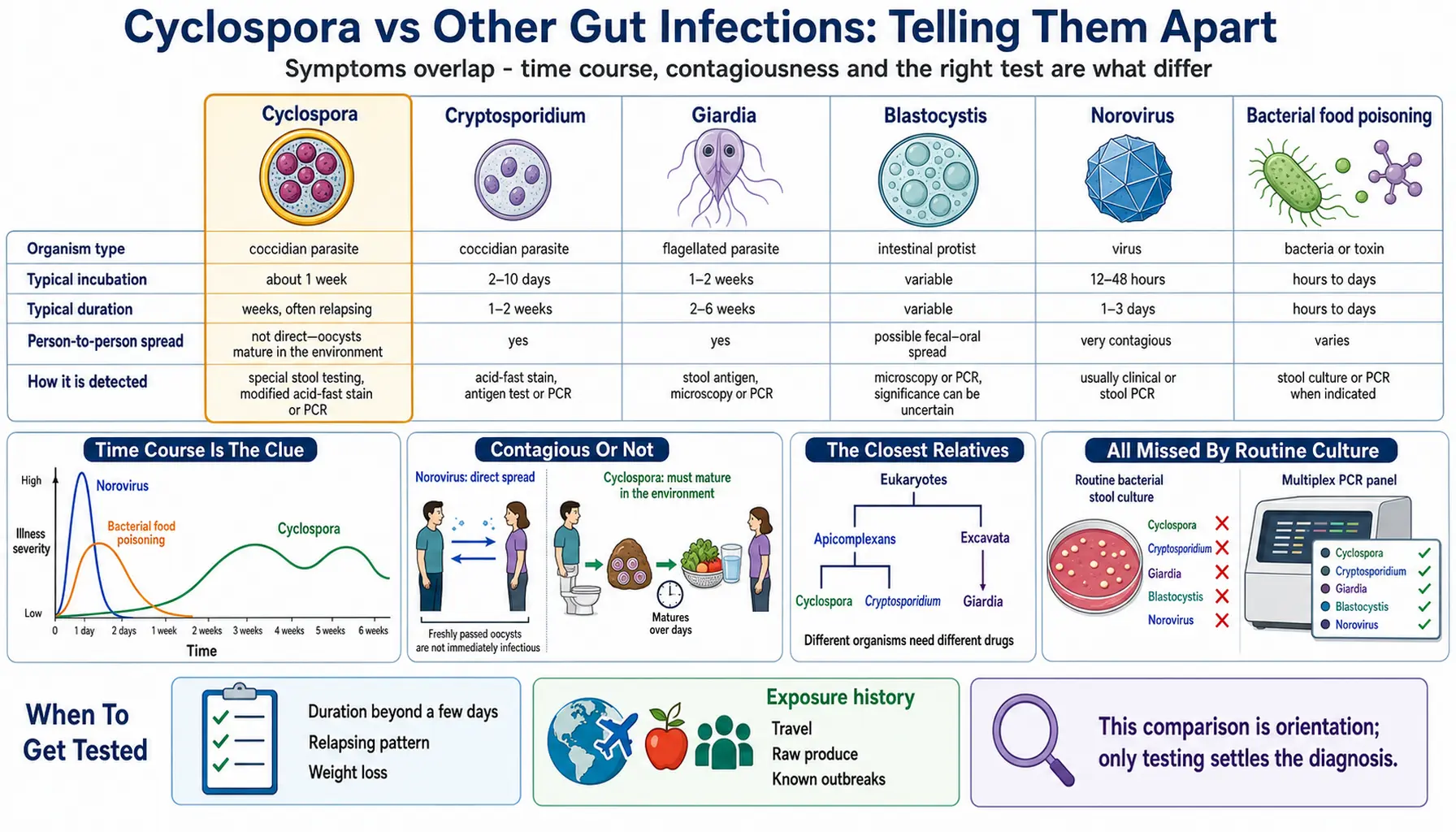
If you are reading this while unwell, you probably want one thing: a name for what is happening to you. This page cannot give you that. Nothing written here, and no symptom checklist anywhere, can distinguish Cyclospora cayetanensis from the half-dozen other things that cause the same misery. The overlap is not a minor technicality — watery diarrhoea, cramping, bloating, gas, nausea and exhaustion are the shared vocabulary of nearly every gut infection there is. A stool test settles it. Nothing else does.
What this page can do is orient you. Because while the symptoms overlap almost completely, three other things differ in ways you can actually observe from your own sofa: how long the illness lasts, whether it spreads to the people around you, and which laboratory test finds it. Those three axes are genuinely useful. They will not diagnose you, but they will tell you whether "wait it out" is a reasonable plan, and they will tell you what to ask your clinician to order — which matters enormously, because several of these organisms are invisible to the test most people assume covers everything.
Cyclospora is the reference point throughout, since that is the parasite behind the 2026 iceberg-lettuce outbreak. But the comparisons run both ways. If your illness lasted forty-eight hours and half your household got it too, this page will tell you why that pattern points firmly away from Cyclospora. That is a useful answer as well.
Interactive Visualization Cyclospora: From Contaminated Field to Relapsing Illness — watch why washing cannot save the salad Follow the parasite from irrigation water to your gut: rinse the leaves and watch it survive, chill the field so it never ripens, then treat it with the drug that works — and the one that has no target on it. Launch →Table of Contents
- Why Symptoms Alone Will Not Tell You Which One You Have
- The Three Things That Actually Differ
- Six Common Causes, Side by Side
- Cyclospora vs Norovirus: The Sharpest Contrast
- Cyclospora vs Ordinary Food Poisoning: The Shape of the Arc
- Cyclospora vs Cryptosporidium: The Close Relative
- Cyclospora vs Giardia: The Easiest One to Confuse
- Cyclospora vs Blastocystis: The Contested One
- What They All Share: The Routine Stool Test Misses Them
- Features That Should Push You Toward Testing
- Where to Go From Here
- Key Research Papers
- Official Guidance
- Connections
- Featured Videos
1. Why Symptoms Alone Will Not Tell You Which One You Have
Here is the uncomfortable truth at the centre of this page: the gut has a very small vocabulary. Whatever is irritating it — a virus, a bacterium, a protozoan parasite — the small intestine responds in more or less the same ways. It secretes fluid. It stops absorbing properly. It moves things along faster. The result is watery stool, cramping, gas and fatigue, and that result looks broadly the same no matter what caused it.
The FDA's own symptom list for cyclosporiasis reads like a description of almost any gut infection: watery diarrhoea with frequent bowel movements, loss of appetite, weight loss, stomach cramps and pain, bloating, increased gas, nausea and fatigue. Vomiting, body aches, headache and fever may also be noted. Some infected people have no symptoms at all. Take that list to any other organism on this page and most of it still fits.
Reviews of protozoal gut infection say the same thing in more formal language. Wright's overview of protozoan infections of the gastrointestinal tract, Hechenbleikner and McQuade's review of parasitic colitis, and Pyzocha and colleagues' summary of common intestinal parasites for family physicians all converge on one point: clinical presentation is a poor discriminator among these organisms. The history narrows the possibilities; the laboratory decides.
So treat everything below as orientation, not diagnosis. The right use of this page is to walk into an appointment able to say "this has gone on for three weeks, it went away and came back, I lost weight, and I ate a lot of shredded lettuce beforehand" — and then to ask what test would find a parasite. That sentence is worth more than any amount of symptom-matching.
2. The Three Things That Actually Differ
If symptoms are a dead end, what is not? Three things, and they are things you can observe without a laboratory.
Time course. This is the single most informative feature available to a patient. Norovirus is measured in days. Ordinary bacterial food poisoning is measured in days to about a week. Cyclospora, untreated, is measured in weeks to a month or longer, and it characteristically remits and relapses — the FDA notes that symptoms "may seem to go away and then return one or more times." An illness still going strong in week three is telling you something real. It is not proof of a parasite, but it has quietly eliminated the two most common causes.
Transmissibility. Whether the people around you got sick too is a genuine clue, and for Cyclospora specifically it is a strong one. Cyclospora oocysts are not infectious when they are freshly shed. They have to sit in the environment and sporulate — roughly one to two weeks at permissive temperatures — before they can infect anyone. That biological delay means cyclosporiasis is not passed person to person the way a stomach virus is. You cannot catch it from your partner, and your partner cannot catch it from you. Dubey, Khan and Rosenthal's review of the life cycle sets this out, and it is the reason outbreak investigations always end up pointing at a shared food or water source rather than a shared household.
Which test finds it. This is the axis nobody tells patients about, and it is the one that most often causes weeks of avoidable delay. A "stool test" is not one test. A routine bacterial stool culture is looking for bacteria and will find nothing else. Ova-and-parasite microscopy finds parasites only if the laboratory applies the right stain and is looking for the right thing. Cyclospora in particular usually has to be asked for by name. Meanwhile a multiplex molecular panel tests for many organisms at once and does not care what the clinician suspected. Knowing which of these was actually run on your sample changes how much a "negative result" is worth.
3. Six Common Causes, Side by Side
This is the heart of the page. Read the Cyclospora row first, then read across the other rows for contrast. Every cell is deliberately short — these are orientation cues, not clinical parameters.
| Cause | Organism type | Typical incubation | Typical duration untreated | Person-to-person spread | Hallmark features | How it is usually detected |
|---|---|---|---|---|---|---|
| Cyclospora cayetanensis | Single-celled coccidian protozoan (phylum Apicomplexa); oocysts about 8–10 µm | About a week (commonly quoted as roughly 2–14 days) | Weeks to a month or longer | No. Oocysts must sporulate in the environment for about 1–2 weeks before they are infectious | Prolonged watery diarrhoea that remits and relapses; heavy fatigue; appetite and weight loss; linked to fresh produce and water | Must usually be requested by name. UV autofluorescence and modified acid-fast staining, or PCR — including multiplex GI panels |
| Cryptosporidium | Single-celled coccidian protozoan (also Apicomplexa) — Cyclospora's nearest relative in this table | Around a week | Roughly one to a few weeks; longer and more severe if immunocompromised | Yes. Faecal–oral; classically associated with recreational water and childcare settings | Watery diarrhoea and cramping; notably tolerant of chlorine, so pools and water systems feature in outbreaks | Usually requested specifically. Acid-fast staining, antigen testing, or PCR / multiplex GI panel |
| Giardia | Single-celled flagellated protozoan — a different branch of life from the two above | Around one to two weeks | Weeks or longer; can relapse | Yes. Faecal–oral; cysts are infectious as passed | Bloating, foul-smelling gas, greasy or floating stools, weight loss; classic after untreated surface or well water | Antigen testing, PCR / multiplex GI panel, or O&P microscopy |
| Blastocystis | Single-celled protist; one of the most commonly found organisms in human stool | Not well defined | Can persist for months or years, often quietly | Faecal–oral spread is described | Frequently present in people with no symptoms; its role as a cause of illness is genuinely contested | Stool microscopy or PCR / multiplex GI panel — often an incidental finding |
| Norovirus | Virus | About a day or two | Typically one to three days | Yes — intensely. Sweeps through households, ships, care homes and schools | Abrupt onset, prominent vomiting alongside diarrhoea, several people ill at once, over quickly | Often diagnosed on the clinical picture alone; included on multiplex GI panels |
| Bacterial food poisoning (e.g. Salmonella, Campylobacter) | Bacteria | Hours to a few days | Usually several days to about a week | Limited; predominantly foodborne rather than household spread | Fever and marked cramping; stool is sometimes bloody; one sharp illness that resolves rather than returning | Routine stool culture — this is exactly what culture is designed to find. Also on PCR panels |
How to read this table honestly. The Cyclospora row is drawn from the cited literature and from the FDA's own materials. The other rows are deliberately kept general — broad, uncontroversial descriptions rather than precise figures — because incubation periods and durations vary widely between individuals, between sources, and between studies. Do not use a range in this table to rule anything in or out. Use the table to notice which patterns your illness resembles, and then get tested.
4. Cyclospora vs Norovirus: The Sharpest Contrast
This is the easiest distinction on the page, and it is worth putting first because it resolves a large share of real-world confusion.
Norovirus is the illness most people mean when they say "stomach bug." It arrives fast, usually within a day or two of exposure. It hits hard, typically with vomiting as a prominent feature alongside the diarrhoea. It is extraordinarily contagious — it moves person to person through households, offices, schools and cruise ships, which is why it produces those characteristic clusters where four people in one house are ill within a day of each other. And then, for most healthy adults, it is over in a couple of days.
Cyclospora is the near-opposite on every one of those axes. It takes about a week to declare itself, so the meal that caused it is already a fading memory. It is not spread person to person at all, because of the sporulation delay described above — the parasite you shed today is not capable of infecting anyone for another week or two, by which time it is in the sewage system rather than on your doorknob. And instead of resolving in days, it drags on for weeks, fading and returning.
So the practical rule is close to a clean test:
- Whole household ill within a day or two of each other, everyone better inside 48 hours? That is not this parasite. That pattern is essentially incompatible with Cyclospora biology.
- One person ill, no one else in the house affected, still unwell in week two or three? That pattern fits Cyclospora and is worth investigating — particularly if there was a shared restaurant meal or fresh produce exposure about a week before symptoms started.
There is a corollary that patients find reassuring, and it is true: if you have laboratory-confirmed cyclosporiasis, you are not a danger to your family. You do not need to isolate from them to protect them. Normal hand hygiene after using the toilet remains sensible for every reason it is always sensible, but the specific fear — that you will give this to your children — does not apply here.
5. Cyclospora vs Ordinary Food Poisoning: The Shape of the Arc
Most people have had bacterial food poisoning at least once, so they have a template in their head for what "something I ate" feels like. That template is the problem, because Cyclospora violates it.
Ordinary bacterial food poisoning — Salmonella, Campylobacter and the general category around them — has a recognisable arc. It starts within hours to a couple of days of the meal, often close enough that people correctly identify the culprit. It builds, often with fever and hard cramping, sometimes with blood in the stool. It peaks. Then it recedes, and within about a week most healthy people are functionally recovered. It is a single event with a beginning, a middle and an end.
Cyclospora has a different shape entirely. It is slow to start, prolonged, and relapsing. The week-long incubation breaks the mental link to the meal. The illness then settles in rather than peaking — watery diarrhoea, profound fatigue, appetite collapse and weight loss over weeks rather than days. And critically, it can appear to resolve and then come back, sometimes more than once. The FDA describes symptoms that "may seem to go away and then return one or more times."
That relapsing pattern is the most misleading feature of the whole illness. When you feel better on day ten you conclude you are recovering; when you feel terrible again on day fourteen you conclude you have caught something new, or eaten something else bad, or that this is "just stress now." All three conclusions are wrong, and all three delay diagnosis. The fluctuation is not you imagining things, and it is not a sign that the illness is trivial.
There is one more practical difference. Bacterial food poisoning is the one category on this page that a routine stool culture is actually built to detect. If your clinician sent a standard culture and it came back negative, that is meaningful information — it argues against the bacteria. It says nothing whatsoever about the four parasites and the virus in the table above.
6. Cyclospora vs Cryptosporidium: The Close Relative
Cryptosporidium is the organism in this table most closely related to Cyclospora. Both are coccidian protozoa in the phylum Apicomplexa — single-celled parasites that live inside intestinal cells, alongside relatives such as Cystoisospora belli, Toxoplasma and Plasmodium. Both are spread by contaminated water and contaminated fresh produce. Both are shed as environmentally tough oocysts that resist the disinfection people assume is sufficient. Ortega and colleagues tested gaseous chlorine dioxide against Cryptosporidium parvum, Cyclospora cayetanensis and Encephalitozoon intestinalis on produce precisely because these organisms present the same food-safety problem: they survive on the surfaces we eat raw.
Clinically they are also similar — watery diarrhoea, cramping, appetite loss — and both cause longer, more severe illness in people with weakened immune systems.
Two differences are worth carrying with you. The first is contagiousness. Cryptosporidium is transmitted person to person by the faecal–oral route; it is a familiar cause of outbreaks in childcare settings and swimming pools, helped by an unusual tolerance of chlorine. Cyclospora, because of its sporulation requirement, simply cannot do this. If a household or a swim class went down together, Cyclospora is not the explanation.
The second difference is treatment, and it is the reason getting the right name matters rather than settling for "some kind of parasite." Cyclosporiasis has a well-established drug. Hoge and colleagues ran a randomised, double-blind, placebo-controlled trial of co-trimoxazole (trimethoprim–sulfamethoxazole, TMP-SMX) in Nepal; after seven days, Cyclospora was still detectable in 1 of 16 treated patients — about 6% — compared with 15 of 17 on placebo, about 88%. That is a decisive result, and TMP-SMX remains what clinicians prescribe for this parasite. Cryptosporidiosis in a person with a normal immune system does not have an equally reliable answer; management leans much more heavily on supportive care. Farthing's review of treatment options for eradicating intestinal protozoa makes the broader point that these organisms differ substantially in how treatable they are and in which drugs work.
That head-to-head comparison of treatability is general clinical understanding rather than something the trials cited here measured directly — but the practical implication is solid enough to act on. Two parasites that produce nearly identical weeks of illness have very different prospects once named, and only one of them has a drug with a placebo-controlled trial behind it. That is why "we found a parasite" is not a finished diagnosis, and why the species matters.
7. Cyclospora vs Giardia: The Easiest One to Confuse
If Cryptosporidium is the closest biological relative, Giardia is the closest clinical impostor. Of everything on this page, this is the pair most likely to be genuinely mistaken for one another by a patient, and sometimes by a clinician who has not ordered the right test.
Look at what they share. Both cause diarrhoea that lasts weeks rather than days. Both produce prominent bloating and excessive gas — often the symptom patients complain about most, ahead of the diarrhoea itself. Both cause weight loss, partly through appetite collapse and partly because the small intestine is not absorbing properly. Both are associated with contaminated water and with travel. And crucially, both can relapse, so the confusing wave pattern described earlier does not distinguish them either. Weitzel and colleagues' GeoSentinel analysis of intestinal protozoa in returning travellers found both organisms among the parasites recovered from people who came home unwell — they occupy the same clinical territory.
Biologically, however, they are not close at all. Giardia is a flagellated protozoan — a swimming, teardrop-shaped organism that attaches to the lining of the small intestine. Cyclospora is a coccidian that develops inside intestinal cells in the jejunum, which is what Dubey and colleagues described in working out its endogenous developmental cycle. Different organisms, different biology, and — the part that matters to you — different drugs. The medication that clears one is not the medication that clears the other. This is a case where guessing is genuinely expensive: an incorrect assumption can mean additional weeks of illness before anyone reconsiders.
Two soft pointers, offered as tendencies rather than rules. Giardia has a strong classical association with untreated surface or well water — camping, hiking, drinking from a stream, a rural water supply. Cyclospora in North America is much more strongly associated with fresh produce, which is exactly what the 2026 iceberg-lettuce outbreak demonstrates. Neither association is reliable enough to decide anything on its own, but both are worth mentioning when you describe your exposures, because they help a clinician choose what to order.
8. Cyclospora vs Blastocystis: The Contested One
Blastocystis belongs in this comparison for a reason that has nothing to do with how similar it is to Cyclospora, and everything to do with what happens when it turns up on a test result.
Blastocystis is one of the most commonly detected organisms in human stool worldwide. It is frequently found in people who feel completely well. And its status as a cause of disease is genuinely contested — not settled-but-debated-at-the-edges, but actively unresolved. Some researchers regard certain subtypes as capable of causing symptoms; others regard it largely as a normal member of the gut community that happens to be visible under a microscope. Honest sources say so rather than picking a side.
Why this matters for someone in the middle of a long gut illness: finding Blastocystis does not close the case. If a stool test comes back with Blastocystis and nothing else, and your illness has the arc described on this page — a week of incubation, weeks of relapsing watery diarrhoea, weight loss, an exposure to fresh produce or a restaurant meal during a known outbreak — then it is entirely reasonable to ask whether Cyclospora was specifically tested for. A common incidental finding can very easily sit alongside the organism actually making you ill, and a positive result for something benign is one of the most effective ways a real diagnosis gets missed.
The contrast with Cyclospora is stark on this point. Cyclospora is not a bystander. It is not a normal gut inhabitant, humans are its only known natural host, and every outbreak traces back to human faecal contamination of food or water. If Cyclospora is in your stool, it is the story — there is no ambiguity to argue about, and there is a drug with trial evidence behind it. That difference in interpretive weight is the reason both organisms appear in the same table.
9. What They All Share: The Routine Stool Test Misses Them
Set aside the differences for a moment, because there is one thing four of the six entries in that table have in common, and it explains an enormous amount of patient frustration.
A routine bacterial stool culture will not find any of the parasites. Culture works by growing bacteria on plates. Cyclospora, Cryptosporidium, Giardia and Blastocystis are not bacteria and will not grow on those plates. Neither will norovirus. If your test was a standard culture and it came back "no growth" or "negative," the correct interpretation is narrow: it argues against Salmonella, Campylobacter and their relatives. It does not mean your stool was examined and found clean.
Traditional ova-and-parasite microscopy is a step closer, but it is not a guarantee either. Cyclospora oocysts are small — about 8–10 µm — and identifying them relies on specific techniques: ultraviolet autofluorescence, under which the oocysts glow, and modified acid-fast staining, which they take up variably. McHardy and colleagues' review of detecting intestinal protozoa in the clinical laboratory lays out how method-dependent this work is. The practical consequence is blunt: the laboratory generally has to be told to look for Cyclospora by name. A general request for "ova and parasites" may not trigger the right stain.
There is a further trap. Cyclospora is shed intermittently. Even when the laboratory is looking correctly, a single stool sample collected on a low-shedding day can be negative in someone who genuinely has the infection. Repeat testing across several days is sometimes what it takes. One negative result does not close the door.
Multiplex GI PCR panels changed this picture substantially. Instead of asking "is this organism present?" one at a time, a molecular panel tests a single stool sample for a whole list of bacteria, viruses and parasites simultaneously — and it does not depend on the clinician having suspected the right thing in advance. Buss and colleagues' multicentre evaluation of the BioFire FilmArray gastrointestinal panel showed what these platforms deliver for diagnosing infectious gastroenteritis, and Cyclospora is among the targets included. This is the single most useful thing to know when you are asking for testing: a panel that includes Cyclospora removes the need for anyone to have guessed correctly first.
So the question worth asking out loud is not "can I have a stool test?" It is: "Which test are you sending, and does it include Cyclospora?" Those are different questions with very different answers.
10. Features That Should Push You Toward Testing
Most gut infections do not need a laboratory. They arrive, they are unpleasant, they resolve, and testing would not have changed anything. That is genuinely the right call for the majority of short illnesses. The features below are the ones that shift the balance — the points at which "wait it out" stops being the better plan.
- Duration beyond a few days. The most useful single trigger. Norovirus and most bacterial food poisoning have declared themselves and started resolving well before this. An illness still going in the second week has already ruled out the common explanations by outlasting them.
- A relapsing pattern. Better, then worse, then better again. This is characteristic of cyclosporiasis and is frequently misread as two separate illnesses. If you have improved and then deteriorated, say exactly that — it is diagnostic information, not a complication of your story.
- Weight loss. Losing weight signals that the small intestine is failing to absorb nutrients, not merely losing fluid. Cyclospora develops in the jejunum, which is precisely where absorption happens, and that is why malabsorption — rather than dehydration alone — is part of this illness.
- Recent travel. Travel widens the list of plausible organisms considerably and is one of the most useful things you can tell a clinician. The GeoSentinel data on returning travellers exists because this history genuinely predicts what turns up.
- Recent raw produce or restaurant exposure during a known outbreak. Specifically relevant right now. The FDA advises seeing a clinician if you have symptoms, "especially if you ate shredded iceberg lettuce in the two weeks before you got sick." Because Cyclospora takes about a week to incubate, cast your memory back further than feels natural — the meal responsible is probably not the most recent suspicious one.
- Being immunocompromised. This changes the calculation entirely. People with weakened immune systems — from HIV, cancer treatment, transplant medication or other causes — get longer and more severe illness, are more likely to relapse, and often need longer courses of treatment. Do not wait out a prolonged gut illness in this situation. Get it identified.
- Signs of dehydration, or an inability to keep fluids down. This is the one that overrides all the reasoning above regardless of cause. Dizziness on standing, very little urine, confusion or persistent vomiting are reasons to seek care promptly, not to keep reading comparison tables.
One note on framing, because it comes up constantly: none of this is about being a difficult patient. Asking "does the test you are sending include Cyclospora?" is a specific, answerable, entirely reasonable question, and during a documented multi-state outbreak it is a question clinicians are actively expecting. You are not overriding anyone's judgement by supplying the exposure history and the time course. You are supplying the two pieces of information that most reliably point at the right test.
11. Where to Go From Here
This page deliberately stops at orientation. Two sibling articles carry the detail, and duplicating them here would only produce two versions to keep in step.
If your next question is "what exactly should be tested, and how do I ask for it?" — go to Diagnosis and Testing, which covers what the different stool tests look for, why a single negative does not exclude the infection, and how molecular panels changed what is possible. If your question is instead "is what I am experiencing consistent with this?" — go to Symptoms and the Relapsing Course, which works through the illness in detail, including why the remitting–relapsing pattern is so disorienting and what recovery tends to look like. And if you are here because of the 2026 outbreak specifically, the 2026 iceberg-lettuce outbreak page tracks the case numbers, the recall and the traceback as the FDA and CDC report them.
The single sentence to carry away: symptoms will not tell you which of these you have, but time course, contagiousness and the right test will — and only one of those three requires a laboratory.
Key Research Papers
- Wright SG. Protozoan infections of the gastrointestinal tract. Infectious Disease Clinics of North America 2012. PMID: 22632642
- Hechenbleikner EM, McQuade JA. Parasitic colitis. Clinics in Colon and Rectal Surgery 2015. PMID: 26034403
- Pyzocha N, et al. Common Intestinal Parasites. American Family Physician 2023. PMID: 37983700
- Weitzel T, et al. Intestinal protozoa in returning travellers: a GeoSentinel analysis from 2007 to 2019. Journal of Travel Medicine 2024. PMID: 38245913
- Giangaspero A, Gasser RB. Human cyclosporiasis. The Lancet Infectious Diseases 2019;19(7):e226-e236. PMID: 30885589
- Ortega YR, Sanchez R. Update on Cyclospora cayetanensis, a food-borne and waterborne parasite. Clinical Microbiology Reviews 2010;23(1):218-34. PMID: 20065331
- Legua P, Seas C. Cystoisospora and cyclospora. Current Opinion in Infectious Diseases 2013. PMID: 23982239
- Dubey JP, Khan A, Rosenthal BM. Life Cycle and Transmission of Cyclospora cayetanensis: Knowns and Unknowns. Microorganisms 2022;10(1):118. PMID: 35056567
- Buss SN, et al. Multicenter evaluation of the BioFire FilmArray gastrointestinal panel for etiologic diagnosis of infectious gastroenteritis. Journal of Clinical Microbiology 2015. PMID: 25588652
- McHardy IH, et al. Detection of intestinal protozoa in the clinical laboratory. Journal of Clinical Microbiology 2014. PMID: 24197877
- Farthing MJ. Treatment options for the eradication of intestinal protozoa. Nature Clinical Practice Gastroenterology & Hepatology 2006. PMID: 16883348
- Hoge CW, et al. Placebo-controlled trial of co-trimoxazole for Cyclospora infections among travellers and foreign residents in Nepal. The Lancet 1995. PMID: 7885125
Also referenced above: Ortega YR, Mann A, Torres MP, Cama V. Efficacy of gaseous chlorine dioxide as a sanitizer against Cryptosporidium parvum, Cyclospora cayetanensis, and Encephalitozoon intestinalis on produce. Journal of Food Protection 2008;71(12):2410-4. PMID: 19244892 · Dubey JP, et al. Endogenous Developmental Cycle of the Human Coccidian Cyclospora cayetanensis. Journal of Parasitology 2020. PMID: 32316032
Live PubMed Searches
- Cyclospora differential diagnosis diarrhea
- Multiplex gastrointestinal PCR panel protozoa
- Persistent diarrhea intestinal protozoa travelers
- Cryptosporidium Cyclospora Giardia comparison
- Blastocystis pathogenicity controversy
- Norovirus versus parasitic gastroenteritis duration
Official Guidance
- CDC — Cyclosporiasis (home page)
- FDA — Cyclospora topic page (symptom list, exposure advice)
- FDA — Investigation of 9-state outbreak of Cyclospora illnesses linked to iceberg lettuce (July 2026)
- CDC — Outbreak advisory
- CDC — Investigation update
- FDA — Recall notice (iceberg lettuce from central Mexico)
Connections
- All Parasites
- Cyclospora: From Contaminated Field to Relapsing Illness — interactive animation
- Cyclospora: Hub
- Diagnosis and Testing
- Symptoms and the Relapsing Course
- The 2026 Iceberg-Lettuce Outbreak
- Life Cycle and Sporulation
- Why Washing Does Not Work
- Treatment and the Ivermectin Question
- Gut Recovery and Malabsorption
- Produce Safety at Home
- Cryptosporidium
- Giardia
- Blastocystis
- Chronic Diarrhea
- SIBO
- Probiotics
- News: July 26, 2026