Cyclospora, Malabsorption, and Recovering Your Gut Afterward
If you are reading this after weeks of cyclosporiasis, nobody needs to tell you that something more than a stomach upset has happened. Clothes fit differently. Stairs are harder. People have started saying you look thin in the tone that means they are worried, and you did not choose any of it.
There is a biological reason for that, and it is not a failure of willpower. Cyclospora cayetanensis does its damage in the exact part of the digestive tract where nutrition happens. This is not a plumbing problem at the far end of the system; it is injury to the absorbing surface itself, sustained over weeks rather than days. The page below marks clearly where the advice rests on evidence about this parasite and where it rests on general post-infectious principles, because that distinction matters and is usually blurred.
Interactive Visualization Cyclospora: From Contaminated Field to Relapsing Illness — watch why washing cannot save the salad Follow the parasite from irrigation water to your gut: rinse the leaves and watch it survive, chill the field so it never ripens, then treat it with the drug that works — and the one that has no target on it. Launch →Table of Contents
- 1. Where This Parasite Actually Lives
- 2. Villi and the Brush Border
- 3. Malabsorption in Plain Terms
- 4. Why Weeks Matter More Than Days
- 5. What the Evidence Supports, and Where General Principles Begin
- 6. Rehydration Done Properly
- 7. Eating Through It, and Eating Afterward
- 8. Dairy and the Temporary Lactose Problem
- 9. Your Gut Bacteria After a Course of TMP-SMX
- 10. When Lingering Symptoms Are Not Still the Parasite
- 11. Who Needs Closer Nutritional Attention
- Key Research Papers
- Official Guidance
- Connections
- Featured Videos
1. Where This Parasite Actually Lives
Most people picture an intestinal infection as something happening near the exit. That model is wrong here, and correcting it explains most of what follows.
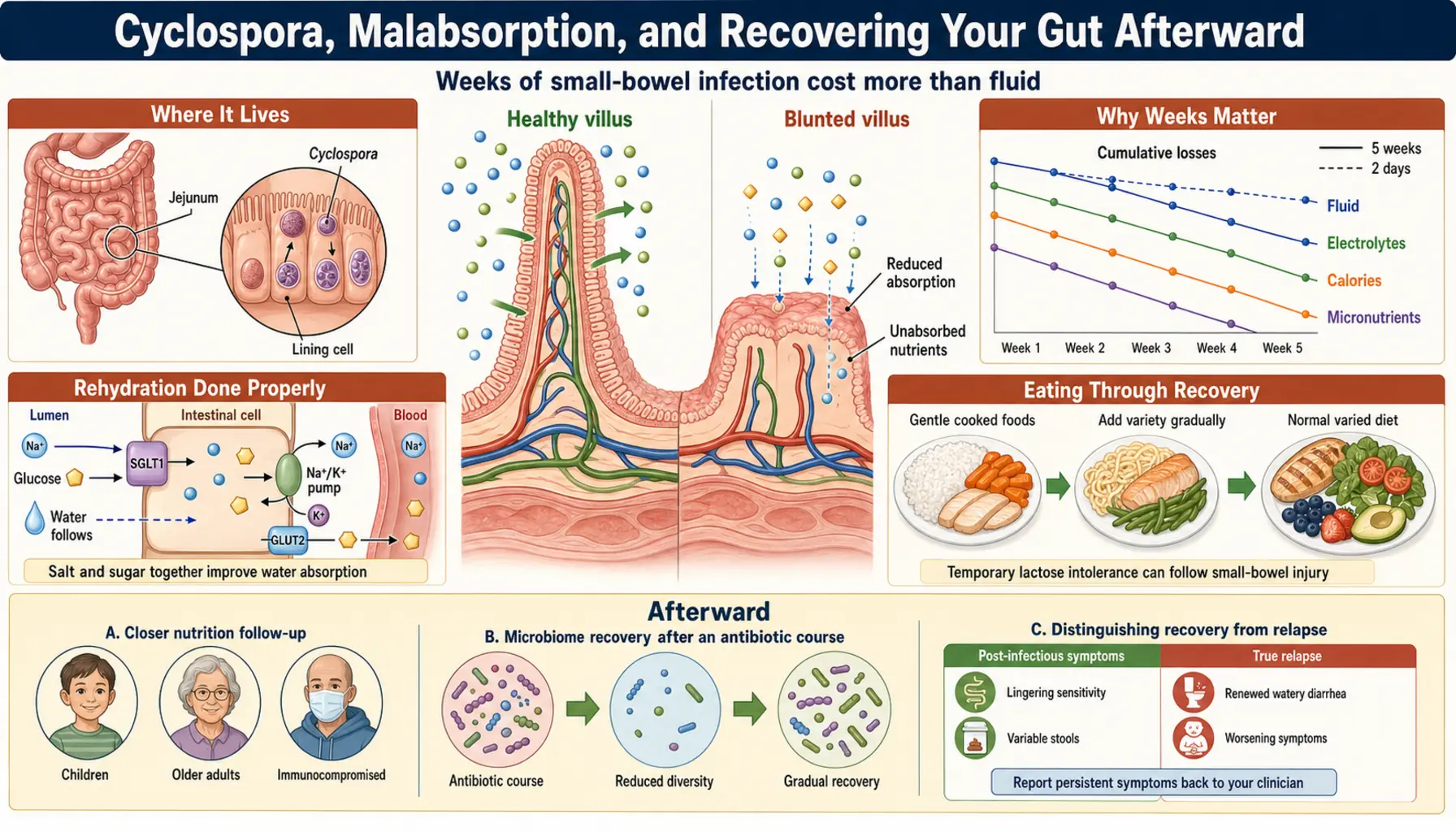
Cyclospora cayetanensis completes its endogenous development inside the cells lining the small intestine, with the jejunum of particular interest. Dubey and colleagues documented that cycle stage by stage inside small-bowel epithelial cells. It is not a passenger drifting along in the intestinal contents; it gets inside the lining cells and develops there.
The small intestine is where absorption happens. The colon is largely a water-recovery and fermentation chamber; the small intestine takes your food apart and moves the resulting sugars, amino acids, fatty acids, vitamins and minerals across into your body. Ortega's review and the later update by Ortega and Sanchez both place this infection in that small-bowel territory, and broader reviews of gastrointestinal protozoal disease, by Wright and by Hechenbleikner and McQuade, describe the same pattern of mucosal involvement. So when someone calls this "a stomach bug," the location is understated. The parasite has been living in the part of you that feeds you.
2. Villi and the Brush Border
The inside of your small intestine is not a smooth pipe. It is covered in villi, microscopic finger-like projections, and each cell on them carries a finer fringe of microvilli called the brush border — the difference between a bare wall and a wall covered in deep shag carpet. The same length of tube ends up with an enormously larger working surface, and the digestive enzymes and nutrient transporters are embedded in it.
So your capacity to absorb food is proportional to how much intact absorptive surface you have, and that surface is built of living cells a parasite can occupy and damage, with inflammation shrinking the working area further.
Think of a harbour with a fixed number of docks. Ships arrive on schedule regardless. If half the docks are shut for repairs, the ships do not stop coming and they do not wait politely. They pass through and leave with cargo still aboard. Nothing was wrong with the food you ate. The unloading capacity was reduced.
3. Malabsorption in Plain Terms
Malabsorption is the clinical word for exactly that: food passes through without being fully taken up. The calories were on the plate and the vitamins were in the meal; they did not all make it across the wall and into you. This is why the FDA's symptom list for this illness runs watery diarrhoea, loss of appetite, weight loss, cramps and abdominal pain, bloating, increased gas, nausea and fatigue, with vomiting, body aches, headache and fever also possible. Weight loss and deep fatigue are on that list not by coincidence but as the visible consequences of a surface not absorbing at full capacity.
- Eating more does not straightforwardly fix it while the infection is active. More ships to a damaged harbour does not unload more cargo, which is why forcing large meals often produces bloating rather than nourishment.
- Bloating and gas are informative. Carbohydrate not absorbed in the small intestine travels on to the colon, where resident bacteria ferment it, and fermentation makes gas.
- The fatigue is not psychological. Weeks on partial fuel and partial micronutrient intake, plus broken sleep and an active immune response, fully explains it.
Cyclosporiasis is treatable, and none of this is meant to alarm you. It is so recovery makes sense as a repair process with a timeline, rather than something that should have ended the moment the pills ran out.
4. Why Weeks Matter More Than Days
A forty-eight-hour illness costs you fluid, a little electrolyte and two days of appetite. Almost everyone absorbs that without lasting consequence, which is why the cultural script for food poisoning is rest, fluids, it passes. Cyclosporiasis does not follow that script. Incubation is roughly a week, commonly quoted as two to fourteen days, and untreated illness can last weeks to a month or longer, with a characteristic remitting and relapsing course. The FDA states plainly that symptoms "may seem to go away and then return one or more times."
Now multiply. Two days of losses is two days. Thirty days is fifteen times that exposure, and it is not only fluid, because the absorbing surface is compromised the whole stretch. You run a continuous shortfall in fluid, in electrolytes lost in stool alongside the water, in calories through reduced appetite and reduced absorption at once, and in the micronutrients ordinarily taken up across that same surface.
The relapsing pattern makes this quietly worse: each remission feels like recovery, so people restart work and exercise on a body that has rebuilt nothing yet, and then the next wave arrives. As of the FDA's July 24, 2026 update, illness onsets in the current outbreak ranged from June 22 through July 20, 2026, and at least 98 people among 1,947 laboratory-confirmed cases had been hospitalised, with no deaths reported. Hospitalisation here is usually about dehydration and being unable to keep up with losses, which is a duration problem as much as a severity one. Treat this as a marathon injury, not a sprint.
5. What the Evidence Supports, and Where General Principles Begin
This section exists because much of what circulates online about "healing your gut after a parasite" is invented with total confidence.
What the cited literature on this parasite supports: that it develops inside the epithelial cells of the small intestine, the jejunum specifically named in the endogenous developmental work; that the clinical picture includes prolonged watery diarrhoea, anorexia and weight loss; that the illness is often protracted and relapsing; and that small-bowel involvement of this kind is the recognised mechanism behind malabsorption, rather than fluid loss alone.
What is not established for this parasite, and is therefore not claimed here: a list of named nutrient deficiencies with percentages attached to cyclosporiasis; figures for how many patients develop iron, B12, zinc or fat-soluble vitamin deficiency; a validated timeline for villous recovery after this infection; or trial evidence that any supplement, probiotic strain or dietary protocol improves recovery from it. None of that is in the literature this page is built on, so none of it appears here. If you find a site that gives you those numbers, ask where they came from.
Everything in the next four sections is therefore general post-infectious principle, drawn from how prolonged small-bowel illness and antibiotic courses are generally managed, not Cyclospora-specific results. It is still worth following — but it is a different grade of evidence, and you deserve to know which grade you are being handed.
6. Rehydration Done Properly
General principle, not Cyclospora-specific trial data. The instinct after days of diarrhoea is to drink a lot of plain water. That is right about the volume and incomplete about the content. What you lose is salty water: stool carries sodium, potassium and other electrolytes out with the fluid, so replacing volume with water alone dilutes what remains. That is why people who drink enormous amounts of water after prolonged diarrhoea still feel dizzy, weak and crampy.
Here is the elegant part. Sodium and glucose are absorbed together. The intestinal lining carries a transporter that moves a sodium ion and a glucose molecule across as a pair, and it will not work efficiently with only one of them present. When they cross, water follows by osmosis, dragged along in their wake. That is the whole logic of oral rehydration solution: salt alone is poorly taken up, sugar alone is poorly taken up and in excess pulls water into the gut and worsens diarrhoea, but together they open a door neither opens alone, even when the absorbing surface is damaged.
- Use a proper oral rehydration product from a pharmacy rather than guessing proportions. The ratio is the entire point, and improvised mixtures usually err toward too much sugar, which makes diarrhoea worse. Soft drinks and most fruit juices are sugar-heavy and salt-light, the wrong shape for this job.
- Sip continuously rather than gulping. Small frequent volumes are tolerated far better by an irritated gut. Broths and salty soups help alongside, and are often the easiest thing to face when nothing else appeals.
- Get medical help the same day for passing little or no urine, dizziness on standing, a dry mouth that drinking does not fix, confusion, or being unable to keep fluids down. Untreated, this infection can cause dehydration and serious complications.
7. Eating Through It, and Eating Afterward
General principle, not Cyclospora-specific trial data. You have lost weight you did not want to lose, and the temptation is to fix it fast with large meals. A damaged absorbing surface responds badly to that, and the resulting bloating gets read as a setback when it is a mismatch of pace.
- Small, frequent meals rather than three large ones: more arrivals, smaller loads, less demanded of the surface at any one moment.
- Cooked rather than raw during recovery. Cooked food is mechanically easier to break down, and during an active outbreak this does double duty, because heat is the reliable kill step for this parasite while washing is not — see Why Washing Does Not Work and Produce Safety at Home.
- Reintroduce gradually, one variable at a time, or you cannot tell which food disagreed with you. Start easy and build outward: simple starches, well-cooked vegetables, soups, eggs, plain cooked proteins. Very fatty meals and high-fibre raw foods are usually least comfortable early on, and there is no prize for pushing through them.
- Eat when appetite appears, even off-schedule — it is unreliable right now, so use it when it shows up, and take fluids alongside food rather than instead of it.
One thing to be clear about: nothing you ate caused this, and no dietary virtue would have prevented it. This is a food-borne parasite from contaminated produce. There is no moral lesson buried in your grocery habits, and recovery needs no elaborate regimen — it needs enough calories, fluid, salt and patience. Weight returns after the absorbing surface does, in that order.
8. Dairy and the Temporary Lactose Problem
General post-enteritis principle, not a Cyclospora-specific finding. Many people find dairy sits badly for a while after a prolonged intestinal illness, having been fine before it. This is a well-recognised phenomenon after small-bowel injury, and knowing it prevents a lot of alarm.
Lactase, the enzyme that digests the sugar in milk, lives in the brush border, on the very tips of the absorptive surface. That location makes it among the first capabilities lost when the surface is disturbed and often among the last to return. With less lactase available, lactose reaches the colon undigested, where bacteria ferment it, producing the gas, bloating, cramping and loose stool people recognise as lactose intolerance.
- It is usually temporary — a phase, not a permanent new condition. There is no Cyclospora-specific published timeline for it, so anyone quoting a precise number of weeks is guessing.
- You do not have to cut dairy pre-emptively. If it is comfortable, keep it; it is convenient calories and protein when both matter. If it is uncomfortable, step back and retry later rather than concluding you have a lifelong intolerance — hard cheeses and yoghurt are often tolerated when milk is not.
- Do not let this expand into cutting whole food categories. Long restrictive diets while underweight are their own problem. This is a period for more nutrition, not less.
9. Your Gut Bacteria After a Course of TMP-SMX
General principle, not Cyclospora-specific trial data. The established treatment is trimethoprim–sulfamethoxazole, also called co-trimoxazole, Bactrim or Septra, whose effectiveness Hoge and colleagues demonstrated in a randomised, double-blind, placebo-controlled trial in Nepal. It is a prescription medicine, described here as what clinicians use rather than a self-treatment plan; the treatment page has the details.
The point here is that this is an antibiotic course with the ordinary consequences of one. Antibiotics do not distinguish the organism you want gone from the resident bacteria of your gut, so it is entirely expected that bowel habits stay unsettled afterward, and that some residual looseness, gas or urgency belongs to the treatment rather than the parasite.
On what helps, here is the measured version rather than the marketed one. There is no Cyclospora-specific trial evidence that any probiotic supplement or fermented food improves recovery from this infection. That describes what the literature contains on the question, which is nothing; it is not a dismissal of probiotics generally.
- Regular, varied food is the foundation. The gut community is fed by what you eat, and getting back to a reasonable range of ordinary foods does more than any single product. Fermented foods are reasonable if you enjoy and tolerate them; add them gradually, as with anything else.
- Probiotic supplements are reasonable to try and a poor thing to promise outcomes about — see Probiotics. If one helps you, that is a legitimate reason to continue, but nobody can tell you it will shorten recovery from this infection, because nobody has studied it. Immunocompromised readers should raise live products with a clinician rather than assume they are risk-free.
- Be cautious with elaborate "gut healing" protocols, especially expensive ones built on long fasts or heavy restriction. You are recovering from prolonged undernutrition; restriction is the wrong direction.
10. When Lingering Symptoms Are Not Still the Parasite
Symptoms that persist after successful treatment do not automatically mean treatment failed. Chronic gastrointestinal sequelae after common food-borne illnesses are a recognised phenomenon, reviewed by Pogreba-Brown and colleagues. Post-infectious irritable bowel syndrome is the best-known example: the infection resolves, the organism is gone, and yet altered bowel habit, bloating, urgency and abdominal pain continue for a period. That framing is worth having, because the alternative reading — that the parasite is still winning — is frightening and often wrong.
But the two halves of this must be held together. Cyclosporiasis genuinely relapses; the remitting and relapsing course is one of its defining features, and the FDA explicitly warns that symptoms may resolve and then return one or more times. So "it is probably just post-infectious" is a reasonable expectation, not a diagnosis to make for yourself and then stop asking questions about. Report persistent or returning symptoms back to your clinician rather than assuming they are benign. They can distinguish a settling gut from a relapse, and that matters because one needs time and the other needs treatment. Do not wait if there is blood in the stool, fever, symptoms worsening rather than plateauing, continued weight loss, an inability to maintain hydration, or a clear return of the original illness after feeling better.
To tell this apart from other causes of prolonged loose stool, see the look-alikes page and Chronic Diarrhea. Small-intestinal bacterial overgrowth, covered at SIBO, can follow disturbance of the small bowel, though whether it follows this particular infection is not established in the literature cited here.
11. Who Needs Closer Nutritional Attention
Most healthy adults recover with treatment, fluids, time and food. Some groups have less margin, and for them the nutritional side of recovery deserves active attention rather than watchful waiting.
- Children. Small bodies have small reserves, dehydrate faster, and are growing on the calories they absorb. Madico and colleagues studied this infection in Peruvian children directly. A child with prolonged diarrhoea, poor intake or weight loss should be assessed rather than managed at home indefinitely.
- Older adults. Reduced reserve, greater sensitivity to fluid and electrolyte shifts, background medication and a high cost to losing muscle mass all make this illness harder to absorb, and weight lost in later life is disproportionately hard to regain.
- Anyone already underweight or nutritionally marginal. Weeks of malabsorption on top of an existing shortfall is genuinely different from the same illness in someone with reserves. Say so plainly to your clinician rather than downplaying it.
- Immunocompromised people. This is where the illness is both longer and more severe. Ramezanzadeh and colleagues assessed the global burden of this infection in people living with HIV and AIDS, and La Hoz and Morris addressed intestinal parasites including Cyclospora in solid organ transplant recipients. These patients often need longer treatment courses and sometimes ongoing suppressive therapy, and relapse is more likely. If this describes you, it calls for close medical follow-up, not self-management.
If one sentence is worth taking from this page, let it be that a body unable to absorb properly for weeks is repairing something real, and that repair is measured in weeks too. You are not being slow. You are healing a surface.
Key Research Papers
- Dubey JP, et al. Endogenous Developmental Cycle of the Human Coccidian Cyclospora cayetanensis. Journal of Parasitology 2020. PMID: 32316032
- Ortega YR, Sanchez R. Update on Cyclospora cayetanensis, a food-borne and waterborne parasite. Clinical Microbiology Reviews 2010;23(1):218-234. PMID: 20065331
- Ortega YR. Cyclospora cayetanensis. Advances in Parasitology 1998. PMID: 9554080
- Wright SG. Protozoan infections of the gastrointestinal tract. Infectious Disease Clinics of North America 2012. PMID: 22632642
- Hechenbleikner EM, McQuade JA. Parasitic colitis. Clinics in Colon and Rectal Surgery 2015. PMID: 26034403
- Pogreba-Brown K, et al. Chronic Gastrointestinal and Joint-Related Sequelae Associated with Common Foodborne Illnesses: A Scoping Review. Foodborne Pathogens and Disease 2020. PMID: 31589475
- Hoge CW, et al. Placebo-controlled trial of co-trimoxazole for Cyclospora infections among travellers and foreign residents in Nepal. The Lancet 1995. PMID: 7885125
- Madico G, et al. Epidemiology and treatment of Cyclospora cayetanensis infection in Peruvian children. Clinical Infectious Diseases 1997;24(5):977. PMID: 9142805
- Ramezanzadeh S, et al. Global Burden of Cyclospora cayetanensis Infection and Associated Risk Factors in People Living with HIV and/or AIDS. Viruses 2022. PMID: 35746750
- La Hoz RM, Morris MI. Intestinal parasites including Cryptosporidium, Cyclospora, Giardia and Microsporidia in solid organ transplant recipients. Clinical Transplantation 2019. PMID: 31145496
Live PubMed Searches
- Cyclospora cayetanensis malabsorption
- Cyclospora, small intestine and jejunum
- Post-infectious irritable bowel syndrome after foodborne illness
- Oral rehydration and sodium-glucose co-transport
- Post-enteritis lactase deficiency and the brush border
Official Guidance
- FDA — Investigation of a 9-State Outbreak of Cyclospora Illnesses Linked to Iceberg Lettuce (July 2026). Source of the case, hospitalisation and onset-date figures above, as of the July 24, 2026 update.
- FDA — Cyclospora topic page. Includes the symptom list referenced in section 3.
- CDC — Cyclosporiasis home
- CDC — Cyclosporiasis outbreak advisory
- FDA — Recall notice for iceberg lettuce from central Mexico
Connections
- All Parasites
- Cyclospora: From Contaminated Field to Relapsing Illness — interactive animation
- Cyclospora — main hub
- The 2026 Iceberg Lettuce Outbreak
- Life Cycle and Sporulation
- Why Washing Does Not Work
- Symptoms and the Relapsing Course
- Diagnosis and Testing
- Treatment and the Ivermectin Question
- Produce Safety at Home
- Cyclospora vs Other Gut Infections
- Cryptosporidium
- Giardia
- Blastocystis
- Chronic Diarrhea
- SIBO — Small Intestinal Bacterial Overgrowth
- Probiotics
- Fermented Foods
- My Healthcare News — July 26, 2026