Produce Safety at Home: Practical Steps During a Cyclospora Outbreak
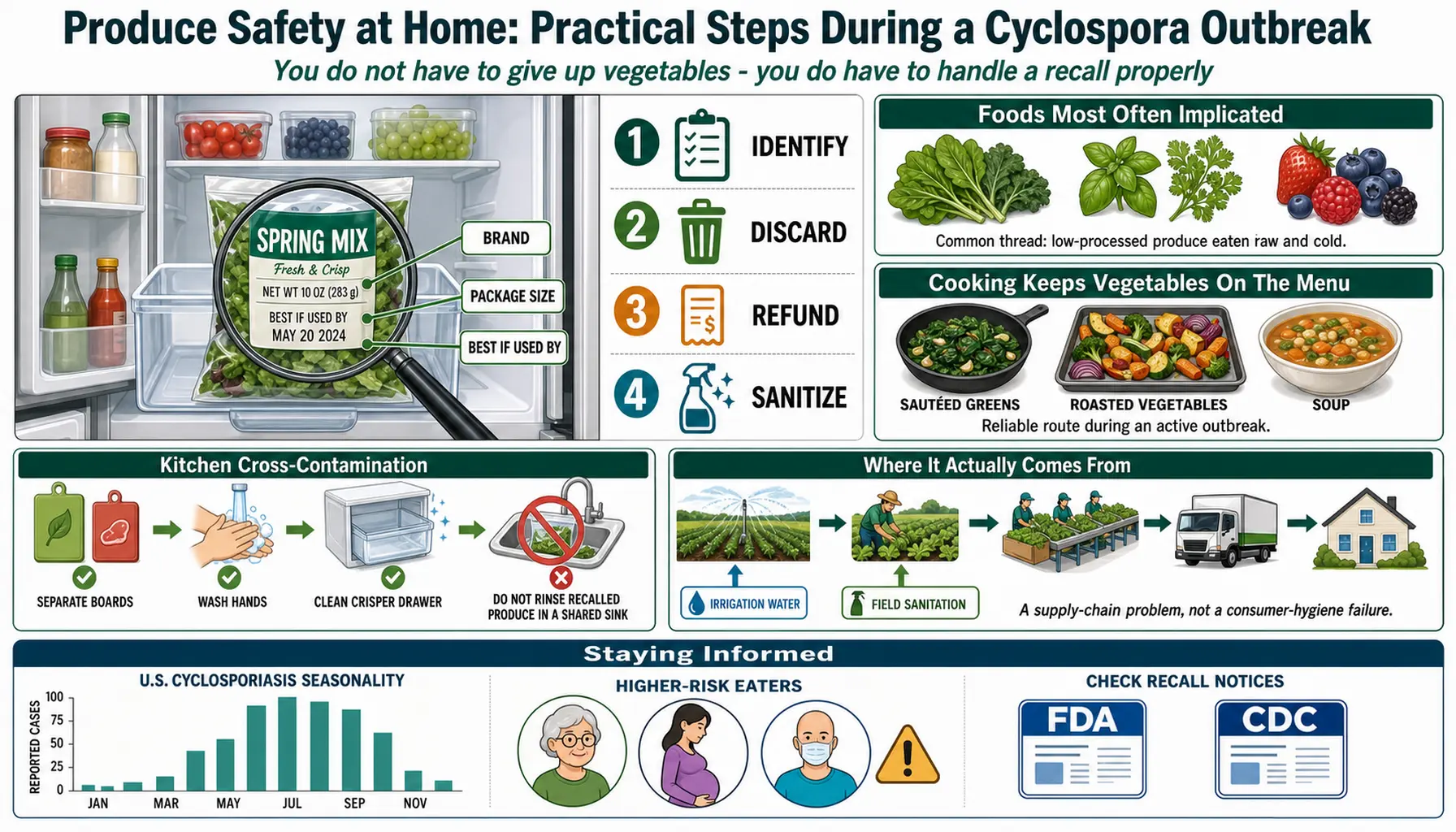
If you are reading this standing in front of an open refrigerator with a bag of lettuce in your hand, skip to section 2. It gives you four steps, in order, and takes about ten minutes. Everything else can wait until the bag is dealt with.
Now the part that matters just as much. This is not an argument against eating vegetables. A recall is a reason to check a label and change one habit for a few weeks — not a reason to retreat into a diet of beige, shelf-stable food. If this page talked you into that trade it would have done you more harm than the parasite. Most produce, most of the time, is fine.
What follows is the honest middle ground: what to do during a named, active outbreak, and the modest habits worth keeping the rest of the year. It also explains where the contamination actually comes from, which is upstream on farms and in irrigation water. Nothing you did in your kitchen caused this.
Interactive Visualization Cyclospora: From Contaminated Field to Relapsing Illness — watch why washing cannot save the salad Follow the parasite from irrigation water to your gut: rinse the leaves and watch it survive, chill the field so it never ripens, then treat it with the drug that works — and the one that has no target on it. Launch →Table of Contents
- Most Produce, Most of the Time, Is Fine
- If You Have Recalled Product Right Now
- Which Foods Get Implicated — and Why
- Cooking Works. Washing Does Not.
- Kitchen Habits That Genuinely Help
- Where It Comes From — and Why It Is Seasonal
- If You Are in a Higher-Risk Group
- Travel: Raw Produce and Water Away From Home
- Staying Informed, and a Practical Checklist
- Key Research Papers
- Official Guidance
- Connections
- Featured Videos
1. Most Produce, Most of the Time, Is Fine
Get the scale right before changing how you eat. As of the FDA's July 24, 2026 update, the iceberg-lettuce outbreak counted 1,947 laboratory-confirmed illnesses, at least 98 hospitalizations and zero deaths, with illness onsets from June 22 to July 20, 2026 across nine states. That is genuinely large for this parasite, and still a vanishingly small share of the produce Americans ate over the same weeks.
Two honest caveats, pointing in opposite directions. The true number of infections is higher than the confirmed number — the CDC says so plainly, because some people recover without ever being tested. And the confirmed count will keep climbing for weeks even though the recall has already happened, because the FDA notes it can take up to six weeks to confirm that a case belongs to the outbreak. Rising numbers in August do not mean contaminated lettuce is still on shelves. They mean the laboratory is catching up with June.
Hold both ideas at once. This is a real outbreak worth acting on, and the goal is risk management, not risk elimination — which is not on the menu for any food.
2. If You Have Recalled Product Right Now
Four steps, in order: identify, discard, refund, sanitize.
Step 1 — Identify, using all four fields
A recall notice is a filter with four fields, and a product only counts as recalled if it matches on all of them. Brand alone is not enough; "lettuce" certainly is not. Read the label out loud if it helps: brand, exact product name, package size, best-if-used-by date.
| Field | What the July 17, 2026 recall notice says |
|---|---|
| Recalling firm | Taylor Farms de Mexico — all iceberg lettuce sourced from central Mexico, voluntarily removed from the U.S. market |
| Retail brand | Marketside, sold at Walmart |
| Products and sizes | Iceberg Salad, 12 oz or 24 oz; Shredded Lettuce, 8 oz or 16 oz |
| Best-if-Used-By | 7/18/2026 through 8/3/2026 |
| Retail states (15) | AL, AR, FL, GA, IN, KS, KY, LA, MO, MS, OK, TN, TX, VA, WV |
| Foodservice | Distributed June 29 – July 16, 2026 to 27 states (the FDA's product-distribution line lists 28, adding West Virginia) |
If you ate out rather than cooked, the foodservice side matters. Taco Bell stopped using Taylor Farms de Mexico lettuce as of July 17, 2026, and not every Taco Bell location in the affected states received lettuce from this supplier. A restaurant sitting in a distribution state is not the same as that restaurant having served the product.
One clarification, because it has been widely garbled: the number of states that received product is not the number with illnesses. Twenty-seven to twenty-eight states got the lettuce. Nine — IL, IN, KS, KY, MI, OH, OK, PA, WV — have confirmed illnesses.
Step 2 — Discard it. Do not wash it and eat it.
This is the most common mistake and a completely understandable one: the bag cost money, the salad looks perfect, and rinsing feels like it should fix things. It does not. Washing is not a rescue operation for recalled product — section 4 explains why, and the sibling page Why Washing Does Not Work makes the full case. Seal the package inside another bag so it cannot drip, and bin it. Or return it unopened.
Step 3 — Get your refund
Recalled products are refundable and you usually do not need the receipt. Before you bin the package, photograph the label showing brand, size and best-by date. That photo is all most customer-service desks need, and it costs you five seconds.
Step 4 — Clean and sanitize what it touched
The FDA specifically advises cleaning and sanitizing surfaces and containers the recalled product touched. That instruction is not boilerplate — cross-contamination is a real route. Work the list: the crisper drawer (take it out, hot soapy water, then sanitize and dry); the shelf below, in case of drips; every container, bowl, colander, salad spinner, board and knife the lettuce touched; the counter where you opened the bag; the sink, if you rinsed it there; and your hands, with soap and water, before touching anything else.
Finally, the medical part. If you have been ill, the FDA's advice is to see a clinician, "especially if you ate shredded iceberg lettuce in the two weeks before you got sick." Say what you ate and when — and ask for Cyclospora testing by name. A routine bacterial stool culture will not find it, and standard ova-and-parasite microscopy only finds it if the lab is specifically asked to look. Our Diagnosis and Testing page covers how to have that conversation.
3. Which Foods Get Implicated — and Why
The foods that have carried Cyclospora cayetanensis into outbreaks fall into a recognisable family. Hadjilouka and Tsaltas reviewed the major outbreaks traced to ready-to-eat fresh fruits and vegetables, and the pattern is consistent (PMID 33233660): leafy greens including lettuce and bagged salad; fresh soft herbs, especially basil and cilantro; and berries, raspberries most famously.
The common thread is not "imported produce" or "bagged produce" or any of the tidy villains people reach for. It is a set of physical properties. These foods are eaten raw and cold, so no heat step ever touches them. They are minimally processed — nothing between field and fork. They are geometrically complicated: a Cyclospora oocyst is roughly eight to ten micrometres across, about a tenth the width of a human hair, and at that scale a raspberry's drupelets, a cilantro frond and the crinkled rib of a lettuce leaf are a landscape of caves. Water running past does not reach into a cave. And they are grown in a seasonal window and shipped a long way, which concentrates supply: for a few weeks, much of a national supply can come from a small number of fields.
Notice which foods are not in that family. Anything you cook. Anything you peel. Root vegetables you scrub and roast. Frozen vegetables, blanched during processing. Canned tomatoes. Bananas, oranges and avocados, where the part you eat has been wrapped in its own packaging since the flower. That is a great deal of produce still open to you during an active outbreak.
One nuance so this page does not oversimplify: the intuitive model in which every case is imported may not be the whole story. Chacin-Bonilla and Santin have asked directly whether developed countries harbour their own endemic foci (PMID 36985114). That question is unsettled, and it is a good reason to think about a food's properties rather than its passport.
4. Cooking Works. Washing Does Not.
Against Cyclospora, heat is the intervention that reliably works. Not rinsing, not vinegar soaks, not commercial produce washes, not fifteen seconds under the tap.
Keep washing produce anyway — it removes soil, grit, insects, some bacteria and pesticide residue, and nothing here revokes that habit. Just do not rely on it against this organism. Three reasons stack up. The oocyst wall is built to survive the outside world (it has to be: the parasite spends one to two weeks maturing in the environment before it can infect anyone at all), and it shrugs off the chlorine levels used in routine produce washing. The oocysts are small enough to lodge in surface irregularities running water never reaches. And they stick — they are not loose dust waiting to be rinsed away. The sanitizers with demonstrated effect are industrial, not domestic: Ortega and colleagues tested gaseous chlorine dioxide against Cyclospora on produce (PMID 19244892), and Baumann's group showed aqueous ozone can inhibit sporulation in a laboratory surrogate (PMID 38460785). Neither is a bottle you can buy. Do not substitute dish soap, detergent or diluted bleach, which are not approved for food and cause their own misery.
Cooking, though, you already own. So during an active outbreak involving leafy greens the answer is not "eat fewer vegetables." It is "eat the same vegetables, hot" — which is how most of the world's great vegetable cooking works anyway:
- Garlic-sautéed greens. Chard, kale, spinach, escarole or beet tops into a wide pan with olive oil and sliced garlic until fully collapsed and steaming through, then lemon and flaky salt off the heat. Three minutes. The workhorse.
- A roasting tray. Broccoli, cauliflower, carrots, fennel, Brussels sprouts, peppers and red onion at high heat until the edges catch. Cold leftovers the next day make a perfectly good "salad" with vinaigrette and beans.
- Soups that carry greens. Caldo verde, minestrone, lentil soup, white-bean-and-escarole. One outbreak-specific caveat: the fashionable move of stirring raw spinach in off the heat so it "just wilts" is exactly the step to skip right now. Add greens two or three minutes before the pot comes off and let them actually simmer.
- Braised greens with beans. Collards or cavolo nero with cannellini, stock, chilli and a parmesan rind. Better on day two.
- Blanched and dressed, if what you miss is salad texture. Boil the leaves briefly, plunge into ice water, squeeze dry, dress with oil, acid and salt. Japanese ohitashi, Italian verdure lesse — a cold green dish with a real heat step in its history.
What counts as a real heat step? Ordinary cooking, throughout the food: a genuine simmer, sauté, boil, steam or roast — not a brief warming, and not a char on one side. Grilling a romaine heart blackens the outside and leaves the middle raw, so it does not qualify. Beyond that, resist the urge — including from this page — to attach a precise temperature-and-time number. The published work has not produced a home-kitchen kill curve you can trust to the degree.
5. Kitchen Habits That Genuinely Help
A handful of ordinary practices do real work, and it is worth being clear about which work they do.
- Separate boards. One for raw meat, one for produce — and during a recall, keep the suspect item off the board you use for anything eaten raw.
- Wash hands after handling raw produce, not only before. This is the step most people skip, and the one that stops a contaminated leaf becoming a contaminated refrigerator handle, phone screen and toddler.
- Clean the crisper drawer regularly, not just after a recall. It is the one part of the fridge that routinely holds unwashed, soil-contact food and almost never gets emptied.
- Do not rinse suspect produce in a sink where you are about to prepare other food. If you must, clean and sanitize the sink and surrounding counter afterwards, and do not leave a colander of something else sitting in the basin.
- Store greens contained and low, so nothing drips downward onto food you will eat uncooked; and prep ready-to-eat foods first, on a clean surface.
Now the honest limit, because it is genuinely reassuring. These habits pay off more against Salmonella, E. coli and Listeria than against Cyclospora, for a peculiar reason: freshly shed oocysts are not infectious. They must sporulate in the environment for roughly one to two weeks first. Which means cyclosporiasis does not spread person to person. You cannot catch it from a sick family member, you cannot give it to your children by sharing a kitchen, and a household cluster means everyone ate the same food. If someone at home is ill, that is one thing you can stop worrying about tonight. (The mechanism is on Life Cycle and Sporulation.)
So why clean the crisper at all? Because produce arriving from the field can carry oocysts that have already sporulated during days or weeks in transit and storage. Those are infectious now, and they can move from the bag to the drawer to the next thing you pull out and eat raw. That is the chain the FDA's sanitize instruction is designed to break: not person-to-person spread, food-to-surface-to-food spread.
6. Where It Comes From — and Why It Is Seasonal
Say this part out loud if you have been feeling responsible: this is a supply-chain and agricultural-water problem, not a consumer-hygiene failure. There is no version of your kitchen routine that would have prevented it, because the contamination happened weeks earlier and hundreds of miles away.
The mechanism is uncomfortable but simple. Humans are the only known natural host of Cyclospora cayetanensis — no animal reservoir has been established. Every outbreak therefore traces back to human faecal contamination of food or water somewhere in the growing and handling chain: irrigation water drawn from a contaminated source, wash water used after harvest, or inadequate sanitation for the people working the fields. This is not speculation. Kahler and colleagues developed large-volume sampling techniques and detected the parasite directly in produce irrigation and wash water (PMID 33681488). Reyes and colleagues then modelled how preharvest water and produce sampling plans would need to be designed to catch it before harvest (PMID 37742835). That second paper tells you where the leverage actually sits: water testing, sanitation infrastructure and preharvest surveillance — none of which is something a shopper can buy.
The sporulation delay reinforces the point: because oocysts need one to two weeks in the environment to become infectious, contamination necessarily happened long before the food reached your store. The food chain acts as a delay line, which is also why traceback is so slow — and it helps explain the seasonality. Cyclosporiasis in the United States is not spread evenly across the year: the CDC's national surveillance summary covering 2011–2015, published in MMWR by Casillas, Hall and Herwaldt, documented a pronounced spring-and-summer pattern (PMID 31002104). Treat that as a documented pattern across years of surveillance, not as a table of month-by-month percentages to quote at anyone. Two plausible drivers, neither fully settled: harvest windows for the implicated crops fall in particular months, so the supply of vulnerable produce is itself seasonal; and sporulation is temperature-dependent, as Sathyanarayanan and Ortega showed across temperatures and food matrices (PMID 16729675). Warm weather is permissive for the step that turns a harmless shed oocyst into an infectious one. The 2026 outbreak, with onsets from June 22 to July 20, sits squarely inside the expected window.
The practical translation is undramatic. If you want one seasonal habit rather than a year-round policy, late spring through summer is the stretch where paying attention to produce recalls actually maps onto the epidemiology. Note too that the FDA is explicit that outbreak-linked illnesses are only a subset of the Cyclospora infections identified nationwide — background cases exist outside any named outbreak.
7. If You Are in a Higher-Risk Group
For most healthy adults, cyclosporiasis is a miserable, drawn-out, relapsing illness that eventually resolves — and resolves considerably faster with the right antibiotic. For some people the calculus differs, and a more conservative posture during an active outbreak is reasonable rather than paranoid: anyone immunocompromised for any reason, solid organ transplant recipients, people on chemotherapy, people with advanced HIV, and anyone frail or elderly, for whom dehydration is the immediate danger rather than the parasite itself.
The transplant literature takes this seriously enough to name the organism. La Hoz and Morris, writing guidance on intestinal parasites in solid organ transplant recipients, cover Cryptosporidium, Cyclospora and Giardia together as organisms that behave worse under immunosuppression (PMID 31145496). In immunocompromised patients the illness runs longer and more severely, relapse is more likely, and clinicians often use longer courses and sometimes ongoing suppressive therapy.
In the kitchen, during a named outbreak involving a specific food category: make cooked the default for that category, for those few weeks. Not forever, and not for all produce — a transplant recipient who stops eating vegetables has traded a small, time-limited risk for a large, permanent one. This is the one place on this page where the advice is genuinely urgent: if you are in this group and develop watery diarrhoea, contact your transplant team, oncology team or infectious-disease clinician early rather than waiting it out, and ask specifically about Cyclospora testing. Waiting is what turns a treatable infection into a dehydration admission.
8. Travel: Raw Produce and Water Away From Home
Cyclospora cayetanensis is endemic in parts of the world and is a well-recognised cause of travellers' diarrhoea — often the frustrating, long-tailed kind that outlasts the trip. The GeoSentinel network's analysis of intestinal protozoa in returning travellers from 2007 to 2019 places it alongside the other protozoan causes (PMID 38245913). Much of what is known clinically came from studying travellers and expatriates in endemic settings: Pandey's update on travellers' diarrhoea pathogens in Nepal is one such body of work (PMID 21366793), and Shlim's review draws heavily on that experience (PMID 12489288). The landmark treatment trial ran in Kathmandu; other key studies came from Peru and Haiti.
- Cooked and served hot is the reliable rule — the same rule as section 4. Heat is the kill step abroad too.
- Fruit you peel yourself is the safest raw option: bananas, oranges, mandarins, a mango you skin with your own hands.
- Watch the garnish. Fresh cilantro and basil scattered over an otherwise perfectly cooked dish are raw produce, and both have been implicated in outbreaks. The soup was boiled; the herb on top was not.
- Salads, raw slaws and ice are the classic exposures. Ice is made from water you did not choose.
- Boiling beats chemistry for water. The same tough oocyst wall that resists routine chlorine in produce washing also resists chlorine-based purification tablets. Boiled water, or a filter rated for protozoan cysts, is the better choice where this parasite circulates.
- If you get sick after travelling, tell the clinician where you went, when, and what the pattern has been — and ask for Cyclospora testing by name. Travel history is often the single detail that gets the right test ordered.
If your illness seemed to clear on the flight home and then came roaring back a week later, that remitting-relapsing course is characteristic of this parasite, not evidence of something new. Say exactly that at the appointment — see Symptoms and the Relapsing Course.
9. Staying Informed, and a Practical Checklist
Go to the primary sources rather than social-media summaries of them. The FDA and CDC pages below are updated as the investigation moves and both date-stamp their figures, which matters, because a screenshot from ten days ago is simply a different fact. To check whether something in your kitchen is recalled, match all four fields — brand, exact product name, package size, best-by date — against the notice. Stores generally post current recall notices near the entrance or at the customer-service desk, and the FDA's recall page is authoritative. The links are under Official Guidance below.
The checklist, in the order you would actually do it:
- Read the label out loud: brand, exact product name, package size, best-by date. All four must match before you treat something as recalled — and all four must clear before you treat it as safe.
- If it matches, do not wash it and eat it. Seal the package inside another bag and bin it, or return it.
- Photograph the label first if you want the refund. You usually do not need the receipt.
- Wash your hands with soap and water immediately afterwards, before touching anything else.
- Empty the crisper drawer, wash it in hot soapy water, sanitize it and let it dry. Wipe the shelf beneath it, in case of drips.
- Wash and sanitize every container, bowl, colander, salad spinner, board and knife the product touched. The dishwasher is fine.
- Clean and sanitize the sink and counter if you rinsed the product there, before preparing anything else in that basin.
- Keep eating vegetables. For the duration of the outbreak, cook the food category involved: sauté, roast, braise, simmer.
- Keep washing produce generally — just do not rely on washing against this parasite.
- Watch for symptoms: watery diarrhoea with frequent bowel movements, loss of appetite, weight loss, stomach cramps, bloating, gas, nausea and fatigue. Vomiting, body aches, headache and fever may also occur, and some infected people have no symptoms at all.
- If you are ill, see a clinician and say what you ate and when — especially if you ate shredded iceberg lettuce in the two weeks before symptoms began.
- Ask for Cyclospora testing by name. A routine stool culture will not find it, and one negative stool does not rule it out, because shedding is intermittent.
- If symptoms fade and then return, report that pattern. It is characteristic of this infection and it helps the diagnosis rather than confusing it.
- If you are immunocompromised, a transplant recipient, on chemotherapy or frail, be more conservative during an active outbreak and call sooner rather than later.
- Check the FDA and CDC pages for updates, and note the date on any number before you repeat it.
Key Research Papers
- Hadjilouka A, Tsaltas D. Cyclospora cayetanensis — major outbreaks from ready to eat fresh fruits and vegetables. Foods 2020;9(11):1703. PMID: 33233660
- Chacin-Bonilla L, Santin M. Cyclospora cayetanensis infection in developed countries: potential endemic foci? Microorganisms 2023. PMID: 36985114
- Kahler AM, et al. Detection of Cyclospora cayetanensis in produce irrigation and wash water using large-volume sampling techniques. Food and Waterborne Parasitology 2021. PMID: 33681488
- Reyes GA, et al. Modeling preharvest Cyclospora cayetanensis sampling and testing for various water and produce sampling plans. Journal of Food Protection 2023. PMID: 37742835
- Casillas SM, Hall RL, Herwaldt BL. Cyclosporiasis surveillance — United States, 2011–2015. MMWR Surveillance Summaries 2019;68(3):1-16. PMID: 31002104
- Ortega YR, Mann A, Torres MP, Cama V. Efficacy of gaseous chlorine dioxide as a sanitizer against Cryptosporidium parvum, Cyclospora cayetanensis, and Encephalitozoon intestinalis on produce. Journal of Food Protection 2008;71(12):2410-4. PMID: 19244892
- Baumann AA, et al. Aqueous ozone exposure inhibits sporulation in the Cyclospora cayetanensis surrogate Eimeria acervulina. Journal of Food Protection 2024. PMID: 38460785
- Sathyanarayanan L, Ortega YR. Effects of temperature and different food matrices on Cyclospora cayetanensis oocyst sporulation. Journal of Parasitology 2006. PMID: 16729675
- Li J, et al. Detection of human intestinal protozoan parasites in vegetables and fruits: a review. Parasites & Vectors 2020. PMID: 32727529
- La Hoz RM, Morris MI. Intestinal parasites including Cryptosporidium, Cyclospora and Giardia in solid organ transplant recipients. Clinical Transplantation 2019. PMID: 31145496
- Weitzel T, et al. Intestinal protozoa in returning travellers: a GeoSentinel analysis from 2007 to 2019. Journal of Travel Medicine 2024. PMID: 38245913
- Pandey P, et al. Travelers' diarrhea in Nepal: an update on the pathogens and antibiotic resistance. Journal of Travel Medicine 2011. PMID: 21366793
Live PubMed Searches
- Cyclospora cayetanensis fresh produce
- Cyclosporiasis outbreak leafy greens
- Cyclospora irrigation water detection
- Produce wash sanitizer protozoan oocyst
- Cyclosporiasis seasonality United States
- Travelers' diarrhea Cyclospora
Official Guidance
- FDA — investigation of the 9-state Cyclospora outbreak linked to iceberg lettuce, July 2026. The authoritative, date-stamped case counts.
- FDA recall notice — Taylor Fresh Foods, iceberg lettuce from central Mexico. The brands, sizes and dates to check against.
- CDC — outbreak advisory and investigation details.
- FDA — Cyclospora topic page and CDC cyclosporiasis home, for symptoms, diagnosis and prevention.
- Taco Bell statement, for readers checking foodservice exposure.
Connections
- All Parasites
- Cyclospora: From Contaminated Field to Relapsing Illness — interactive animation
- Cyclospora — main hub
- The 2026 iceberg-lettuce outbreak
- Life cycle and sporulation
- Why washing does not work
- Symptoms and the relapsing course
- Diagnosis and testing
- Treatment and the ivermectin question
- Gut recovery and malabsorption
- Cyclospora vs other gut infections
- Cryptosporidium
- Giardia
- Blastocystis
- Chronic diarrhea
- Probiotics
- SIBO
- News — July 26, 2026