The 2026 Iceberg Lettuce Cyclospora Outbreak: What Happened and What To Do
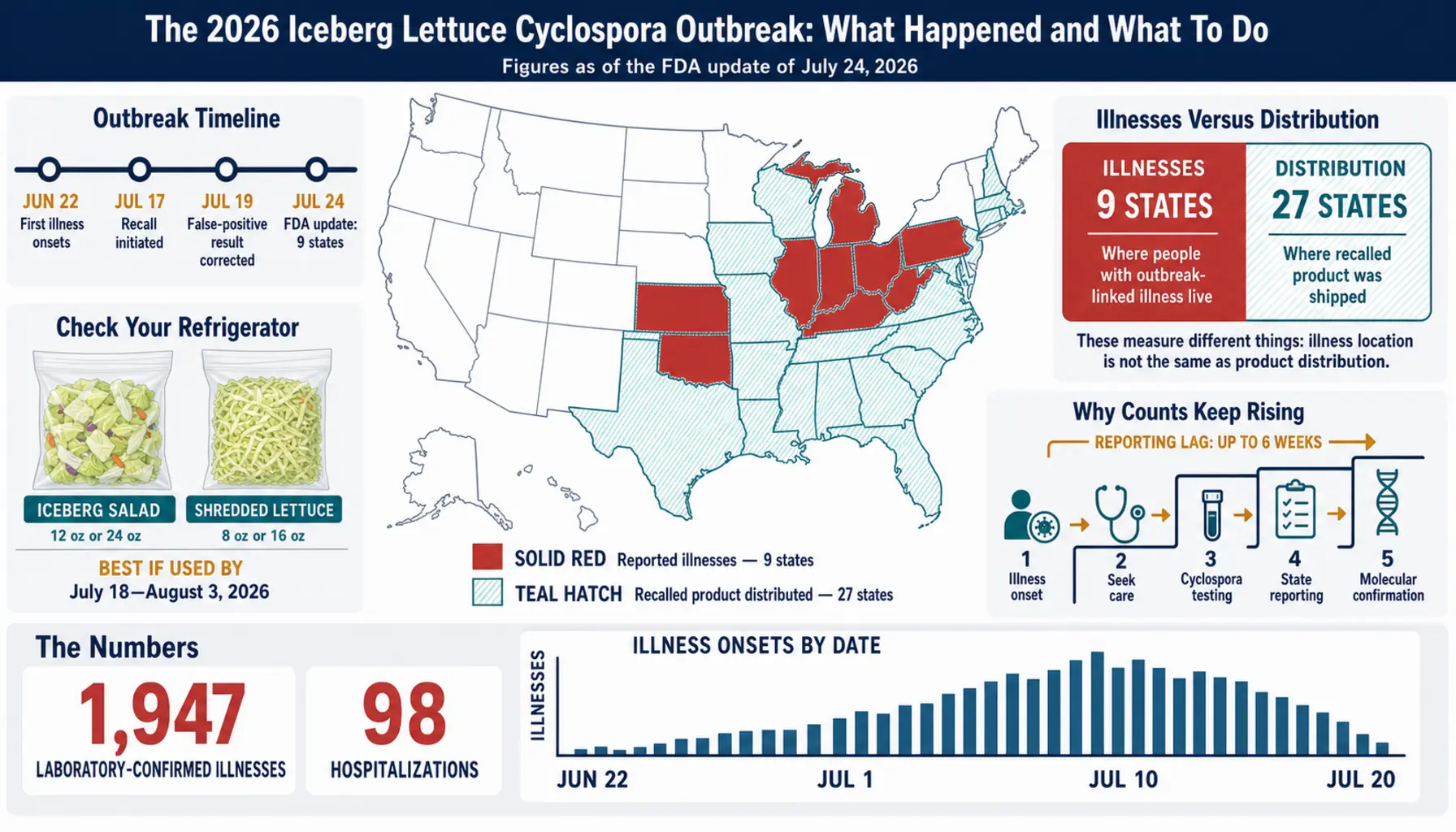
If you ate shredded iceberg lettuce this summer and then spent a week or two with watery diarrhea that almost cleared up and came back — you are not imagining it, and you are far from alone. A microscopic parasite called Cyclospora cayetanensis travelled into the United States on iceberg lettuce grown in central Mexico. As of the FDA's July 24, 2026 update it has produced 1,947 laboratory-confirmed illnesses across nine states, with at least 98 hospitalizations and no deaths. The investigation is still open.
This page is the plain-language dossier on that outbreak. It covers the timeline, the exact products recalled and how to check your own refrigerator, why the illness map and the distribution map are two different maps, why the federal case count sits below the numbers some state health departments publish, what actually happened with the product sample that tested positive and then did not, and what to do next.
Numbers in an active outbreak move. Every figure below is stamped with the date and the agency that published it, so you can tell at a glance whether what you are reading has been overtaken by events, and the official links are gathered at the bottom so you can check for yourself.
Interactive Visualization Cyclospora: From Contaminated Field to Relapsing Illness — watch why washing cannot save the salad Follow the parasite from irrigation water to your gut: rinse the leaves and watch it survive, chill the field so it never ripens, then treat it with the drug that works — and the one that has no target on it. Launch →Table of Contents
- What Is Happening Right Now
- Timeline: How the Outbreak Unfolded
- Exactly What Was Recalled — Check Your Fridge
- Nine States Sick, Twenty-Eight Supplied: Why Both Numbers Are Right
- Why the Federal Count Is Lower Than Some State Numbers
- The Taco Bell Connection and the Michigan Interview Data
- The July 18–19 “False Positive,” and Why the Recall Still Stands
- What To Do Now
- Numbers Circulating Online: What the FDA Actually Says
- Why Outbreaks Like This Keep Happening
- Where To Read More on This Site
- Key Research Papers
- Connections
- Featured Videos
1. What Is Happening Right Now
As of the FDA's July 24, 2026 update, an ongoing multistate outbreak of Cyclospora infection is linked to iceberg lettuce. The federal tally stands at 1,947 laboratory-confirmed illnesses in nine states — Illinois, Indiana, Kansas, Kentucky, Michigan, Ohio, Oklahoma, Pennsylvania and West Virginia. At least 98 people have been hospitalized. No deaths have been reported. The illness-onset dates in that federal posting run from June 22, 2026 through July 20, 2026.
The implicated food is iceberg lettuce grown in central Mexico and supplied by Taylor Farms de Mexico. On July 17, 2026 that company voluntarily pulled all of its central-Mexico iceberg lettuce from the U.S. market and initiated a recall. The same day, Taco Bell stopped using lettuce from that supplier.
Two things about the count are worth understanding before you read any headline about it.
First, the FDA has noted that part of the recent jump came from adding four new states to the outbreak. Some of that increase is investigators recognizing cases that already existed, not a fresh wave of infections.
Second, and more important: the number will keep climbing even though the recall already happened. The FDA says it can take up to six weeks to confirm that a given illness belongs to this outbreak. Cases that began weeks ago are still working their way through the laboratory pipeline. A rising count next week is not proof that contaminated lettuce is still being eaten; it is mostly the reporting system catching up with itself.
The FDA makes one further point that is easy to skip past: the illnesses in this outbreak are a subset of all the Cyclospora infections identified nationwide. There is a background level of cyclosporiasis in the United States that has nothing to do with this lettuce. Not every 2026 case of this parasite is part of this event.
2. Timeline: How the Outbreak Unfolded
Two federal agencies have posted about this outbreak at different points, and they framed the illness window differently as the investigation widened. Both versions appear below, labelled with who said what and when, rather than blended into one tidy story that no source actually supports.
| Date | What happened | Source |
|---|---|---|
| May 13, 2026 | Earliest illness onset in CDC's earlier five-state posting (Indiana, Kentucky, Michigan, Ohio, West Virginia), which reported 1,644 cases and 94 hospitalizations, with onsets running May 13 – July 13, 2026. | CDC, earlier posting (superseded) |
| June 22, 2026 | Earliest illness onset in the FDA's current nine-state outbreak definition. | FDA, July 24, 2026 update |
| June 29 – July 16, 2026 | Window during which the implicated iceberg lettuce was distributed to foodservice customers in 27 states. This is the exposure window for restaurant meals. | FDA recall information |
| July 17, 2026 | Taylor Farms de Mexico voluntarily removes all central-Mexico iceberg lettuce from the U.S. market and initiates a recall. Retail product sold under the Marketside brand at Walmart is included. | FDA recall notice |
| July 17, 2026 | Taco Bell stops using Taylor Farms de Mexico lettuce. Not every Taco Bell location in the affected states had been receiving lettuce from this supplier. | Taco Bell statement |
| July 18, 2026 | A product sample collected at the border tests positive for Cyclospora. | FDA |
| July 19, 2026 | FDA laboratory experts re-review that result and conclude it “does not represent true amplification” — a false positive. FDA states the correction does not change the basis for the investigation or the recall. | FDA |
| July 20, 2026 | Most recent illness onset in the FDA's current nine-state update. This falls after the recall, which is expected: people who ate contaminated lettuce before July 17 were still inside their incubation period when the product came off the shelves. | FDA, July 24, 2026 update |
| July 24, 2026 | FDA update: 1,947 laboratory-confirmed illnesses, at least 98 hospitalizations, 0 deaths, nine states, status ongoing. No confirmed positive product samples. | FDA |
Read down that column of dates and one thing stands out: the July 17 recall sits near the end of the illness-onset range, not the beginning. That is the normal, frustrating shape of a produce outbreak. People eat the food, wait about a week for symptoms, wait longer before seeking care, and laboratory confirmation arrives after that. By the time investigators can see the pattern clearly enough to name a supplier, most of the exposure has already happened. Section 10 explains why this parasite in particular stretches that lag further than most.
One honest wrinkle: the two published onset ranges do not line up. CDC's earlier five-state posting began at May 13; the FDA's current nine-state posting begins at June 22. Ranges shift as an investigation matures — cases get added, some get reclassified as background infections rather than outbreak cases, and the working case definition tightens. A moving date range is a sign the analysis is being redone, not that somebody was caught out.
3. Exactly What Was Recalled — Check Your Fridge
This is the practical section. Read it standing at your refrigerator.
The recall covers all iceberg lettuce sourced from central Mexico by Taylor Farms de Mexico. (The FDA's recall notice is filed under the Taylor Fresh Foods name, so search either if you are looking it up yourself.) It has two halves that behave completely differently for consumers.
Retail product you might physically have at home
The recalled retail bags were sold under the Marketside brand at Walmart:
| Brand | Product | Package sizes | Best-if-Used-By | Sold at |
|---|---|---|---|---|
| Marketside | Iceberg Salad | 12 oz or 24 oz | 7/18/2026 through 8/3/2026 | Walmart, 15 states |
| Marketside | Shredded Lettuce | 8 oz or 16 oz | 7/18/2026 through 8/3/2026 | Walmart, 15 states |
The Best-if-Used-By date is printed on the bag. If the bag in your hand says Marketside, is one of those four sizes, and carries a Best-if-Used-By date anywhere from 7/18/2026 to 8/3/2026 inclusive, it is recalled. Do not open it, do not rinse it, do not pick out the good-looking leaves. Contaminated lettuce looks, smells and tastes exactly like clean lettuce — the Best-if-Used-By range here is an identifier, not a freshness suggestion. Bag it, seal it, bin it. Refunds are available.
Retail distribution reached 15 states: Alabama, Arkansas, Florida, Georgia, Indiana, Kansas, Kentucky, Louisiana, Missouri, Mississippi, Oklahoma, Tennessee, Texas, Virginia and West Virginia.
Foodservice product you cannot check, because it never had a consumer label
The larger share of this lettuce went into foodservice — restaurant kitchens, cafeterias and similar operations — distributed between June 29 and July 16, 2026 to 27 states: Alabama, Arkansas, Connecticut, Florida, Georgia, Iowa, Illinois, Indiana, Kansas, Kentucky, Louisiana, Massachusetts, Maryland, Michigan, Missouri, Mississippi, North Carolina, New Hampshire, New Jersey, Ohio, Oklahoma, Pennsylvania, South Carolina, Tennessee, Texas, Virginia and Wisconsin. The FDA's “U.S. Product Distribution” line adds West Virginia, bringing that figure to 28.
There is nothing in your kitchen to inspect for this half of the recall. Foodservice lettuce arrives in unbranded bulk cases and is emptied into a prep container long before it reaches a plate. If you ate out in one of those states during that window, you cannot verify anything from your end — which is exactly why the guidance for restaurant meals is symptom-based rather than package-based. See Section 8.
4. Nine States Sick, Twenty-Eight Supplied: Why Both Numbers Are Right
This is the single most-confused point in public coverage of this outbreak, and it deserves an unhurried explanation, because the confusion is genuinely understandable.
There are two different maps, and they answer two different questions.
| The illness map | The distribution map | |
|---|---|---|
| Question it answers | Where do confirmed sick people live? | Where was the recalled lettuce shipped? |
| Count | 9 states | 27 states foodservice (28 on FDA's distribution line); 15 states retail |
| Which states | IL, IN, KS, KY, MI, OH, OK, PA, WV | Full lists in Section 3 |
| What it means for you | Confirmed illness has been documented here. | Recalled product reached here. Check for it and discard it. |
Shipping a product into a state is not the same as making someone in that state sick, and several ordinary things stand between the two:
- Contamination is patchy. A parasite does not distribute itself evenly through every case of lettuce from a growing region. Some shipments carried it; most probably did not.
- Much of the product was eaten without incident or thrown out. Lettuce has a short shelf life, and a great deal of what shipped in that window was gone before anyone knew there was a problem.
- Not every restaurant in a state used the implicated supplier. This has been stated explicitly about Taco Bell locations.
- Cases only count if they are diagnosed. Cyclosporiasis is missed by routine stool testing unless a clinician specifically requests it, so a state can have real infections that never become confirmed cases.
- Confirmation lags by weeks. A state can be an illness state and not yet know it. The FDA added four new states in the July 24 update alone.
Notice the internal logic that makes the picture hang together: every one of the nine illness states also appears on a distribution list. That is exactly the pattern you would expect if the lettuce is the vehicle, and it is part of why investigators are confident.
So the honest one-sentence version is: nine states have confirmed illnesses; roughly 27 to 28 states received the recalled product. Collapsing those into a single “27 states affected” overstates the illness picture; assuming only nine states need to check their refrigerators understates the recall. Both maps are real, and they are not supposed to match.
5. Why the Federal Count Is Lower Than Some State Numbers
If you have looked at your own state health department's page and found a number well above the federal 1,947, you have not caught anyone lying. You have run into a definitional difference that public-health agencies live with constantly and explain badly.
FDA and CDC count only laboratory-confirmed cases. To enter the federal tally, a person's stool specimen has to have been tested, found positive for Cyclospora, and then linked to this outbreak. That is a deliberately high bar. It makes the federal number defensible under scrutiny, and it guarantees the federal number is an undercount of true illness.
State health departments frequently also count probable cases. A probable case is typically someone with a compatible illness and a documented link to the outbreak — the right symptoms, the right timing, the right exposure — but no confirmatory laboratory result, often simply because nobody ordered the right test. Michigan's own tally therefore runs far above the federal figure for Michigan. Both numbers are true. They answer different questions: “how many can we prove?” versus “how many do we think there are?”
Then there is the lag, which is why the federal number is not merely lower but permanently behind. The FDA says confirming that a case belongs to this outbreak can take up to six weeks. Stack the delays and it is easy to see why:
- The parasite has an incubation period of roughly a week before symptoms begin at all.
- Many people wait several more days, assuming they have a stomach bug that will pass.
- When they do seek care, standard stool tests do not look for Cyclospora — it has to be specifically requested, or included on a molecular gastrointestinal panel.
- A positive result then has to be reported to the state, forwarded to the federal level, and matched to the outbreak.
The consequence is that the count will keep rising for weeks after the recall, and those additions will mostly be old infections finally being confirmed — not evidence that contaminated lettuce is still circulating. CDC has separately cautioned that the true case count is likely higher than any published figure, because plenty of people recover without ever being tested. If you had a miserable fortnight in early July, never had a stool test, and eventually got better, you are almost certainly not in anyone's number.
When two sources disagree, the useful question is therefore not “who is wrong?” but “confirmed or probable, which date, and which geography?”
6. The Taco Bell Connection and the Michigan Interview Data
CDC's statement of the case is direct: “Epidemiologic and traceback data show that shredded iceberg lettuce from Taylor Farms de Mexico served at some Taco Bell locations is contaminated with Cyclospora and is making people sick.”
Two independent lines of evidence produced that conclusion, and it is their convergence that makes the finding solid.
The interview data. The Michigan Department of Health and Human Services analyzed food exposures for 190 cases who had eaten at Taco Bell. Ninety percent reported eating iceberg lettuce. That is precisely the signal investigators hunt for: within a group of sick people who visited the same restaurant chain, one ingredient dominates. Nine in ten across nearly two hundred separately interviewed people is not what an innocent bystander item on a menu looks like.
The traceback data. Separately, the FDA worked backwards through invoices and shipping records from the implicated Taco Bell locations — distributor to processor to grower. That paper trail converged on a single supplier, Taylor Farms de Mexico. Traceback is unglamorous document work, but when many geographically scattered restaurants that each made people sick turn out to share one upstream source, the convergence itself is the finding.
Put the two together — sick people overwhelmingly ate one ingredient, and that ingredient traces to one supplier — and you have the basis for a recall. That is how produce outbreaks are normally solved.
A third tool works quietly behind both: CDC uses molecular typing — genetic fingerprinting of the parasite recovered from patients — to decide which scattered illnesses genuinely belong to one cluster. That is why states can be added to an outbreak weeks after the fact.
Two clarifications get lost in the retelling. First, not all Taco Bell locations in the affected states received lettuce from this supplier — eating at a Taco Bell in an affected state does not mean you were exposed. Second, the problem was the lettuce, not the restaurant chain as such. The same supplier's product went to many foodservice customers and into retail bags at Walmart. Taco Bell is where the epidemiological signal was strong enough to see, because a chain restaurant gives investigators a name people reliably remember on a questionnaire. If you ate that lettuce somewhere without a memorable brand attached, your case is just as real and much harder to trace.
7. The July 18–19 “False Positive,” and Why the Recall Still Stands
This episode circulated widely, usually stripped of its context, so here is the sequence exactly.
On July 18, 2026, a product sample collected at the border tested positive for Cyclospora. On July 19, 2026, the FDA announced that its laboratory experts had re-reviewed the result and concluded it “does not represent true amplification” — in plain terms, a false positive. As of the July 24 update there were no confirmed positive product samples in this investigation.
“Amplification” is what a PCR test does: it repeatedly doubles any target DNA in the sample while a fluorescent signal tracks how much is present. Real target DNA produces a characteristic curve — flat, then a clean exponential rise as the doubling compounds, then a plateau — and the instrument calls “positive” when the signal crosses a threshold. But a signal can cross that threshold for reasons unrelated to the target: chemistry artefacts, primers binding one another, debris in the sample, background fluorescence drifting upward. When an analyst opens the raw plot and sees a shape that is not exponential growth, the correct call is that this crossed the line but is not real amplification — noise that looked like a signal. A rough analogy: a smoke alarm chirping at 3 a.m. makes the alarm noise, but on inspection there is no smoke and the battery is dying. You do not conclude that fire does not exist; you conclude that this particular alert was not evidence of one.
The FDA found the error and corrected it publicly within a day. That is the system working, not failing. And in the same announcement the agency stated that the correction “does not change the basis for FDA's ongoing outbreak investigation or the overwhelming epidemiological data supporting the current voluntary recall.”
That statement is correct, and here is why a reasonable person should accept it rather than read it as institutional stubbornness.
With this organism, a negative product test is weak evidence. Failing to find Cyclospora on produce is the expected outcome even when the produce is genuinely contaminated. Several features of the parasite conspire against detection:
- The evidence is eaten. Illness onset comes roughly a week after exposure; diagnosis days to weeks after that; confirmation and clustering weeks after that. By the time investigators know which lot to sample, that lettuce was consumed or composted a month ago.
- The target is tiny. Oocysts are roughly 8–10 micrometres across — about a tenth the width of a human hair. There is nothing visible or palpable on a leaf.
- Contamination is sparse and uneven. Oocysts arrive with contaminated water or soil, so they land in patches. Testing one bag and finding nothing does not clear the shipment; it may only mean you tested the wrong handful of leaves.
- Recovering them from produce is genuinely hard. Oocysts lodge in the microscopic irregularities of leaf surfaces and resist being washed off into a test tube — the same stubbornness that makes rinsing lettuce at home unreliable. Extraction and detection protocols for Cyclospora in food and water remain an active area of method development in the food-safety literature, which tells you how difficult the problem still is.
- Sampling plans have limited statistical power. Modelling work on preharvest sampling and testing for Cyclospora in water and produce has examined this directly: against a rare, unevenly distributed contaminant, realistic sampling plans miss it a great deal of the time.
The logic underneath all of that is something people apply intuitively in other settings and forget here: a test that frequently misses the thing it is looking for cannot, by failing to find it, prove the thing is absent. When sensitivity is low, a negative result is close to uninformative. That is why food-safety investigations do not wait for a positive product sample before acting, and why they should not.
What the case actually rests on is the convergence described in Section 6 — 190 interviewed Michigan cases with 90% iceberg-lettuce exposure, a traceback landing on one supplier, and nearly two thousand laboratory-confirmed human infections. Those human specimens are positive. Nobody disputes that people are infected. The only open question was which food carried the parasite, and the epidemiology answered it. A recall that stops thousands more people from eating suspect lettuce, at the cost of discarding lettuce that may have been fine, is the right trade in that situation.
8. What To Do Now
If you have recalled product in your refrigerator
- Throw it away. Do not taste it to check. Do not try to wash it clean — washing does not reliably remove or kill this parasite. The oocyst wall is environmentally tough, it resists routine chlorine at produce-wash concentrations, and lettuce surfaces have exactly the kind of microscopic irregularities oocysts lodge in. Heat is the reliable kill step, and nobody cooks iceberg lettuce. Bag it, seal it, bin it.
- Get your refund. Refunds are available for recalled product. You generally do not need the bag itself if you have already discarded it; a receipt or a photo is usually enough at customer service.
- Clean and sanitize what it touched. The FDA specifically asks people to clean and sanitize surfaces and containers the product contacted — crisper drawer, cutting board, salad bowl, tongs, countertop. This matters more here than you might guess: the oocysts on contaminated lettuce are already sporulated, meaning already infectious, so they can transfer from the bag to a shelf to the next thing you put there. Hot soapy water first, then sanitize. This is the step people skip, and it is the one that protects the rest of the household.
If you ate the lettuce and feel fine
Do nothing special. The incubation period is about a week, commonly quoted as two to fourteen days. If you are well past that window with no symptoms, you very likely escaped — contamination is patchy, and many people who ate from an implicated lot were never exposed at all. Some infected people also have no symptoms whatsoever. There is no preventive treatment to take “just in case,” and no reason to seek one.
If you are sick
The FDA's guidance is to see a clinician if you have symptoms, “especially if you ate shredded iceberg lettuce in the two weeks before you got sick.” This is the one place on this page where that advice is not filler — it is the whole point, and here is the specific reason.
Say the word “Cyclospora” out loud at the appointment, and mention the lettuce. A routine stool test will not find this parasite. Standard bacterial stool culture does not detect it, and conventional ova-and-parasite microscopy only finds it if the laboratory is specifically asked to look, using the right stain or ultraviolet examination. Molecular gastrointestinal panels do include it. If you do not raise it, there is a real chance you are told your tests are negative and you have a virus — and then spend another three weeks miserable. Shedding is also intermittent, so a single negative stool does not rule it out; repeat testing across several days is sometimes needed.
Symptoms worth describing, from the FDA's own list: watery diarrhea with frequent bowel movements, loss of appetite, weight loss, stomach cramps or pain, bloating, increased gas, nausea and fatigue. Vomiting, body aches, headache and fever may also be present. The feature that most distinguishes this illness is relapse — symptoms that seem to go away and then return one or more times. If you have been through two or three rounds of “I think I'm finally over it,” say so. That history is a diagnostic clue in itself, and it is the main reason people delay seeking care for weeks.
Seek care sooner rather than later if you cannot keep fluids down, are showing signs of dehydration, are losing weight quickly, are pregnant, are older, or have a weakened immune system — immunocompromised people get longer, more severe illness and are more likely to relapse.
There is effective treatment, and it is prescription medicine. What clinicians prescribe is trimethoprim–sulfamethoxazole (co-trimoxazole; Bactrim, Septra), established by a randomized, double-blind, placebo-controlled trial in Nepal in which the parasite was still detectable after seven days in 1 of 16 treated patients (6%) versus 15 of 17 on placebo (88%). If you are allergic to sulfa drugs, say so early — the alternatives are fewer and weaker, and that conversation shapes the plan. Alongside the prescription, ordinary rehydration and electrolytes do real good. Untreated, this illness can run for weeks to a month or longer; treated, it usually resolves quickly. That gap is the entire argument for getting properly diagnosed instead of riding it out. Treatment detail, sulfa-allergy alternatives and an honest answer on whether ivermectin has any role here — it does not — are on the Treatment and the Ivermectin Question page.
9. Numbers Circulating Online: What the FDA Actually Says
Several figures being shared about this outbreak do not match the federal sources. That is not surprising and not sinister — with three different state lists and two different counting methods in play, these are easy mistakes to make in good faith. Rather than argue with any particular account, here is a straight comparison against what the FDA publishes.
| Claim in circulation | What the FDA actually says |
|---|---|
| “Over 6,000 sick across 27 states.” | Two unlike things have been merged. Nine states have illnesses. 27–28 states received the recalled product. The FDA's July 24, 2026 figure for laboratory-confirmed illnesses is 1,947. Larger totals generally come from state tallies that also include probable cases — a legitimate but different measure (see Section 5) — and pairing such a total with the 27-state number compounds the error. |
| Lettuce was distributed “July 29 through July 16.” | A range cannot end before it begins. The foodservice distribution window was June 29 through July 16, 2026. This matters, because readers use it to work out whether their own restaurant meal falls inside the exposure window. |
| “More than 100 hospitalizations.” | The FDA reports at least 98 hospitalizations as of July 24, 2026. That is a floor and it may well pass 100 in a later update — but reporting it as already past 100 states tomorrow's number as today's. |
| The positive sample was retracted, so the recall was baseless. | The FDA states that the false-positive finding “does not change the basis for FDA's ongoing outbreak investigation or the overwhelming epidemiological data supporting the current voluntary recall.” The recall was never built on that sample; it rests on epidemiology and traceback (see Section 7). |
None of these corrections make the outbreak small. Nearly two thousand confirmed infections and at least 98 hospitalizations from one product line is a serious event by any standard, and the confirmed count is an undercount. The reason to get the numbers right is not to minimize anything — it is that people make real decisions from them. Someone in a state that received product but has no confirmed cases still needs to check their refrigerator. Someone in a state with confirmed cases who never bought that lettuce does not need to panic. Precision serves both of them; a scrambled number serves neither, and it makes the real figures harder to believe.
10. Why Outbreaks Like This Keep Happening
Cyclosporiasis outbreaks tied to fresh produce are a recurring feature of the North American summer, not a freak event. Reviews of the major Cyclospora outbreaks traced to ready-to-eat fresh fruits and vegetables document a long list of past vehicles, and CDC has published a formal national surveillance summary of what routine cyclosporiasis reporting looked like across 2011–2015. Three features of this particular parasite explain why the pattern persists.
Humans are the only known host
Cyclospora cayetanensis has no established animal reservoir. A systematic review of Cyclospora in animals found no persuasive evidence of one, and the major life-cycle reviews treat humans as the only known natural host. That has a blunt implication: every contamination event traces back to human faecal material reaching food or water. Not wildlife, not livestock. Human sewage, human-contaminated irrigation water, or inadequate sanitation for the people working in and around the field.
It also explains why this is not a problem you can solve by testing animals or vaccinating a herd. The intervention points are all human ones: water treatment, sewage containment, and toilets and handwashing within reach of where produce is being cut.
Water and field sanitation are the route in, and both are hard to police
The realistic entry points are irrigation water drawn from a contaminated source, water used to wash or hydro-cool produce after harvest, and field hygiene. Researchers have developed large-volume sampling techniques specifically to detect Cyclospora in produce irrigation and wash water, which tells you both that the route is taken seriously and that finding the organism in water is itself a technical challenge. Modelling of preharvest sampling plans has shown how limited the power of realistic testing regimes is against a rare, patchily distributed target — which is another way of saying that you cannot inspect your way out of this problem at the end of the line. It has to be prevented upstream.
Leafy greens are also uniquely exposed. They are eaten raw, so there is no kill step: heat destroys this parasite, but nobody cooks iceberg lettuce, which means every other point in the food-safety system has to work perfectly. They have enormous surface area relative to their mass. And shredding multiplies both the surface area and the mixing, so a small quantity of contaminated lettuce entering a shredder can be spread across a great deal of finished product. Layer on consolidated processing — one supplier feeding 27 states in a two-and-a-half-week window — and the failure mode of an efficient system becomes obvious.
The sporulation delay makes traceback hard
This is the feature that sets Cyclospora apart from most foodborne pathogens, and it is worth understanding properly.
Freshly shed oocysts are not infectious. They must sporulate in the environment first — roughly one to two weeks at permissive temperatures — before they can infect anyone. Two consequences follow. The good one: cyclosporiasis is not spread person-to-person the way norovirus is. You cannot catch it from a sick family member's hands, because what they are shedding has not yet matured. Nursing someone through this illness does not put you at risk of catching it from them.
The bad consequence is that the food chain becomes a delay line. Contamination happens, then sits for one to two weeks while the oocysts mature, then the crop is harvested, shipped and eaten, then the parasite incubates about another week inside the person before symptoms begin, and only then does the testing-and-confirmation queue start. By the time a cluster becomes visible to investigators, the causal event may be a month or more in the past. The field may already be replanted; the water source may have changed; the lot is long since eaten. That is why Cyclospora outbreaks so often close without a confirmed positive food sample and without a definitively identified point of contamination — and why investigators lean on epidemiology and paper-trail traceback rather than waiting for a laboratory to find the organism on a leaf.
The investigative tools are improving. Molecular typing of Cyclospora from produce and clinical samples allows genetically distinct clusters of cases to be linked together, and there is now published work evaluating what happens when that typing is integrated with classical epidemiology in U.S. outbreak investigations. Genomic reference resources are expanding too, including the first published genome of a Cyclospora cayetanensis lineage A isolate from Mexico — a research resource, not a finding about this outbreak. None of it changes the fundamental problem, which sits upstream in the water and the fields rather than in the laboratory. This outbreak is an unusually large instance of a very familiar pattern rather than a new phenomenon — which is both the reassuring reading and the frustrating one.
11. Where To Read More on This Site
This page stays deliberately on the outbreak itself. The mechanism, clinical and practical questions each have a dedicated page, so nothing is duplicated here in a thinner form:
- Why did my stool test come back negative? → Diagnosis and Testing
- What do I take, and does ivermectin work? → Treatment and the Ivermectin Question
- Why do I keep getting better and then worse? → Symptoms and the Relapsing Course
- Why didn't washing the lettuce protect me? → Why Washing Does Not Work
- How does this parasite actually work? → Life Cycle and Sporulation
- I'm better, but my digestion isn't. → Gut Recovery and Malabsorption
- How do I lower my risk going forward? → Produce Safety at Home
- Could this be something else? → Cyclospora vs. Other Gut Infections — Giardia, Cryptosporidium, norovirus and post-infectious syndromes.
Key Research Papers
These peer-reviewed sources cover Cyclospora outbreak epidemiology, traceback, produce contamination and detection. They are the scientific background to this outbreak, not reports of it — for the outbreak itself, the FDA and CDC pages in the next section are the primary record.
- Hadjilouka A, Tsaltas D. Cyclospora cayetanensis — major outbreaks from ready to eat fresh fruits and vegetables. Foods 2020;9(11):1703. PMID: 33233660
- Casillas SM, Hall RL, Herwaldt BL. Cyclosporiasis surveillance — United States, 2011–2015. MMWR Surveillance Summaries 2019;68(3):1-16. PMID: 31002104
- Almeria S, et al. Cyclospora cayetanensis and cyclosporiasis: an update. Microorganisms 2019;7(9):317. PMID: 31487898
- Giangaspero A, Gasser RB. Human cyclosporiasis. The Lancet Infectious Diseases 2019;19(7):e226-e236. PMID: 30885589
- Dubey JP, Khan A, Rosenthal BM. Life cycle and transmission of Cyclospora cayetanensis: knowns and unknowns. Microorganisms 2022;10(1):118. PMID: 35056567
- Totton SC, et al. A review of Cyclospora cayetanensis in animals. Zoonoses and Public Health 2021. PMID: 34156154
- Kahler AM, et al. Detection of Cyclospora cayetanensis in produce irrigation and wash water using large-volume sampling techniques. Food and Waterborne Parasitology 2021. PMID: 33681488
- Reyes GA, et al. Modeling preharvest Cyclospora cayetanensis sampling and testing for various water and produce sampling plans. Journal of Food Protection 2023. PMID: 37742835
- Durigan M, et al. Detection of Cyclospora cayetanensis in food and water samples: optimized protocols. Journal of Food Protection 2024. PMID: 38701974
- Cinar HN, et al. Molecular typing of Cyclospora cayetanensis in produce and clinical samples using targeted enrichment of complete mitochondrial genomes. Parasites & Vectors 2020. PMID: 32143704
- Ahart L, et al. Retrospective evaluation of an integrated molecular-epidemiological approach to cyclosporiasis outbreak investigations — United States. Epidemiology and Infection 2023. PMID: 37466070
- Santin M, et al. The first Cyclospora cayetanensis lineage A genome from an isolate from Mexico. BMC Genomics 2024. PMID: 38443790
Live PubMed Searches
- Cyclospora cayetanensis outbreak
- Cyclosporiasis, lettuce and leafy greens
- Cyclospora traceback investigation and epidemiology
- Cyclospora, irrigation water and produce
- Cyclosporiasis surveillance in the United States
- Cyclospora cayetanensis detection methods in food and water
Official Guidance
These are the primary sources for everything on this page. Because the investigation is ongoing, check them for figures newer than the July 24, 2026 update cited here.
- FDA — Investigation of a 9-state outbreak of Cyclospora illnesses linked to iceberg lettuce (July 2026) — the current case counts, state lists and status.
- FDA — Recall notice: iceberg lettuce from central Mexico — brands, package sizes, Best-if-Used-By dates and distribution states.
- CDC — Cyclosporiasis outbreak advisory
- CDC — Investigation update — the epidemiologic and traceback findings.
- FDA — Cyclospora topic page — general background on the parasite and food safety.
- CDC — Cyclosporiasis home — symptoms, testing and treatment overview.
- Taco Bell — company statement
Connections
- All Parasites
- Cyclospora: From Contaminated Field to Relapsing Illness — interactive animation
- Cyclospora — main hub
- Life Cycle and Sporulation
- Why Washing Does Not Work
- Symptoms and the Relapsing Course
- Diagnosis and Testing
- Treatment and the Ivermectin Question
- Gut Recovery and Malabsorption
- Produce Safety at Home
- Cyclospora vs. Other Gut Infections
- Cryptosporidium
- Giardia
- Blastocystis
- Chronic Diarrhea
- SIBO (Small Intestinal Bacterial Overgrowth)
- Probiotics
- My Healthcare News — July 26, 2026