Why Washing Lettuce Does Not Remove Cyclospora
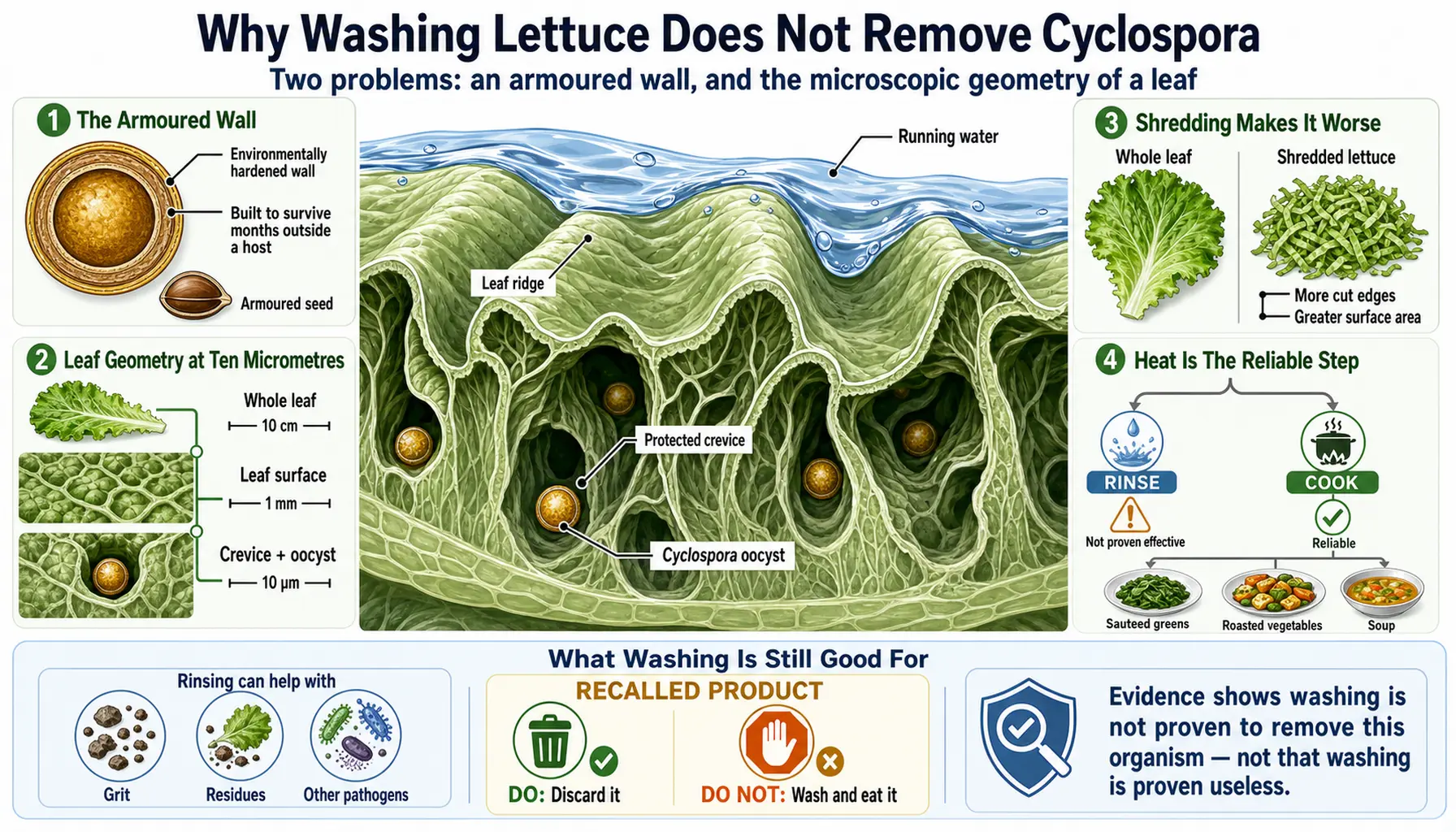
If you got sick in this outbreak, someone has probably already asked you — gently, or not so gently — did you wash it? Here is the answer, and it is not the one most people expect: rinsing lettuce under the tap is not a reliable defence against Cyclospora cayetanensis. It never was. Washing produce is a sensible habit for other reasons, and you should keep doing it. But it is not the safety net you were told it is, and against this organism it does not close the gap.
That is hard to believe, because "wash your fruits and vegetables" is one of the most repeated pieces of food advice in existence, and for many hazards it does real work. The trouble is that the advice was built around things water can actually dislodge — loose dirt, grit, surface residues, some microbial load — and Cyclospora arrives in a form shaped by evolution to survive exactly this kind of treatment. The oocyst, the parasite's environmental stage, sits in soil and water for weeks or months waiting for a host. Thirty seconds under a kitchen faucet is not the challenge it was built for.
This page explains why, what does work, why "triple-washed" bagged salad is a weaker promise than it sounds, and why none of this means you should stop washing produce. The honest summary: washing is not proven effective and not reliable against this parasite — a different and more accurate statement than "washing does nothing."
Interactive Visualization Cyclospora: From Contaminated Field to Relapsing Illness — watch why washing cannot save the salad Follow the parasite from irrigation water to your gut: rinse the leaves and watch it survive, chill the field so it never ripens, then treat it with the drug that works — and the one that has no target on it. Launch →Table of Contents
- The Advice Everybody Knows — and Why It Fails Here
- The Oocyst: A Microscopic Armored Egg
- What the Sanitizer Studies Actually Show
- The Geometry Problem: Lettuce Is Not a Smooth Surface
- "Triple-Washed" Is a Weaker Promise Than It Sounds
- What Does Work: Heat
- This Is Not an Argument Against Washing Produce
- The Failure Happens Hundreds of Miles Before Your Sink
- Key Research Papers
- Connections
- Featured Videos
1. The Advice Everybody Knows — and Why It Fails Here
"Wash your produce" feels authoritative because it is intuitive: dirt is visible, water removes visible dirt, therefore water removes what is on the leaf. The mental model is a plate under a tap — whatever is on it comes off. That model quietly assumes three things. First, that the contaminant is sitting loosely on an exposed surface. Second, that water reaches every part of that surface with enough force to move it. Third, that anything the water does not physically remove is at least damaged by the rinse.
Cyclospora defeats all three at once. It arrives as an oocyst roughly 8–10 micrometres across, small enough to settle into the texture of a leaf rather than sit on it. It arrives on produce whose surface is not a plate but a landscape of ridges, folds and cut edges. And it arrives wrapped in a wall selected over evolutionary time for its ability to sit in the environment for long periods without dying — another way of saying it is not chemically fragile.
So the advice does not fail because you did it wrong. It fails because the thing you were washing off was never the kind of thing washing removes. Reviews of this parasite are consistent: washing does not reliably remove or inactivate Cyclospora oocysts on fresh produce, and the reliable kill step is heat. That is one of the main reasons this organism keeps causing outbreaks in salads, herbs and fresh fruit.
And one thing worth saying plainly, because it matters more than the microbiology: this is not a story about personal carelessness. In the 2026 outbreak the implicated product was shredded iceberg lettuce — commercially processed, bagged, and at retail sold ready to eat. As of the FDA's July 24, 2026 update, 1,947 laboratory-confirmed illnesses and at least 98 hospitalizations had been counted across nine states, with no deaths reported. Those people did not fail to wash a salad. There was no wash that would have made the difference.
2. The Oocyst: A Microscopic Armored Egg
An oocyst is the parasite's travel form — an armoured egg: a spherical case holding the cells that will eventually become infectious, wrapped in a wall whose entire job is to keep them alive and intact outside a host, exposed to sunlight, drying, temperature swings, soil chemistry and moving water.
Cyclospora cayetanensis is a coccidian protozoan — a single-celled parasite in the phylum Apicomplexa, the same broad group as Cryptosporidium, Toxoplasma and the malaria parasites. Its oocysts measure about 8–10 micrometres across. A micrometre is one thousandth of a millimetre, far below anything the eye can resolve. For intuition: a single human hair is wide enough that several of these oocysts could sit side by side across its width. There is no visual cue, no texture you could feel with a fingertip, no discolouration. A contaminated leaf looks exactly like a clean one.
Now the part that makes washing a losing proposition. The oocyst wall is environmentally robust. It has to be, because of a peculiarity in this parasite's life cycle: freshly shed oocysts are not infectious. They must first sporulate — mature in the outside world — which takes roughly one to two weeks at permissive temperatures. Only then can they infect anyone. The consequence is hard: any oocyst that has become dangerous has already spent at least one to two weeks surviving in soil or water. Selection has relentlessly favoured a wall that shrugs off ordinary environmental insult.
Put that together and the intuition flips. You are not rinsing away something delicate. You are rinsing at a structure whose defining evolutionary achievement is not being destroyed by exactly the conditions in your sink. From the oocyst's point of view, tap water is a mild and familiar environment — considerably gentler than a field in August.
3. What the Sanitizer Studies Actually Show
The natural follow-up: fine, plain water is weak — what about a produce wash, a splash of vinegar, a chlorine soak? Here it matters to be precise, because both overclaiming and dismissing outright would be wrong.
Routine chlorine at produce-wash concentrations is not a reliable kill step for this organism. The oocyst wall's chemical resistance is a recognised feature of the parasite and one reason Cyclospora is treated in the food-safety literature as a hard target. That resistance is a family trait among the environmentally transmitted coccidia — the closely related Cryptosporidium is notorious for the same thing in treated drinking water.
Two studies come up constantly in this discussion, and both are constantly misdescribed. Ortega and colleagues (2008) tested gaseous chlorine dioxide as a sanitizer against Cryptosporidium parvum, Cyclospora cayetanensis and Encephalitozoon intestinalis on produce, in the Journal of Food Protection. Note carefully what that is and is not. It is a gas-phase industrial sanitizing treatment applied under controlled laboratory conditions — not household bleach in a bowl, not a supermarket spray bottle, not anything reproducible at home. Whatever such a study finds does not transfer to a kitchen rinse, and this page will not quote a log-reduction figure from it, because no home-applicable number has been established.
Baumann and colleagues (2024), also in the Journal of Food Protection, reported that aqueous ozone exposure inhibits sporulation — and here two caveats do a great deal of work. First, the study used a surrogate organism, Eimeria acervulina, a related coccidian used as a stand-in because Cyclospora is notoriously difficult to work with; a surrogate result is an indication, not a demonstration in the actual parasite. Second, inhibiting sporulation is not the same as removing or killing an oocyst that has already sporulated — and by the time produce reaches a consumer, the oocysts capable of causing illness have typically completed that step upstream. Ozone is also processing-plant equipment, not a kitchen technique.
The fair reading of the sanitizer literature: serious people are working the problem, the tools being tested are industrial rather than domestic, and nothing available at a household sink has been shown to reliably inactivate this parasite on fresh produce. A product claiming otherwise is claiming more than the evidence supports.
4. The Geometry Problem: Lettuce Is Not a Smooth Surface
Set chemistry aside entirely and there is still a purely physical reason water underperforms here. Picture a lettuce leaf at high magnification. It is not a smooth plane but a corrugated landscape: raised veins branching across the surface, valleys between them, a waxy micro-texture, folds where the leaf curls, and — critically for shredded product — cut edges, torn-open cell walls sticky with released plant fluid. Iceberg in particular is built of tightly wrapped leaves with pronounced ribs and enclosed pockets.
Now drop an 8-micrometre particle onto that landscape. It does not sit on an exposed summit waiting to be swept off. It settles into a valley, lodges against a vein, tucks into a fold, or sticks to a cut edge. Those surface irregularities give oocysts places to sit where a rinse does not reach — one of the standard explanations in the literature for why washing underperforms here.
The second half of the problem is how water actually moves. When fluid flows over a surface, the layer touching that surface is essentially stationary — friction holds it in place — and speed rises with distance out from it. You can see a crude version in a river: fast in the middle, nearly still at the bank. On a leaf under a tap, the forceful current is happening some distance above the surface texture; down in the valleys and folds where an oocyst sits, the water is barely moving. The stream skates over the top of the very region you need it to scour.
Scrubbing helps in principle, which is why root vegetables with hard skins are a different case — you can take a brush to a potato. You cannot take a brush to salad greens without turning them into compost. Delicate leaves, soft berries and fresh herbs are exactly the foods where mechanical cleaning is impossible, and exactly the foods that show up again and again in Cyclospora outbreaks. That is the same physics, expressed as epidemiology.
5. "Triple-Washed" Is a Weaker Promise Than It Sounds
Bagged salad carries language that sounds like a guarantee: triple washed, ready to eat, no need to rinse. Many people quite reasonably read that as "somebody more capable than me has already handled the safety problem."
Commercial washing is a real, engineered process — large volumes of chilled, chemically treated water, multiple stages, tight controls — and it is genuinely better than what you can do in a sink. But it is built around the hazards that dominate fresh-cut produce: reducing bacterial load and keeping the shared wash water from turning one contaminated head into a whole contaminated batch. It was not designed as, and does not function as, a kill step for an environmentally hardened protozoan oocyst.
Two documented facts anchor that rather than leaving it as reasoning. First, Cyclospora has been detected not only in produce irrigation water but in produce wash water — Kahler and colleagues (2021) reported detection in both, using large-volume sampling. Wash water is not automatically a solution; under the wrong conditions it is a route. Second, Cyclospora has a documented history of major outbreaks traced to ready-to-eat fresh fruits and vegetables, reviewed by Hadjilouka and Tsaltas (2020). "Ready to eat" describes processing, not parasitological safety.
The 2026 outbreak illustrates the point without any inference. The recalled retail products were Marketside-brand Iceberg Salad and Shredded Lettuce sold at Walmart, with Best-if-Used-By dates from 7/18/2026 to 8/3/2026 — bagged, commercially processed, pre-washed convenience product. Taylor Farms de Mexico voluntarily removed all iceberg lettuce sourced from central Mexico from the U.S. market on July 17, 2026 and recalled it the same day. Commercial processing did not prevent this outbreak, and no amount of consumer re-rinsing of that bag would have.
None of that makes bagged salad uniquely dangerous. It means the label is answering a different question than the one you are asking.
6. What Does Work: Heat
Here is the good news, such as it is. Cooking is the reliable kill step. Heat is the one intervention that consistently works against Cyclospora oocysts. Where washing is partial and unpredictable, thorough cooking is real.
And here is why that good news does not solve the problem: you cannot sauté a Caesar salad. The foods this parasite rides in on are, almost by definition, foods nobody wants to cook — salad greens, fresh herbs, berries, garnishes, the raw vegetables in a taco or a sandwich. Applying the effective intervention destroys the food. That single fact explains the outbreak history of this organism: essentially every large Cyclospora outbreak has involved something eaten raw, which is exactly what the review of major outbreaks from ready-to-eat fresh fruits and vegetables describes.
So the honest advice is not "cook your salad." It is: know which foods carry residual risk. Cooked vegetables are not part of this problem. If there is an active outbreak with a named product, or you are immunocompromised and want to reduce exposure during one, leaning temporarily toward cooked vegetables is a rational, effective choice — and it is temporary, not a permanent instruction to stop eating salad.
Two things this page will not tell you, because the evidence is not there. It will not give you a temperature and time, because no specific home cooking threshold for this organism is established well enough to publish as a number. And it will not tell you that home freezing solves the problem — freezing is sometimes floated as a substitute for cooking with other parasites, and there is no basis for claiming it works here. Thorough cooking is the claim that holds up.
7. This Is Not an Argument Against Washing Produce
It would be easy to leave this page with the wrong conclusion — so washing is pointless, why bother — and that would be worse than the misconception it set out to correct. Please do not over-correct. Washing produce still does real work:
- Soil, grit and field debris. Water removes these well. It is the job washing was invented for.
- Pesticide and handling residues. Rinsing reduces what is sitting on the outside of the food.
- Loosely attached microbial load. Rinsing does not sterilise produce, but it reduces what is casually adhering, and for ordinary hazards that reduction is meaningful.
- Things you can actually see. Insects, mould spots, damaged tissue — washing is when you notice these and cut them out.
The correct conclusion is narrow: washing is a good general habit that happens not to work against this one unusually well-armoured organism. A tool being useless for one job does not make it useless. Seatbelts do not protect against carbon monoxide; nobody stops wearing them over it.
There is also a kitchen-hygiene point that does matter during a recall, and it is a different action from washing the food. The FDA's advice in 2026 was to discard recalled product (refunds are available) and to clean and sanitize surfaces and containers it touched — stopping what was on the lettuce from spreading to your cutting board, your knife, your crisper drawer and then onto the next thing you eat raw. Cross-contamination control is well within your power even when decontaminating the leaf is not.
8. The Failure Happens Hundreds of Miles Before Your Sink
Zoom out and the deepest reason washing cannot save you becomes clear: the decisive events happened weeks earlier and hundreds of miles away, and no step at the kitchen sink reaches back to undo them.
Start with where the parasite comes from. Humans are the only known natural host of Cyclospora cayetanensis; a formal review of Cyclospora in animals found no established animal reservoir. That means every contamination event traces back to human faecal contamination of food or water — at root, a sanitation failure: inadequate facilities for field workers, contaminated irrigation or processing water, or contamination during handling.
Then add the time delay. Because freshly shed oocysts need roughly one to two weeks to sporulate, Cyclospora is not spread person-to-person the way norovirus is — a sick person cannot directly infect you today. Contamination is introduced upstream, sits and matures in soil or water, and only then gets picked, packed and shipped. The food chain acts as a delay line, which is why traceback is so difficult: by the time cases are recognised the implicated lot may already have been eaten, and the FDA has noted it can take up to 6 weeks to confirm a case belongs to an outbreak.
The documented environmental route supports this directly: Kahler and colleagues (2021) detected Cyclospora in produce irrigation and wash water, meaning the parasite has been found in the water that touches produce long before anyone buys it. Once contaminated water has met a crop in the field, the contamination is baked into the product. A rinse at the end of a supply chain thousands of miles and several weeks long is being asked to solve a problem it was never positioned to solve.
This is also where the research effort has gone. Rather than hunting for a better rinse — a search the field has largely abandoned — the work is aimed at catching contamination before harvest. Reyes and colleagues (2023) modelled preharvest Cyclospora sampling and testing across a range of water and produce sampling plans, asking the unglamorous but decisive question: how much testing, of what, and where, would actually catch a contaminated lot before it ships? Because contamination is patchy and the parasite is genuinely hard to recover from samples, sampling design is not a technicality — it decides whether monitoring is meaningful or merely reassuring. Note what this line of work is not: none of it is a technique you can apply at home, and none of it is in place today in a way that would let anyone promise you a safe bag of salad. It is promising, and it is upstream, which is exactly where the leverage sits.
That reframes what "food safety" means for a consumer. The meaningful controls — sanitation for agricultural workers, treatment of irrigation water, water quality in processing, traceability that identifies a supplier quickly — are upstream, regulatory and industrial. Your realistic contributions are narrower but not nothing: watch for active recalls and act on them, discard recalled product rather than washing it, control cross-contamination in your kitchen, cook when you have reason to be cautious, and take symptoms seriously rather than waiting them out. The FDA's guidance for this outbreak was to see a clinician if you have symptoms — especially if you ate shredded iceberg lettuce in the two weeks before you got sick.
And if you already got sick: the parasite got past you upstream, not at the sink. There was no rinse that would have changed it.
Key Research Papers
- Ortega YR, Mann A, Torres MP, Cama V. Efficacy of gaseous chlorine dioxide as a sanitizer against Cryptosporidium parvum, Cyclospora cayetanensis, and Encephalitozoon intestinalis on produce. Journal of Food Protection 2008;71(12):2410-4. PMID: 19244892
- Baumann AA, et al. Aqueous Ozone Exposure Inhibits Sporulation in the Cyclospora cayetanensis Surrogate Eimeria acervulina. Journal of Food Protection 2024. PMID: 38460785 — surrogate organism, not Cyclospora itself.
- Kahler AM, et al. Detection of Cyclospora cayetanensis in produce irrigation and wash water using large-volume sampling techniques. Food and Waterborne Parasitology 2021. PMID: 33681488
- Reyes GA, et al. Modeling Preharvest Cyclospora cayetanensis Sampling and Testing for Various Water and Produce Sampling Plans. Journal of Food Protection 2023. PMID: 37742835
- Hadjilouka A, Tsaltas D. Cyclospora cayetanensis — Major Outbreaks from Ready to Eat Fresh Fruits and Vegetables. Foods 2020;9(11):1703. PMID: 33233660
- Li J, et al. Detection of human intestinal protozoan parasites in vegetables and fruits: a review. Parasites & Vectors 2020. PMID: 32727529
- Sathyanarayanan L, Ortega YR. Effects of temperature and different food matrices on Cyclospora cayetanensis oocyst sporulation. Journal of Parasitology 2006. PMID: 16729675
- Ortega YR, Sanchez R. Update on Cyclospora cayetanensis, a food-borne and waterborne parasite. Clinical Microbiology Reviews 2010;23(1):218-34. PMID: 20065331
- Dubey JP, Khan A, Rosenthal BM. Life Cycle and Transmission of Cyclospora cayetanensis: Knowns and Unknowns. Microorganisms 2022;10(1):118. PMID: 35056567
- Almeria S, et al. Cyclospora cayetanensis and Cyclosporiasis: An Update. Microorganisms 2019;7(9):317. PMID: 31487898
- McCaughan KJ, et al. Current Knowledge and Future Directions for Cyclospora cayetanensis Research and Its Surrogates. Comprehensive Reviews in Food Science and Food Safety 2026. PMID: 41347294
Live PubMed Searches
- Cyclospora cayetanensis produce washing
- Cyclospora oocyst inactivation sanitizer
- Cyclospora irrigation water contamination
- Fresh produce protozoan parasite contamination
- Ready-to-eat leafy greens parasite outbreak
Official Guidance
- FDA — Cyclospora topic page
- CDC — Cyclosporiasis
- FDA — Investigation of 9-state outbreak of Cyclospora illnesses linked to iceberg lettuce (July 2026)
- FDA — Taylor Fresh Foods recall of iceberg lettuce from central Mexico
- CDC — Cyclospora outbreak advisory
Connections
- All Parasites
- Cyclospora: From Contaminated Field to Relapsing Illness — interactive animation
- Cyclospora — main hub
- The 2026 Iceberg Lettuce Outbreak
- Life Cycle and Sporulation
- Produce Safety at Home
- Symptoms and the Relapsing Course
- Diagnosis and Testing
- Treatment and the Ivermectin Question
- Gut Recovery and Malabsorption
- Cyclospora vs. Other Gut Infections
- Cryptosporidium
- Giardia
- Blastocystis
- Chronic Diarrhea
- SIBO
- Probiotics
- News — July 26, 2026