The Cyclospora Life Cycle: Why This Parasite Is Not Contagious
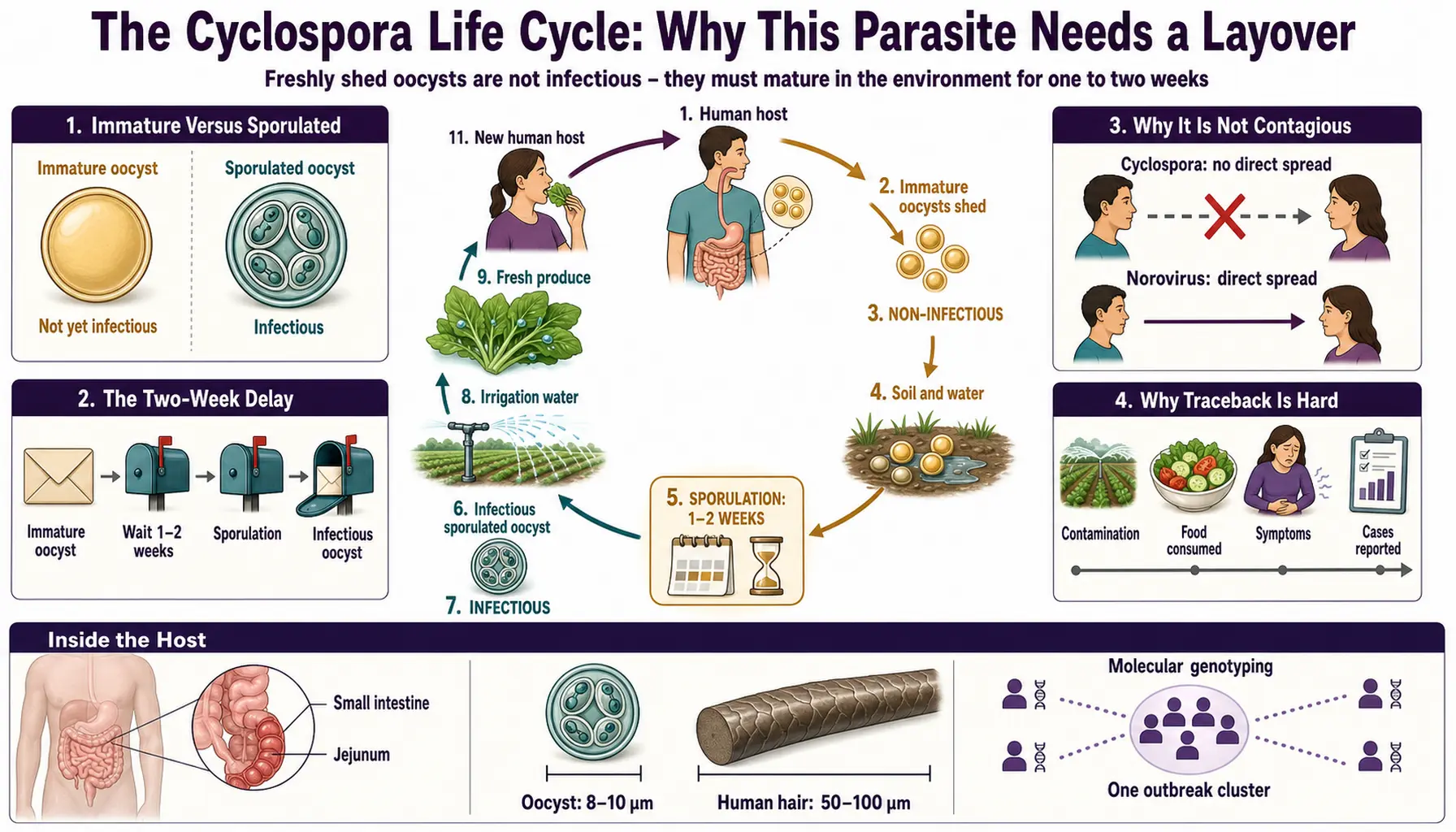
When people hear that a diarrhoeal illness is caused by a parasite, they reach for the mental model they already have for a stomach bug: one person in the house gets it, everyone else follows a day or two later, and the family spends a week passing it around. That model is correct for norovirus. It is wrong for Cyclospora cayetanensis, and the reason is one of the odder quirks in human parasitology.
Cyclospora leaves the body in a form that cannot infect anyone. The microscopic packages shed in stool are unfinished. They have to sit outside a human body, out in the environment, at agreeable temperatures, for roughly one to two weeks before they mature into the infectious form. Picture a letter dropped into a warm mailbox with a timer built into the glue: for two weeks the envelope simply will not open, no matter who picks it up or how badly they want to read it. Only afterwards does the letter become readable — and only then can the parasite infect the next person.
That single delay explains nearly everything strange about this illness. It is why a sick family member is not a danger to the household the way a norovirus case is. It is why outbreak investigators are always chasing food that was eaten and thrown out weeks ago. And it is why the search always ends at irrigation water and field sanitation rather than at somebody behind a counter. This page walks through the biology in plain language — what kind of organism this is, what it does inside your small intestine, how investigators fingerprint it, and what scientists still honestly do not know. No prior biology needed.
Interactive Visualization Cyclospora: From Contaminated Field to Relapsing Illness — watch why washing cannot save the salad Follow the parasite from irrigation water to your gut: rinse the leaves and watch it survive, chill the field so it never ripens, then treat it with the drug that works — and the one that has no target on it. Launch →Table of Contents
- 1. What Kind of Organism Is Cyclospora?
- 2. Humans Are the Only Known Host
- 3. The Sporulation Delay: The Letter in the Warm Mailbox
- 4. Consequence One: You Cannot Catch It From a Sick Person
- 5. Consequence Two: The Food Is Gone Before Anyone Gets Sick
- 6. Consequence Three: Look at the Field, Not the Kitchen
- 7. What Happens Inside the Small Intestine
- 8. Too Small to See — and Probably Not Many Are Needed
- 9. Reading the Parasite's Genome: How Cases Get Linked
- 10. Knowns and Unknowns: What Is Still Open
- Key Research Papers
- Connections
- Featured Videos
1. What Kind of Organism Is Cyclospora?
Cyclospora cayetanensis is a single-celled protozoan. One cell. Not a worm, not an insect, not a bacterium, not a virus. More precisely it is a coccidian parasite belonging to the phylum Apicomplexa.
"Apicomplexan" sounds forbidding, but the idea behind the word is simple and rather vivid. These organisms carry a specialised cluster of structures at one end — the apex — of the cell. That cluster is the apical complex, and its entire job is to attach to a host cell, discharge proteins into it, and drive the parasite inside. It is, functionally, a lockpick set mounted on the nose of the cell. Almost every member of this phylum lives inside other cells for at least part of its life, because that lockpick is how it makes a living.
Once you know that, the family album makes sense. Cyclospora's relatives include:
- Cryptosporidium — the waterborne parasite behind swimming-pool and drinking-water outbreaks of watery diarrhoea.
- Cystoisospora belli — a close cousin that causes a very similar intestinal illness, historically important in advanced HIV.
- Toxoplasma gondii — the reason pregnant women are warned about cat litter and undercooked meat.
- Plasmodium — the genus that causes malaria.
- Eimeria — the coccidia that poultry and livestock farmers fight constantly, and, as it happens, a useful laboratory stand-in for Cyclospora researchers.
Plant this flag now, because it pays off twice. These are not worms. A tapeworm, a roundworm and a threadworm are multicellular animals with muscles and a nervous system. Cyclospora is a single cell with neither. Anti-worm drugs work by attacking nerve-and-muscle machinery that a single-celled protozoan simply does not possess — which is the whole mechanistic answer to the popular question "can I just take ivermectin for this?", taken seriously and answered in full on our Treatment and the Ivermectin Question page. The taxonomy is not trivia. It is the mechanism.
The second payoff is the coccidian life-cycle pattern: a tough environmental package called an oocyst, which carries the parasite from one host to the next. The oocyst is the star of this page. It is the parasite's travel case — a thick-walled sphere built to survive in soil, in water, on the surface of a leaf. It is also the only form anyone ever sees in a stool sample, and the only form a laboratory can hope to recover from food or water.
2. Humans Are the Only Known Host
Here is a fact that changes how you should think about this infection. As far as the published evidence goes, humans are the only known natural host of Cyclospora cayetanensis. Every documented outbreak traces back, one way or another, to human faecal contamination of food or water — contaminated irrigation water, contaminated wash water, inadequate field sanitation. There is no established animal reservoir sitting in the background quietly re-seeding the environment.
That conclusion comes from people who went looking. A 2021 review by Totton and colleagues surveyed the published literature on Cyclospora cayetanensis in animals specifically to ask whether an animal reservoir could be established. Dubey, Khan and Rosenthal's 2022 review — titled, with commendable honesty, "Life Cycle and Transmission of Cyclospora cayetanensis: Knowns and Unknowns" — treats the question as one of the field's genuinely live items.
Be careful how you hold this. "No animal reservoir has been established" is not the same statement as "it has been proven that no animal can carry it." Only the first is supported. Cyclospora-like organisms have been reported in animals over the years, and telling them apart from C. cayetanensis is genuinely difficult. What the reviews say is that no animal host has been convincingly established, and that this remains an active research question rather than settled fact. If a reservoir is eventually pinned down, that will be real news — but it would not overturn the practical picture, because the outbreak record is overwhelmingly a record of human-origin contamination.
Two things follow that matter to you directly. Your pets are not the source and are not at risk from you — the dog did not give you this and cannot catch it from you. And contamination is a human sanitation failure: not deer in a field, not birds overhead, but human waste reaching the crop or the water that touched it. That makes it a preventable, fixable problem, which is why regulators focus so hard on water sourcing and worker facilities on farms.
3. The Sporulation Delay: The Letter in the Warm Mailbox
This is the heart of the page, and if you take away one idea, take this one.
An oocyst freshly shed in someone's stool cannot infect anyone. Not "less infectious," not "infectious at a higher dose." It is unsporulated — structurally incomplete — and it cannot start an infection at all. Swallowing it would do nothing. The travel case has been posted, but the contents are not yet assembled.
To become infectious, the oocyst must undergo sporulation: a maturation that happens outside any host, in the environment, and takes roughly one to two weeks at permissive temperatures. During that period the cell inside the capsule divides and repackages itself into inner capsules called sporocysts, which hold the actual invasive units — the sporozoites that will eventually break into your intestinal cells. Only when that internal reorganisation is finished is the oocyst a threat to anybody.
Hence the mailbox. The letter is posted the moment an infected person's waste reaches water, soil or a crop. It then sits on the shelf for its mandatory period, and no amount of urgency shortens it. Only afterwards can it be delivered. And the crucial detail: the shelf is not inside a human body. A person's gut is where the letter is written and where it is eventually opened, but the waiting happens out in the world.
Temperature is the thermostat on that shelf. Sporulation is not automatic. Sathyanarayanan and Ortega tested in 2006 how oocysts sporulate at different temperatures and on different food matrices — that is, sitting on actual produce rather than in a clean laboratory suspension. Temperature governs whether the process runs and how fast, and the surface the oocysts are resting on matters too. Too cold and it stalls; conditions typical of a growing season let the clock run. This is why the delay is described as "roughly one to two weeks" rather than a fixed number: the clock runs at the speed the weather sets. It is also the mechanistic reason cyclosporiasis clusters in the warmer months, when the produce it rides on is grown, harvested and eaten raw.
Researchers have asked whether that maturation can be deliberately blocked as a food-safety intervention. Baumann and colleagues showed in 2024 that aqueous ozone exposure inhibits sporulation — not in Cyclospora itself, but in Eimeria acervulina, the poultry coccidian used as a laboratory surrogate for it. If you can stop sporulation you break the cycle without needing to kill anything, which is an appealing idea. But note carefully what the study is and is not: a surrogate organism rather than Cyclospora, and a processing intervention rather than anything you can do at a kitchen sink. Promising research direction, not solved problem.
Two clarifications people frequently need:
- The delay is a starting gun, not an expiry date. Once sporulated, an oocyst does not become harmless again after a few days. Its wall is environmentally robust, which is a large part of why rinsing produce is such an unreliable defence — see Why Washing Does Not Work.
- The delay applies to the parasite, not to your symptoms. Once you swallow a sporulated oocyst, the clock that matters is the incubation period — about a week, commonly quoted as roughly 2 to 14 days — not another fortnight. The two-week wait already happened, out in the world, before the food ever reached you.
4. Consequence One: You Cannot Catch It From a Sick Person
Now the payoff, and it is the most reassuring fact in this entire topic.
Cyclosporiasis does not spread person-to-person the way norovirus does. A sick person cannot infect their family at the dinner table, a partner by sharing a glass, or a colleague by shaking hands. The logic is airtight once you see it: everything the sick person sheds is unsporulated. Even in a worst-case hygiene scenario — direct hand-to-mouth transfer, immediately — what gets transferred is a capsule that is not yet capable of establishing an infection and will not be for one to two weeks. There is no shortcut, no partial infectivity, no "small chance." The maturation step is not optional and it does not happen inside a person.
Compare that to norovirus, which is the mental model most people are running when they hear "stomach bug from a restaurant." Norovirus particles leave a sick person already infectious, in enormous numbers, and very few are needed to make the next person ill. That is why it rips through a household or a cruise ship in hours. Cyclospora is the opposite kind of pathogen wearing similar symptoms.
So if someone in your home is ill in this outbreak:
- You do not need to isolate them. They can eat at the table with you.
- You do not need to disinfect the bathroom hourly on this parasite's account.
- Nobody needs to sleep in the spare room.
- Ordinary handwashing is still worth doing. It protects against everything else that travels the faecal-oral route — including norovirus and the bacteria behind food poisoning — and until a diagnosis is confirmed you do not actually know which one you are dealing with. Someone with active diarrhoea from an undiagnosed cause should not be preparing food for others.
The important caveat is that household members can still get sick, and often do — not from each other, but because they ate the same contaminated food. If two people in a house fall ill a few days apart, the instinctive reading is "she caught it from him." With Cyclospora, the correct reading is almost always "they both ate the same thing." That distinction reframes the question from who brought this home to what did we both eat about a week ago, which is the question that actually leads somewhere.
Public-health investigators use exactly that logic at scale. In the 2026 iceberg-lettuce outbreak, the Michigan Department of Health and Human Services analysed food exposures for 190 cases who had eaten at Taco Bell and found 90% reported eating iceberg lettuce — the kind of signal that only makes sense if a shared food item, not a shared sick contact, is doing the work.
5. Consequence Two: The Food Is Gone Before Anyone Gets Sick
The delay that protects your household is the same delay that torments investigators. Line up the clock:
- Contamination happens in the field or the water — day zero.
- Sporulation: roughly one to two weeks before the oocysts can infect anyone.
- Harvest, processing, shipping, shelf and service: more days.
- Someone eats it.
- Incubation: about a week before symptoms start.
- The person waits, assuming it is a passing stomach bug — often days, sometimes longer, because this illness famously seems to improve and then come back.
- Testing and confirmation: the right test has to be ordered by name, run, and reported.
Add it up and you are routinely a month or more downstream of the contamination event before the first data point exists. The implicated food was eaten, composted or landfilled long ago. The FDA says so plainly: it can take up to 6 weeks to confirm that a given case belongs to an outbreak, which is why counts keep climbing even after a recall has cleared the shelves. Rising numbers after a recall do not mean the recall failed — they mean the backlog is catching up.
The 2026 outbreak shows the squeeze exactly. As of the FDA's July 24, 2026 update, illness onsets ran from June 22 through July 20, 2026, while the implicated foodservice lettuce had been distributed from June 29 through July 16, 2026 and the recall came on July 17, 2026. By the time the recall was announced the entire distribution window had already closed — perishable lettuce shipped in early July was not sitting in a warehouse waiting to be sampled.
Which is why the absence of a positive food sample is not the exoneration people assume it is. As of that July 24, 2026 update there were no confirmed positive product samples — the expected result when you are hunting a microscopic, patchily distributed, hard-to-recover organism on a product that no longer exists. The case rested instead on epidemiology and traceback convergence, which is a normal and entirely sufficient basis for public-health action. The full account is on our 2026 lettuce outbreak page and in our news coverage.
The general lesson: with Cyclospora, you are always investigating the past. The food chain acts as a delay line, and by the time the alarm sounds the evidence has usually been digested.
6. Consequence Three: Look at the Field, Not the Kitchen
The third consequence follows directly from the first two, and it shapes how investigations are actually run.
With most contagious foodborne pathogens there is a plausible story that runs: a food handler at the end of the chain was ill or careless, contaminated the food shortly before serving, and diners got sick. That story is right often enough for norovirus that it has become the public default — which is why people's first instinct after a restaurant outbreak is to blame somebody behind the counter.
That story cannot work for Cyclospora. Anything a food handler shed today would need one to two weeks in the environment before it could infect anyone. Contamination introduced at the end of the chain, onto food about to be served, does not have time to become infectious. So the delay does something genuinely useful: it rules the kitchen out and points investigators upstream, to the places where contamination could plausibly have happened weeks before the food was eaten.
Upstream means, in practice:
- Irrigation water — surface water carrying human waste, applied to a growing crop with weeks of field time still ahead of it. That is exactly the window sporulation needs. Kahler and colleagues developed large-volume sampling techniques in 2021 specifically to detect Cyclospora cayetanensis in produce irrigation and wash water, which tells you where the field considers the risk to live.
- Field sanitation — whether harvest crews have working toilets and handwashing stations, and how human waste is kept away from the crop and the water.
- Wash and processing water — water reused across large volumes of produce can spread a small amount of contamination across a very large amount of product.
- The growing region itself — which is why traceback in 2026 converged on one supplier's central Mexican iceberg lettuce rather than on any particular restaurant.
This is genuinely reassuring for anyone who has been served food they now suspect. The person who handed you the plate almost certainly did nothing wrong. The failure, if there was one, happened weeks earlier and hundreds or thousands of miles away — and fixing it takes water treatment, sanitation infrastructure and preharvest testing, not a sterner handwashing sign in a restaurant bathroom.
7. What Happens Inside the Small Intestine
Suppose the mailbox timer has run, the letter is open, and a sporulated oocyst arrives on a leaf that you eat. Here is the sequence.
Excystation — the capsule opens. The oocyst survives the stomach; that thick wall is built for exactly this. Then the chemistry of the upper digestive tract — acid, followed by bile and digestive enzymes — triggers it to open. This step is called excystation, and it is a lock that only the right key opens: the key is the inside of a human gut. The sporozoites are released into the small bowel.
Invasion of the jejunum. The released sporozoites deploy the apical complex and force their way into the lining cells of the small intestine, particularly the jejunum — the long middle stretch that does the heavy lifting of nutrient absorption.
The endogenous cycle. Inside those cells the parasite runs its endogenous developmental cycle — "endogenous" simply meaning "the part that happens inside the host." Dubey and colleagues published a detailed account of it in 2020. Broadly it is a two-phase affair: rounds of asexual multiplication, in which one parasite copies itself into many and the progeny invade neighbouring cells; then a switch to sexual forms which fuse, and that fusion produces the new oocysts. Those oocysts pass into the stool unsporulated and non-infectious, and the whole loop restarts with the mandatory pause built back into it.
That asexual amplification step also answers something patients often wonder about: how a tiny swallowed dose can produce a serious infection. The parasite multiplies once it is in.
Why the location matters clinically. The jejunum is not a passive tube. It is lined with villi — microscopic finger-like projections that create an enormous absorptive surface. Damage them and you do not merely lose fluid, you lose the ability to take up fat, sugars and micronutrients from food. That is the mechanism behind the greasy stools, the bloating and gas, the weight loss and the flattening fatigue patients describe — symptoms out of all proportion to an "upset stomach," because the machinery of absorption itself has been chewed up. It is also why recovery lags behind the end of the diarrhoea: a damaged surface has to regrow. Our Gut Recovery and Malabsorption page covers that phase, and Symptoms and the Relapsing Course covers the remitting–relapsing pattern.
8. Too Small to See — and Probably Not Many Are Needed
Cyclospora oocysts are roughly 8–10 micrometres across. A micrometre is a thousandth of a millimetre. That is a small fraction of the width of a single human hair, and it is far below anything the human eye can resolve — under any lighting, at any angle, at any distance. You cannot see one. You cannot see a thousand of them.
Every consequence of that is bad news for the instinct that we can inspect our way to safety:
- Contaminated produce looks perfect. No discolouration, no slime, no film, no smell, nothing wrong to the touch. A contaminated leaf is visually identical to a clean one. That is not a failure of your senses; it is a matter of scale.
- There is nothing to rinse off that you can watch leaving. You cannot confirm success. Combined with the toughness of the oocyst wall and the way oocysts lodge in the microscopic irregularities of a leaf surface, this is why washing is not a reliable defence — and why heat is the reliable kill step.
- Laboratories struggle too. Recovering a handful of 8–10 micrometre objects from a bag of shredded lettuce is a serious technical problem, which is why specialised sampling protocols exist and why a negative product test carries so little weight.
How much do you have to swallow? Here we should be careful, because this is a spot where confident-sounding numbers circulate without support. A minimum infectious dose for Cyclospora cayetanensis has not been established. Pinning one down would require controlled human exposure studies that have not been done, and the organism's difficulty in the laboratory has made the question hard to approach indirectly. Dubey, Khan and Rosenthal place this territory among the unknowns.
What can be said honestly is an inference rather than a measurement: outbreaks repeatedly arise from fresh produce carrying contamination too sparse for anyone to detect, sometimes sickening large numbers of people across many states. That pattern does not suggest a large dose is required. Treat "the infectious dose is probably low" as a reasonable reading of the outbreak record — not as a number anyone has measured. If a page or a video gives you a specific oocyst count, ask where it came from.
9. Reading the Parasite's Genome: How Cases Get Linked
For most of this parasite's history investigators faced a maddening limitation: under a microscope, every Cyclospora oocyst looks like every other one. If forty people fall ill in the same fortnight you can confirm that all forty have cyclosporiasis — but not whether they ate the same contaminated shipment or are forty unrelated cases that happened to coincide. That distinction is not academic, because cyclosporiasis does not only occur in outbreaks. There is a continuous background of United States cases, and the FDA is explicit that the illnesses counted in the 2026 outbreak "are a subset of the Cyclospora infections identified nationwide." Separating outbreak from background is a real problem that has to be solved before anyone can act.
Genotyping solves it, and the analogy is straightforward. Identifying a car as "a blue sedan" is nearly useless for linking cases; reading its vehicle identification number is decisive. Saying that every patient has "Cyclospora" is the blue sedan. Reading enough of each parasite's DNA gives each infection something closer to a serial number. If the parasites from forty patients share a distinctive profile, those forty illnesses came from a common source and their food histories can be pooled with confidence. If they do not match, the cluster dissolves into unrelated background cases and the investigation goes elsewhere. Genotyping tells signal from noise.
Three strands of recent work built that capability:
- Mitochondrial genome typing. Cinar and colleagues published a method in 2020 for typing Cyclospora cayetanensis in both produce and clinical samples, using targeted enrichment of complete mitochondrial genomes. That "both" is the important word: a method that works on a food sample and a patient sample can, in principle, connect the two ends of a chain directly rather than inferring the link from interviews alone.
- Integrating typing with epidemiology. Ahart and colleagues went back over United States cyclosporiasis outbreak investigations in 2023 to evaluate how well combining genetic clustering with classical food-history epidemiology actually performed. Genotyping does not replace shoe-leather epidemiology; it is a filter that makes the shoe leather far more productive.
- A reference genome for lineage A. Santin and colleagues reported the first Cyclospora cayetanensis lineage A genome in 2024, from an isolate obtained in Mexico. A high-quality reference genome is the foundation everything else rests on: it is what short fragments read from a patient sample get compared against, and each new one reveals more of the variable regions that distinguish strains.
One caution, because the coincidence invites over-reading: that 2024 genome came from a Mexican isolate, and the 2026 outbreak was traced to central Mexican lettuce. Those two facts are not connected. The Santin genome is a reference-genomics contribution published two years before this outbreak; it is not evidence about it. Genome papers build the ruler — they do not measure the case.
10. Knowns and Unknowns: What Is Still Open
The leading modern review of this parasite's biology is titled "Life Cycle and Transmission of Cyclospora cayetanensis: Knowns and Unknowns." When the field's flagship review puts "Unknowns" in its own title, the honest thing for a health page to do is repeat the gaps rather than paper over them.
Reasonably well established:
- It is a coccidian apicomplexan protozoan, transmitted faecal-orally through contaminated food and water.
- Oocysts are shed unsporulated and must mature in the environment for roughly one to two weeks before becoming infectious.
- Sporulation is temperature-dependent and influenced by the matrix the oocyst is sitting on.
- Development in the host occurs in the small intestine, with the endogenous cycle described in detail — and only recently, in 2020. Before that, much of what textbooks said about the intracellular stages was extrapolated from related coccidia rather than observed in this species.
- Humans are the only host that has been established, and outbreaks trace to human faecal contamination.
Genuinely open:
- Whether any animal host exists at all. The 2021 animal review and the 2022 Knowns-and-Unknowns review both leave this unresolved rather than closed.
- The minimum infectious dose. Not established, as discussed above.
- Exactly which conditions in a real field permit or prevent sporulation. Laboratory temperature and matrix studies give a framework, not a forecast.
- Where the parasite persists between seasons, and whether high-income countries now harbour local transmission. Chacín-Bonilla and Santín asked in 2023 whether developed countries have potential endemic foci of their own rather than only importing the parasite on produce and in travellers. The honest answer today is that this is under active investigation, not settled in either direction.
- How to study it well. This is the quiet obstacle behind all the others. Cyclospora is difficult to work with experimentally, which is why researchers frequently fall back on surrogate species — the 2024 ozone study used Eimeria acervulina as a stand-in. Surrogate work is legitimate and necessary, but it is one step removed from the real thing, and conclusions have to be carried across that gap carefully.
None of this uncertainty should unsettle you, because the practical advice does not depend on the open questions. Whether or not an animal reservoir is eventually found, the route you can act on is contaminated fresh produce and water. Whether or not the infectious dose is ever quantified, cooking remains the reliable kill step and rinsing remains unreliable. The unknowns are real, and they are mostly the researchers' problem rather than yours.
There is even a strange comfort in the delay. This parasite is hard to trace, hard to detect in food, and capable of making a great many people miserable for weeks. But in one specific and important sense it is weak: it cannot spread the way ordinary contagion spreads. The risk lives in the supply chain, not at your dinner table.
If you are unwell right now and any of this sounds like your last few weeks, the useful next step is not more biology — it is getting the right test ordered by name, because a routine stool workup will miss this organism entirely. Take that to a clinician, and mention the raw produce you ate in the two weeks before you got sick. Our Diagnosis and Testing page explains what to ask for.
Key Research Papers
- Dubey JP, Khan A, Rosenthal BM. Life Cycle and Transmission of Cyclospora cayetanensis: Knowns and Unknowns. Microorganisms 2022;10(1):118. PMID: 35056567
- Dubey JP, et al. Endogenous Developmental Cycle of the Human Coccidian Cyclospora cayetanensis. Journal of Parasitology 2020. PMID: 32316032
- Sathyanarayanan L, Ortega YR. Effects of temperature and different food matrices on Cyclospora cayetanensis oocyst sporulation. Journal of Parasitology 2006. PMID: 16729675
- Totton SC, et al. A review of Cyclospora cayetanensis in animals. Zoonoses and Public Health 2021. PMID: 34156154
- Ortega YR, Sanchez R. Update on Cyclospora cayetanensis, a food-borne and waterborne parasite. Clinical Microbiology Reviews 2010;23(1):218-34. PMID: 20065331
- Giangaspero A, Gasser RB. Human cyclosporiasis. The Lancet Infectious Diseases 2019;19(7):e226-e236. PMID: 30885589
- Santin M, et al. The first Cyclospora cayetanensis lineage A genome from an isolate from Mexico. BMC Genomics 2024. PMID: 38443790
- Cinar HN, et al. Molecular typing of Cyclospora cayetanensis in produce and clinical samples using targeted enrichment of complete mitochondrial genomes. Parasites & Vectors 2020. PMID: 32143704
- Ahart L, et al. Retrospective evaluation of an integrated molecular-epidemiological approach to cyclosporiasis outbreak investigations — United States. Epidemiology and Infection 2023. PMID: 37466070
- Kahler AM, et al. Detection of Cyclospora cayetanensis in produce irrigation and wash water using large-volume sampling techniques. Food and Waterborne Parasitology 2021. PMID: 33681488
- Baumann AA, et al. Aqueous Ozone Exposure Inhibits Sporulation in the Cyclospora cayetanensis Surrogate Eimeria acervulina. Journal of Food Protection 2024. PMID: 38460785
- Chacin-Bonilla L, Santin M. Cyclospora cayetanensis Infection in Developed Countries: Potential Endemic Foci? Microorganisms 2023. PMID: 36985114
Live PubMed Searches
- Cyclospora cayetanensis life cycle
- Cyclospora oocyst sporulation temperature
- Cyclospora cayetanensis animal reservoir
- Cyclospora cayetanensis genome and molecular typing
- Cyclospora endogenous developmental cycle in the small intestine
- Cyclospora irrigation water and produce contamination
Official Guidance
- FDA — Cyclospora topic page (what the parasite is, how it spreads, prevention)
- CDC — Cyclosporiasis home (biology, symptoms, diagnosis, treatment)
- FDA — Investigation of the 9-state outbreak of Cyclospora illnesses linked to iceberg lettuce, July 2026 (current case counts and status)
- CDC — Outbreak advisory, July 2026
- CDC — Investigation update, July 2026
Connections
- All Parasites
- Cyclospora: From Contaminated Field to Relapsing Illness — interactive animation
- Cyclospora — main hub
- The 2026 Iceberg Lettuce Outbreak
- Why Washing Produce Does Not Work
- Symptoms and the Relapsing Course
- Diagnosis and Testing
- Treatment and the Ivermectin Question
- Gut Recovery and Malabsorption
- Produce Safety at Home
- Cyclospora vs Other Gut Infections
- Cryptosporidium — a fellow apicomplexan
- Giardia
- Blastocystis
- Chronic Diarrhea
- SIBO (Small Intestinal Bacterial Overgrowth)
- Probiotics
- News — July 26, 2026