Pantothenic Acid (Vitamin B5) Deficiency: What the Evidence Shows
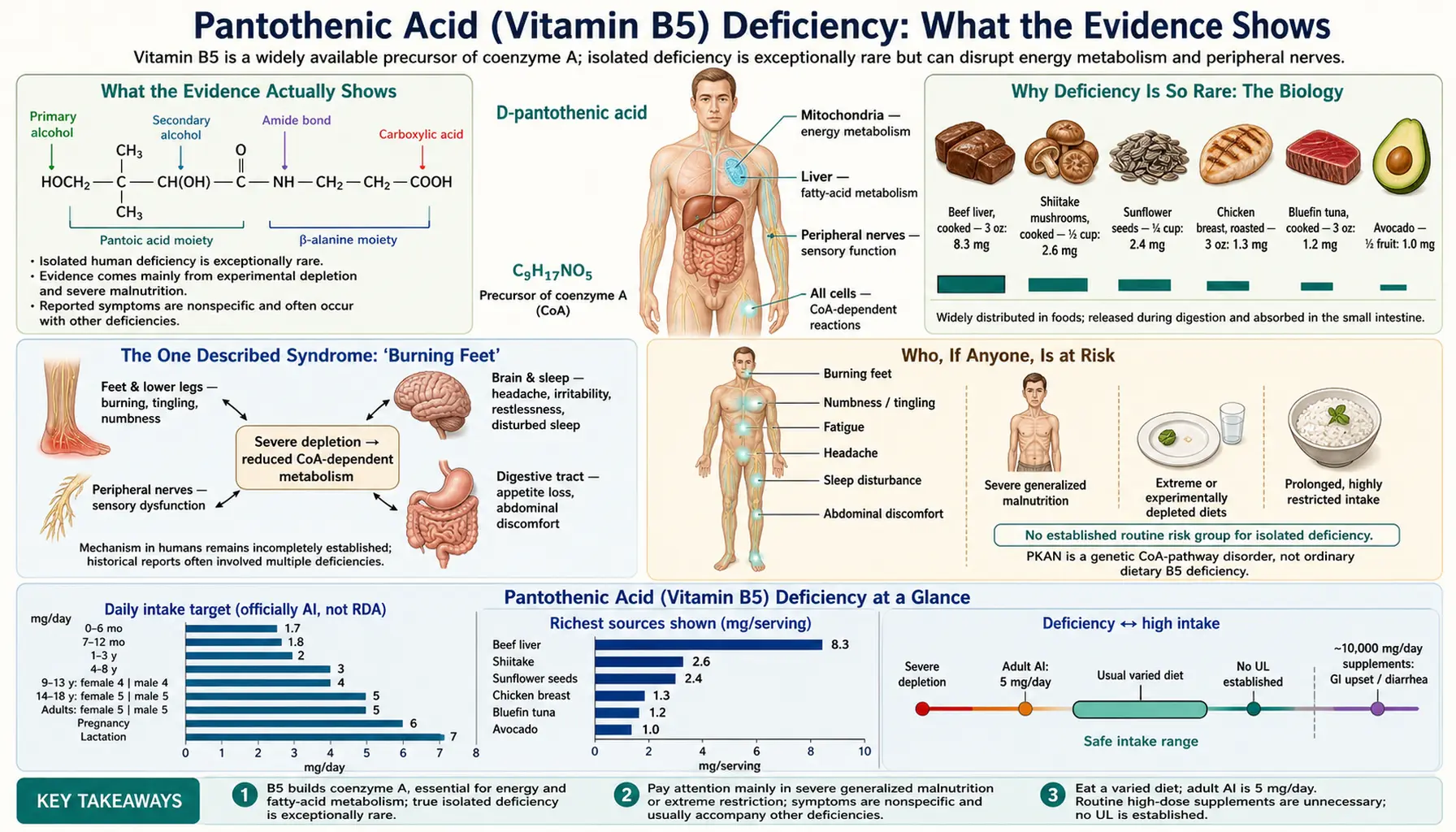
Here is the honest bottom line first: an isolated deficiency of pantothenic acid (vitamin B5) essentially does not happen in people eating a normal mixed diet. The vitamin's name says it all — pantos is Greek for "everywhere," and B5 truly is in almost every food, from eggs and meat to whole grains, legumes, avocado, and vegetables. Because it is so widespread and the body recycles it efficiently, no recognized natural deficiency disease exists, the way scurvy exists for vitamin C or pellagra for niacin. The one human syndrome ever clearly tied to B5 alone — a painful "burning feet" sensation — was seen only in extreme circumstances: prisoners of war on starvation diets in the 1940s, and a handful of volunteers in mid-century experiments who were deliberately fed a purified B5-free diet together with a drug that blocks the vitamin. In ordinary life, if someone is short on B5 they are almost always short on many nutrients at once (severe malnutrition, alcohol-use disorder, or a serious malabsorption illness), so the picture is one of general undernutrition, not a specific "B5 deficiency." This page explains what the evidence actually shows, why the body is so well protected, who the rare exceptions are, and what sensible steps to take — without inventing a symptom list that does not exist.
Table of Contents
- What the Evidence Actually Shows
- Why Deficiency Is So Rare: The Biology
- The One Described Syndrome: "Burning Feet"
- Who, If Anyone, Is at Risk
- Can It Even Be Measured?
- What to Do: A Low-Key, Practical Take
- When Symptoms Deserve a Real Work-Up
- Key Research Papers
- Connections
- Featured Videos
What the Evidence Actually Shows
It is worth being candid, because the internet is full of articles listing "signs of vitamin B5 deficiency" — fatigue, irritability, sleep trouble, numbness, stomach upset — as though it were a common problem to screen yourself for. The medical and nutritional literature does not support that. Naturally occurring pantothenic acid deficiency in otherwise well-nourished people has essentially never been documented. The authoritative US dietary reference report from the Institute of Medicine put it plainly: a deficiency of pantothenic acid alone is so rare that the symptoms have only been produced experimentally, and there was not enough evidence to set a Recommended Dietary Allowance at all — only a looser "Adequate Intake" (5 mg/day for adults).
The reason is simple arithmetic of supply. B5 is one of the most evenly distributed nutrients in the entire food supply. A typical Western diet delivers somewhere around 4–7 mg a day without anyone trying, which comfortably meets the Adequate Intake. To run low on B5 specifically, a person would essentially have to stop eating — and at that point they are short of many things, not just one vitamin. So the honest framing is this:
- There is no recognized "vitamin B5 deficiency disease" in the way there is for vitamin C (scurvy), niacin (pellagra), thiamin (beriberi), or vitamin D (rickets). B5 simply does not produce a stand-alone, nameable illness in real-world diets.
- The symptoms attributed to it come almost entirely from two artificial settings: deliberate experiments in which volunteers were fed a synthetic diet stripped of B5 (often plus a chemical antagonist that blocks the vitamin), and historical wartime starvation where the diet was missing nearly everything.
- When B5 is low in a real patient, it is a marker of broad malnutrition, not an isolated finding. Treating the whole nutritional state — not "the B5" — is the point.
This does not mean B5 is unimportant; quite the opposite. It is essential for life because the body builds coenzyme A from it (more on that below), and you could not survive without any. It means the body's protective systems and the food supply are so good at keeping B5 topped up that a deficiency almost never gets a chance to develop. A page that honestly says "this is not a common clinical problem" is doing its job better than one that manufactures a symptom checklist.
Why Deficiency Is So Rare: The Biology
Three facts about pantothenic acid explain why a shortage is so hard to produce: it is everywhere in food, the body holds onto it, and a little goes a long way because it is recycled.
1. It is genuinely "everywhere." The name pantothenic acid comes from the Greek pantothen, "from all sides" or "everywhere," chosen by the chemist Roger Williams precisely because his team kept finding it in every tissue and food they tested. It is abundant in animal foods (organ meats and liver are the richest, but also eggs, chicken, and fish), in whole grains, in legumes such as lentils, and in many vegetables including broccoli, sweet potatoes, and avocado. Even yogurt and milk contribute. The main way to lose B5 from food is heavy processing and refining — milling grains and over-cooking can strip a good fraction — but no normal mixed diet comes close to eliminating it. For a fuller list and amounts, see the Vitamin B5 Food Sources page.
2. The body builds an essential molecule from it — and guards the supply. Pantothenic acid's entire job is to serve as the backbone of coenzyme A (CoA) and of a related carrier called acyl-carrier protein. CoA is one of the busiest molecules in metabolism: it carries the two-carbon "acetyl" units that feed the Krebs cycle (how cells release energy from food), and it is required to build and break down fats, make cholesterol and steroid hormones, and produce the neurotransmitter acetylcholine. Because CoA is so central, cells are built to make it efficiently from very small amounts of B5 and to recycle the components. The deep mechanism is covered on the Coenzyme A Biosynthesis page; the relevant point here is that the demand for raw B5 is modest because the molecule is reused, not consumed one-for-one.
3. The intake target is low and easy to meet. Because no clear deficiency exists to anchor a precise requirement, the Adequate Intake for adults is just 5 mg per day (about 6 mg in pregnancy and 7 mg while breastfeeding). That is a small target, routinely exceeded by ordinary eating. Some B5 is also produced by gut bacteria, though how much the body actually absorbs and uses from that source is uncertain and probably minor — the food supply does the heavy lifting.
Put together, these explain the central paradox of B5: it is utterly essential, yet running short of it specifically is one of the rarest nutritional events in human medicine.
The One Described Syndrome: "Burning Feet"
If pantothenic acid deficiency has a single human face, it is the "burning feet" syndrome — also called nutritional melalgia. This is the one symptom complex that researchers have repeatedly linked, at least in part, to a lack of B5, and it is worth understanding precisely because it shows how extreme the conditions had to be.
What it is. Burning feet syndrome is a distressing sensation of burning, aching, throbbing, or "pins and needles" in the soles of the feet, often worse at night and sometimes accompanied by redness and excessive warmth. It is a form of peripheral neuropathy — irritation or damage to the small nerves of the feet. Phillip Glusman's 1947 description in The American Journal of Medicine framed it explicitly as a manifestation of nutritional deficiency.
Where it was seen. The condition became well known among prisoners of war and in famine populations during and after the Second World War — people surviving for months on grossly inadequate diets. In those settings the diet was deficient in many B vitamins at once, so burning feet was never a clean "B5 only" experiment of nature. The link to pantothenic acid specifically came from deliberate human studies. In the 1950s, Robert Hodges and colleagues fed volunteers a purified diet lacking B5, frequently combined with omega-methyl pantothenic acid — a synthetic compound that competitively blocks the vitamin's actions and accelerates a deficiency that diet alone could not reliably produce. Under those forced conditions the volunteers developed a recognizable constellation: burning, tingling, and numbness in the hands and feet; fatigue and weakness; headache; irritability and restlessness; sleep disturbance; nausea and abdominal cramps; and increased susceptibility to infection. Bean and Hodges had earlier shown in 1954 that human deficiency could be induced experimentally at all, and Thornton's group documented impaired stomach acid secretion and gut motility in the same kind of study.
The honest takeaways from this body of work:
- The symptoms are real, but they required an artificial diet plus, usually, a drug antagonist to appear. They are not something a normal diet produces.
- "Burning feet" in the real world is far more often caused by other things — diabetic neuropathy (the most common cause by far), vitamin B12 deficiency, vitamin B1 (thiamin) deficiency in alcohol-use disorder, kidney disease, thyroid problems, certain medications, and nerve compression. A burning-feet sensation is a reason to look for these common causes, not to assume pantothenic acid.
- Even in the experimental subjects, B5 was rarely acting alone in any clean way, and giving B5 back reversed the induced symptoms — confirming the link while underscoring how contrived the setup had to be.
In short, the burning-feet story is the proof that B5 is essential, and simultaneously the proof of how extreme conditions must become before its absence is felt.
Who, If Anyone, Is at Risk
Since a normal diet protects almost everyone, the only people in whom low B5 is even plausible are those whose entire nutrition has broken down or who carry a rare genetic condition. None of these is a reason for the general public to worry about B5 specifically; in every case the bigger problem is the underlying situation.
- Severe, generalized malnutrition or starvation. This is the classic setting — famine, refugee crises, prolonged starvation, or extreme restrictive eating disorders. Here B5 falls alongside protein, calories, and most other vitamins. The clinical priority is careful refeeding of the whole diet under medical supervision, not a B5 supplement.
- Chronic, heavy alcohol use. Alcohol-use disorder is the leading real-world cause of multiple B-vitamin deficiencies in wealthy countries, because of poor diet, reduced absorption, and increased losses. Thiamin (B1) is the dangerous one to miss (it can cause Wernicke encephalopathy), but pantothenic acid can be low as part of the same picture. Treatment targets the whole deficiency state and the drinking, not B5 in isolation.
- Serious malabsorption. Advanced inflammatory bowel disease such as Crohn's disease, untreated celiac disease, short-bowel syndrome after surgery, or long-term reliance on intravenous (parenteral) nutrition that was not properly supplemented can all impair B vitamin status broadly. Again, B5 is one thread in a wider deficiency.
- A rare inherited disorder of CoA metabolism. There is a serious neurodegenerative condition called pantothenate kinase-associated neurodegeneration (PKAN), caused by mutations in an enzyme (PANK2) that uses B5 to make CoA. Importantly, PKAN is not a dietary deficiency — it is a genetic enzyme defect, and giving extra dietary B5 does not fix it. It is mentioned only to head off confusion: a problem in the pathway that uses B5 is a different thing from not getting enough B5 from food.
For everyone outside these uncommon circumstances — including the overwhelming majority of vegetarians and vegans, who get ample B5 from grains, legumes, seeds, and vegetables — pantothenic acid deficiency is not a realistic concern.
Can It Even Be Measured?
Because clinical deficiency is so rare, doctors essentially never order a pantothenic acid level, and it is not part of routine blood panels. There is no standard, widely available, well-validated blood test for B5 status the way there is a clear test for, say, vitamin B12. When researchers need to measure it, they typically collect a 24-hour urine sample — urinary excretion tracks intake reasonably well — or measure whole-blood pantothenic acid, since the level in red blood cells reflects body stores better than serum does. These are research tools, not everyday clinical tests.
What this means in practice: if you have symptoms that some website blamed on "low B5," the right step is not to hunt for a B5 test. It is to evaluate the symptom on its own merits. Persistent fatigue, tingling feet, or stomach trouble all have far more common explanations, and a sensible work-up looks for those — a complete blood count and a comprehensive metabolic panel to check for anemia, kidney, liver, and blood-sugar problems; a B12 level; thyroid testing; and a focused neurological exam if there is numbness or burning. In someone with broad malnutrition or alcohol-use disorder, clinicians treat the whole nutritional deficit empirically rather than testing for B5 specifically.
What to Do: A Low-Key, Practical Take
The practical advice here is refreshingly undramatic, precisely because there is no common problem to fix.
- For almost everyone: do nothing special. If you eat any reasonable mixed diet — including a varied vegetarian or vegan one — you are getting plenty of B5. There is no need to take a B5 supplement to prevent a deficiency, because the deficiency is not realistically going to happen.
- Favor whole, minimally processed foods. The only meaningful dietary way to lose B5 is through heavy refining and overcooking. Choosing whole grains over highly refined ones and not boiling vegetables to death preserves B5 (and a lot of other nutrients). Good everyday sources are listed on the Vitamin B5 Food Sources page; standouts include liver, eggs, chicken, whole grains, lentils, avocado, broccoli, and sweet potatoes.
- If you are in a genuinely high-risk situation, treat the situation. Recovery from severe malnutrition, an eating disorder, alcohol-use disorder, or serious malabsorption should be managed by a clinician or dietitian, who will restore the whole diet (usually including a B-complex or multivitamin) rather than single out B5. That broad approach automatically covers pantothenic acid.
- Separate "deficiency" from "supplement therapy." People do take B5 supplements — or its derivative pantethine — for reasons that have nothing to do with deficiency: pantethine for cholesterol, and B5 for acne or so-called adrenal support. Those are separate questions about extra B5, not about correcting a shortage; the evidence and the dosing are different, and they are covered on the Vitamin B5 Benefits pages and the Vitamin B5 Toxicity page. For the purpose of preventing deficiency, none of it is necessary.
When Symptoms Deserve a Real Work-Up
Because there is no common B5 deficiency to point to, the most useful safety message is the reverse of the usual one: do not let "maybe it's low B5" delay you from getting real symptoms properly evaluated. The sensations people blame on B5 — burning or numb feet, deep fatigue, stomach trouble — can be the first sign of conditions that genuinely need attention. See a clinician promptly if you have:
- New or worsening numbness, tingling, or burning in the feet or hands — especially if you have diabetes or a family history of it, drink heavily, or take medications known to affect nerves. This pattern points to neuropathy from diabetes, B12 or thiamin deficiency, kidney disease, or thyroid disease far more often than anything to do with B5.
- Weakness that is spreading or affecting balance and walking — numbness that climbs up the legs, unsteadiness, or trouble with fine movements deserves a neurological exam, not a vitamin guess.
- Persistent, unexplained fatigue — lasting weeks, this warrants checking for anemia, thyroid disease, blood-sugar problems, sleep disorders, and depression rather than self-treating with B5.
- Signs of serious malnutrition — rapid unintended weight loss, an inability to eat, or recovery from an eating disorder or alcohol-use disorder — which should be managed medically, with attention to the dangerous deficiencies (especially thiamin) and to safe refeeding.
In other words: take the symptom seriously, and let a clinician find its real cause. Isolated pantothenic acid deficiency will almost never be that cause.
Key Research Papers
- Institute of Medicine, Food and Nutrition Board (1998). Pantothenic Acid. In: Dietary Reference Intakes for Thiamin, Riboflavin, Niacin, Vitamin B6, Folate, Vitamin B12, Pantothenic Acid, Biotin, and Choline. Washington, DC: National Academies Press. — DOI: 10.17226/6015
- Bean WB, Hodges RE (1954). Pantothenic acid deficiency induced in human subjects. Proceedings of the Society for Experimental Biology and Medicine;86(4):693-698. — DOI: 10.3181/00379727-86-21204
- Hodges RE, Bean WB, Ohlson MA, Bleiler R (1958). Pantothenic acid deficiency in man. Journal of Clinical Investigation;37(11):1642-1657. — DOI: 10.1172/jci103756
- Hodges RE, Ohlson MA, Bean WB (1959). Human pantothenic acid deficiency produced by omega-methyl pantothenic acid. Journal of Clinical Investigation;38(8):1421-1425. — DOI: 10.1172/jci103918
- Thornton GHM, Bean WB, Hodges RE (1955). The effect of pantothenic acid deficiency on gastric secretion and motility. Journal of Clinical Investigation;34(8):1085-1091. — DOI: 10.1172/jci103157
- Glusman M (1947). The syndrome of "burning feet" (nutritional melalgia) as a manifestation of nutritional deficiency. The American Journal of Medicine;3(2):211-223. — DOI: 10.1016/0002-9343(47)90151-4
- Fry PC, Fox HM, Tao HG (1976). Metabolic response to a pantothenic acid deficient diet in humans. Journal of Nutritional Science and Vitaminology;22(4):339-346. — DOI: 10.3177/jnsv.22.339
- Tahiliani AG, Beinlich CJ (1991). Pantothenic acid in health and disease. Vitamins & Hormones;46:165-228. — DOI: 10.1016/s0083-6729(08)60684-6
- Leonardi R, Zhang YM, Rock CO, Jackowski S (2005). Coenzyme A: back in action. Progress in Lipid Research;44(2-3):125-153. — DOI: 10.1016/j.plipres.2005.04.001
- National Institutes of Health, Office of Dietary Supplements. Pantothenic Acid — Health Professional Fact Sheet. — PubMed (topic review)
PubMed Topic Searches
- PubMed — Pantothenic acid deficiency in humans
- PubMed — Burning feet syndrome and nutritional deficiency
- PubMed — Pantothenic acid and coenzyme A metabolism
- PubMed — Pantothenic acid status and adequate intake
- PubMed — Peripheral neuropathy and B-vitamin deficiency
Connections
- All Vitamins
- Vitamin B5 (Pantothenic Acid) Overview
- Vitamin B5 Toxicity
- Vitamin B5 Benefits Deep Dive
- Coenzyme A Biosynthesis
- B5 for Adrenal Support and Stress
- Vitamin B5 Food Sources
- Vitamin B5: History and Discovery
- Vitamin B12
- Vitamin B6
- Adrenal Fatigue (HPA Axis Dysfunction)
- Crohn's Disease
- Celiac Disease
- Complete Blood Count
- Comprehensive Metabolic Panel
- Beef Liver
- Eggs
- Chicken
- Lentils
- Avocado
- Broccoli
- Sweet Potatoes