Vitamin B5: History and Discovery
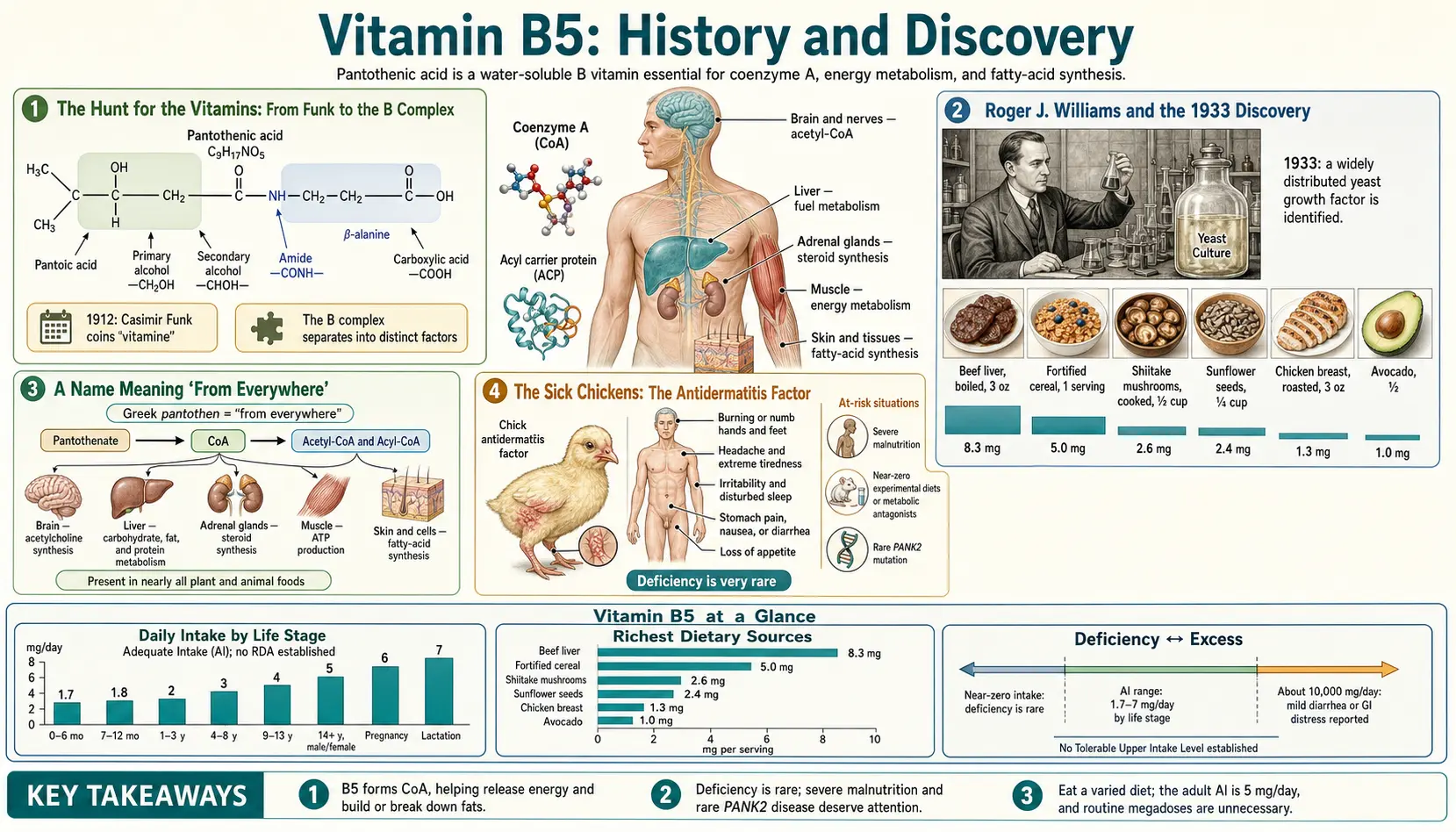
In 1933, a chemist at Oregon State College named Roger J. Williams announced that he had found an acidic substance that yeast could not grow without — and that the same substance turned up in nearly every living thing he tested. He gave it a name built from the Greek word for "everywhere," pantothen, and called it pantothenic acid. That single naming choice is the spine of this vitamin's history: it really is everywhere, and the story of how scientists tracked it down winds through yeast cultures, sick chickens with scaly skin, a 1940 race to pin down its chemical structure and synthesize it, and finally a 1953 Nobel Prize awarded for discovering the molecule — coenzyme A — that explains why every cell on Earth needs it. This article tells that documented story, names the people who did the work, and is careful to separate what the historical record firmly supports from the claims that remain estimates or interpretation.
Table of Contents
- The Hunt for the Vitamins: From Funk to the B Complex
- Roger J. Williams and the 1933 Discovery
- A Name Meaning "From Everywhere"
- The Sick Chickens: The Antidermatitis Factor
- Cracking the Structure and the 1940 Synthesis
- Coenzyme A and the 1953 Nobel Prize
- Is Vitamin B5 a "Real" Vitamin?
- From Laboratory Curiosity to Everyday Nutrient
- Research Papers and References
- Connections
- Featured Videos
The Hunt for the Vitamins: From Funk to the B Complex
To understand how pantothenic acid was found, it helps to remember the moment in science when the search began. In the early twentieth century, researchers were realizing that food contained tiny "accessory factors" — substances present in only trace amounts but essential for life. In 1912, the Polish-born biochemist Casimir Funk proposed the word vitamine (from "vital amine") for these factors, after his work on the substance in rice husks that prevented the deficiency disease beriberi. The terminal "e" was later dropped to give vitamin, once it was clear that not all of these compounds were amines.
What Funk and his contemporaries first treated as a single anti-beriberi substance — loosely called "water-soluble B" — gradually turned out to be a whole family of distinct molecules. Through the 1920s and 1930s, chemists slowly pried this "vitamin B complex" apart into separate, individually numbered members. Thiamine (B1), riboflavin (B2), and niacin (B3) were teased out one by one. Pantothenic acid was one of these B-complex discoveries — it emerged from exactly this effort to figure out which precise chemical compounds the umbrella term "vitamin B" actually contained. Funk himself did not discover pantothenic acid; his lasting contribution to its story is the very word vitamin and the framework of thinking that made the whole search possible.
Roger J. Williams and the 1933 Discovery
The central figure in pantothenic acid's discovery is the American biochemist Roger John Williams (1893–1988). Williams was studying what living cells need in order to grow, using yeast (Saccharomyces cerevisiae) as his test organism — a clever approach, because yeast, like us, requires certain nutrients it cannot make for itself. If you remove an essential factor, the yeast stops growing; add it back, and growth resumes. This gave Williams a sensitive biological assay for hunting an unknown nutrient.
Working through the late 1920s and into the early 1930s, Williams identified an acidic growth factor that yeast could not do without. The landmark publication came in 1933: Williams and his co-workers (Carl M. Lyman, George H. Goodyear, John H. Truesdail, and Duncan A. Holaday) reported the substance in the Journal of the American Chemical Society under the title "‘Pantothenic Acid,’ A Growth Determinant of Universal Biological Occurrence." The title itself announces the two things that would define the vitamin forever after: it is a growth factor, and it is found nearly everywhere in living matter.
Williams pursued pantothenic acid for more than twenty years, much of that work carried out at the University of Oregon, at Oregon State College, and later at the University of Texas at Austin, where he founded a major biochemical research institute. It is worth being clear about credit: Williams is recognized as the discoverer and namer of pantothenic acid, and unlike some vitamins whose priority was bitterly contested, his claim to this discovery is not seriously disputed. What was distributed across several laboratories — as the next sections show — was the parallel detective work that eventually proved his yeast factor and several other mysterious "factors" were one and the same compound.
A Name Meaning "From Everywhere"
The name pantothenic acid is one of the most quietly descriptive in all of nutrition. Williams coined it from the Greek pantothen (παντοθεν), meaning "from everywhere" or "from all sides." He chose it because the factor turned up in essentially every animal and plant tissue and every foodstuff he examined — liver, egg yolk, yeast, cereal grains, vegetables. Where most vitamins are concentrated in a few foods, this one seemed to be genuinely universal.
That naming choice has had a real practical consequence that runs all the way to the modern dinner table. Because pantothenic acid is so widely distributed in food, outright deficiency is very rare in people who eat an ordinary mixed diet — the body is rarely starved of something present in nearly everything. The Greek root, in other words, is not just a historical flourish; it encodes the single most important fact about how this vitamin behaves in human nutrition. (The familiar shorthand "vitamin B5" is a later, informal label from the B-complex numbering system; in the scientific and historical literature the compound is almost always called pantothenic acid.)
The Sick Chickens: The Antidermatitis Factor
Most vitamins were discovered through a deficiency disease — scurvy pointed to vitamin C, beriberi to thiamine, pellagra to niacin, rickets to vitamin D. Pantothenic acid's deficiency story is a little different, and it played out largely in poultry rather than in people. In 1930, the researchers Leo C. Norris and A. T. Ringrose described a skin disease in chicks — a scaly, crusty dermatitis around the beak, eyes, and feet — that could be cured by something present in certain food extracts. Because it remained in the liquid "filtrate" after other known factors were removed, this mystery nutrient became known as the "filtrate factor" or the "chick antidermatitis factor."
For several years, nobody knew that the chickens' antidermatitis factor, the yeast growth factor Williams had named, and a separate nutrient needed by certain bacteria were the same chemical. The pieces came together at the end of the decade. In 1939, Thomas H. Jukes published a paper in the Journal of the American Chemical Society titled "Pantothenic Acid and the Filtrate (Chick Anti-Dermatitis) Factor," and around the same time the laboratory of Conrad Elvehjem reached the same conclusion: the chick antidermatitis factor was pantothenic acid. This convergence — several independent "factors" collapsing into one named vitamin — is a recurring and genuinely satisfying pattern in the history of nutrition, and pantothenic acid is one of its clearest examples.
A note on certainty: the chick dermatitis observations of Norris and Ringrose are well documented, but the early literature is tangled, with overlapping "filtrate" and "anti-dermatitis" factors described by several groups across the 1930s. The firmly established milestone is the 1939 demonstration that the chick antidermatitis factor and pantothenic acid are identical; the finer details of who saw exactly what, and when, in the years before that are reported here as they appear in the historical record rather than as a tidy single discovery.
Cracking the Structure and the 1940 Synthesis
Naming a vitamin and being able to grow yeast with it is one thing; knowing its exact chemical architecture — and being able to build it from scratch — is another. That decisive step came in 1940. Williams, together with Randolph T. Major, reported the chemical structure of pantothenic acid in the journal Science in a short 1940 paper titled simply "The Structure of Pantothenic Acid." The molecule proved to be an amide joining two pieces: a small acid (now called pantoic acid) linked to the amino acid β-alanine. That β-alanine fragment would later turn out to be the key to how the body uses the vitamin.
In the same year, the full chemical synthesis of pantothenic acid was achieved by chemists at the pharmaceutical firm Merck & Co. in Rahway, New Jersey — the team associated with Karl Folkers (1906–1997), one of the great vitamin chemists of the era, with the structural and synthetic work published in the Journal of the American Chemical Society. Randolph Major was the research director who led Merck's broader vitamin program, which also delivered industrial syntheses of thiamine (B1) and riboflavin (B2). Being able to make pantothenic acid in the laboratory mattered enormously: it confirmed the proposed structure beyond doubt, and it opened the door to producing the vitamin in quantity for research, for fortifying foods and animal feed, and eventually for supplements.
It is worth marking what "discovery" means across these two stages. Williams found the factor and named it; Williams and Major then determined its structure; and the Merck chemists synthesized it. The most widely used commercial form of the vitamin today, calcium D-pantothenate, is a direct descendant of this synthetic chemistry — the stable calcium salt of the very molecule worked out in 1940.
Coenzyme A and the 1953 Nobel Prize
The deepest chapter in pantothenic acid's history explains why a nutrient found everywhere should be needed by every living cell — and it earned a Nobel Prize. In the 1940s, the German-born American biochemist Fritz Albert Lipmann (1899–1986) was studying how cells activate and transfer the small two-carbon "acetyl" groups that sit at the crossroads of metabolism. He isolated and named a previously unknown helper molecule and called it coenzyme A (the "A" standing for the activation of acetyl groups). When the structure of coenzyme A was worked out, it contained a familiar building block at its core: pantothenic acid itself.
This was the revelation that united everything. Pantothenic acid is not, in the main, used by the body as a free vitamin — it is the irreplaceable backbone of coenzyme A, a molecule that participates in a huge number of metabolic reactions, including the release of energy from carbohydrates, fats, and proteins, and the synthesis of fats, cholesterol, and many other essential compounds. A nutrient found "everywhere" in living matter turned out to be needed everywhere in metabolism, because the molecule built from it is one of the central tools of the cell.
For this work, Fritz Lipmann was awarded the 1953 Nobel Prize in Physiology or Medicine "for his discovery of co-enzyme A and its importance for intermediary metabolism." He shared the prize that year with Hans Adolf Krebs, who was honored separately for his discovery of the citric acid cycle (the Krebs cycle) — the very metabolic engine that coenzyme A feeds. The pairing was fitting: Krebs had mapped the cycle, and Lipmann had identified the pantothenic-acid-based molecule that delivers fuel into it. This 1953 prize is the Nobel-level milestone in pantothenic acid's story, and it is fully documented.
Is Vitamin B5 a "Real" Vitamin?
A fair question to ask of any B-number is whether it still counts as a genuine vitamin. The B-complex numbering is full of gaps and retired entries — several "B vitamins" (such as the old B4, B8, B10, and B11 designations) were later found not to be true vitamins, either because the body can make them or because they were duplicates or mislabeled compounds. So the honest answer matters.
In the case of pantothenic acid, the answer is clear: vitamin B5 is a genuine, essential vitamin and has never been demoted. It meets the definition fully — humans cannot synthesize it in adequate amounts, it must be obtained from the diet, and a true deficiency produces real harm. Modern authorities including the U.S. National Institutes of Health classify pantothenic acid as an essential nutrient and set an Adequate Intake for it (about 5 mg per day for adults). Because the vitamin is so widely available in food, deficiency is rare and an upper safe limit has not been needed, but rarity of deficiency is not the same as being optional. The cell's absolute requirement for coenzyme A is exactly what makes pantothenic acid indispensable.
From Laboratory Curiosity to Everyday Nutrient
The arc of pantothenic acid's history runs from a yeast culture in 1933 to a household-name ingredient. Once the vitamin could be made synthetically, its derivatives spread well beyond the supplement aisle. Dexpanthenol (panthenol), an alcohol form that the body converts into pantothenic acid, became a staple of skin creams, ointments, and hair-care products, valued for soothing and moisturizing skin. Pantethine, a closely related form that sits one step closer to coenzyme A, has been studied for its effects on blood lipids. And the basic calcium salt, calcium D-pantothenate, is added to multivitamins and to animal feeds worldwide.
What makes this history worth knowing is how it reframes a humble vitamin. Pantothenic acid is easy to overlook precisely because it is everywhere and deficiency is rare — but that ubiquity is the whole point. Williams chose its name to capture a striking observation in 1933; Williams and Major gave it a structure in 1940; Folkers and the Merck chemists let us manufacture it; and Lipmann's 1953 Nobel-winning work explained that the reason it is needed everywhere is that the molecule built from it, coenzyme A, runs at the very center of the chemistry of life. The fuller picture of what the vitamin does in the body, how much you need, and the foods that supply it is covered on the main Vitamin B5 page and in the Vitamin B5 Benefits articles; this page has been concerned only with how the vitamin came to be discovered, named, built, and understood.
Research Papers and References
The list below combines the key primary papers in pantothenic acid's discovery with authoritative reference resources and curated PubMed topic-search links. Author names, titles, and journals are given as plain text; only a stable DOI, PMID, or institutional link is hyperlinked, and each opens in a new tab. Where a historical paper predates modern indexing, it is named in plain text in the article above.
- Williams RJ, Lyman CM, Goodyear GH, Truesdail JH, Holaday DA. “Pantothenic acid,” a growth determinant of universal biological occurrence. Journal of the American Chemical Society. 1933;55(7):2912-2927. — doi:10.1021/ja01334a049
- Williams RJ, Major RT. The structure of pantothenic acid. Science. 1940;91(2358):246. — Search PubMed · doi:10.1126/science.91.2358.246
- Jukes TH. Pantothenic acid and the filtrate (chick anti-dermatitis) factor. Journal of the American Chemical Society. 1939;61(4):975-976. — doi:10.1021/ja01873a515
- The Nobel Prize in Physiology or Medicine 1953 — Fritz A. Lipmann, “for his discovery of co-enzyme A and its importance for intermediary metabolism.” — NobelPrize.org: Fritz A. Lipmann, 1953
- Pantothenic acid — discovery and history PubMed: pantothenic acid history and discovery
- Pantothenic acid and coenzyme A in metabolism PubMed: pantothenic acid and coenzyme A
External Authoritative Resources
- NIH Office of Dietary Supplements — Pantothenic Acid Fact Sheet
- American Chemical Society — The Vitamin B Complex (National Historic Chemical Landmark)
- NobelPrize.org — 1953 Prize in Physiology or Medicine (Krebs and Lipmann)