Crohn's Disease
Interactive Visualization The Gut Barrier & Your Microbiome Watch fibre become butyrate and butyrate tighten the gut wall — then starve the microbes and see them eat your mucus layer instead. Launch →
Table of Contents
- What is Crohn's Disease?
- Common Symptoms of Crohn's Disease
- Causes and Risk Factors
- Diagnosis
- Treatment Options
- Prevention and Management Strategies
- Complications of Crohn's Disease
- Research Papers
- Connections
- Featured Videos
What is Crohn's Disease?
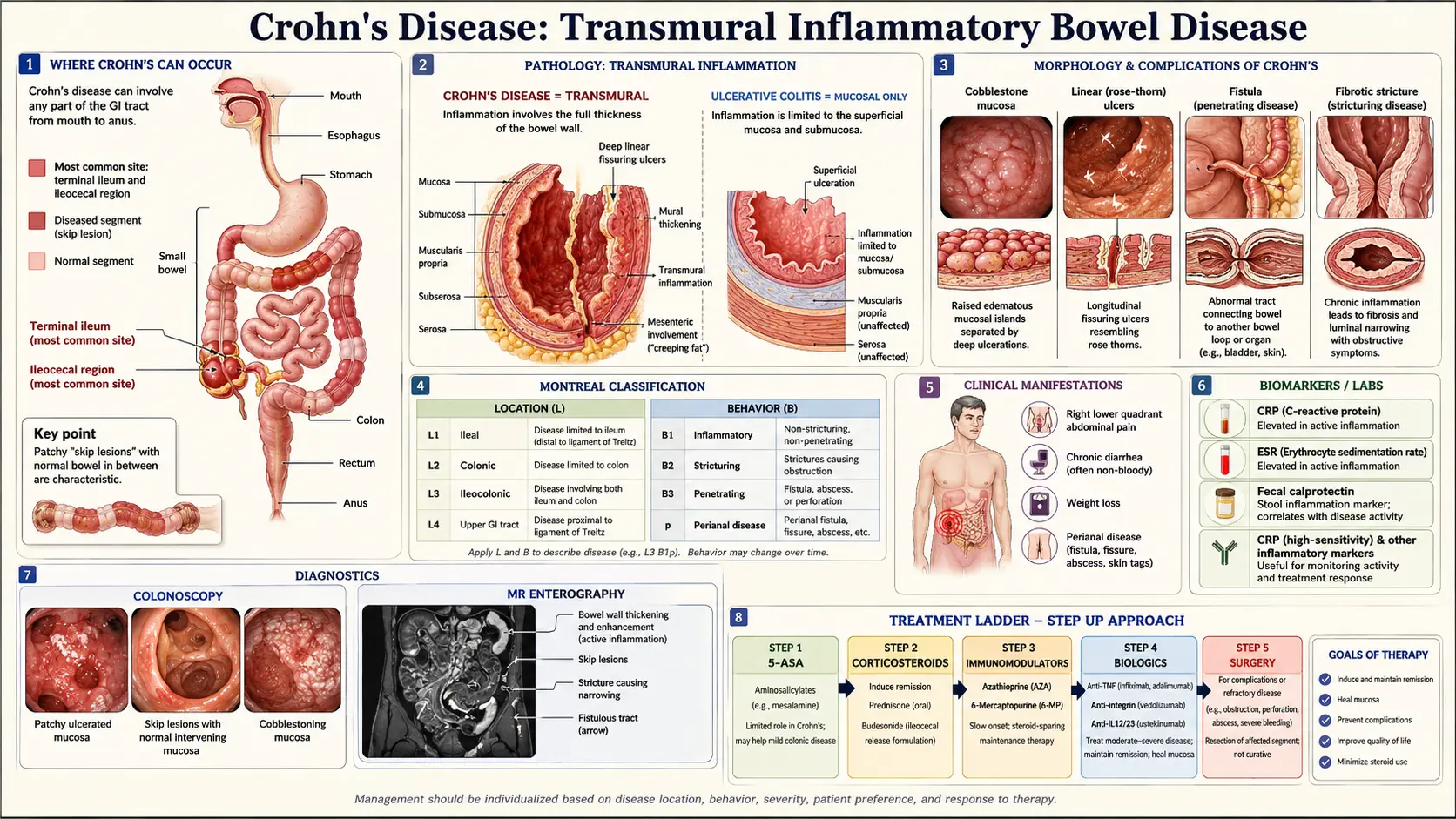
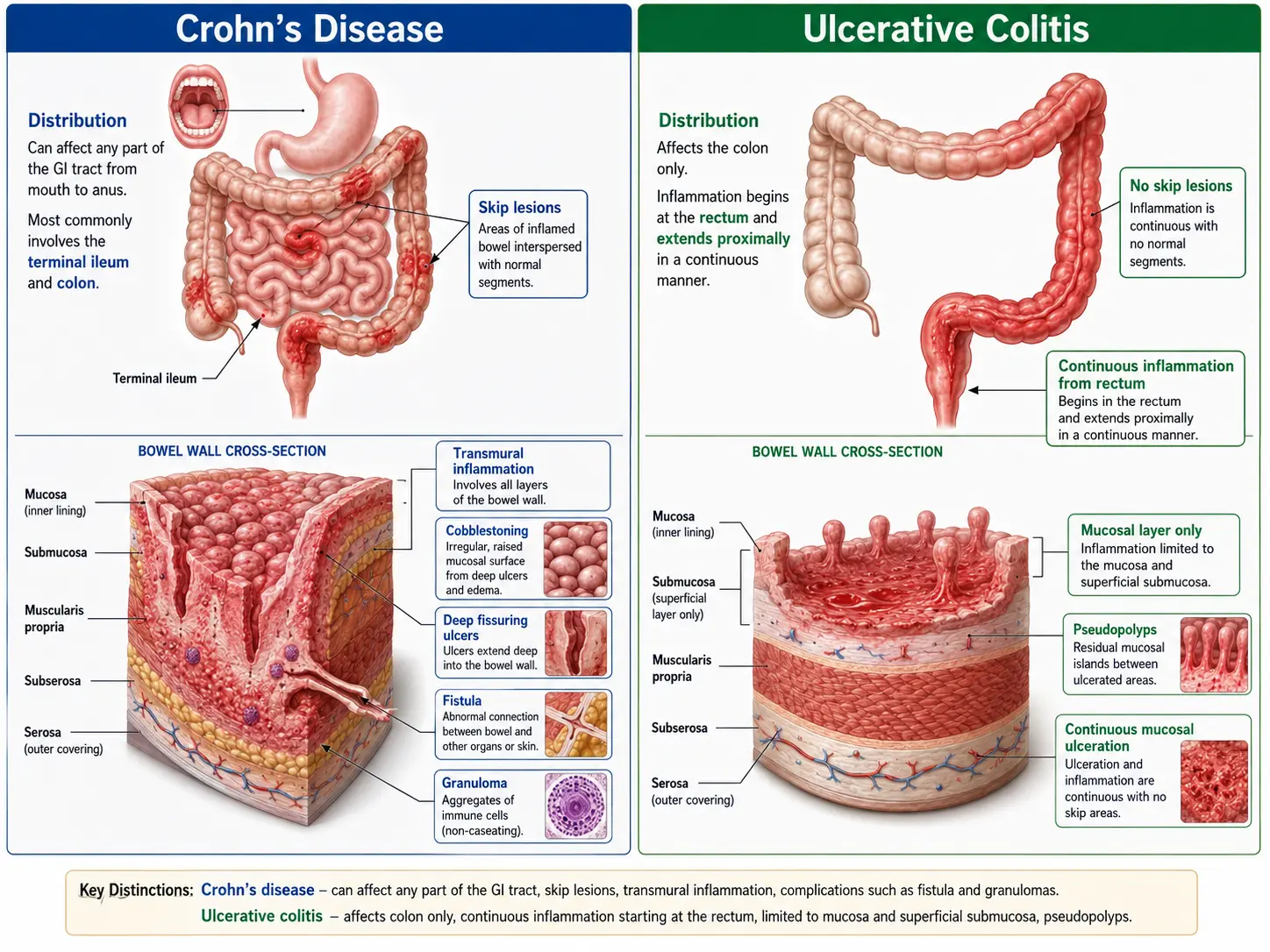
Crohn's disease is a type of Inflammatory Bowel Disease (IBD) that causes chronic inflammation of the gastrointestinal (GI) tract. It can affect any part of the digestive tract, from the mouth to the anus, but most commonly affects the end of the small intestine (ileum) and the beginning of the colon. The inflammation can extend through multiple layers of the bowel wall, leading to various complications.
Common Symptoms of Crohn's Disease
- Persistent diarrhea
- Abdominal pain and cramping
- Blood in the stool
- Unintended weight loss
- Fatigue
- Reduced appetite
- Mouth sores
- Fever
Causes and Risk Factors
- Genetics: A family history of Crohn's disease increases the risk.
- Immune system response: An abnormal immune reaction can lead to inflammation in the GI tract.
- Environmental factors: More common in developed countries and urban areas.
- Age: Most commonly diagnosed between the ages of 15 and 35, though it can occur at any age.
- Smoking: Increases the risk of developing severe forms of Crohn's disease.
Diagnosis
- Medical history and physical examination: To assess symptoms and family history.
- Endoscopic procedures:
- Colonoscopy: Allows the doctor to view the entire colon and take tissue samples.
- Upper endoscopy: Used to examine the upper part of the digestive tract.
- Imaging tests: MRI or CT scans to identify inflammation, fistulas, or blockages in the GI tract.
- Blood tests: To check for anemia or signs of infection.
- Stool tests: To rule out other causes of GI symptoms, such as infections.
Treatment Options
- Medications:
- Aminosalicylates (5-ASAs): Used to reduce inflammation for mild cases.
- Corticosteroids: For short-term relief of flare-ups to reduce inflammation.
- Immunosuppressants: Such as azathioprine or methotrexate to decrease immune system activity.
- Biologic therapies: Target specific proteins involved in the inflammatory process (e.g., infliximab, adalimumab).
- Antibiotics: To treat or prevent infections related to Crohn’s complications.
- Diet and Nutrition:
- Special diets: A low-residue or low-fiber diet during flare-ups to ease symptoms.
- Small, frequent meals: To help maintain nutrition and minimize discomfort.
- Surgery:
- Bowel resection: Removal of damaged parts of the intestine.
- Abscess or fistula repair: To manage complications.
Prevention and Management Strategies
- Avoid smoking: Can worsen symptoms and increase the risk of complications.
- Maintain a balanced diet: Emphasize nutrient-dense foods and avoid known trigger foods.
- Stay hydrated
- Manage stress: Stress-reduction techniques such as yoga and meditation can help prevent flare-ups.
- Regular medical follow-ups: To monitor the disease and adjust treatment as needed.
Complications of Crohn's Disease
- Bowel obstruction: Due to thickening of the intestinal walls, leading to blockage.
- Fistulas: Abnormal connections between different parts of the intestine or between the intestine and other organs.
- Abscesses: Pockets of infection that can form in the abdomen, rectum, or anus.
- Malnutrition: Due to poor absorption of nutrients.
- Colon cancer: Increased risk with long-term Crohn’s disease.
- Other systemic effects: Such as arthritis, eye inflammation, and skin problems.
8. References & Research
Historical Background
Crohn's disease is named after Dr. Burrill B. Crohn, who, along with colleagues Leon Ginzburg and Gordon Oppenheimer, published a landmark paper in 1932 describing "regional ileitis" as a distinct clinical entity. Earlier descriptions of granulomatous bowel inflammation were made by Giovanni Battista Morgagni in 1769 and T. Kennedy Dalziel in 1913.
Key Research Papers
- Crohn BB, Ginzburg L, Oppenheimer GD. Regional ileitis: a pathologic and clinical entity. JAMA. 1932;99(16):1323-1329.
- Torres J, Mehandru S, Colombel JF, Peyrin-Biroulet L. Crohn's disease. The Lancet. 2017;389(10080):1741-1755.
- Baumgart DC, Sandborn WJ. Crohn's disease. The Lancet. 2012;380(9853):1590-1605.
- Colombel JF, Sandborn WJ, Reinisch W, et al. Infliximab, azathioprine, or combination therapy for Crohn's disease (SONIC trial). N Engl J Med. 2010;362(15):1383-1395.
- Hanauer SB, Feagan BG, Lichtenstein GR, et al. Maintenance infliximab for Crohn's disease: the ACCENT I randomised trial. The Lancet. 2002;359(9317):1541-1549.
- Sandborn WJ, Feagan BG, Rutgeerts P, et al. Vedolizumab as induction and maintenance therapy for Crohn's disease (GEMINI 2). N Engl J Med. 2013;369(8):711-721.
- Feagan BG, Sandborn WJ, Gasink C, et al. Ustekinumab as induction and maintenance therapy for Crohn's disease (UNITI). N Engl J Med. 2016;375(20):1946-1960.
- Jostins L, Ripke S, Weersma RK, et al. Host-microbe interactions have shaped the genetic architecture of inflammatory bowel disease. Nature. 2012;491(7422):119-124.
- Lichtenstein GR, Loftus EV, Isaacs KL, et al. ACG clinical guideline: management of Crohn's disease in adults. Am J Gastroenterol. 2018;113(4):481-517.
- Ng SC, Shi HY, Hamidi N, et al. Worldwide incidence and prevalence of inflammatory bowel disease in the 21st century. The Lancet. 2017;390(10114):2769-2778.
- Gomollon F, Dignass A, Annese V, et al. 3rd European evidence-based consensus on the diagnosis and management of Crohn's disease (ECCO). J Crohns Colitis. 2017;11(1):3-25.
- de Souza HSP, Fiocchi C, Iliopoulos D. The IBD interactome: an integrated view of aetiology, pathogenesis and therapy. Nat Rev Gastroenterol Hepatol. 2017;14(12):739-749.
Research Papers
Curated PubMed topic searches of peer-reviewed literature on Crohn's Disease. Each link opens a live PubMed query so you always see the most current studies.
- PubMed: Crohn's disease epidemiology
- PubMed: Crohn's disease pathophysiology
- PubMed: Biologic therapy in Crohn's
- PubMed: Anti-TNF agents
- PubMed: NOD2 genetics and Crohn's
- PubMed: Gut microbiome in Crohn's
- PubMed: Surgical management of Crohn's
- PubMed: Enteral nutrition therapy
- PubMed: Vedolizumab and ustekinumab
- PubMed: Fistulizing Crohn's disease
- PubMed: Colorectal cancer risk in Crohn's
- PubMed: Pediatric Crohn's disease
Connections
- Gastroenterology
- The Gut Barrier & Your Microbiome — interactive animation
- Ulcerative Colitis
- Inflammatory Bowel Disease Overview
- Celiac Disease
- Irritable Bowel Syndrome
- SIBO
- Crohn's vs Ulcerative Colitis: Key Differences
- Biologics: TNF, IL-23, and Integrin Inhibitors
- JAK Inhibitors and S1P Modulators
- Diet for IBD: SCD and Mediterranean
- Extraintestinal Manifestations: Joints, Skin, Eyes
- Chronic Diarrhea
- AS and IBD Overlap
- Ankylosing Spondylitis
- Gut Healing Protocol
- Elimination Diet
- Vitamin D3
- Zinc
- Diverticulitis
- Colorectal Cancer