Vitamin B5 (Pantothenic Acid) — Benefits Deep Dive
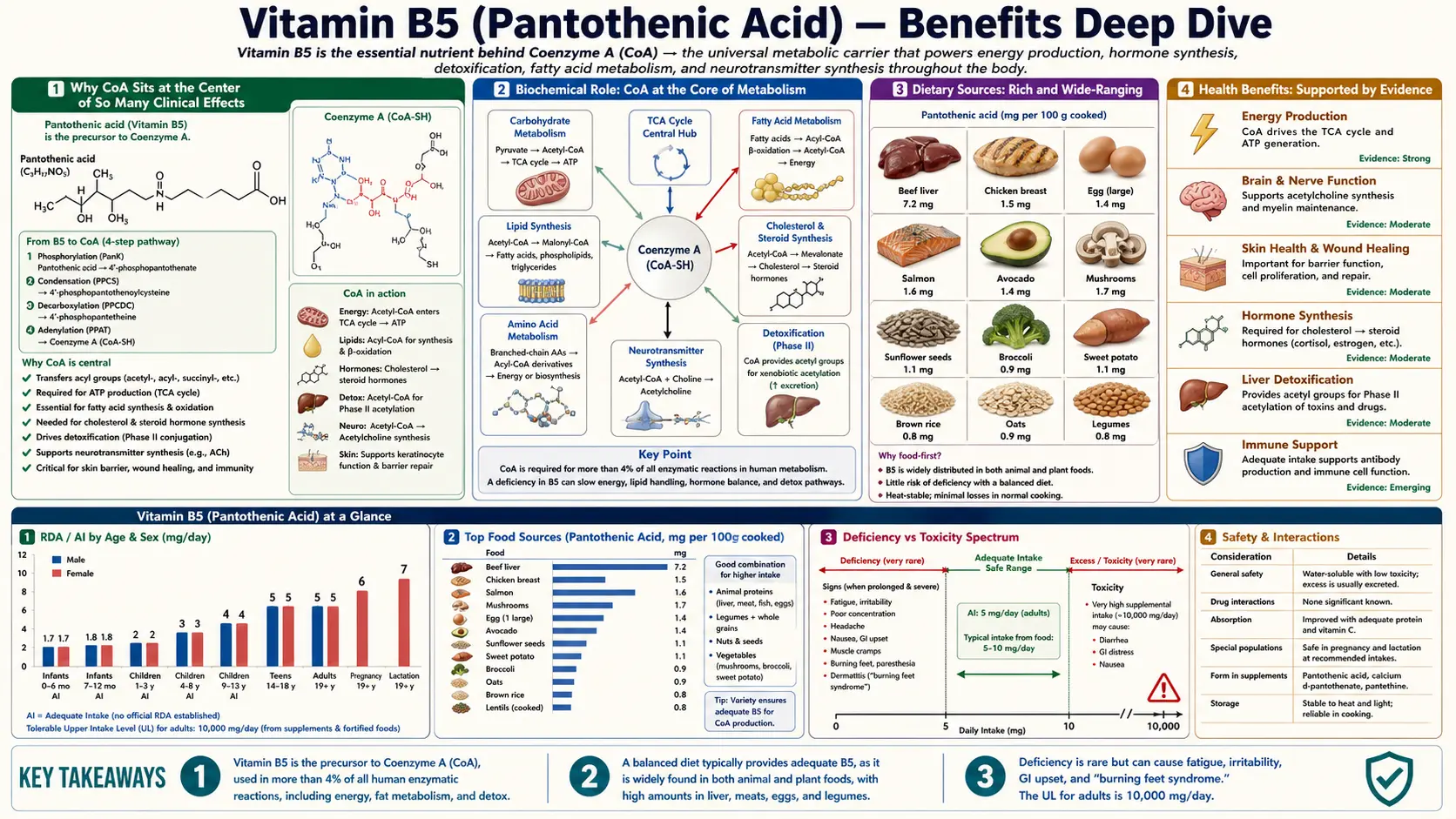
Vitamin B5 (pantothenic acid) is the precursor to Coenzyme A — the single most metabolically central cofactor in human biochemistry. Because CoA participates in roughly 4% of all known enzymatic reactions (fatty acid synthesis, fatty acid oxidation, the TCA cycle, ketogenesis, cholesterol biosynthesis, steroidogenesis, acetylcholine production, and Phase II acetylation detoxification), pantothenate sits beneath an unusually wide range of clinical applications. The four deep-dive articles below explore the most evidence-supported and most clinically practiced uses: the CoA biosynthesis pathway itself, adrenal/stress support, high-dose acne protocols, and the pantethine-for-cholesterol literature.
Deep-Dive Articles
Coenzyme A Biosynthesis
The five-enzyme pathway that converts pantothenate into CoA (pantothenate kinase, phosphopantothenoylcysteine synthetase, phosphopantothenoylcysteine decarboxylase, phosphopantetheine adenylyltransferase, and dephospho-CoA kinase), the regulation of PANK as the rate-limiting step, why 4'-phosphopantetheine is also installed as a prosthetic group on acyl carrier protein (ACP) and fatty acid synthase (FAS), and why clinical pantothenate deficiency is vanishingly rare in free-living humans (gut bacteria produce it; it is in virtually every food).
Adrenal Support & Chronic Stress
Why the adrenal cortex concentrates more pantothenate than almost any other tissue, the CoA-dependent steroidogenic cascade (cholesterol → pregnenolone → cortisol via CYP11A1 and CYP11B1), the integrative-medicine framing of "adrenal fatigue" vs the formal endocrine view, the 500-1,000 mg/day pantothenic acid protocols used in burnout and chronic stress, the vitamin C + magnesium + ashwagandha stack, and what the actual human data does and does not show.
Acne & Skin (Leung Protocol)
The 1995 Leung trial that put high-dose pantothenic acid (10 g/day) on the integrative-dermatology map, the proposed CoA-driven sebum-reduction mechanism, modern lower-dose (1-2 g/day) and pantethine + L-carnitine combination protocols, the royal-jelly-derived pantothenate angle, why mainstream dermatology has remained skeptical despite a remarkably benign safety profile even at gram-level dosing, and how to think about evidence quality in this niche.
Pantethine & Cholesterol
Pantethine is the disulfide dimer of pantotheine and sits one biosynthetic step closer to CoA than pantothenate itself. The 1980s-90s Italian and Japanese trials at 600-900 mg/day consistently showed 10-15% LDL reduction, ~10% HDL increase, and meaningful triglyceride drops. Mechanism (downstream CoA pool driving HMG-CoA reductase regulation and fatty acid β-oxidation), comparison to statins, and where pantethine fits in modern lipidology — an adjunct or a niche alternative, not a first-line therapy.
Table of Contents
- Deep-Dive Articles
- Why CoA Sits at the Center of So Many Clinical Effects
- Research Papers: Coenzyme A Biosynthesis
- Research Papers: Adrenal Function & Stress
- Research Papers: Acne & Sebum
- Research Papers: Pantethine & Lipids
- Research Papers: Cross-Cutting (Forms, Safety, Pharmacokinetics)
- External Authoritative Resources
- Connections
- Featured Videos
Why CoA Sits at the Center of So Many Clinical Effects
The reason pantothenate keeps showing up in clinical applications as different as cortisol biology and LDL cholesterol is that the molecule it produces — Coenzyme A — is one of the most heavily used cofactors in the cell. CoA shuttles two-carbon acetyl groups (and longer acyl groups) through virtually every metabolic pathway that handles fats, carbohydrates, or two-carbon intermediates:
- Universal acyl carrier in fat metabolism — acetyl-CoA is the building block of fatty acid synthesis (via fatty acid synthase) AND the terminal product of fatty acid β-oxidation. The same molecule, used in opposite directions, depending on whether the cell is storing energy or burning it. This is why pantethine influences lipid metabolism — it expands the CoA pool that drives both arms of the cycle.
- Gateway to the TCA cycle — every macronutrient (carbohydrate via pyruvate, fat via β-oxidation, protein via various amino acid pathways) converges on acetyl-CoA before entering the citric acid cycle. Succinyl-CoA is a TCA intermediate. The whole bioenergetic machinery of aerobic life runs on CoA-thioester chemistry.
- Steroidogenesis — cholesterol is built from acetyl-CoA (18 molecules of it, via HMG-CoA reductase). Cholesterol then feeds the entire steroid hormone cascade: pregnenolone, progesterone, cortisol, aldosterone, DHEA, testosterone, estradiol. This is the mechanistic root of the adrenal-support framing.
- Acetylcholine synthesis — acetyl-CoA + choline → acetylcholine, catalyzed by choline acetyltransferase. Cognitive function, parasympathetic tone, and muscle contraction all depend on this reaction.
- Phase II acetylation detoxification — the N-acetyltransferase (NAT) enzymes use acetyl-CoA to deactivate aromatic amines, hydrazines, sulfonamide antibiotics, and certain neurotransmitters (including serotonin → N-acetylserotonin → melatonin).
- 4'-phosphopantetheine prosthetic groups — beyond free CoA, an intermediate in CoA biosynthesis (4'-phosphopantetheine) is covalently installed as a swinging-arm cofactor on fatty acid synthase (FAS) and on acyl carrier proteins (ACP) in polyketide and non-ribosomal peptide biosynthesis. These prosthetic groups don't turn over with the free CoA pool.
The clinical implication: pantothenate status sits beneath so many systems that frank deficiency would produce a catastrophic, simultaneous multi-system failure — which is exactly why it is so rare. Free-living humans almost never see classical pantothenate deficiency because the gut microbiome synthesizes it and it is present in essentially every food. Where pantothenate matters clinically is at the pharmacologic end of the dose-response curve: 1-10 g/day of pantothenic acid or 600-900 mg/day of pantethine, doses orders of magnitude above the 5 mg/day adequate intake, where the goal is to push CoA-pool-dependent enzymatic flux above baseline. Whether those pharmacologic doses produce the claimed benefits is what the four deep-dive pages below examine in detail.
Research Papers: Coenzyme A Biosynthesis
- Leonardi R, Zhang YM, Rock CO, Jackowski S (2005). Coenzyme A: back in action. Progress in Lipid Research. — PubMed: Leonardi CoA review
- Jackowski S, Rock CO — PANK (pantothenate kinase) as the rate-limiting enzyme — PubMed: PANK rate-limiting CoA
- Strauss E — phosphopantothenoylcysteine synthetase and decarboxylase mechanism — PubMed: PPC synthetase mechanism
- 4'-phosphopantetheine prosthetic group on ACP and FAS — PubMed: phosphopantetheine ACP FAS
- Pantothenate kinase associated neurodegeneration (PKAN, formerly Hallervorden-Spatz) — PubMed: PKAN PANK2
- Gut microbiome pantothenate biosynthesis — PubMed: gut microbiome pantothenate
- Pantothenate transport (SMVT, SLC5A6) — PubMed: SMVT SLC5A6 pantothenate
- CoA pool regulation in liver and skeletal muscle — PubMed: CoA pool regulation
Research Papers: Adrenal Function & Stress
- Adrenal cortex pantothenate concentration vs other tissues — PubMed: adrenal pantothenate concentration
- CYP11A1 (cholesterol side-chain cleavage) and steroidogenesis — PubMed: CYP11A1 steroidogenesis
- Steroidogenic acute regulatory protein (StAR) and cortisol biosynthesis — PubMed: StAR cortisol biosynthesis
- Pantothenic acid and corticosteroid biosynthesis (animal data) — PubMed: pantothenic acid corticosteroid
- "Adrenal fatigue" critical endocrine review (Cadegiani 2016) — PubMed: Cadegiani adrenal fatigue review
- HPA axis dysregulation in chronic stress and burnout — PubMed: HPA axis burnout
- Ashwagandha (Withania somnifera) and cortisol — PubMed: ashwagandha cortisol RCT
- Vitamin C and adrenal cortisol response to stress — PubMed: vitamin C cortisol stress
Research Papers: Acne & Sebum
- Leung LH (1995). Pantothenic acid deficiency as the pathogenesis of acne vulgaris. Medical Hypotheses. — PubMed: Leung 1995
- Yang M et al. — pantothenic acid randomized trial for acne — PubMed: pantothenic acid acne RCT
- Pantothenic acid + L-carnitine acne combination — PubMed: pantothenic acid + L-carnitine acne
- Sebum composition and fatty acid metabolism — PubMed: sebum fatty acid metabolism
- Royal jelly and pantothenic acid bioactivity — PubMed: royal jelly pantothenic acid
- Dexpanthenol topical for inflammatory skin conditions — PubMed: dexpanthenol topical skin
- Pantothenic acid high-dose safety profile — PubMed: pantothenic acid high-dose safety
Research Papers: Pantethine & Lipids
- Gaddi A et al. (1984) — pantethine for hyperlipidemia (early Italian trial) — PubMed: Gaddi pantethine 1984
- Bertolini S et al. — pantethine in dyslipidemia — PubMed: Bertolini pantethine
- Arsenio L et al. — pantethine effect on triglycerides and HDL — PubMed: Arsenio pantethine HDL
- Rumberger JA et al. (2011) — pantethine RCT in low-to-moderate CVD risk — PubMed: Rumberger pantethine RCT
- Evans M et al. — pantethine, lipoprotein subfractions and CHD risk — PubMed: Evans pantethine lipoproteins
- Pantethine mechanism — HMG-CoA reductase and fatty acid β-oxidation regulation — PubMed: pantethine HMG-CoA reductase mechanism
- Pantethine vs statin comparative effect size — PubMed: pantethine vs statin
Research Papers: Cross-Cutting (Forms, Safety, Pharmacokinetics)
- Calcium D-pantothenate bioavailability — PubMed: calcium D-pantothenate bioavailability
- Pantethine vs pantothenate — CoA pool expansion comparison — PubMed: pantethine vs pantothenate CoA
- Pantothenate and biotin shared transporter (SMVT) competition — PubMed: SMVT pantothenate biotin competition
- Long-term high-dose pantothenic acid safety review — PubMed: pantothenic acid long-term safety
- Pantothenate and Phase II acetylation (N-acetyltransferase) — PubMed: NAT acetyl-CoA detoxification
- Acetylcholine synthesis — choline acetyltransferase + acetyl-CoA — PubMed: ChAT acetyl-CoA acetylcholine
- Acetyl-CoA carboxylase regulation (fatty acid synthesis switch) — PubMed: acetyl-CoA carboxylase regulation
External Authoritative Resources
- Linus Pauling Institute — Pantothenic Acid Micronutrient Information Center — the most authoritative regularly-updated scientific summary of pantothenate biology and clinical evidence
- NIH Office of Dietary Supplements — Pantothenic Acid Fact Sheet
- MedlinePlus — Pantothenic Acid (Vitamin B5)
- PubMed — All research on pantothenic acid
- PubMed — All research on pantethine
Connections
- All Vitamins
- Vitamin B5 (Main Page)
- CoA Biosynthesis Deep Dive
- Adrenal Support & Stress
- Acne & Skin
- Pantethine & Cholesterol
- Pantothenic Acid & Adrenal Health (sibling)
- Pantothenic Acid & Wound Healing (sibling)
- Vitamin B1 (Thiamine)
- Vitamin B2 (Riboflavin)
- Vitamin B3 (Niacin)
- Vitamin B7 (Biotin)
- Vitamin C
- Magnesium
- Adrenal Fatigue
- Burnout
- Acne
- DHEA-S