Essential Minerals
The Four Mineral Groups
Every mineral on this site now lives under one of four groups, on disk and in the URL, so the path reads Minerals → group → mineral → section and the sub-menu above shows where you are.
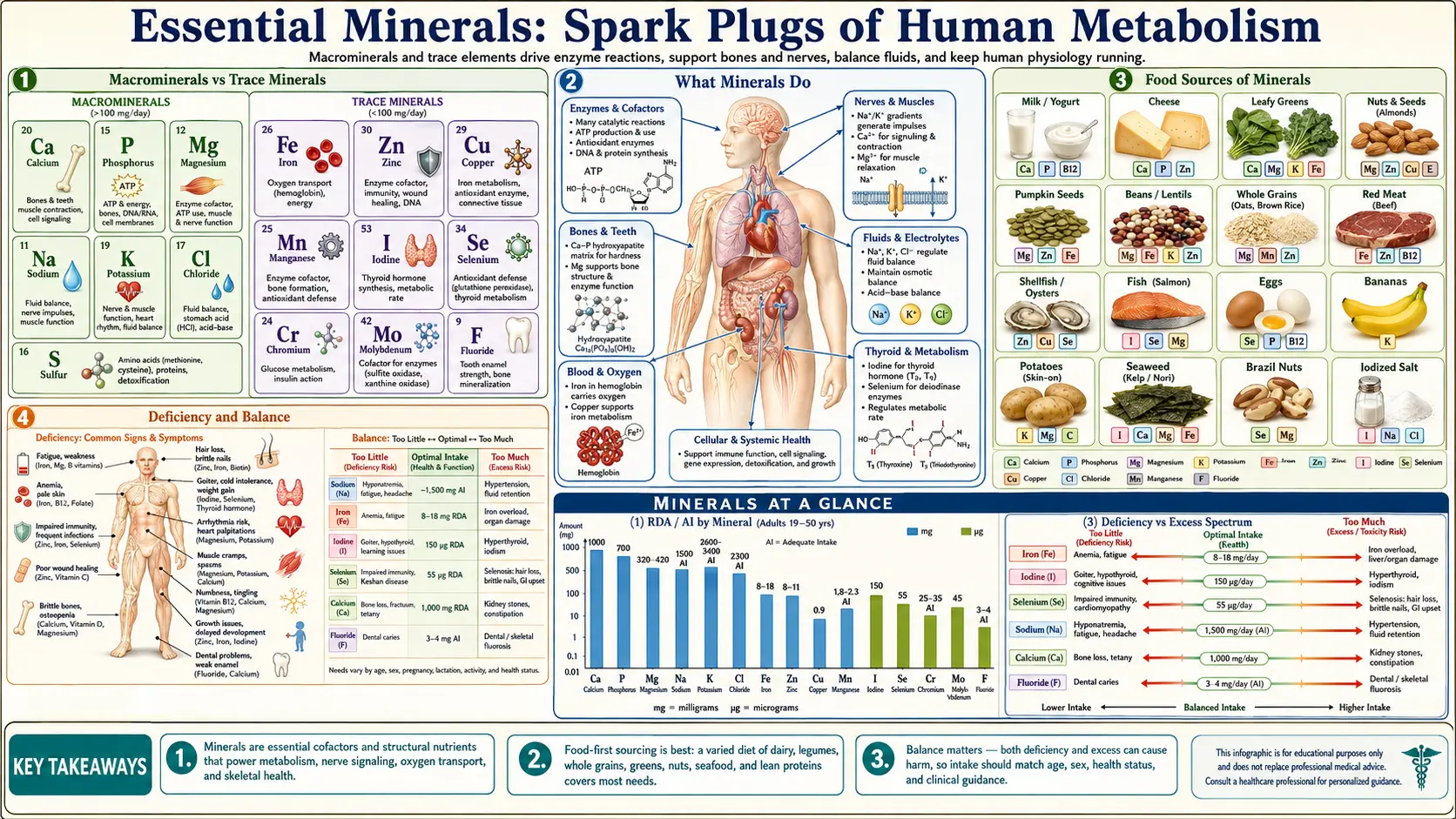
Minerals are the foundational elements your body requires for hundreds of enzymatic reactions, structural integrity, and cellular communication. From macro-minerals needed in larger quantities to trace minerals required in tiny but critical amounts, each plays an irreplaceable role in maintaining optimal health.
Macro-Minerals
Trace Minerals
Mineral-Rich Natural Substances
Mineral Salts & Historical Preparations (1926 Dispensatory)
Toxic Minerals & Heavy Metals
Not every element is a nutrient. Some are poisons with no safe biological role, and even essential minerals turn toxic in excess. The Toxic Minerals & Heavy Metals section explains each one’s toxicity to the body, symptoms, diagnosis (blood, urine, and hair testing), treatment, and the peer-reviewed research behind it.
Connections
- Vitamins — the vitamins that most mineral pathways depend on, and vice versa.
- Amino Acids — glycine, taurine and the chelating amino acids that carry minerals into cells.
- Food — the whole foods each mineral actually comes from.
- Herbs — botanical medicine, including the mineral-rich nutritive herbs.
- Toxins — environmental exposures that displace essential minerals.
- Lab Tests — serum, red-cell and urine testing for mineral status.
- Conditions — the conditions driven by mineral deficiency and mineral excess.
- Remedies — protocols and practitioners that work through mineral status.
- Magnesium — cofactor for over 300 enzymes and the most widely under-consumed mineral.
- Zinc — immune function, wound healing, taste and testosterone.
- Iron — oxygen transport — and the mineral most dangerous to over-supplement.
- Iodine — the thyroid’s irreplaceable raw material.
- Selenium — glutathione peroxidase, thyroid hormone conversion and a narrow safe range.
- Potassium — blood pressure, heart rhythm and the mineral most diets are short of.
- Copper — iron handling, connective tissue and the copper–zinc balance.
- Toxic Minerals & Heavy Metals — lead, mercury, arsenic, cadmium and essential minerals in excess.
- Conditions on this site that reference this page: Tinnitus · Tooth Decay (Dental Caries) · Vertigo & Ménière's Disease · Galactosemia
Featured Videos